

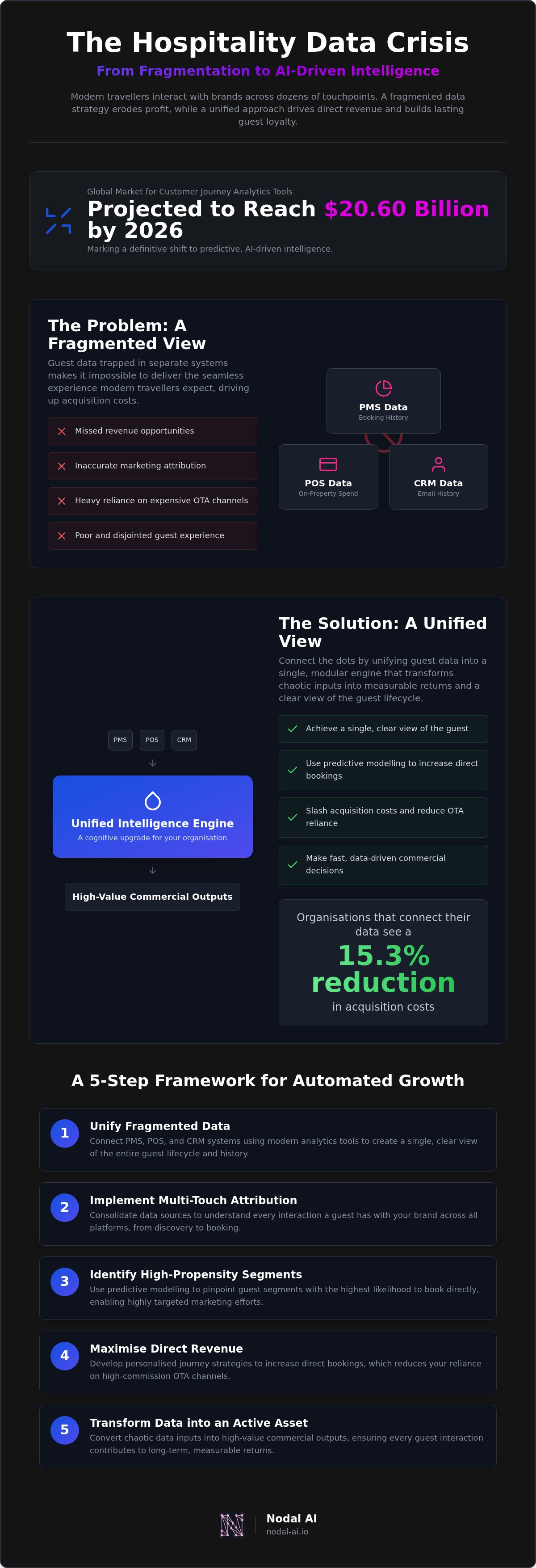
The global market for customer journey analytics tools is projected to reach 20.60 billion dollars in 2026, marking a definitive shift from basic tracking to predictive, AI-driven intelligence. You likely recognise the frustration of guest data trapped in separate PMS, POS, and CRM systems, a fragmentation that makes it nearly impossible to deliver the seamless experience modern travellers expect. This lack of visibility doesn't just hurt the guest experience; it drives up acquisition costs and forces a heavy reliance on expensive OTA channels.
This guide provides the clarity you need to move from manual complexity to automated growth. We will show you how to connect the dots by unifying your guest data into a single, modular engine that acts as a cognitive upgrade for your organisation. You will learn how to use advanced journey mapping and predictive modelling to slash acquisition costs and increase direct revenue. Prepare to transform your passive data into an active participant in your business strategy, ensuring every guest interaction contributes to long-term stability and measurable returns.
Key Takeaways
- Understand why generic marketing is eroding your profit margins and how to transition to a dynamic, AI-driven sequence of touchpoints.
- Discover how to unify fragmented PMS, POS, and CRM data using modern customer journey analytics tools to create a single, clear view of the guest lifecycle.
- Learn a five-step framework to implement multi-touch attribution and consolidate your data sources into a modular intelligence engine.
- Identify high-propensity guest segments and use predictive modelling to increase direct bookings while reducing reliance on expensive OTA channels.
- Explore how the Nodal Platform serves as a cognitive upgrade for your organisation by transforming chaotic data inputs into high-value commercial outputs.
The Evolution of Personalised Customer Journey Analytics in 2026
In 2026, the guest experience has shifted from a static set of interactions to a dynamic, AI-driven sequence of touchpoints. Traditional hospitality models often viewed the customer journey as a predictable, linear path from discovery to booking. Today, the reality is a non-linear, multi-device ecosystem where a guest might interact with your brand twenty times across five different platforms before making a final decision. Generic marketing fails to account for this complexity, acting as a primary cause of profit margin erosion. When you blast the same message to everyone, you aren't just wasting budget; you are actively alienating high-value segments who expect relevance. The personalised customer journey is the strategic alignment of data, intent, and timing.
By leveraging modern customer journey analytics tools, brands can finally move beyond guesswork. We are entering the era of commercial intelligence, where every digital footprint becomes a signal for future action. This isn't just about tracking what happened yesterday; it's about using predictive modelling to anticipate what a guest will need tomorrow. This transition replaces the anxiety of manual, tedious data sorting with the confidence of a streamlined, high-level perspective that treats your guest data as an active participant in your business growth.
Why Hospitality Leaders are Prioritising Personalisation
Modern hospitality leaders are pivoting away from simple occupancy-focused metrics toward sustainable direct revenue growth. Relying on third-party distributors creates an OTA leakage problem where high commission fees eat directly into your bottom line. To combat this, hotels must offer bespoke value that OTAs cannot replicate. This includes tailored room preferences, curated local experiences, and personalised loyalty rewards. For example, organisations that connect their data dots effectively have seen a 15.3 per cent reduction in acquisition costs. In the private club sector, member retention now relies heavily on on-property spend insights, allowing managers to personalise treatment recommendations in spa and wellness areas to drive ancillary spend.
The Cost of Fragmentation in Guest Data
Fragmented data is the silent killer of hospitality ROI. When guest information remains siloed across separate PMS, POS, and CRM systems, your team loses the ability to see the unified guest lifecycle. This fragmentation leads to missed revenue opportunities and inaccurate attribution, making marketing budget allocation a gamble rather than a science. Manual reporting prevents teams from making the fast, data-driven decisions required to stay competitive in a high-speed market. Implementing sophisticated customer journey analytics tools allows you to consolidate these disparate sources into a modular intelligence engine. This cognitive upgrade for your organisation removes ambiguity, ensuring that every marketing pound is spent targeting guests with the highest propensity to book directly.
Solving the Data Fragmentation Crisis in Hospitality
Hospitality operators often battle with a data swamp rather than a database. Your PMS holds the booking; your POS holds the restaurant spend; your CRM holds the email history. Without a unified view, these are just isolated numbers that fail to tell a story. Modern customer journey analytics tools act as the bridge, turning these chaotic inputs into high-value commercial outputs. Achieving a single view of all revenue and marketing data is no longer a luxury. It is a fundamental requirement for any organisation looking to reduce OTA leakage and reclaim their guest relationships.
Data governance serves as the foundation for this transformation. Maintaining a clean, actionable database ensures that your automated reporting remains accurate and trustworthy. By adopting a modular architecture, you can scale your intelligence engine at your own pace, adding new data sources as your business grows. This structural flexibility allows you to transform passive assets into active participants in your commercial strategy. You can explore how these components fit together by reviewing the modular features of the Nodal Platform to see how they resolve fragmentation.
Connecting PMS, POS, and CRM Systems
Legacy systems like Oracle OPERA or Mews often struggle to communicate with modern marketing stacks. This technical disconnect is where revenue is lost. Real-time data ingestion solves this by creating a live guest profile that updates the moment a guest checks in or orders a cocktail at the bar. Linking restaurant spend directly to room profiles allows for situational personalisation. If a guest frequently visits the hotel spa, your system should recognise this intent and offer a bespoke wellness package during their next booking window. This level of integration replaces manual guesswork with automated precision.
Leveraging External Signals for Demand Forecasting
Demand does not exist in a vacuum. Your internal guest data is only half the story. High-performing teams now integrate external signals like local events, tourism trends, and even flight demand into their guest profiles. If flight searches from specific international hubs spike, your predictive modelling should trigger targeted campaigns for those high-value segments. Nodal AI connects these dots to identify need periods early, allowing you to capture demand before your competitors even realise it exists. Incorporating FX rates and weather patterns further refines your targeting, ensuring your offers are always relevant to the guest's immediate context.
A 5-Step Framework for Implementing Journey Analytics Tools
Transitioning from fragmented data to a unified commercial engine requires a structured approach. Many hospitality organisations struggle because they attempt to fix every silo at once, resulting in technical debt rather than growth. By following a logical sequence, you can replace the anxiety of manual reporting with the calm efficiency of automated insights. This framework ensures that your investment in customer journey analytics tools delivers measurable returns at every stage of the implementation.
- Step 1: Consolidate data sources. Connect your PMS, POS, and CRM into a modular intelligence engine to eliminate blind spots.
- Step 2: Implement multi-touch attribution. Move beyond last-click metrics to understand the true value of every digital touchpoint.
- Step 3: Segment by propensity. Use AI to identify guest groups with the highest likelihood of booking directly.
- Step 4: Automate growth recommendations. Deploy systems that identify revenue opportunities in real time, reducing the need for manual analysis.
- Step 5: Deploy predictive modelling. Use historical data to anticipate future guest behaviour and stay ahead of market shifts.
Implementing Multi-Touch Attribution
Traditional last-click models are a primary cause of budget waste in hospitality marketing. They fail to capture the complexity of the modern guest journey, often over-valuing the final booking engine interaction while ignoring the social media and search touchpoints that built the initial intent. To gain total clarity, you must track how top-of-funnel content influences direct bookings. You can explore the technical requirements for this shift in our guide on mastering marketing attribution. By assigning value to every interaction, you can optimise your spend and achieve the 24.5 per cent increase in ROAS that high-performing brands now expect.
AI-Driven Audience Segmentation
Modern segmentation has evolved far beyond basic demographics like age or location. Today, the most effective customer journey analytics tools focus on behavioural and intent-based segments. This involves identifying high-propensity guests who show clear signs of wanting to book direct, such as repeated visits to your booking page or engagement with specific loyalty offers. By analysing historical on-property spend, you can craft tailored commercial offers that resonate with a guest's specific preferences. If a guest consistently spends on fine dining but never visits the spa, your next recommendation should reflect that specific appetite. This level of precision turns your data into an active participant in the sales process, ensuring that every message you send adds value rather than noise.
Maximising Direct Revenue through Predictive Journey Strategies
Predictive strategies allow hospitality brands to move from reactive management to proactive revenue generation. By using modern customer journey analytics tools, operators can identify specific need periods and target high-propensity guests with precision. This approach goes beyond simply filling rooms; it focuses on maximising the value of every square foot within a property. For hostel operators, this means understanding stay extensions and individual guest value to optimise bed yield. In the Quick Service Restaurant (QSR) sector, it involves measuring footfall against actual orders across multiple locations to identify and resolve operational gaps. Predictive modelling transforms fragmented data into a clear blueprint for future growth.
Increasing ancillary spend is another area where intelligence replaces guesswork. In spa and wellness environments, personalising treatment recommendations based on historical preference can significantly boost revenue. If your system recognises a guest's preference for specific treatments, it can trigger a bespoke offer at the exact moment of highest intent. This level of situational relevance turns a passive guest profile into an active revenue driver, ensuring that every interaction contributes to the bottom line.
Reducing Acquisition Costs with Predictive Insights
Hospitality brands often overspend on broad marketing because they lack granular visibility into which channels actually drive value. By shifting budget toward high-performing channels identified through automated growth recommendations, you can drastically improve your financial efficiency. Ovolo Hotels, for instance, achieved a 15.3 per cent reduction in acquisition costs by leveraging these specific insights. Integrating predictive modelling allows your team to stop chasing every lead and start focusing on the guest segments that provide the highest return on investment. This shift replaces the anxiety of budget waste with the confidence of data-backed allocation.
Enhancing the Guest Lifecycle Value
Long-term commercial stability relies on guest retention and lifecycle management. In the private club sector, identifying predictive churn risk signals allows managers to intervene with personalised outreach before a member decides to leave. Advanced customer journey analytics tools track these lifecycle shifts in real time, providing the clarity needed to personalise post-stay communication effectively. This ensures that loyalty is treated as a measurable financial metric rather than an abstract concept. By using automated reporting to monitor long-term guest value through every touchpoint, you can ensure that your marketing efforts are always aligned with the most profitable guest behaviours.
Book a demo to transform your guest data into a direct revenue engine
Unifying Your Commercial Intelligence with the Nodal Platform
The Nodal Platform isn't just another entry in the saturated market of customer journey analytics tools; it's a cognitive upgrade for your entire hospitality organisation. While generic enterprise software often feels like a cold algorithm, our solution acts as a visionary partner that understands the specific nuances of the UK hospitality sector. We specialise in connecting the dots between your disparate data sources, turning chaotic inputs into high-value commercial outputs that drive long-term stability. The technical setup is designed for speed, allowing for seamless historical data ingestion so you can begin seeing results without the typical months of integration lag. As a London-based partner, we provide the local expertise and high-level protection of assets that UK enterprises require to remain competitive. This proximity ensures your team has direct access to efficient experts who understand the local market benchmarks for ROAS and guest acquisition.
Modular Architecture for Tailored Insights
You can configure the Nodal Platform to meet your specific commercial goals through its modular intelligence engine. Our architecture allows you to deploy specific modules for Guest, Commercial, and Operational insights, ensuring your team only sees the data that drives immediate value. This flexibility ensures that you maintain a single, transparent view of all marketing and revenue performance, removing the ambiguity that often plagues manual reporting. By unifying these streams, you replace the anxiety of fragmented systems with the confidence of a streamlined, high-level perspective. We invite you to explore the platform features to see how this modularity can be tailored to your unique business model, whether you are managing a boutique hotel group or a large-scale QSR operation.
Make More, Waste Less: The Nodal Promise
The transition from intuition to insight is the hallmark of a visionary leader. By moving away from the manual, tedious tasks of data reconciliation, your team can focus on high-level strategy and measurable returns. The Nodal promise is simple: make more revenue and waste less marketing budget. By integrating our customer journey analytics tools, we help you identify high-propensity guest segments and reclaim direct bookings from expensive third-party channels, ensuring that your commercial intelligence is always working for you. This proactive approach turns your guest data into an active participant in your business process, mirroring the ease and efficiency of the service itself. If you are ready to replace complexity with clarity and drive your organisation toward a future of total commercial transparency, we are here to guide you. Take the next step in your cognitive upgrade and book a demo for a tailored platform tour today.
Future-Proof Your Commercial Strategy
The transition from fragmented data to unified intelligence represents a cognitive upgrade for your entire organisation. By moving beyond last-click attribution and manual reporting, you replace the anxiety of budget waste with the confidence of measurable returns. This guide has outlined how a modular intelligence engine allows you to identify high-propensity segments and deliver the situational personalisation that modern guests expect. Using advanced customer journey analytics tools ensures that your guest data becomes an active participant in your growth strategy.
The Nodal Platform provides the structural clarity needed to reclaim your guest relationships and reduce reliance on expensive third-party channels. Our London-based technical support team is ready to help you achieve the same results as partners like Ovolo Hotels, who realised a 24.5 per cent increase in ROAS. It is time to turn your chaotic inputs into high-value commercial outputs and lead your brand into a more profitable 2026.
Book a demo of the Nodal Platform to unify your guest data
Take the first step toward total commercial transparency and empower your team with the insights they need to succeed today.
Frequently Asked Questions
What is a personalised customer journey in the hospitality industry?
A personalised customer journey is a dynamic sequence of touchpoints tailored to individual guest intent and historical behaviour. It represents a shift from generic marketing to bespoke interactions that align data and timing with the specific needs of each traveller. This strategic alignment ensures that every guest receives relevant communication, which directly drives higher engagement and long-term brand loyalty.
How does AI help in creating a personalised guest experience?
AI acts as a cognitive engine that processes vast amounts of real-time data to identify patterns and predict future needs. It replaces manual, tedious analysis with automated precision, allowing you to trigger situational offers based on a guest's immediate context. By using machine learning to automate complex tasks, you can deliver recommendations that feel like a conversational partner rather than a cold algorithm.
Can I build a personalised journey if my data is fragmented across different systems?
Yes, provided you utilise sophisticated customer journey analytics tools to unify your disparate data silos. These platforms are designed to ingest data from legacy PMS, POS, and CRM systems, connecting the dots into a single, transparent guest view. This transformation turns chaotic inputs into high-value commercial outputs without requiring a total overhaul of your existing technical infrastructure.
What are the benefits of using predictive modelling for the customer journey?
Predictive modelling allows you to anticipate guest behaviour before it happens, enabling proactive management of your revenue streams. You can identify high-propensity segments likely to book direct or flag members at risk of churning before they leave. This foresight replaces the anxiety of guesswork with the confidence of data-backed growth recommendations, ensuring your commercial strategy remains forward-thinking.
How does multi-touch attribution improve personalisation efforts?
Multi-touch attribution provides total clarity on which specific touchpoints influence a guest's decision to book. By moving away from flawed last-click models, you can understand the true value of early-stage interactions across social media and search. This insight allows you to personalise the journey based on the specific path a guest took, ensuring your marketing spend is always optimised for the highest return.
Is a personalised customer journey invasive to guest privacy?
No, effective personalisation relies on transparency and privacy-by-design principles to build guest trust. Modern customer journey analytics tools prioritise high-level protection of assets and adhere to strict regulatory standards like GDPR. By focusing on zero-party data and intentional sharing, you turn data security into a competitive advantage that enhances the guest relationship rather than hindering it.
What is the first step to implementing an AI-driven customer journey?
The first step is consolidating your existing data sources into a modular intelligence engine to establish a clean, actionable database. You must remove ambiguity from your data foundation before deploying advanced predictive layers. This structural work ensures that your automated reporting provides a reliable baseline for all future commercial intelligence and growth strategies, making the transition to AI-driven operations seamless and effective.


