

How much of your marketing budget is actually leaking into the pockets of third-party platforms because you cannot see the full picture? In 2026, only 41 per cent of marketers can successfully demonstrate the return on their investments, a statistic that proves marketing ROI tracking has become a significant commercial hurdle. You likely feel this pressure every day as you struggle to reconcile fragmented data across your PMS and POS systems while watching high OTA commissions eat into your margins.
We understand that proving the direct impact of your spend on revenue feels like an uphill battle when your tools don't talk to each other. This guide will empower you to master these complexities to eliminate data silos, reduce your reliance on OTAs, and significantly maximise your commercial returns. We will show you how to establish a single source of truth for your performance using multi-touch attribution and predictive modelling to generate clear growth recommendations based on real-time data.
Key Takeaways
- Move beyond static spreadsheets by adopting a continuous commercial intelligence process that reflects the reality of complex, multi-touch customer journeys.
- Transition from restrictive last-click models to Multi-Touch Attribution to ensure high-value bookings are correctly credited to the channels that drive them.
- Resolve the disconnect between booking engines and operational systems to identify and eliminate OTA leakage that erodes your profit margins.
- Establish a unified framework for marketing ROI tracking by auditing your tech stack and standardising naming conventions across all internal teams.
- Transform passive data into a competitive advantage by using predictive modelling to identify upcoming occupancy gaps and generate active growth recommendations.
Why Traditional Marketing ROI Tracking Fails in 2026
The era of static reporting is over. In 2026, marketing ROI tracking isn't just about calculating a ratio; it's a continuous process of commercial intelligence. For years, commercial leaders relied on isolated spreadsheets to justify their spend. However, these manual tools cannot capture the reality of a modern guest journey that spans dozens of touchpoints across various devices. Relying on fragmented data doesn't just lead to inaccurate reports; it causes significant profit margin erosion as hidden costs and OTA commissions slip through the cracks.
A narrow focus on Return on Marketing Investment (ROMI) often ignores the operational friction that defines the hospitality sector. When you only look at top-line revenue versus ad spend, you miss the true cost of acquisition. It's time to move from vanity metrics that look good in board meetings to commercial clarity that actually protects your bottom line.
The Death of the Simple ROI Formula
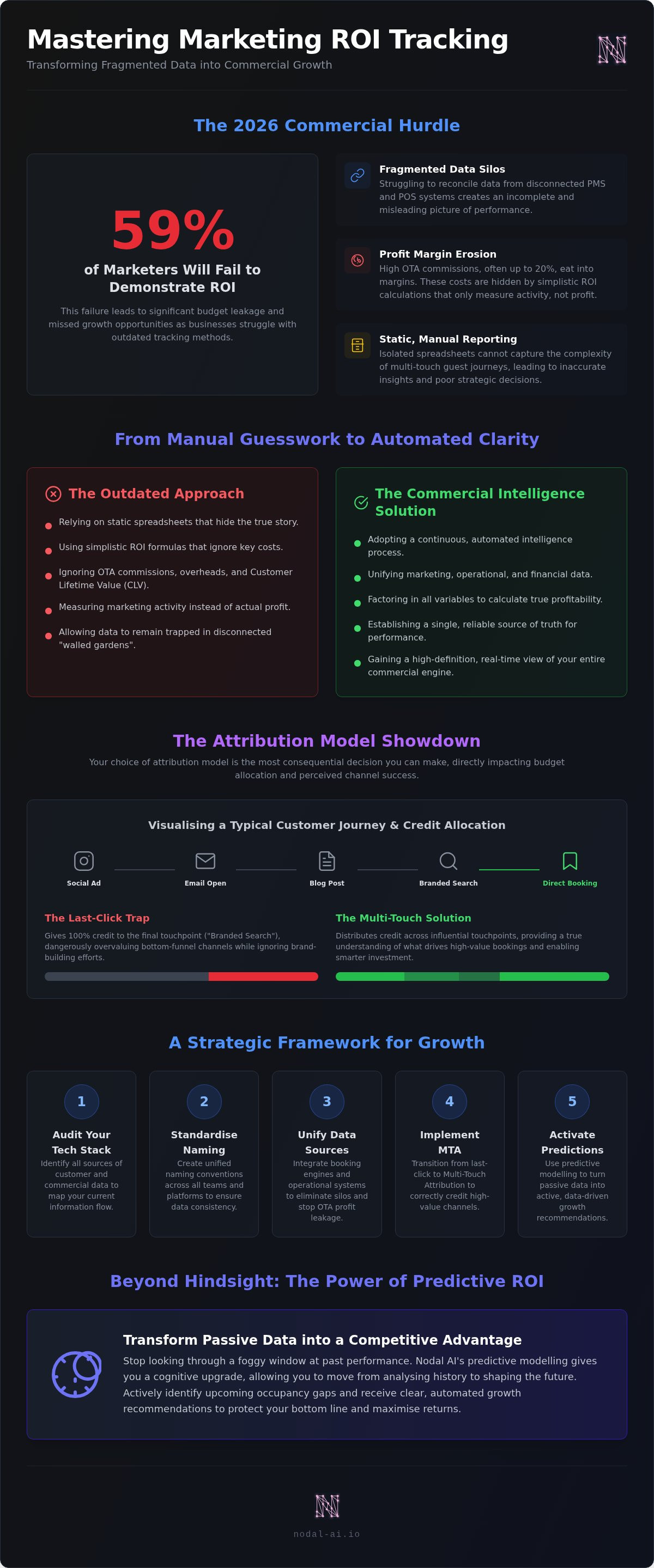
The basic formula of revenue minus cost divided by cost is dangerously simplistic. It treats every pound of revenue as identical, ignoring the massive difference between a direct booking and one burdened by a 20 per cent OTA commission. You must account for Customer Lifetime Value (CLV) and operational overheads to see the full picture. If your tracking doesn't factor in these variables, you aren't measuring profit. You're measuring activity. Modern attribution requires you to see the influence of every social impression and email open, not just the last click before a booking. Spreadsheets die in this environment because they can't scale with the complexity of real-time data flows from multiple sources. They often hide walled gardens where data is trapped, making it impossible to realise why a guest chose your brand over a competitor.
Moving Toward Commercial Intelligence
True commercial intelligence requires the unification of marketing and operational data. Nodal AI acts as the bridge between these disparate worlds, transforming chaotic inputs from systems like Oracle OPERA, Mews, or Synxis into high-value strategic outputs. This shift replaces the anxiety of manual data entry with the confidence of automated clarity. You gain a cognitive upgrade that allows you to see exactly where your spend creates the most value. By connecting Performance Marketing Analytics with your actual property management systems, you can finally stop guessing and start growing. It's the difference between looking through a foggy window and having a high-definition view of your entire commercial engine. This automated reporting doesn't just save time; it protects your assets by ensuring every marketing decision is backed by hard, operational reality.
Evaluating Attribution Models: From Last-Click to Multi-Touch
Choosing an attribution model is the most consequential decision a commercial leader makes. It dictates where you invest your next million pounds and which channels you choose to starve. Many organisations falter here because they rely on default settings that don't reflect the reality of a guest's decision-making process. As highlighted in various challenges in measuring marketing ROI, the difficulty lies in assigning value to the invisible interactions that happen before the final conversion. Effective marketing ROI tracking requires a move away from these rigid, single-point views toward a more fluid understanding of value.
Standard models often fall into three categories. First-click attribution rewards the initial discovery but ignores the closing effort. Linear attribution spreads credit equally, which is fair but lacks the nuance to identify your true power players. Then there is the industry's most common trap: last-click attribution. While easy to implement, it provides a distorted view of performance that can lead to disastrous budget decisions.
The Pitfalls of Last-Click Bias
Last-click models overvalue bottom-of-funnel channels like branded search while completely ignoring the brand-building efforts that put your property on the guest's radar in the first place. This creates a dangerous feedback loop. You spend more on search because it looks successful, while your top-of-funnel awareness withers. The hidden cost of this misallocation is a shrinking audience and an increasing dependency on expensive, late-stage captures. Last-click bias is the strategic error of crediting only the final touchpoint. When you ignore the early social impressions or the middle-funnel email engagements, you lose the ability to optimise the entire journey.
Implementing Multi-Touch Attribution (MTA)
Multi-Touch Attribution (MTA) solves this by distributing credit across every interaction in the guest journey. It transforms passive data points into active insights, allowing you to see exactly how a display ad in January influenced a high-value booking in March. To build this reliable source of truth, you must leverage user-level data that tracks individuals across sessions and devices. This level of granularity is essential for moving beyond guesswork. For a deeper dive into these technical frameworks, consult our Mastering Marketing Attribution guide.
Beyond simple credit distribution, consider the role of incrementality. This measures the true marketing lift by identifying which bookings would have happened anyway and which were directly caused by your spend. By focusing on incremental growth, you ensure your budget is driving new revenue rather than just claiming credit for existing demand. Explore how our Performance Marketing Analytics can provide this clarity for your organisation.
The Hospitality Crisis: Solving the Data Fragmentation Problem
Hospitality leaders face a unique challenge that generic analytics tools simply cannot solve. Your data is likely trapped in silos, with booking engines, property management systems (PMS), and point-of-sale (POS) terminals operating in total isolation. This disconnect makes accurate marketing ROI tracking nearly impossible because the guest who clicks an ad in London might not appear in your revenue report until they check into a property in Edinburgh. Without a unified view, you cannot see the full journey, leading to a massive blind spot in your commercial strategy.
This fragmentation often results in "OTA leakage," a phenomenon where guests discover your brand through your marketing efforts but ultimately book through a third-party platform. When this happens, your tracking might show a failed campaign, while in reality, you are paying a 20 per cent commission on a guest you already "won." The Nodal Platform addresses this crisis through a modular architecture designed specifically for the hospitality sector. By acting as the bridge between marketing spend and operational revenue, we transform these disconnected data points into a single, cohesive intelligence engine.
Connecting PMS and POS to Marketing Spend
Integrate your core systems to stop the revenue drain. By connecting data from Oracle OPERA, Mews, or Cloudbeds directly to your marketing analytics, you move beyond website clicks and into actual room nights. This integration allows you to see the true value of every campaign, including the high-value direct bookings that OTAs often obscure. Stop guessing which ads work and start seeing which check-ins they generated.
Linking POS data from platforms like OpenTable or SevenRooms clarifies your F&B marketing ROI. You can finally track whether a specific social media campaign drove covers in your restaurant or spend in your spa, providing a total view of guest value across your entire property. This granular level of insight ensures that every pound spent on promotion is tied to a specific operational outcome, removing the ambiguity that typically plagues hospitality budgets.
Tracking the Full Guest Lifecycle
Marketing shouldn't stop at the point of booking. True commercial growth comes from measuring the full lifecycle, including stay extensions, ancillary spend, and member retention. When you unify your data, you can use AI-driven audience segmentation to identify high-propensity guests who are likely to upgrade or return. This level of insight ensures your budget is always focused on the most profitable segments.
To understand how to map these complex interactions for maximum profit, read our Definitive Guide to the Customer Journey. By mastering this lifecycle, you turn passive visitors into active, long-term assets for your brand. This cognitive upgrade allows your organisation to transition from chaotic inputs to high-value strategic growth.
A Strategic Framework for Effective Campaign Tracking
Mastering marketing ROI tracking requires more than just sophisticated software; it demands a rigorous operational framework. You cannot optimise what you cannot accurately observe. Start by identifying the "walled gardens" within your current ecosystem, specifically those platforms that withhold the granular data you need to prove value. By establishing a standardised approach to data collection, you turn passive metrics into active commercial assets that guide your investment strategy.
Adopting a first-party data strategy is essential to maintain tracking accuracy in an increasingly privacy-first environment. With the 2026 updates to the California Consumer Privacy Act and the decline of third-party cookies, relying on external data is a losing game. Focus on building your own database of guest preferences and behaviours. This ensures your attribution remains precise even as global regulations tighten and automated decision-making becomes the industry standard.
Auditing Your Commercial Tech Stack
Evaluate the compatibility of your existing CRM, PMS, and booking engines to ensure they communicate without friction. Data is often lost in the gap between a digital click and a physical check-in, leading to undervalued campaigns and missed opportunities. You must verify that your tech stack supports the full integration of guest profiles across every touchpoint. Explore the Nodal Platform features to see how we bridge these technical gaps to provide total visibility.
Data Standardisation and Governance
Clean data entry is the foundation of successful predictive modelling. If your internal teams use different naming conventions for campaigns, your intelligence engine will struggle to find meaningful patterns. Standardise your UTM parameters and campaign tags to create a uniform language across the entire organisation. Historical data ingestion is also vital, as it provides the context needed to forecast future performance based on past success. Consult our Data Governance Framework to establish these critical pillars.
Establish a regular cadence for reviewing these insights and reallocating your budget. Don't let your spend remain static. Use the clarity gained from your framework to move funds from underperforming channels to those driving the highest direct booking growth. This proactive approach ensures your marketing remains a cognitive upgrade for the business rather than a sunk cost.
Book a demo to see the framework in action
Predictive ROI: Moving Beyond Hindsight into Growth
Historical reporting tells you where your money went, but it rarely explains where it should go next. While traditional marketing ROI tracking focuses on past performance, the next generation of commercial leaders is embracing predictive modelling to secure a competitive edge. This shift from passive observation to active growth recommendations allows you to anticipate market shifts before they impact your bottom line. By turning your data into a forward-looking asset, you move beyond the limitations of hindsight and begin to shape your own demand.
Artificial intelligence now identifies early signs of "need periods" by analysing occupancy trends and booking velocity. When the system detects a potential gap in occupancy weeks in advance, it can trigger automated adjustments to your marketing spend. This proactive approach was central to the success of Ovolo Hotels, which achieved a 24.5 per cent increase in ROAS and a 15.3 per cent reduction in acquisition costs. By spending smarter rather than just spending more, they transformed their marketing budget into a precision instrument for revenue generation.
Integrating External Signals for Accuracy
True predictive accuracy requires looking beyond your own internal systems. External variables such as local weather patterns, flight demand, and major city events significantly influence guest behaviour and campaign effectiveness. An unexpected heatwave or a sudden spike in regional flight searches can drastically change the ROI of a specific ad set. AI-driven platforms process these signals in real time, adjusting your bids and creative placements to capitalise on emerging opportunities. To learn more about how these variables are integrated into a modern strategy, explore our pillar on Predictive Modelling.
Maximising Returns with Nodal AI
The transition from fragmented data to strategic clarity is the single most important cognitive upgrade your organisation can make in 2026. By unifying your PMS, POS, and marketing spend into a modular intelligence engine, you eliminate the guesswork that leads to wasted budget and OTA dependency. You gain the ability to see the future of your commercial performance with startling transparency, allowing for rapid pivots and confident investments. This isn't just about better reporting; it's about total commercial optimisation.
We invite you to book a demo to see how our platform can revolutionise your approach to marketing ROI tracking. Experience the relief of automated clarity and start making data-driven decisions that protect your margins. Nodal AI helps brands make more and waste less.
Master Your Commercial Future
Modernising your marketing ROI tracking is the most critical step toward achieving total commercial clarity. By unifying fragmented data from your PMS and POS systems, you move from reactive reporting to proactive growth. Our specialised hospitality modular engine bridges the gap between marketing spend and operational revenue, allowing you to reclaim margins lost to third-party commissions.
The results speak for themselves. With the ability to predict need periods and automate reporting, brands have realised a 24.5 per cent increase in ROAS and a 15.3 per cent reduction in acquisition costs. It's time to replace the anxiety of manual spreadsheets with the confidence of high-level perspectives and streamlined intelligence.
Book a demo with Nodal AI to transform your fragmented data into profitable growth
Step into the future of hospitality analytics and turn your complex data into a cognitive upgrade for your entire organisation. You have the tools to make more and waste less; now is the time to use them.
Frequently Asked Questions
What is the difference between marketing ROI tracking and basic analytics?
Basic analytics focus on surface metrics such as clicks, impressions, and session durations. In contrast, marketing ROI tracking connects these digital actions directly to actual revenue and operational data from your PMS. It provides a complete financial picture by factoring in acquisition costs and property-level spend rather than just counting website traffic.
Why is last-click attribution considered inaccurate for the hospitality industry?
Last-click models ignore the complex, multi-touch journey that precedes a high-value hotel booking. Guests often interact with social ads, travel blogs, and email newsletters over several weeks before making a final decision. By crediting only the final touchpoint, you undervalue the critical brand-building efforts that initially captured the guest's interest and put your property on their radar.
Can I track marketing ROI without using third-party cookies?
You can maintain high levels of accuracy by shifting to a robust first-party data strategy. By leveraging server-side tracking and integrating your own CRM and PMS data, you create a durable source of truth that does not rely on external trackers. This approach ensures your performance insights remain reliable even as browsers phase out traditional tracking methods.
How does multi-touch attribution help in reducing OTA commission costs?
Multi-touch attribution identifies the specific sequences of interactions that lead to direct bookings rather than third-party captures. When you understand which channels drive guests to your own booking engine, you can reallocate your budget to those high-value paths. This clarity reduces your reliance on expensive OTAs and significantly protects your bottom-line profit margins.
What specific hospitality data sources should be integrated for accurate ROI?
You should integrate your Property Management System, such as Oracle OPERA or Mews, along with your Point of Sale systems for F&B and spa services. Combining these with your booking engine and CRM data allows for a unified view of the entire guest lifecycle. This integration ensures that room revenue and ancillary spend are correctly attributed to your specific marketing campaigns.
How long does it take to implement a commercial intelligence platform?
Implementation typically takes between four to eight weeks depending on the complexity of your existing tech stack. A modular architecture allows for a phased rollout, starting with core PMS integrations before expanding to POS data and advanced predictive modelling. This structured approach ensures your team gains immediate value without disrupting daily property operations.
Is advanced attribution tracking compliant with GDPR and UK privacy laws?
Modern platforms are built with privacy-first principles to ensure full compliance with GDPR and UK data protection standards. By using anonymised data and secure first-party collection methods, you can track commercial performance without compromising guest privacy. This protects your brand from regulatory risk while providing the strategic clarity needed for sustained growth.
How does AI-driven segmentation improve marketing return on investment?
AI-driven segmentation identifies guests with the highest propensity to book directly or spend on ancillary services. By targeting these high-value segments with personalised offers, you drastically increase the efficiency of your ad spend. This precision improves your overall marketing ROI tracking outcomes by ensuring your budget is always focused on the most profitable opportunities.


