
Your marketing campaigns are running. Budgets are being spent. But do you actually know which campaign filled that block of rooms during the low-occupancy week in February? If you're honest, the answer is probably no — and that's not a technology problem, it's a data fragmentation problem. Effective marketing campaign performance tracking isn't about collecting more numbers; it's about connecting your PMS, POS, and CRM systems into a single commercial intelligence engine that tells you exactly what's working and what's quietly draining your budget.
You're not alone in feeling this. Most hospitality marketers are working from spreadsheets stitched together on a Friday afternoon, making high-stakes decisions on incomplete attribution and gut instinct. The cost of that guesswork shows up in OTA commissions you didn't need to pay and ad spend pointed at the wrong audiences.
This guide changes that. You'll learn how to unify fragmented data across your properties, attribute revenue to the right campaigns with confidence, and use predictive insights to fill low-occupancy periods before they become a problem. Let's build the tracking engine your growth strategy actually deserves.
Key Takeaways
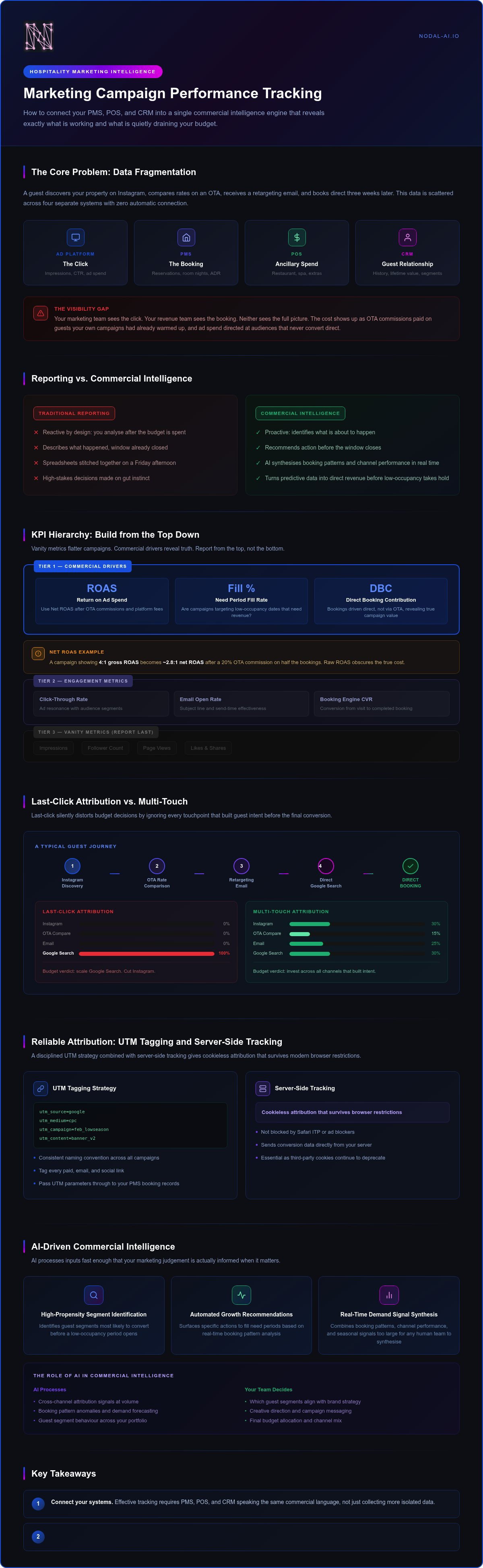
- Effective marketing campaign performance tracking in hospitality requires connecting your PMS, POS, and CRM into a single intelligence engine, not just collecting more data in isolation.
- Vanity metrics like impressions and clicks obscure commercial reality; the KPIs that actually matter are ROAS and direct booking contribution, which reveal true campaign value.
- Last-click attribution silently distorts your budget decisions by ignoring every touchpoint that built guest intent before the final conversion, and multi-touch attribution corrects that blind spot.
- A disciplined UTM tagging strategy combined with server-side tracking gives you reliable, cookieless attribution that survives modern browser restrictions.
- AI-driven commercial intelligence can identify high-propensity guest segments and surface automated growth recommendations, turning predictive data into direct revenue before low-occupancy periods take hold.
What is Marketing Campaign Performance Tracking in 2026?
Marketing campaign performance tracking is the continuous process of measuring how your campaigns drive commercial outcomes, not just digital activity. In hospitality, that definition carries real weight. A click on a paid search ad means nothing in isolation. What matters is whether that click became a booking, what that guest spent at your restaurant, how many times they've returned, and what their lifetime value looks like across your entire property portfolio.
That's a fundamentally different challenge from tracking a product sale in e-commerce, where the click and the transaction happen in the same environment. In hospitality, the click lives in your ad platform, the booking sits in your PMS, the ancillary spend is locked in your POS, and the guest relationship is stored in your CRM. Four systems. Four data silos. Zero automatic connection between them.
This is precisely why generic tracking frameworks fail hospitality operators. They're built for linear purchase journeys, not the fragmented, multi-touchpoint reality of a guest who discovers your property on Instagram, compares rates on an OTA, receives a retargeting email, and finally books direct three weeks later.
The Evolution from Reporting to Intelligence
Traditional marketing reporting is reactive by design. You run a campaign, it ends, and then you pull a report. By the time the data reaches your desk, the budget's been spent and the opportunity has passed. That model worked when campaigns were slower and competition was thinner. Neither condition applies in 2026.
Commercial intelligence flips that sequence. Instead of describing what happened, it identifies what's about to happen and recommends action before the window closes. AI is central to this shift because the volume of data involved, spanning booking patterns, channel performance, guest segment behaviour, and seasonal demand signals, is simply too large for any human team to synthesise in real time. The role of AI isn't to replace your marketing judgement; it's to process the inputs fast enough that your judgement is actually informed when it matters.
Why Hospitality Data Fragmentation is the Primary Hurdle
The core problem is a visibility gap. Your marketing team sees the click. Your revenue team sees the booking. Neither team sees the full picture, so neither can make a confident decision about where the next pound of budget should go.
The practical cost of that gap shows up in two places: ad spend directed at audiences that never convert to direct bookings, and OTA commissions paid on guests your own campaigns had already warmed up. Closing that gap requires a system that connects your PMS, POS, and CRM into a single attribution layer, which is exactly the mission behind the Nodal Platform. Effective marketing campaign performance tracking only becomes possible once those systems are speaking the same commercial language.
Essential KPIs for Measuring Hospitality Marketing Success
Not all metrics are created equal, and in hospitality, the gap between a metric that feels good and one that drives decisions is enormous. Impressions tell you your ad was served. Click-through rates tell you someone was curious. Neither tells you whether that curiosity became a reservation, a spa booking, or a returning guest. Effective marketing campaign performance tracking starts by discarding the metrics that flatter your campaigns and replacing them with the ones that reveal commercial truth.
The hierarchy is straightforward: vanity metrics sit at the bottom, engagement metrics sit in the middle, and commercial drivers sit at the top. Your reporting should be built from the top down, not the bottom up.
Commercial KPIs: Revenue and Profitability
Return on Ad Spend is the starting point, but raw ROAS obscures as much as it reveals. Net ROAS, which accounts for OTA commissions, platform fees, and operational fulfilment costs, gives you the number that actually matters to your bottom line. A campaign generating a 4:1 ROAS looks strong until you subtract a 20% OTA commission on half those bookings and realise your true return is closer to 2.8:1.
Two additional commercial KPIs deserve consistent attention:
- Need period fill rate: Are your campaigns actively targeting the low-occupancy dates that cost you most? Tracking which campaigns drive bookings during identified need periods tells you whether your marketing is reactive or genuinely strategic.
- Average Booking Value (ABV): Upsell campaigns live or die by this metric. If your ABV isn't climbing alongside your room rate promotions, your upsell messaging isn't converting, and that's a creative or targeting problem you need to see clearly.
OTA leakage is a third commercial signal that most marketing teams ignore entirely. If a guest discovers your property through your paid search ad, visits your website, and then books via an OTA, you've paid for the acquisition twice. Measuring the rate at which guests enter your direct booking funnel but exit through a third-party channel is essential for understanding the true cost of your campaigns and for identifying where your direct booking experience is losing ground.
Ancillary spend tracking adds another dimension entirely. A guest who spends £180 per night but adds £95 in restaurant covers, spa treatments, and activity bookings is worth far more than their room rate suggests. Connecting your POS data to campaign attribution reveals which audience segments over-index on ancillary spend, and that insight should be shaping your targeting decisions.
Customer KPIs: Lifecycle and Retention
Guest Lifetime Value is the gold standard for performance tracking because it reframes the question entirely. Instead of asking "did this campaign generate bookings?", it asks "did this campaign attract guests worth keeping?" A campaign that delivers a modest initial ROAS but consistently acquires guests who return twice a year is outperforming a high-ROAS campaign that attracts one-and-done visitors, even if the spreadsheet doesn't show it yet.
For private members' clubs and spa operations, repeat visit frequency and membership retention rates function as the equivalent metric. If a campaign brings in new members who lapse within six months, the acquisition cost was wasted. Tracking retention cohorts by acquisition channel tells you which campaigns are building your business and which are simply filling a leaky bucket.
These metrics connect directly to the broader customer journey, where understanding every touchpoint before and after the booking shapes how you allocate budget and build loyalty programmes. If you want to see how these KPIs translate into actionable intelligence across your property portfolio, the Nodal Platform's features are built precisely for that connection.
A Step-by-Step Way to Track Campaigns Effectively
Knowing which KPIs to measure is only half the battle. The other half is building the technical infrastructure that actually captures those numbers reliably. Without a disciplined tracking architecture underneath your reporting, even the most sophisticated KPI framework produces data you can't trust. Here's how to build the foundation correctly, from the first UTM tag to a fully automated reporting environment.
Establishing the Technical Foundation
Start with UTM parameters, because inconsistent tagging is the single most common reason marketing campaign performance tracking breaks down in practice. When one team labels a campaign "Feb_Spa_Promo" and another uses "february-spa-promotion", your reporting tool treats them as two separate campaigns. The data splits. The picture fragments. Standardise your naming conventions across every channel before a single ad goes live.
A robust UTM checklist for hospitality teams should cover:
- utm_source: the traffic origin, such as google, meta, or mailchimp
- utm_medium: the channel type, such as cpc, email, or organic-social
- utm_campaign: a consistent naming convention tied to the booking period or offer, such as 2026-Q1-lowseason-direct
- utm_content: the specific creative variant, useful for A/B testing ad copy or imagery
- utm_term: the paid keyword, for search campaigns specifically
Once your tagging is consistent, the next layer is connectivity. API integrations are what move data between your fragmented systems: pulling confirmed booking data from a PMS like Mews or Cloudbeds and matching it against the UTM source that originated the session. Without that API bridge, your ad platform reports clicks and your PMS reports bookings, but neither system knows the other exists. Server-side tracking closes the final gap by collecting data directly from your server rather than the guest's browser, ensuring accuracy in a cookieless environment where client-side scripts are increasingly blocked or degraded.
This is where generic tracking guides fall short. Tools like HubSpot's built-in tracking work cleanly within a single digital ecosystem, but they have no mechanism for ingesting a confirmed check-in from an external booking engine or reconciling offline ancillary spend from a POS system. Hospitality tracking requires a layer that sits above those individual tools and connects them all.
Automating the Reporting Process
Manual reporting doesn't just waste time; it introduces lag at precisely the moment you need clarity. Marketing teams that consolidate data by hand typically operate on a weekly or fortnightly reporting cycle, which means budget decisions are always made on stale information. Automated reporting eliminates that lag and, conservatively, recovers more than 20 hours per month that would otherwise be spent stitching spreadsheets together.
Real-time data changes the nature of campaign management entirely. When you can see booking velocity shifting mid-campaign, you can redirect budget toward the channels that are converting before the low-occupancy window closes, not after. That agility is the difference between filling a difficult week and discounting your way through it.
The Nodal Platform's features are built around this exact requirement, automating the ingestion of complex, multi-system data so that your commercial dashboard reflects what's actually happening across your properties right now. Instead of a report that describes last week, you get intelligence that informs this afternoon's decision.
Moving Beyond Last-Click with Multi-Touch Attribution
Last-click attribution has one job: it awards 100% of the credit for a booking to the final touchpoint before conversion. It's a simple model, and that simplicity is exactly what makes it dangerous. A guest who discovered your property through a TikTok video, clicked a retargeting ad two weeks later, read a review on TripAdvisor, and then typed your brand name directly into Google didn't convert because of that brand search. They converted because of everything that came before it. Last-click attribution sees only the final step and ignores the entire journey that made it possible.
In hospitality, where the average guest journey spans multiple channels and several weeks, that blind spot compounds into a budget allocation problem. Your paid search campaigns look like heroes. Your awareness and discovery channels look like underperformers. So you cut the TikTok spend, double down on brand search, and quietly dismantle the top-of-funnel activity that was feeding your pipeline all along.
Multi-touch attribution (MTA) corrects that distortion by assigning fractional credit to every touchpoint in the guest journey, proportional to the role each one played in driving intent. AI-driven MTA models are particularly well-suited to this challenge because they can process thousands of journey paths simultaneously, identifying which channel combinations correlate with high-value bookings and which touchpoints are genuinely influential versus merely coincidental. The result is a credit allocation that reflects commercial reality rather than the convenience of a single data point.
The Hidden Cost of Miscalculated ROI
When last-click models dominate your marketing campaign performance tracking, the distortion compounds across every budget cycle. Discovery channels are systematically underfunded because their contribution never appears in the conversion report. Brand search is systematically overfunded because it harvests intent that other channels built. Over time, you're paying to capture demand you've stopped investing in creating.
This is precisely the problem Nodal addressed for Ovolo Hotels. By replacing last-click reporting with AI-driven multi-touch attribution, Nodal surfaced the true contribution of upper-funnel activity that had previously been invisible in standard reporting. The outcome was a 24.5% increase in ROAS, not by spending more, but by reallocating existing budget toward the channels that were actually building guest intent. For a deeper breakdown of the methodology behind that shift, the mastering marketing attribution guide covers the full framework in detail.
There's a structural challenge that sits underneath all of this: walled gardens. Meta and Google both restrict the granular, user-level data that precise attribution requires. You see aggregated performance signals, not the individual journey paths that reveal true channel influence. The practical solution is to model around those gaps using probabilistic attribution, combining the data you do have access to with server-side signals and first-party CRM data to construct a credible picture of channel contribution. It's not a perfect science, but it's considerably more accurate than handing all the credit to the last click.
Predictive Modelling: Tracking the Future
Attribution answers the question of what worked. Predictive modelling answers the question of what will work next. By applying machine learning to historical booking patterns, channel performance data, and guest segment behaviour, predictive models can forecast campaign outcomes before budget is committed, which turns your marketing calendar from a reactive schedule into a proactive revenue strategy.
The most powerful applications pull in external signals alongside internal data. Flight search volume into your destination, local event calendars, and even seasonal weather forecasts all influence booking propensity in ways that historical data alone can't capture. A model that knows a major conference is arriving in your city three weeks before your own sales team does can trigger targeted campaigns at precisely the right moment, filling rooms at rate rather than at discount. The predictive modelling pillar explores how to operationalise these signals across your property portfolio.
See how Nodal's multi-touch attribution and predictive modelling work together in a live demo.
Optimising Performance with AI-Driven Commercial Intelligence
All the attribution frameworks and UTM conventions covered in previous sections are only as valuable as the decisions they inform. Data unified. Attribution corrected. Reporting automated. The final question is this: what does that intelligence actually tell you to do next? That's where AI-driven commercial intelligence moves from infrastructure to competitive advantage.
The distinction matters. Generic marketing software describes your audience. Commercial intelligence identifies which guests are worth acquiring, at what cost, and through which channel, before you've committed a single pound of budget.
Identifying High-Value Guest Segments
When your PMS, POS, and CRM data flows into a unified intelligence layer, AI can cluster that combined dataset in ways no human analyst could replicate at speed. It surfaces patterns across booking lead times, ancillary spend behaviour, repeat visit frequency, and rate sensitivity simultaneously, producing guest personas defined not by demographics but by commercial value.
These AI-generated segments become the input for lookalike audience targeting across paid channels. Instead of targeting "UK adults aged 35 to 54 interested in travel", you're targeting people who behaviourally resemble your highest-spending returning guests. The precision compounds. For Nodal clients, this approach has delivered a 15.3% reduction in acquisition costs, not by cutting reach, but by concentrating spend on audiences with a demonstrably higher propensity to convert and return.
The practical outputs from this kind of segmentation include:
- Automated budget recommendations: the platform identifying which segments are underserved by current spend and where the next pound generates the highest return
- Need-period targeting: surfacing which high-value segments have historically booked during low-occupancy windows, so campaigns reach them before the gap opens
- OTA leakage reduction: identifying segments that enter the direct funnel but exit through third-party channels, triggering personalised retention messaging to reclaim those bookings
This is the "make more and waste less" principle in practice. Every pound of ad spend is pointed at an audience the data has already validated, rather than an audience that feels plausible.
The Next Step: From Data to Action
The journey from fragmented spreadsheets to a modular intelligence engine doesn't require rebuilding your entire tech stack. It requires connecting what you already have. Start by auditing your current attribution debt: how many campaigns are running without consistent UTM tagging, how many booking sources are untracked in your PMS, and how many guest records exist across systems that have never been reconciled. That audit reveals the gap between what your marketing campaign performance tracking currently shows and what it could show.
Once the gaps are visible, the path forward is straightforward. Connect your systems. Automate attribution. Let the intelligence surface the decisions your team shouldn't have to make manually.
Book a demo with Nodal AI to see your commercial intelligence in action and find out exactly where your next pound of budget should go.
Your Next Booking Starts With Better Data
Fragmented systems don't just slow your reporting; they silently distort every budget decision you make. Effective marketing campaign performance tracking means connecting your PMS, POS, and CRM into a single commercial intelligence engine, replacing last-click guesswork with multi-touch attribution that reflects how guests actually decide to book, and using predictive modelling to fill low-occupancy periods before discounting becomes the only option.
The proof is already there. A 24.5% increase in ROAS and a 15.3% reduction in acquisition costs aren't theoretical outcomes; they're what happens when fragmented data becomes unified intelligence. Nodal's modular architecture connects seamlessly with systems like Mews, Oracle OPERA, and Salesforce, so you don't need to rebuild your tech stack to start seeing the full picture. The Performance Marketing Awards Gold recognition reflects what that clarity delivers in practice.
Your data already knows where your next pound of budget should go. Nodal helps you hear it.
Transform your fragmented data into profitable growth: Book a Nodal AI demo today
Frequently Asked Questions
How do I track marketing performance if my booking engine is on a different domain?
Cross-domain tracking is the solution. You'll need to configure your analytics platform to recognise both domains as part of the same user session, typically by sharing a client ID across domains and ensuring UTM parameters are passed through correctly at the handoff point. Without this, every guest who clicks from your main website to your booking engine registers as a new session, and your campaign attribution collapses entirely.
Server-side tracking adds a further layer of reliability here. Because it captures data at the server level rather than relying on browser scripts, it maintains session continuity even when guests move between domains or have third-party cookies blocked. For properties using external booking engines, this architecture is non-negotiable for accurate attribution.
What is the most accurate attribution model for hotels in 2026?
No single model is universally correct, but data-driven multi-touch attribution is the most accurate approach available for hospitality marketing campaign performance tracking in 2026. It distributes credit across every touchpoint proportional to each one's actual influence on conversion, rather than applying a fixed rule like first-click or last-click. That distinction matters enormously when your average guest journey spans three to five weeks and multiple channels.
The practical caveat is data volume. Data-driven models require sufficient conversion events to generate reliable outputs, so smaller properties with lower booking volumes may find that a position-based or linear attribution model is more stable in practice. The priority is always choosing a model that reflects your guest's actual journey over one that simply flatters your most visible channels.
Can I track offline conversions, like phone bookings, back to digital campaigns?
Yes, and doing so is essential for properties where a meaningful share of bookings still come through the reservations team. The standard approach is call tracking software that assigns unique phone numbers to specific campaigns or traffic sources. When a guest calls, the system logs which number they dialled, connecting that offline conversion back to the originating digital touchpoint.
For CRM-based tracking, you can supplement this by training your reservations team to ask how guests found the property and recording that source consistently against the booking record. It's imperfect compared to automated digital attribution, but it closes a significant blind spot. Connecting those offline conversion records to your PMS via API then allows you to include phone bookings in your overall campaign revenue calculations.
How often should I review my marketing performance reports?
Review cadence should match the decision cycle, not the calendar. Campaign-level metrics warrant a weekly review so you can reallocate budget before a low-occupancy window closes. Channel-level trends and guest segment performance are better assessed monthly, when enough data has accumulated to distinguish a genuine pattern from short-term noise. Strategic KPIs like guest lifetime value and acquisition cost by channel deserve a quarterly review tied to your commercial planning cycle.
The important shift is moving from scheduled reporting to trigger-based alerts. When booking velocity for a target need period drops below a defined threshold, your system should flag it immediately, not wait for the next Friday report. Automated reporting infrastructure makes that real-time alerting possible and removes the lag that turns a manageable occupancy gap into a discounting problem.
Why does Google Analytics 4 show different revenue figures than my PMS?
This discrepancy is almost universal, and it comes from several compounding factors. GA4 records a transaction at the moment of booking confirmation, while your PMS records revenue at check-in or check-out. Cancellations that occur after GA4 has logged the sale won't automatically reverse in GA4. Currency conversion differences, tax handling variations, and session attribution gaps caused by browser restrictions all add further divergence between the two figures.
The practical resolution is to treat GA4 as a directional indicator for campaign performance rather than a financial source of truth. Your PMS is the authoritative revenue record. Building a unified data layer that reconciles both systems, matching GA4 session data against confirmed PMS bookings via a shared booking reference, gives you the accurate picture that neither system can provide independently.
What is the difference between marketing reporting and commercial intelligence?
Marketing reporting describes what has already happened. It tells you how many clicks a campaign generated, what your cost per booking was last month, and which channel drove the most sessions. It's inherently retrospective, and by the time the report reaches your desk, the opportunity it describes has usually passed. Most hospitality marketing teams are operating primarily in this mode.
Commercial intelligence is prospective. It identifies which guest segments have the highest propensity to book during your next low-occupancy period, recommends where your next pound of budget generates the highest return, and surfaces OTA leakage patterns before they compound. The underlying difference is that commercial intelligence connects your PMS, POS, and CRM into a unified layer and applies predictive modelling to that combined dataset, turning historical patterns into forward-looking decisions.
Is multi-touch attribution worth the investment for a single-property hotel?
It depends on your booking volume and channel mix. If you're running campaigns across three or more channels simultaneously and generating enough monthly bookings to produce statistically meaningful data, multi-touch attribution will almost certainly surface budget misallocations that a last-click model is hiding. The investment pays for itself when it reveals, for example, that your awareness campaigns are driving intent that your brand search is harvesting without credit.
For single properties with lower booking volumes or simpler channel mixes, a position-based model that assigns weighted credit to the first and last touchpoints is a practical middle ground. It corrects the worst distortions of last-click attribution without requiring the data volume that a fully data-driven model needs to produce reliable outputs. Start with the model your data can support, and graduate as your volume grows.
How does predictive modelling help with seasonal demand in hospitality?
Predictive modelling analyses your historical booking patterns, channel performance data, and external demand signals to forecast occupancy gaps before they materialise. Instead of identifying a low-occupancy week when it's already two weeks away and discounting is your only lever, a predictive model surfaces that gap six to eight weeks out, when targeted campaigns to high-propensity segments can fill rooms at rate.
The most effective models incorporate signals beyond your own booking history, including local event calendars, flight search volume into your destination, and competitive rate data, to build a demand forecast that reflects the full commercial environment. That context transforms your marketing calendar from a reactive schedule into a proactive revenue strategy, which is the practical difference between filling a difficult period and surviving it.


