

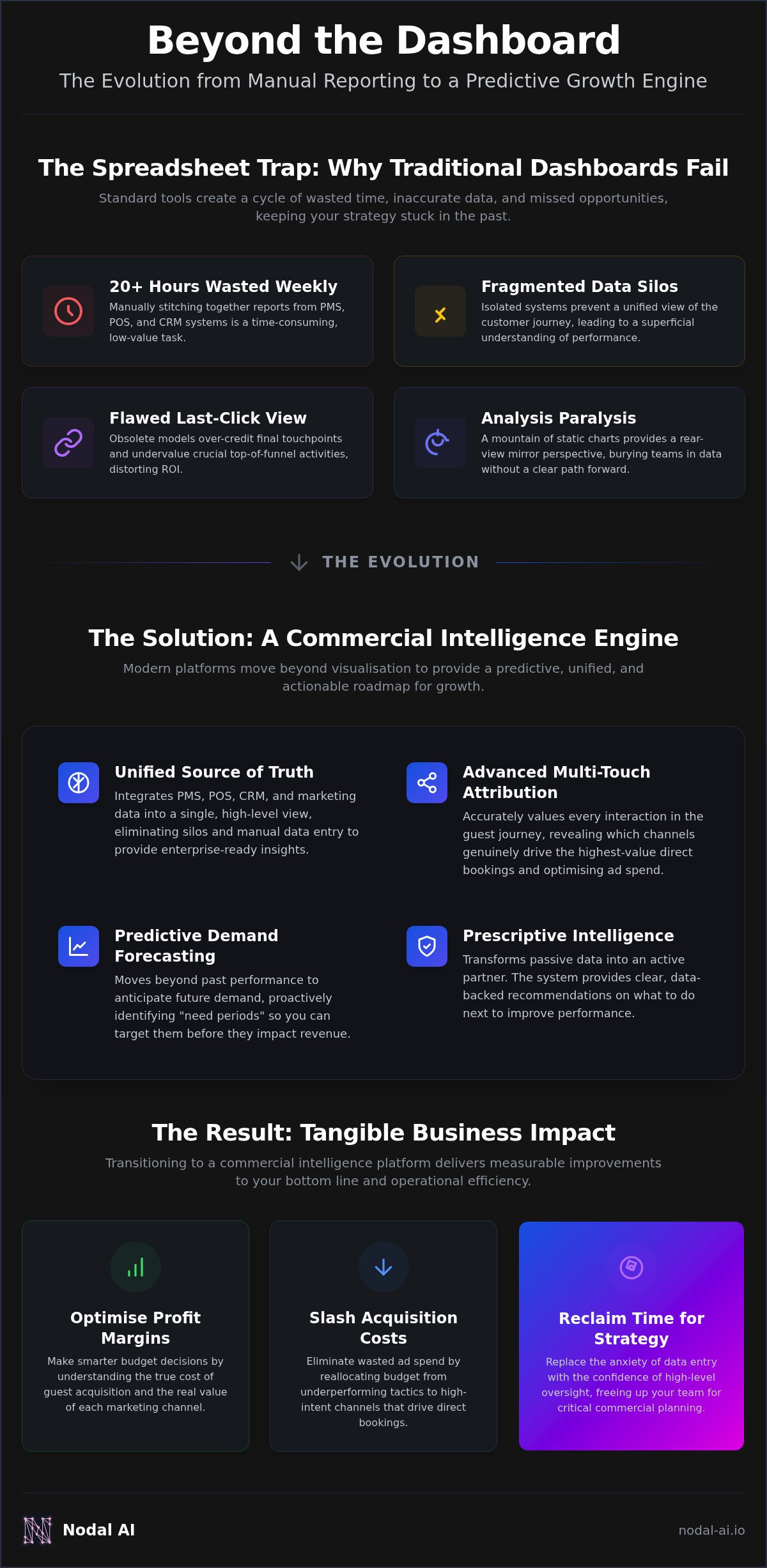
Data visualisation is the graveyard where marketing budgets go to die. If you're spending 20 hours every week manually stitching together reports from your PMS, POS, and CRM, you aren't managing a strategy; you're managing a spreadsheet. Standard performance marketing dashboard software often fails because it provides a rear-view mirror perspective rather than a forward-looking roadmap. It's a frustrating cycle that leaves you with inaccurate attribution and wasted ad spend while your direct booking margins continue to shrink.
You likely recognise that fragmented data is the primary barrier to achieving a truly competitive ROAS. This article promises to show you how to transform those chaotic inputs into a predictive growth engine that identifies need periods and slashes acquisition costs. We'll explore how to move beyond simple charts to a unified view of the customer journey, allowing you to optimise profit margins and reclaim your time for high-level commercial strategy.
Key Takeaways
- Understand why modern performance marketing dashboard software must evolve into a commercial intelligence engine to eliminate analysis paralysis and drive growth.
- Learn to integrate disparate systems like Oracle OPERA or Mews with marketing data to reveal the true cost of guest acquisition.
- Utilise predictive modelling to forecast demand and proactively target specific "need periods" for your property before they impact revenue.
- Optimise your profit margins by applying multi-touch attribution to identify which digital channels drive the highest-value direct bookings.
- Follow a clear, two-step implementation strategy to transition from manual spreadsheets to automated, high-level commercial insights.
The Evolution of Performance Marketing Dashboard Software in 2026
Yesterday's dashboards were digital paperweights; today's commercial intelligence engines are growth catalysts. In 2026, the definition of performance marketing dashboard software has shifted from simple data visualisation to active decision support. Traditional tools often bury hospitality leaders under a mountain of static charts, leading to chronic analysis paralysis. You see the numbers, but you don't see the path forward. This cognitive overload forces teams into a reactive stance, where they're constantly explaining past failures instead of engineering future wins.
The transition from descriptive analytics to prescriptive intelligence is the hallmark of this new era. It's no longer enough to know what happened; you must know what to do next. Modern systems use AI to move beyond the "what" and "how" to provide the "why." Instead of merely reporting a drop in conversion rates, an intelligence engine identifies the specific friction point in the guest journey and recommends a budget reallocation to high-intent channels. It transforms passive data into a conversational partner that guides your commercial strategy with calm, data-backed confidence.
Why Last-Click Dashboards are Obsolete
Standard reporting is failing in a privacy-first, cookie-less world. The core of performance marketing lies in paying for measurable results; however, those results are increasingly difficult to measure using outdated models. Relying on last-click attribution creates a distorted reality where top-of-funnel awareness is undervalued and bottom-of-funnel tactics are over-credited. This fragmentation leads to miscalculated ROI and significant budget wastage. In this complex environment, mastering marketing attribution is the only way to ensure every pound spent contributes to a direct booking. Without a sophisticated model, you're essentially flying blind through a storm of disconnected signals.
The Rise of Integrated Commercial Intelligence
True clarity requires moving data out of isolated silos and into a unified single source of truth. When your PMS, POS, and CRM systems operate independently, your performance marketing dashboard software remains a superficial layer rather than a deep intelligence tool. Integrated commercial intelligence demands real-time data ingestion to facilitate agile decision making. This process personifies your passive assets, turning cold numbers into active participants in your business process. By connecting disparate systems like Oracle OPERA or Mews directly to your marketing spend, you gain a high-level perspective that replaces manual toil with streamlined, enterprise-ready insights. This is the cognitive upgrade your organisation needs to maintain a competitive edge and protect your profit margins.
Core Features of High-Performance Marketing Analytics Platforms
Visualisation is merely the surface layer of a truly effective commercial strategy. High-performance marketing analytics platforms don't just present data; they translate it into actionable intelligence. Selecting the right performance marketing dashboard software allows your team to reclaim over 20 hours per week currently lost to the manual assembly of spreadsheets. This shift replaces the anxiety of data entry with the confidence of high-level oversight. It's the difference between staring at a map and having a GPS that predicts the traffic ahead.
Advanced Multi-Touch Attribution and Journey Mapping
The hospitality customer journey is rarely linear. A potential guest may interact with your brand five or six times before making a direct booking. Multi-touch attribution (MTA) is the only way to accurately value these touchpoints. By adopting a system of comprehensive marketing performance measurement, you can identify which channels are genuinely driving revenue and which are merely taking credit for it. This level of clarity is vital for calculating incrementality. When you combine this with predictive modelling, you stop reacting to past guest behaviour and start anticipating future demand. You can identify upcoming "need periods" with precision, ensuring your marketing spend is deployed exactly when and where it will yield the highest return.
Automated Reporting and Growth Recommendations
Most legacy dashboards suffer from the "visualisation trap" by providing slick charts that offer no real direction. Real intelligence requires a move toward growth recommendations. The Nodal Platform excels here by consolidating PMS, POS, and CRM data to provide a unified view of the customer journey. This isn't just about reporting numbers; it's about receiving automated, client-ready intelligence that highlights specific opportunities for expansion. Consider the results seen by Ovolo Hotels, who realised a 15.3% reduction in acquisition costs and a 24.5% increase in ROAS. They didn't achieve this by looking at prettier graphs; they did it by acting on tailored commercial insights. If you're ready to see how these features can transform your own data into a predictive engine, the transition to commercial intelligence is the logical next step.
Industry-Specific Needs: Solving the Hospitality Data Fragment
Generic analytics tools often fail because they treat a hotel brand like a SaaS company or a simple e-commerce store. In the hospitality sector, your data is naturally fragmented across legacy Property Management Systems (PMS), Point of Sale (POS) terminals, and disparate CRM databases. If your performance marketing dashboard software doesn't bridge the gap between your digital spend and these operational cores, you're only seeing a fraction of your commercial reality. You need an engine that translates complex operational signals into clear marketing actions.
Solving this fragment requires more than just a data connection; it requires a cognitive upgrade of your entire reporting structure. By integrating external signals such as local events, FX rate fluctuations, and even weather patterns, you can move from reactive reporting to proactive demand generation. This comprehensive view allows you to identify exactly where OTA leakage is occurring and deploy targeted strategies to reclaim those direct bookings. It transforms your data from a passive record of the past into an active participant in your property's future growth.
Connecting Operational and Marketing Systems
Your dashboard must act as a real-time translator between your booking engine and your operational systems. Whether you use Oracle OPERA, Mews, or a bespoke solution, the integration must be seamless to ensure data integrity. A modular architecture is essential here, as it allows you to tailor insights specifically for the unique needs of hotels, hostels, or QSR environments. This level of synchronisation is the only way to maintain robust data governance across multiple properties and locations. When your marketing spend is directly linked to your live inventory and operational capacity, you eliminate the risk of over-promoting during peak periods or under-investing when you have rooms to fill.
Measuring Full Guest Value and Ancillary Spend
Occupancy is a vanity metric if you aren't tracking the total value of every guest who walks through your doors. To truly optimise your profit margins, you must move beyond the room rate and monitor Total Revenue Per Available Room (TrevPAR). This shift requires a unified view of on-property spend, from the bar and restaurant to spa services and late check-outs. By utilising customer journey mapping, you can identify high-value touchpoints that lead to increased ancillary revenue. Tracking repeat visits and total lifetime value allows you to focus your acquisition budget on high-propensity guests, ensuring that every pound spent on marketing is an investment in long-term commercial stability.
How to Implement a Performance Marketing Dashboard Strategy
Implementation is the bridge between raw potential and realised profit. Many hospitality brands struggle with a DIY approach to performance marketing dashboard software, often finding themselves trapped in a cycle of broken integrations and mismatched metrics. To avoid this, you must follow a structured journey that prioritises commercial outcomes over technical vanity. Start by auditing your existing data sources. Identify the critical gaps where information is lost between your booking engine and your marketing reports. This initial clarity allows you to define your core commercial KPIs and growth targets with precision, ensuring your strategy is built on a foundation of truth.
Once your targets are established, select a platform with a modular architecture that fits the specific nuances of the hospitality industry. Integrate your operational and marketing data to create a unified view of your guest’s journey. This transition from manual reporting to AI-driven growth execution is where the true value lies. You are no longer just observing the business; you are actively steering it. By automating the flow of information, you empower your team to focus on high-level strategy rather than the tedious task of data entry. This cognitive upgrade ensures your organisation remains agile in a fast-paced market.
Selecting the Right Partner and Platform
Choosing a technology solution is a high-stakes decision that impacts your long-term stability. You must evaluate more than just the technical setup; consider the depth of data source integration and the quality of onboarding support. There is a significant difference between a generic SaaS tool and a strategic technology partner. A partner understands your commercial pressures and provides the expert support needed to turn complex data into a competitive advantage. You can check out our full list of features to see the Nodal difference and understand how a tailored approach outperforms a one-size-fits-all solution.
Maintaining Data Governance and Accuracy
Accuracy is the lifeblood of commercial intelligence. Without a robust data governance framework, your dashboard will eventually provide misleading signals. Establishing this framework ensures strategic clarity and protects the integrity of your insights. In a global marketing environment, you must also ensure strict GDPR compliance and data security to protect your brand's reputation and guest privacy. Regularly audit your integrations to maintain a single source of truth, preventing the drift that often occurs when multiple systems are updated independently. This disciplined approach ensures your data remains a reliable asset for future-facing analytics.
Book a demo to transform your data strategy
Nodal AI: The Intelligent Alternative to Generic Dashboards
Generic data hubs provide connections, but they lack the cognitive depth required to drive a high-level commercial strategy. Nodal AI represents a fundamental shift in how hospitality organisations interact with their data. Rather than just aggregating signals, the Nodal Platform acts as an intelligent layer that personifies your passive assets, turning them into active participants in your business process. This is why London-based enterprises are increasingly moving away from generic performance marketing dashboard software in favour of a solution that offers deep, sector-specific expertise and expert support.
The power of our modular architecture lies in its ability to provide specific insights for Operational, Demand, and Guest segments. For Ovolo Hotels, this meant moving beyond simple reporting to achieve a 15.3% reduction in acquisition costs. By leveraging the platform's ability to connect disparate systems like Oracle OPERA and Mews, they also realised a 24.5% increase in ROAS. These aren't just statistics; they are the tangible results of replacing manual toil with automated, high-value intelligence. When your data is integrated correctly, it stops being a source of anxiety and starts being a source of competitive advantage.
Commercial Intelligence Tailored to Your Business
Whether you manage a portfolio of boutique hotels, a fast-growing QSR brand, or an exclusive Private Members’ Club, Nodal AI provides tailored commercial insights that generic tools simply cannot match. We use AI-driven audience segmentation to identify your most profitable guests and optimise your marketing spend in real-time. Our Growth Recommendations serve as a strategic roadmap, directly impacting your profit margins by identifying exactly where to deploy capital for the highest return. This level of transparency removes the ambiguity that often plagues fragmented marketing departments, allowing you to focus on high-level growth execution.
Ready to Transform Your Marketing Performance?
The transition from manual chaos to a streamlined, high-level perspective is a relief that every modern professional deserves. You can finally stop managing spreadsheets and start leading your organisation with the confidence of an expert. Experience the cognitive upgrade that comes from resolving complexity and protecting your most valuable assets. It's time to see your data not as a burden, but as a predictive engine for growth. Book a demo with Nodal AI to see your data in a new light and take the first step toward total strategic clarity.
Master Your Commercial Future with Predictive Intelligence
The era of manual reporting and fragmented data is over. By embracing performance marketing dashboard software that prioritises commercial intelligence over simple visualisation, you transform your marketing department into a predictive growth engine. You've seen how a modular architecture, designed specifically for complex hospitality ecosystems, turns disconnected signals from your PMS and POS into actionable growth recommendations. It's time to move beyond the rear-view mirror and start engineering future wins with total clarity.
The results are undeniable. With a Gold win at the Performance Marketing Awards and a proven 24.5% increase in ROAS for hospitality clients, the Nodal Platform offers the cognitive upgrade your organisation needs to maintain a competitive edge. You can finally replace the anxiety of wasted ad spend with the confidence of high-level, automated oversight. This shift allows your team to focus on high-value strategy while the technology handles the underlying complexity. Reclaim your time and lead your business toward a future of long-term financial stability.
Book a demo to see how the Nodal Platform organises your data for growth
Step into a new era of commercial efficiency and watch your direct booking margins flourish.
Frequently Asked Questions
What is the difference between a marketing dashboard and a commercial intelligence platform?
A standard marketing dashboard acts as a digital ledger of past events, while a commercial intelligence platform serves as a strategic advisor. While dashboards focus on visualising historical data, intelligence platforms use predictive modelling to identify future opportunities. This transition turns passive reporting into active growth execution, providing specific recommendations to optimise your profit margins rather than just displaying static charts.
Can performance marketing dashboard software integrate with my PMS like Mews or Oracle OPERA?
Seamless integration with PMS systems like Mews and Oracle OPERA is a core requirement for modern performance marketing dashboard software. By connecting these operational cores directly to your marketing spend, the platform eliminates data silos. This synchronisation ensures that your customer journey mapping includes real-time booking data, providing a unified view of guest behaviour from the first click to the final check-out.
How does AI improve the accuracy of my marketing attribution data?
AI improves accuracy by moving beyond simplistic last-click models to sophisticated multi-touch attribution. It identifies the true value of every touchpoint in the complex hospitality journey, even in a privacy-first, cookie-less environment. By personifying passive data signals, AI fills the gaps left by traditional tracking, ensuring your ROAS calculations reflect the actual contribution of each digital channel to your total revenue.
Will this software help me reduce my reliance on OTAs and increase direct bookings?
The platform is specifically engineered to reduce OTA leakage by identifying where potential guests drop off before booking directly. By leveraging AI-driven audience segmentation, you can target high-propensity guests with personalised offers that encourage direct interaction. This shift protects your profit margins and allows you to reclaim ownership of the customer relationship from third-party intermediaries.
How long does the implementation and onboarding process typically take?
The implementation timeline typically ranges from four to eight weeks, depending on the complexity of your existing tech stack and the number of properties involved. This process includes a thorough data audit, system integration, and tailored onboarding support. Our London-based experts guide you through every step, ensuring a smooth transition from manual reporting to automated commercial intelligence without disrupting your daily operations.
Is it possible to track offline conversions and footfall within a digital dashboard?
Tracking offline conversions is possible through the integration of POS and CRM data into the central hub. By connecting on-property spend and repeat visits to specific digital campaigns, you gain a complete picture of guest value. This allows you to track footfall and ancillary revenue, ensuring your performance marketing dashboard software accounts for the full commercial impact of your marketing investment beyond the initial room booking.
What are the data governance requirements for using AI-powered analytics in the UK?
Organisations must adhere to strict GDPR and UK Data Protection Act standards when using AI-powered analytics. This requires a robust data governance framework that ensures transparency, security, and the ethical use of guest information. Our platform is designed with these regulations at its core, providing the high-level protection of assets necessary to maintain compliance while delivering deep commercial insights in a secure environment.
How does predictive modelling help in identifying future need periods for hotels?
Predictive modelling analyses historical booking trends and external signals, such as local events or FX rates, to forecast upcoming demand. This foresight allows you to identify need periods well in advance, giving you the opportunity to adjust your marketing strategy proactively. Instead of reacting to low occupancy after it occurs, you can deploy targeted campaigns to fill rooms before the gap impacts your revenue.


