

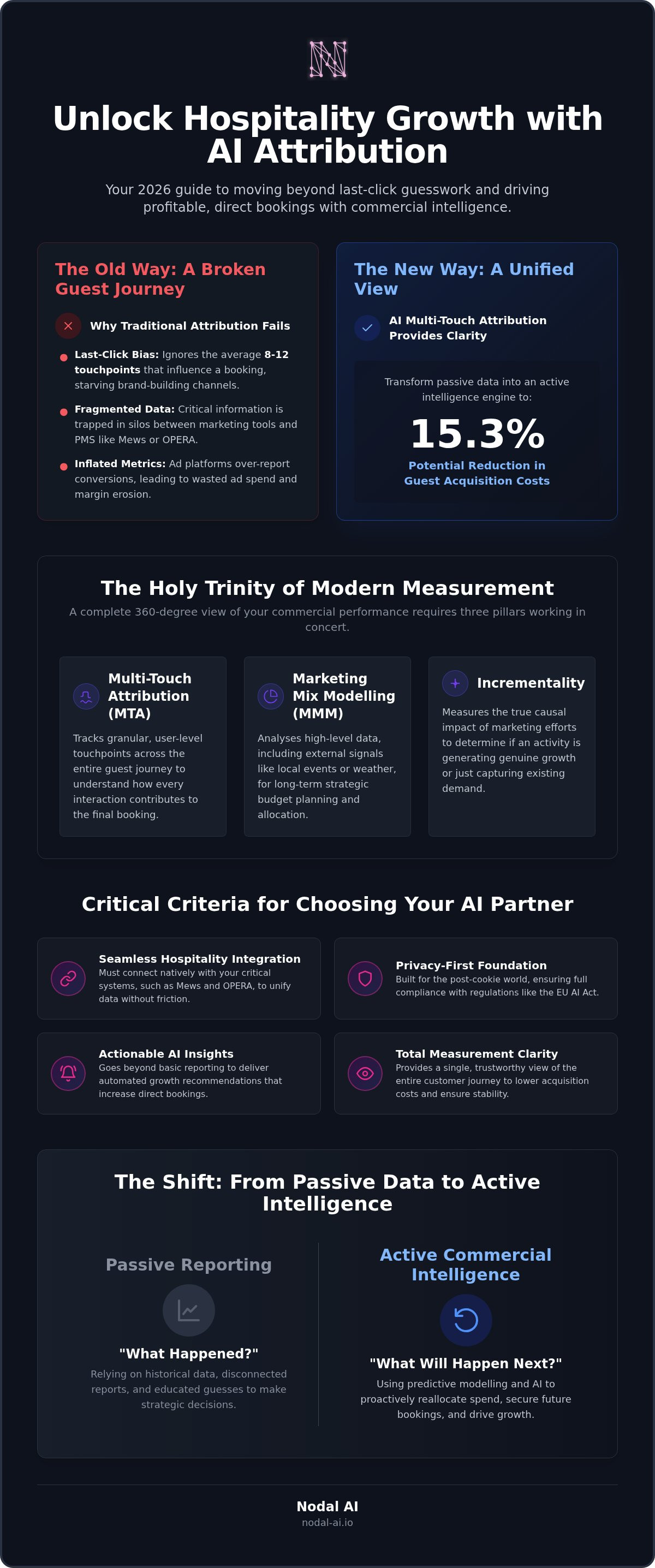
In 2026, the average guest journey spans up to 12 touchpoints before a booking is finalised, yet many hospitality brands remain blind to the actual path their customers take. You likely recognise the frustration of looking at inflated platform metrics that simply don't match the revenue in your PMS. It's difficult to justify ad spend when last-click bias hides the true value of your brand awareness efforts. Adopting AI multi touch attribution is the only way to move past this uncertainty and gain a transparent, cognitive upgrade for your entire marketing department.
We understand that fragmented data silos between marketing tools and operational systems like Mews or OPERA are the primary barrier to profitable growth. This guide will show you how to evaluate the best AI multi-touch attribution vendors to unify your data and drive measurable results. You'll learn how to transform your passive data into an active commercial intelligence engine that has been shown to reduce acquisition costs by as much as 15.3%. We will explore the top platforms and provide a strategic framework to help you choose a solution that delivers total clarity and fuels direct bookings.
Key Takeaways
- Replace outdated last-click models with privacy-first tracking to stop margin erosion and reclaim wasted ad spend.
- Understand the synergy between MTA, Marketing Mix Modelling, and incrementality for total measurement clarity across all channels.
- Vet potential vendors by prioritising their ability to integrate seamlessly with critical hospitality systems like Mews and OPERA.
- Learn how AI multi touch attribution provides a single view of the customer journey to lower acquisition costs.
- Move beyond basic reporting to automated growth recommendations that specifically increase direct booking volume and long-term stability.
The Evolution of AI Multi-Touch Attribution Vendors in 2026
The marketing landscape in 2026 looks nothing like the digital environment of the previous decade. With the final deprecation of third-party cookies and the strict enforcement of the EU AI Act and New York AI Disclosure Law, the old ways of tracking guests have crumbled. Modern Marketing attribution has evolved into a sophisticated discipline where AI multi touch attribution acts as the central nervous system for commercial growth. Marketers now face the challenge of fragmented data as their primary hurdle, requiring a shift from simple channel tracking to complex customer journey mapping. It's no longer enough to know which ad was clicked last; you need to understand how every interaction across the guest lifecycle contributes to the final booking.
Reliance on last-click models is a recipe for profit margin erosion. When you credit the final click alone, you ignore the 8 to 12 touchpoints that typically occur before a customer commits. This leads to inflated budgets for bottom-of-funnel channels while starving the brand-building activities that actually fuel the pipeline. The result is a cycle of wasted ad spend and diminishing returns that modern hospitality leaders can no longer afford to ignore. Moving toward a more intelligent model ensures that every pound spent is an investment in measurable growth rather than a shot in the dark.
Why Traditional Attribution Models Fail Modern Enterprises
Walled gardens like Meta and Google provide a distorted view of reality. They often claim credit for the same conversion, leading to a phenomenon where reported sales can be double or triple the actual revenue recorded in your PMS. This lack of transparency is compounded by dark social blind spots, such as recommendations shared in private messaging apps or offline word-of-mouth. Without a vendor capable of connecting these fragmented data points across different platforms, your marketing strategy remains a series of educated guesses rather than a data-driven roadmap.
The Rise of AI-Powered Commercial Intelligence
The shift from passive reporting to active intelligence represents the most significant leap in marketing technology. While traditional tools simply tell you what happened, this technology predicts what will happen next. It transforms raw, chaotic inputs from your CRM and POS systems into actionable growth recommendations. It treats your data as an active participant in the business, identifying exactly where to reallocate spend to maximise direct bookings. AI multi touch attribution is a strategic asset for margin protection that ensures every pound spent contributes to long-term stability.
The Integrated Measurement Framework: MTA, MMM, and Incrementality
Modern marketing measurement requires more than just a single lens. By 2026, industry leaders have adopted what we call the Holy Trinity of measurement: AI multi touch attribution, Marketing Mix Modelling (MMM), and Incrementality. These three pillars work in concert to eliminate blind spots and provide a comprehensive 360-degree view of your commercial performance. While MTA tracks the granular steps of a guest journey, MMM provides the high-level perspective needed for annual budget planning. You can explore the foundational elements of this approach in our sibling guide, Mastering Marketing Attribution: The Definitive Guide for 2026.
The real power lies in how these systems feed into predictive modelling. By identifying future trend lines and upcoming need periods, hospitality brands can shift from reactive spending to proactive growth. This allows you to secure bookings during low-occupancy windows before your competitors even realise the opportunity exists. Academic research into Multi-touch attribution models confirms that combining these methodologies leads to the most accurate ROI reporting available to modern enterprises.
Marketing Mix Modelling (MMM) for Long-Term Strategy
MMM acts as your strategic compass. It accounts for external signals that digital tracking often misses, such as local events, changing weather patterns, or fluctuations in FX rates. These factors significantly impact travel demand but are invisible to standard pixels. By incorporating these variables, MMM helps you decide where to allocate your primary budget for the next quarter. For a deeper look at how to use these signals to your advantage, see our article on Predictive Modelling: Transforming Fragmented Data into Future Growth.
Incrementality Testing: Measuring True Value
Incrementality is the ultimate truth-teller in marketing. It measures the specific revenue that would not have happened without a particular ad spend. For hospitality brands, this is the most effective way to identify OTA leakage. If an OTA is bidding on your brand terms, incrementality tests reveal if those guests would have booked directly anyway. To run these tests without disrupting performance, use a "geo-match" framework:
- Select two similar geographic markets with comparable booking patterns.
- Maintain your baseline spend in one market as a control group.
- Reduce or pause specific spend in the other for a set period.
- Compare the resulting direct booking volume to measure the true uplift.
This rigorous approach ensures you aren't paying for conversions you already owned. If you're ready to unify your fragmented data into a single source of truth, you can explore the features of a modern commercial intelligence engine today.
Top Multi-Touch Attribution Vendors: A Comparative Evaluation Framework
Selecting a vendor requires a shift from generic software to specialised commercial intelligence. We categorise the current market into three distinct tiers: Enterprise Suites, B2B Specialists, and Industry-Specific Platforms. While legacy enterprise clouds provide a broad view of the marketing funnel, they often fail to capture the nuance of hospitality operational data. B2B Specialists focus on long-form lead generation, which doesn't always translate to the fast-paced world of F&B or hotel bookings. Industry-Specific Platforms, such as Nodal AI, are engineered to bridge the gap between marketing clicks and actual property management system (PMS) revenue.
Your evaluation must prioritise three core pillars: data ingestion, modelling transparency, and ease of integration. In a world without third-party cookies, first-party data ownership is your most valuable asset. Own your data, or you'll find yourself locked into a vendor's proprietary ecosystem. Don't settle for "black box" algorithms that hide their methodology. You must understand how your credit is assigned to avoid the margin erosion we previously identified. Transparency ensures that your AI multi touch attribution strategy remains a cognitive upgrade for your entire organisation rather than a confusing technical hurdle.
Enterprise vs. Niche Attribution Solutions
Large-scale generalised platforms often carry significant hidden costs. While a tool might seem cost-effective initially, the total cost of ownership can escalate quickly when you factor in implementation and onboarding fees for custom integrations. Specialised modular engines offer a more streamlined alternative. They prioritise speed to value, turning chaotic data into actionable insights without requiring a six-month setup period. Professional implementation is essential for complex customer journeys, but it should focus on results rather than endless technical configuration.
The Checklist for Evaluating MTA Software
Use this checklist during your procurement process to ensure your chosen platform can handle the demands of 2026. A vendor's ability to resolve identities across mobile and desktop devices is non-negotiable. Ensure they can answer these critical questions:
- Does the vendor integrate directly with operational systems like OPERA, Mews, or OpenTable?
- How does the platform track offline conversions from walk-ins or phone bookings?
- Does the modelling provide clear, actionable growth recommendations rather than just passive reporting?
- Is the data governance framework robust enough for global marketing teams?
If you're ready to see how a specialised engine handles these challenges, you can request a demo of the Nodal Platform to see these features in action. Choosing the right partner transforms your marketing from a cost centre into a predictable revenue driver.
Critical Selection Criteria: Integration, Governance, and AI Insights
For many marketing departments, the biggest hurdle isn't a lack of data; it's the sheer volume of disconnected noise. Clicks and impressions provide a surface-level view, but they don't represent the reality of your balance sheet. In 2026, seamless integration with operational systems like OPERA, Mews, or OpenTable is a non-negotiable requirement for any serious enterprise. If your AI multi touch attribution platform cannot see the actual booking in your PMS, it's merely guessing at your ROI. True commercial intelligence requires a direct bridge between digital touchpoints and physical revenue.
This integration does more than just provide clarity; it restores your team's time. Manual data cleaning is a tedious, low-value task that drains productivity and introduces human error. By implementing automated reporting, global marketing teams frequently reclaim 20 or more hours per week. This shift allows your best minds to stop acting as data janitors and start acting as growth strategists. It replaces the anxiety of manual spreadsheets with the confidence of real-time, verified performance metrics.
Solving the Fragmented Data Crisis
Consolidating your inputs requires a sophisticated Commercial Intelligence approach. It's about more than just grouping channels; it's about mapping complex guest segments across multiple properties and global locations. A Modular Architecture ensures that your AI multi touch attribution setup is tailored to your specific business model, whether you're managing a boutique hotel group or a multinational QSR brand. This flexibility transforms chaotic, fragmented data into a streamlined asset that fuels consistent growth and reduces acquisition costs.
From Data Governance to Strategic Clarity
Confidence in your numbers starts with a robust data governance framework. Without it, different departments will inevitably report conflicting figures, leading to internal friction and stalled initiatives. Establishing one version of the truth ensures that every stakeholder, from the CMO to the property manager, is looking at the same verified reality. This is particularly critical when managing compliance requirements like GDPR, where transparency isn't just a benefit, it's a legal necessity. You can explore our detailed guide on The Modern Data Governance Framework: From Fragmented Data to Strategic Clarity to learn how to build this foundation.
Clarity leads to momentum. When you remove the ambiguity from your reporting, decision-making becomes faster and more confident. You no longer need to debate the validity of a source; instead, you can focus on the growth recommendations that will actually increase your direct bookings and protect your margins. It's the difference between guessing where your guests come from and knowing exactly how to reach them.
Book a demo to see our integration framework in action
Nodal AI: The Commercial Intelligence Engine for High-Stakes Performance
Nodal AI stands as the strategic partner for hospitality, QSR, and wellness brands that demand more than simple tracking. We provide a cognitive upgrade for your entire organisation by transforming chaotic, fragmented data into high-value commercial intelligence. Our focus remains fixed on a single objective: helping you make more and waste less. By employing margin-centric AI multi touch attribution, we replace the anxiety of eroded margins with the confidence of predictable, profitable growth. The results are measurable and immediate. Ovolo Hotels, for instance, realised a 15.3% reduction in acquisition costs and a 24.5% increase in ROAS after implementing our platform. You can explore the Nodal Platform features to see how we turn passive data into an active participant in your business success.
Hospitality-Specific Attribution: Beyond the Click
Most attribution tools fail because they stop at the digital booking. They treat a guest journey as a series of clicks rather than a complex human experience. Nodal AI goes further by tracking total guest value, stay extensions, and ancillary spend across your POS and PMS systems. We identify exactly where OTA leakage occurs, allowing you to reclaim high-margin direct bookings and protect your brand equity. Our engine even incorporates external signals, such as local weather patterns and flight demand, to provide a deeper layer of commercial analysis. This granular visibility ensures you aren't just seeing where your guests come from; you are understanding why they choose you and how to keep them coming back.
Why London Enterprises Choose Nodal AI
Success in the London hospitality market requires a partner that understands the local landscape and the complexity of global operations. We provide expert, London-based support and a professional onboarding process that ensures your team is empowered from day one. Our modular architecture is designed to connect the dots across fragmented hospitality systems, whether you are using Mews, OPERA, or specialised wellness platforms. We remove the technical hurdles that typically stall digital transformation, allowing you to focus on strategic execution. It is time to replace manual, tedious reporting with a streamlined perspective that drives measurable returns. Connect your systems and take control of your performance data today.
Book a demo today to transform your performance data
Secure Your Competitive Edge with Commercial Intelligence
Navigating the 2026 privacy landscape requires more than just a tracking tool; it demands a total cognitive upgrade for your organisation. You have seen how moving beyond last-click models and unifying fragmented data can transform your marketing from a cost centre into a predictable revenue engine. By choosing a partner that understands the specific nuances of the hospitality sector, you can finally eliminate dark social blind spots and reclaim high-margin direct bookings from third-party platforms.
Implementing AI multi touch attribution is the final step in resolving the complexity of the modern guest journey and securing your long-term stability. It turns your passive data into an active participant in your business strategy, replacing guesswork with verified performance metrics.
Brands like Ovolo Hotels have already realised a 15.3% reduction in acquisition costs and a 24.5% increase in ROAS through this approach. Our modular intelligence engine is specifically engineered to bridge the gap between your digital touchpoints and your actual property revenue. You now have the framework to replace the anxiety of manual data cleaning with the confidence of streamlined, high-level perspectives.
Transform your fragmented data into profitable growth; book your Nodal AI demo today
The path to total clarity is now open, and the measurable growth you have been searching for is well within your reach.
Frequently Asked Questions
What is the difference between AI multi-touch attribution and marketing mix modelling?
AI multi-touch attribution focuses on the granular journey of individual guests to credit specific digital touchpoints, while marketing mix modelling (MMM) provides a high-level strategic view of budget allocation. MTA is ideal for daily campaign optimisation, whereas MMM accounts for external factors like economic shifts or seasonal trends that digital tracking might miss.
How do multi-touch attribution vendors handle the loss of third-party cookies in 2026?
Modern vendors have shifted toward server-side tracking and the prioritisation of first-party data to maintain accuracy. By using AI-driven identity resolution, these platforms can reconstruct complex customer journeys across multiple devices without relying on traditional, invasive tracking methods that are no longer supported by major browsers.
Is multi-touch attribution worth the investment for hospitality brands?
Adopting AI multi touch attribution is a critical step for any brand seeking to reduce its reliance on high-commission third-party booking sites. It provides the transparency needed to prove the value of brand awareness campaigns, helping you to reclaim margins and drive a higher volume of direct bookings through your own channels.
How long does it typically take to implement an AI-powered MTA platform?
The implementation process generally spans four to eight weeks depending on the complexity of your existing data infrastructure. This period includes the initial audit of your data sources, the configuration of API connectors, and the time required for the machine learning models to recognise and categorise your specific guest behaviours.
Can multi-touch attribution track offline conversions like restaurant footfall?
Yes, by connecting your marketing data directly to point-of-sale (POS) systems and reservation platforms. This integration allows you to link digital ad impressions to physical transactions, providing a clear view of how your online spend influences real-world restaurant visits and walk-in guest revenue.
What are the most common mistakes when choosing an attribution vendor?
Many organisations fail by selecting "black box" solutions that offer no transparency into their underlying modelling methodology. Another frequent error is choosing a generic tool that lacks the specialised connectors required to ingest data from hospitality-specific systems like property management or table booking software.
How does Nodal AI integrate with my existing PMS and POS systems?
The Nodal Platform uses secure, direct API connections to ingest data from industry-standard systems such as OPERA, Mews, and OpenTable. This automated process removes the need for manual data cleaning, transforming fragmented operational inputs into a single, cognitive upgrade for your entire commercial department.
What is the Holy Trinity of marketing measurement in 2026?
The Holy Trinity refers to the integrated use of AI multi touch attribution, Marketing Mix Modelling, and Incrementality testing. Combining these three methodologies ensures that you have a 360-degree view of performance, allowing you to validate individual touchpoints while also understanding the true uplift of your total marketing spend.


