

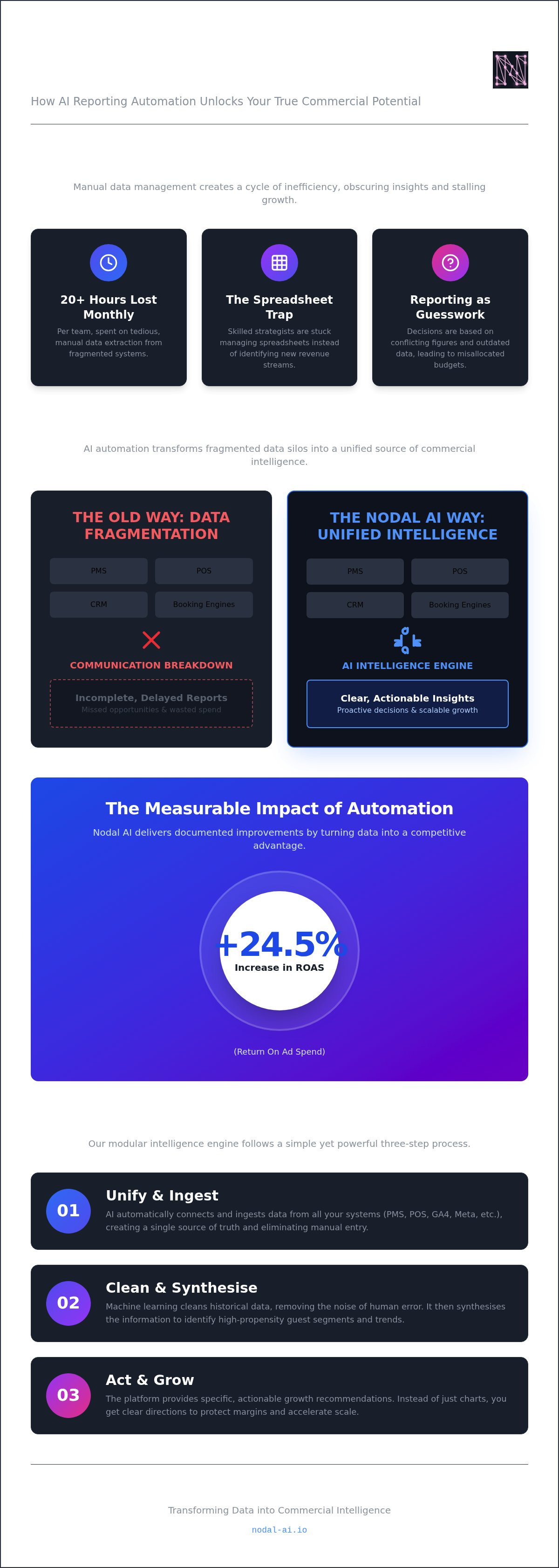
Most marketing teams lose over 20 hours every month to the tedious manual extraction of data from fragmented silos. It's a frustrating cycle that leaves you buried in spreadsheets rather than driving strategy. You likely recognise the anxiety of presenting reports that feel like guesswork because your POS and CRM data simply refuse to talk to each other. This friction does more than just waste time; it obscures your true return on ad spend and stalls your commercial momentum. Transitioning to ai reporting automation is the cognitive upgrade your organisation needs to replace this manual chaos with streamlined efficiency.
We understand the pressure to deliver results in a landscape where data moves faster than human hands can track. This guide demonstrates how AI-driven automation eliminates silos to provide real-time, actionable insights for scalable business growth. You'll discover how to unify your performance data into a single, transparent view that identifies growth opportunities before they pass you by. We will explore the shift from reactive collection to proactive intelligence, ensuring you spend less time on administration and more time on high-value commercial outcomes.
Key Takeaways
- Reclaim your team's productivity by eliminating the spreadsheet trap that currently consumes a quarter of your working week, allowing you to focus on high-value strategy.
- Transform your operations with ai reporting automation to bridge the gap between static, fragmented data and real-time commercial intelligence.
- Move beyond passive dashboards that merely display charts; instead, adopt modular intelligence engines that provide specific, actionable growth recommendations.
- Build a strategic framework for growth by auditing your current ecosystem, from PMS to CRM, to ensure every report answers a critical commercial question.
- Leverage the Nodal Platform to unify your performance marketing analytics and achieve measurable improvements, such as a documented 24.5% increase in ROAS.
The Hidden Cost of Manual Data Management in 2026
Marketing teams today face a silent drain on their most valuable asset: time. Many professionals lose up to 25 per cent of their working week to the manual extraction and cleansing of data from disparate systems. This productivity trap keeps skilled strategists tethered to static spreadsheets instead of identifying new revenue streams. When your team spends ten hours a week just trying to make sense of conflicting figures, they are not just tired; they are expensive. This manual burden creates a state of perpetual catch-up where decisions are based on yesterday's news rather than tomorrow's opportunities.
In high-competition sectors, this inefficiency translates directly into margin erosion. Without the clarity provided by ai reporting automation, businesses often struggle to calculate multi-touch attribution accurately. Relying on manual calculations introduces significant human error, leading to misallocated budgets and wasted ad spend. Most organisations still fall back on last-click reporting, which offers a distorted, flat view of the customer journey. It ignores the complex path a guest takes before booking, making it impossible to see which channels truly drive long-term value. This lack of transparency is where profit margins quietly bleed away.
Data Fragmentation and the Hospitality Industry
Hospitality leaders deal with a unique level of complexity as they attempt to connect Property Management Systems (PMS), Point of Sale (POS), and various booking engines. These silos act as barriers, preventing a unified view of guest lifetime value. When information is fragmented, you cannot tell if a high-spending restaurant guest is also a frequent hotel stayer. Delayed reporting further compounds the issue, as missing a trend in occupancy or direct revenue for even a few days can lead to increased reliance on high-commission OTAs. This "OTA leakage" is a direct result of being unable to see your data in a single, coherent view.
The Shift from Reactive to Proactive Analysis
Relying on last month's performance data to make current decisions is a recipe for stagnation. Real-time commercial intelligence allows you to pivot before a trend becomes a missed opportunity. By implementing ai reporting automation, you transform your data from a passive archive into an active participant in your growth. This shift removes the administrative overhead that stifles creativity. It finally creates the space your team needs for high-level strategic brand planning. You will finally realise the full potential of your marketing spend by looking forward rather than backwards. Stop looking in the rear-view mirror; start driving your commercial outcomes with the confidence of total clarity.
How AI Reporting Automation Bridges the Gap Between Data and Decisions
Traditional reporting is often a passive archive of what has already happened. In contrast, ai reporting automation acts as an active intelligence layer that sits above your tech stack. It is defined as the strategic use of machine learning to ingest, clean, and synthesise disparate data sources into actionable insights. This process takes the chaotic inputs of your daily operations and distils them into a clear, high-value output. It transforms data from a burden into a competitive advantage, ensuring that your leadership team spends their energy on execution rather than interpretation.
A modular intelligence engine is the foundation of this transformation. By unifying complex data sets from systems like Oracle OPERA, Mews, and GA4, it creates a single, transparent view of your commercial health. This integration allows the platform to identify early signs of "need periods" in occupancy long before they manifest as a crisis. Instead of reacting to a quiet week after it occurs, you receive specific growth recommendations that allow for proactive budget reallocation. This is the "make more, waste less" mission in action: using technology to protect your margins and accelerate your scale.
The Mechanics of Data Ingestion and Synthesis
Efficiency relies on the seamless connection between GA4, Meta, and your internal operational systems. The Nodal Platform automates this ingestion, using advanced data science to scrub historical data and remove the noise of human error. This cleaning process is vital; it ensures that the guest segments identified by the system are truly high-propensity targets. You can stop guessing which audiences drive value and start targeting the segments that the data has already verified as profitable. If you want to see this clarity in your own organisation, you can book a demo of our modular engine today.
Predictive Modelling vs Static Reporting
Static dashboards tell you that bookings were down last week; they cannot tell you why or how to fix it. Predictive modelling shifts the focus toward future outcomes by incorporating external signals such as local weather patterns and FX rates into your demand forecasting. This approach moves your strategy beyond simple historical analysis. It allows you to predict what will happen next, giving you the lead time required to adjust your pricing or marketing spend. For a deeper technical exploration of these capabilities, read our full guide on predictive modelling and how it turns fragmented data into future growth.
Comparing Legacy Dashboards with AI-Driven Insight Engines
Legacy Business Intelligence (BI) tools often fail because they demand too much from the user. They require constant manual maintenance, which frequently turns expensive software into "shelfware" that sits unused by the very marketing teams it was meant to empower. While these platforms can display historical data, they rarely provide the "why" behind the numbers. Transitioning to ai reporting automation changes this dynamic entirely. It moves the organisation from a state of passive observation to one of active commercial intelligence. You stop looking at what happened and start understanding what to do next.
The fundamental difference lies in the output. A legacy dashboard shows you a chart of declining bookings; an AI-driven engine provides a specific recommendation to adjust your Meta spend for a high-propensity guest segment. This shift addresses the notorious "Walled Garden" problem of digital advertising. By synthesising data from hidden silos, the system provides a holistic view that manual reporting simply cannot replicate. When you weigh the cost of a SaaS subscription against the hundreds of manual labour hours lost each month, the commercial choice becomes clear. It is an investment in clarity over complexity.
The Limits of Visualisation-Only Tools
A visually appealing dashboard is often a mask for deeply fragmented data. Visualisation-only tools still require a human to perform the heavy lifting of interpretation, which adds a significant cognitive load to your team. Marketing managers shouldn't need a degree in data science to understand their multi-channel performance. Automated insights remove this barrier by handling the complex synthesis behind the scenes. This reduces the need for deep technical specialisation within your team, allowing your talent to focus on creative execution instead of data entry. You gain the freedom to lead rather than manage.
Commercial Intelligence as a Competitive Advantage
True commercial intelligence provides a shield against margin erosion. By improving direct booking attribution, you can actively reduce OTA leakage and reclaim your relationship with the guest. This level of clarity directly impacts your financial performance. For example, our clients have realised a 24.5 per cent increase in ROAS through automated audience segmentation. These are not just marginal gains; they are transformative shifts in efficiency. Ovolo Hotels achieved a 15.3 per cent reduction in acquisition costs by leveraging the Nodal Platform to unify their performance data. Secure your competitive edge by turning your data into a decisive commercial weapon.
Implementing Automated Reporting: A Strategic Framework for Growth
Successful deployment of ai reporting automation requires more than just a software installation; it demands a structured strategic realignment. You must begin by auditing your current data ecosystem to map every touchpoint from your PMS to your CRM. This audit identifies exactly where silos exist and where information is being lost. Once you understand the landscape, you can identify the key commercial questions your reporting must answer. Focus on the metrics that drive actual growth, such as net revenue per available room or guest acquisition cost, rather than vanity metrics. Transitioning to ai reporting automation ensures these answers are available in real-time, providing the clarity needed for rapid scaling.
A robust data governance framework is essential for this transition. It provides the rules for how data is collected, stored, and used, ensuring total compliance and strategic clarity across the business. We recommend a phased onboarding approach. Start with high-impact integrations, such as connecting your primary booking engine with GA4, before expanding to more complex operational modules. This creates immediate value and builds internal momentum for the wider organisational shift. It turns a complex technical hurdle into a series of manageable, high-value wins.
Mapping the Customer Journey with Automation
Tracking performance across the entire guest lifecycle becomes effortless when you remove the manual burden of data collection. Automation allows you to integrate multi-touch attribution into your daily workflow, providing a granular view of how different channels contribute to a single booking. You can finally see the interplay between social discovery and direct conversion. This level of detail is vital for profitable scaling and long-term stability. For specific strategies on how to visualise these paths, consult our comprehensive customer journey guide.
Ensuring Data Security and GDPR Compliance
UK organisations must navigate a complex regulatory environment regarding guest privacy and data protection. Choosing a London-based technology partner offers a significant security advantage, as it ensures your data residency and compliance standards align with local requirements. Managing sensitive guest data within an automated AI environment requires a professional touch and a secure architecture. Our implementation programme focuses on high-level protection, ensuring that your cognitive upgrade does not come at the expense of security. Total transparency in how data is handled remains our primary value proposition.
Book a demo to start your implementation journey
Nodal AI: The Modular Solution for Automated Hospitality Intelligence
The Nodal Platform acts as the connective tissue for your entire commercial operation. It transforms passive data streams into active participants in your business growth, ensuring that your tech stack finally works as hard as your team. By deploying ai reporting automation, you move beyond the limitations of generic cloud services that lack the specific context required for high-touch service sectors. Our modular architecture allows you to customise your intelligence engine with specific guest and operational modules. This ensures the insights you receive are perfectly aligned with your unique commercial objectives, replacing chaotic inputs with high-value outputs.
Strategic growth recommendations replace the guesswork of manual analysis. By using AI-driven audience segmentation, you can identify high-value guest profiles and target them with surgical precision. This reduces media waste and ensures that every pound of your ad spend works harder to drive direct revenue. Our mission is simple: we help you make more and waste less. This is not just about short-term efficiency; it is about building a scalable foundation for long-term commercial stability. You gain the confidence that comes from total transparency and streamlined, high-level perspectives.
Why Hospitality Leaders Choose Nodal
Decision-makers in the hospitality sector require specialised tools that understand their unique ecosystem. The Nodal Platform offers deep, modular integrations with industry standards including Oracle OPERA, Mews, and SevenRooms. These connections allow for a seamless flow of data from your property systems directly into your performance marketing analytics. The results are documented and decisive. Our clients have realised a 24.5 per cent increase in ROAS, while partners like Ovolo Hotels have achieved a 15.3 per cent reduction in acquisition costs. Beyond the software, our marketing and AI consultancy team provides the strategic advice needed to navigate this cognitive upgrade.
Next Steps: From Fragmentation to Clarity
Evaluating the ROI of an ai reporting automation platform requires a focus on both time saved and revenue gained. Consider the hundreds of administrative hours your team will reclaim and the margin erosion you will prevent through better multi-touch attribution. The transition from fragmented silos to total clarity is a journey that requires dedicated support, especially during the vital ingestion of historical data. Our team ensures that your technical setup is flawless, providing the bridge you need to reach a state of calm efficiency. Take the first step toward a more intelligent, automated future.
Book a demo of the Nodal Platform
Reclaim Your Commercial Momentum
The era of manual reporting is drawing to a close. By adopting ai reporting automation, you replace the anxiety of fragmented silos with the confidence of a single, transparent view of performance. This transition allows your team to move from reactive data collection to proactive commercial intelligence. We have seen how our partners realised a 24.5 per cent increase in ROAS and a 15.3 per cent reduction in acquisition costs. These results aren't just statistics; they represent a fundamental shift in operational efficiency and financial stability. You're no longer just tracking history; you are predicting future growth.
Our London-based expert support is ready to guide you through this cognitive upgrade. We help you turn chaotic inputs into high-value outputs, ensuring your organisation remains competitive and forward-thinking. It is time to stop managing spreadsheets and start leading your brand toward measurable, scalable success. Focus your energy on strategy and let technology handle the complexity of synthesis. You deserve the relief that comes from resolving manual friction once and for all.
Book a demo of the Nodal Platform to see automated reporting in action
Frequently Asked Questions
What is AI reporting automation and how does it differ from traditional reporting?
AI reporting automation is the use of machine learning to ingest, clean, and synthesise data from multiple sources into a single intelligence layer. Traditional reporting relies on manual extraction and static spreadsheets, which are often reactive and prone to human error. In contrast, this automated approach provides real-time, proactive insights that turn chaotic inputs into high-value commercial outputs.
How much time can my team save by automating our marketing reports?
Marketing teams typically reclaim over 20 hours every month by eliminating manual data entry and spreadsheet management. This represents approximately 25 per cent of a standard working week returned to your staff for high-level strategic planning. By removing the administrative burden, your team can focus on creative execution and brand growth rather than tedious data collection.
Is AI reporting automation compliant with GDPR and data privacy laws?
Yes, our platform is designed with high-level protection and total transparency as primary values. As a London-based technology partner, we ensure all data residency and processing standards align strictly with UK GDPR and global privacy requirements. Automated systems actually improve compliance by removing the risks associated with manual data handling and insecure spreadsheet sharing.
Can Nodal AI integrate with my existing PMS and CRM systems like Oracle OPERA?
The Nodal Platform features a modular architecture specifically built to connect with industry standards such as Oracle OPERA, Mews, and GA4. This allows you to unify fragmented data from your Property Management System and CRM into one transparent view. You can finally see the complete guest journey without the need for manual intervention or custom coding.
What kind of growth recommendations does an AI reporting tool provide?
Our intelligence engine delivers specific, actionable advice such as identifying high-propensity guest segments for immediate budget reallocation. It moves beyond simple charts to suggest how to fill upcoming "need periods" in occupancy. These recommendations allow you to pivot your strategy proactively, ensuring you maximise revenue before a trend becomes a missed opportunity.
How does automated reporting help in reducing OTA leakage for hotels?
Automated reporting provides the clarity needed to improve direct booking attribution and reclaim the guest relationship. By unifying data across PMS and POS silos, you can identify your most profitable guests and target them through direct channels. This reduces your reliance on high-commission third parties and protects your margins from the erosion caused by OTA leakage.
Do I need a data scientist to manage an automated reporting platform?
You do not need a data scientist or deep technical specialisation to use our platform effectively. We have mastered the complex underlying technology to ensure the user experience is streamlined, punchy, and effortless. It acts as a cognitive upgrade for your existing marketing team, providing expert-level analytics through an approachable and professional interface.
What is the typical return on investment for AI reporting automation?
Most organisations realise a significant return on investment within the first few months of implementation. By deploying ai reporting automation, our clients have documented a 24.5 per cent increase in ROAS and a 15.3 per cent reduction in acquisition costs. These returns are driven by both the drastic reduction in administrative overhead and the increased efficiency of marketing spend.


