

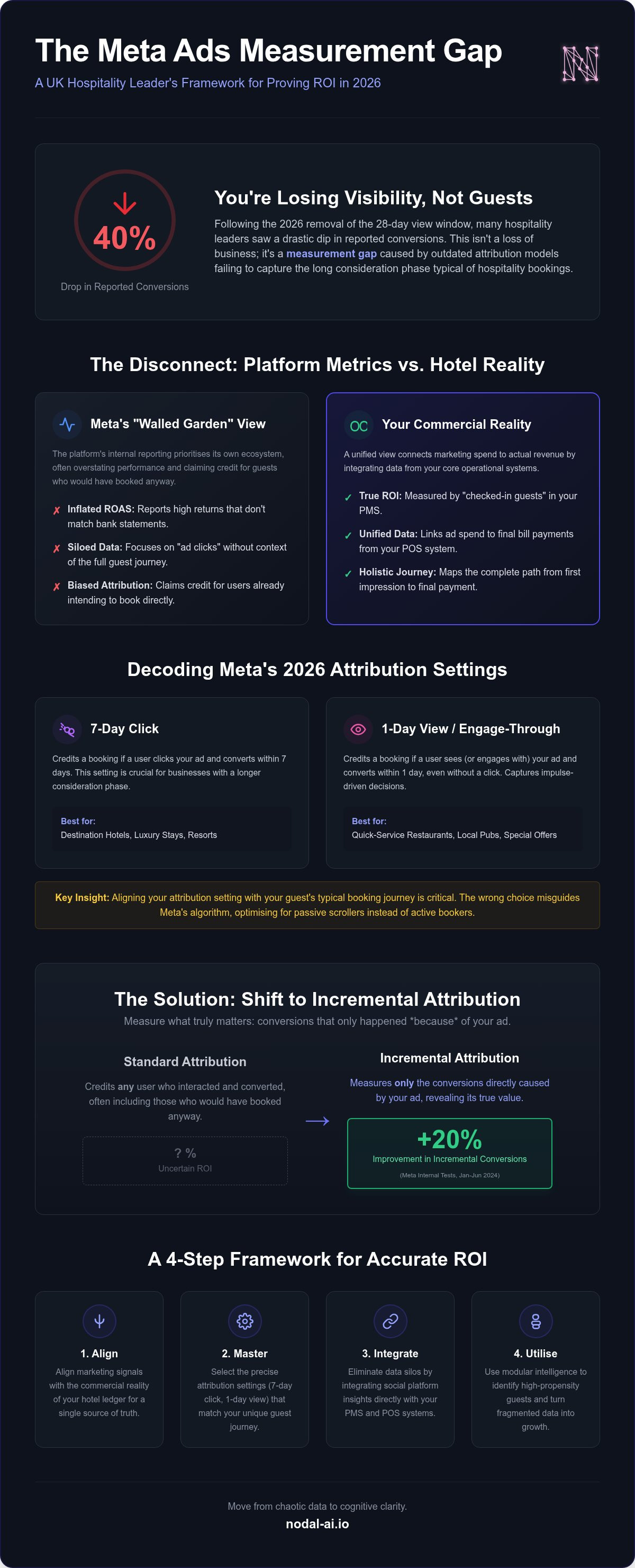
If your reported conversions plummeted by 40% following the permanent removal of the 28-day view window in early 2026, you aren't losing guests; you are simply losing visibility. This measurement gap is the primary frustration for UK hospitality leaders who recognise that standard meta ads attribution often fails to reflect the reality of the hotel ledger. You likely feel the burden of data fragmentation between social platforms and your Property Management System, which makes proving the incremental value of your spend an exhausting, manual struggle.
It is time to replace the anxiety of manual reconciliation with the confidence of streamlined, high-level perspectives. Discover how to move beyond Meta’s internal reporting to achieve a unified, high-fidelity view of your advertising ROI. We will provide a clear framework to reduce acquisition costs and increase direct booking contributions, ensuring your measurement strategy remains robust under the Data (Use and Access) Act 2025. This guide previews the transition from chaotic data points to a cognitive upgrade for your entire organisation, turning passive metrics into active commercial growth.
Key Takeaways
- Align your marketing signals with the commercial reality of your hotel ledger to resolve the complexity of long hospitality booking windows.
- Master the 2026 meta ads attribution landscape by selecting the precise settings required for 7-day clicks and 1-day engage-through views.
- Eliminate data silos by integrating social platform insights directly with your PMS and POS systems to map the entire guest journey.
- Utilise modular intelligence to identify high-propensity guest segments and transform fragmented inputs into clear growth recommendations.
The Fundamentals of Meta Ads Attribution: Why Accuracy Matters in 2026
In the high-stakes world of UK hospitality, your marketing data is either a precision instrument or a costly distraction. At its core, meta ads attribution is the methodology used to credit conversions, such as room bookings or table reservations, to specific ad interactions. It sounds simple; yet, for a hotel or restaurant group, the reality is far more complex. Unlike a low-cost impulse purchase, a luxury stay often involves a weeks-long consideration phase. This extended journey makes Attribution (marketing) a significant hurdle for leaders who need to justify every pound of social spend to their stakeholders.
Relying on fragmented data leads to a dangerous erosion of profit margins. When your reporting suggests a high return on ad spend (ROAS) that does not appear in your bank balance, you are witnessing the gap between statistical modelling and direct tracking. In our privacy-first 2026 landscape, inaccurate data causes brands to over-invest in saturated channels while ignoring the touchpoints that actually drive direct bookings. Precision is no longer a luxury; it is the foundation of a sustainable growth strategy.
Understanding the Role of the Attribution Window
An attribution window defines the timeframe during which Meta can claim credit for a guest's action. Following the 2026 updates, the default setting is now a 7-day click and 1-day view model. This means if a user clicks your ad and books six days later, Meta takes the credit. However, "view-through" credit is more subtle, as it tracks users who saw an ad but did not click. With the Data (Use and Access) Act 2025 tightening consent requirements, traditional tracking has become less reliable. You must now distinguish between a casual browser and a high-propensity guest to protect your acquisition costs.
Why Hospitality Leaders Must Look Beyond Meta Ads Manager
Meta operates as a "walled garden," meaning it prioritises its own ecosystem when assigning value. This creates a natural bias where the platform may claim credit for a guest who was already planning to book directly. There is a frequent disconnect between "ad clicks" reported in a dashboard and "checked-in guests" recorded in your Property Management System (PMS). To resolve this, you must adopt marketing attribution as a holistic business strategy. Mastering meta ads attribution requires moving beyond siloed views to see the complete path from the first impression to the final bill payment.
Decoding Meta’s Attribution Settings: From 7-Day Clicks to 1-Day Views
As of March 2026, Meta's default attribution setting has shifted to a 7-day click, 1-day engage-through, and 1-day view model. This update is more than a technical adjustment; it is a fundamental reconfiguration of how the platform identifies your most valuable guests. For UK hospitality leaders, selecting the wrong setting doesn't just skew your reports. It misguides Meta’s machine learning. If you optimise for 1-day views when your guests typically require a week of research before booking a luxury suite, the algorithm will prioritise passive scrollers over active bookers. This misalignment can fundamentally alter your reported ROAS, often masking a decline in actual guest acquisition.
Your choice of setting must mirror your specific hospitality offering. A high-street quick-service restaurant (QSR) thrives on the 1-day view, capturing the immediate impulse of a lunch-hour search. In contrast, a destination hotel relies on the 7-day click window to account for the research-heavy consideration phase. When you change these settings, you reset the learning phase of your campaigns. This creates a temporary period of instability as the system re-learns which user behaviours lead to a confirmed reservation. To maintain a steady flow of direct bookings, you must align these settings with your guest's natural path to purchase.
Comparing Standard vs Incremental Attribution
Standard attribution credits any user who interacted with an ad within your chosen window. While this provides a high-level view, it often overstates performance by claiming credit for guests who might have booked anyway. Incremental attribution is the strategic solution for 2026. It measures only the conversions that were directly caused by the ad, providing a true reflection of your marketing ROI. Meta’s internal tests between January and June 2024 showed that advertisers using incremental models saw a 20% improvement in incremental conversions. Relying on independent measurement is now essential to distinguish between genuine growth and platform-reported noise.
The Technical Mechanics: CAPI and Advanced Matching
Precision in meta ads attribution now depends on server-side technology. Conversions API (CAPI) is a server-side tool that sends web events directly to Meta for improved data reliability. By bypassing browser-based tracking limitations, CAPI ensures that guest actions are recorded even when cookies are blocked. When paired with advanced matching, which uses hashed guest data to link off-platform actions to social profiles, your data fidelity increases significantly. This technical foundation allows you to move beyond guesswork and start making decisions based on verified guest journeys. You can explore how these tools integrate with your existing stack through our Performance Marketing Analytics features.
The Walled Garden Problem: Why In-Platform Reporting Often Overstates Performance
Meta's reporting exists to justify Meta's budget. This inherent bias means the platform naturally claims credit for organic or direct bookings that would have occurred regardless of your ad spend. When a potential guest sees your ad but chooses to book through a direct search two days later, the 1-day view window often attributes that revenue to the ad. This creates a "walled garden" effect where your dashboard ROAS looks stellar, but your actual bank balance remains stagnant. You are left with an illusion of growth that masks the reality of your guest acquisition costs.
The "last-touch" trap further complicates this picture. In the UK hospitality sector, the path to a reservation is rarely linear. A guest might browse your rooms on a mobile device during a lunch break but wait until they are at a desktop to finalise the booking. Standard meta ads attribution often fails to bridge this cross-device gap, leading you to over-optimise for "cheap" mobile impressions that lack genuine conversion intent. You risk chasing vanity metrics while your high-value segments remain underserved and your profit margins are quietly eroded by misallocated spend.
Identifying Overlap with Other Channels
Data silos between Meta and your other channels, such as Google Ads or email marketing, lead to chronic double-counting. If a guest interacts with an ad on two different platforms, both will claim 100% of that booking value in their respective dashboards. This inflation makes it impossible to see your true acquisition costs. Implementing a multi-touch attribution model is the only way to achieve a unified perspective. It allows you to see how different channels work in harmony rather than competing for unearned credit.
The Impact on Direct Booking Strategy
Inaccurate reporting frequently forces hospitality leaders back into the arms of high-commission OTAs. When you cannot verify the incremental value of your social spend, the perceived safety of an OTA booking becomes tempting, despite the eroded margins. Shift your perspective by leveraging ai marketing analytics to spot the ad sets that actually prevent OTA leakage. By identifying these high-propensity segments, you can protect your direct booking strategy and reclaim your commercial independence.
Building a Unified View: Connecting Meta Ads to Your PMS and POS Systems
Your marketing data is only as good as its connection to your operational reality. While Meta Ads Manager provides a glimpse into user intent, it remains isolated from the actual revenue generated at your properties. To achieve true meta ads attribution, you must break down the silos between your marketing team and your operations. This requires stitching together the guest journey from that first social impression through to the final bill payment using unique identifiers like hashed emails and loyalty IDs. By unifying these disparate sources, you transform passive metrics into high-value commercial intelligence.
This integration allows for a fundamental shift in your Key Performance Indicators (KPIs). You can move beyond the surface-level "Cost per Lead" and start measuring the "Cost per Occupied Room" or "Cost per Cover." This perspective reveals the actual financial performance of your campaigns; it ensures that your budget is allocated to the segments that drive the highest long-term value. It replaces the anxiety of estimated returns with the clarity of verified revenue, allowing you to scale your successes with absolute confidence.
Integrating Operational Data Sources
The bridge to total clarity is built on direct integrations with your Property Management Systems (PMS). Connecting Meta data to platforms like Mews, Cloudbeds, or Oracle OPERA allows you to see exactly which ad interactions resulted in a checked-in guest. For F&B and QSR brands, incorporating Point of Sale (POS) data is equally vital to measure physical footfall and order volume. Throughout this process, maintaining a robust data governance framework is essential to protect sensitive guest information and comply with UK privacy standards.
Leveraging AI for Predictive Attribution
AI-driven analytics move your strategy from reactive reporting to proactive growth. By using predictive modelling, you can forecast future booking trends based on current ad performance and historical patterns. Predictive modelling uses historical data to calculate the likelihood of future guest stays with high precision. This technology identifies high-propensity segments that Meta’s standard algorithm often misses, allowing you to capture demand before your competitors even realise it exists. It is the ultimate cognitive upgrade for your meta ads attribution strategy.
Book a demo to unify your hospitality data
Leveraging Nodal AI to Maximise Meta Ads ROI and Direct Bookings
The complexity of the 2026 digital landscape demands more than just better tracking; it requires a cognitive upgrade for your entire commercial operation. The Nodal Platform serves as a modular intelligence engine, specifically engineered to bridge the gap between Meta’s walled garden and the reality of your hotel or restaurant ledger. By unifying fragmented data from your PMS and social channels, Nodal transforms chaotic inputs into high-value Growth Recommendations. This shift from manual reconciliation to automated clarity allows your team to focus on strategic expansion rather than tedious data entry.
The impact of this unified approach is measurable and immediate. For example, Ovolo Hotels achieved a 24.5% increase in ROAS and a 15.3% reduction in acquisition costs by connecting their disparate data sources through our platform. These results demonstrate that when meta ads attribution is tethered to actual guest stays, your marketing spend becomes a precision instrument for driving direct bookings. You no longer have to guess which campaigns are performing; you have the architectural proof required to scale with confidence.
Transforming Data into Commercial Intelligence
Nodal replaces the anxiety of data fragmentation with the relief of streamlined, high-level perspectives. By consolidating commercial, guest, and operational insights into a single view, we empower hospitality leaders to make more and waste less. Our Performance Marketing Analytics go beyond simple clicks to reveal the true lifetime value of every guest acquired through social channels. This specialisation in hospitality-specific integrations ensures that your Customer Journey Mapping reflects the unique nuances of the UK market, from seasonal booking fluctuations to local privacy regulations.
Next Steps for Your Attribution Strategy
Transitioning to a high-fidelity measurement model requires a structured journey from complexity to growth. Start by following these essential steps to reclaim your marketing ROI:
- Audit your current settings: Identify gaps in your existing meta ads attribution to see where Meta may be overstating organic performance.
- Integrate your systems: Establish a technical roadmap to connect your PMS data directly with your marketing analytics for a unified guest view.
- Automate your reporting: Replace manual spreadsheets with Automated Reporting to ensure your team always has access to real-time commercial signals.
- Cultivate a data culture: Encourage your organisation to move beyond vanity metrics and focus on "Cost per Occupied Room" as your primary success factor.
Ready to see the true impact of your advertising? Book a demo with Nodal AI today
Master Your Commercial Future
The transition from fragmented data to strategic clarity is the defining challenge for hospitality leaders in 2026. Accuracy in meta ads attribution is no longer a technical preference; it is a fundamental requirement for commercial sovereignty. By aligning social signals with your internal property ledger, you eliminate the bias of the walled garden and reclaim your profit margins from high OTA commissions. You deserve a measurement strategy that reflects the true complexity of the guest journey.
Our modular architecture is specifically tailored for the nuances of the hospitality sector. This approach has already empowered brands to achieve a 24.5% increase in ROAS and a 15.3% reduction in acquisition costs. It is time to replace the anxiety of manual reconciliation with the confidence of automated, high-fidelity insights. Take the final step in your cognitive upgrade and turn your marketing spend into a precision instrument for growth.
Book a demo to unify your hospitality data
Your journey toward total transparency starts today. Embrace the clarity of a unified view and lead your organisation with absolute confidence.
Frequently Asked Questions
What is the default Meta Ads attribution setting in 2026?
The default setting for new campaigns in 2026 is a 7-day click, 1-day engage-through, and 1-day view window. This standard, introduced in March 2026, ensures that interactions such as video views of five seconds or more are captured under the engage-through category. It provides a baseline for measuring user intent while reflecting the modern guest's multi-stage research process.
How does the Conversions API (CAPI) improve Meta attribution accuracy?
Conversions API improves data fidelity by sending web events directly from your server to Meta. It bypasses the limitations of browser-based tracking and cookie blocks, which have become more restrictive under the Data (Use and Access) Act 2025. This server-side connection ensures that guest actions are recorded reliably, providing a more stable foundation for your meta ads attribution strategy.
Why does Meta Ads Manager show more sales than my website analytics?
Meta credits any conversion that follows an ad interaction within its window, whereas tools like GA4 typically attribute sales to the final session source. This discrepancy often occurs because Meta can track cross-device journeys that session-based analytics miss. While Meta provides a platform-specific view, it often overstates its individual contribution by ignoring the influence of other marketing channels.
Can I track Meta Ads performance directly in my Property Management System (PMS)?
Standard PMS platforms like Mews or Oracle OPERA do not natively track social ad performance. You must integrate these systems with a modular intelligence engine to link your marketing spend to checked-in guests. This bridge allows you to move beyond estimated leads and see the actual revenue generated at the property level, turning your PMS into an active participant in your marketing evaluation.
What is the difference between 7-day click and 1-day view attribution?
7-day click attribution credits a sale if the guest clicks your ad and converts within a week. In contrast, 1-day view attribution assigns credit if a user simply sees your ad and books within 24 hours without clicking. Choosing the right balance is essential; over-reliance on view-through data can inflate your perceived ROI by claiming credit for guests who were already intending to book.
How can I measure the incrementality of my Meta Ads spend?
Incrementality is measured through lift studies and machine learning models that isolate the conversions caused specifically by your ads. It compares a group of users who saw your ads against a control group who did not. This process identifies the true bookings that would not have happened otherwise, providing a clear perspective on the actual commercial value of your social budget.
What are the benefits of using a multi-touch attribution model for hotels?
Multi-touch attribution provides a unified view of the guest journey by assigning value to every touchpoint, from the initial Meta impression to the final search. It eliminates the problem of double-counting revenue across different platform dashboards. For hospitality brands, this clarity leads to reduced acquisition costs and a more efficient allocation of capital across the entire marketing mix.
How does Nodal AI help with Meta Ads reporting for hospitality brands?
Nodal AI unifies your fragmented social data with operational insights to provide a single, actionable commercial view. Our platform automates the reconciliation process between your meta ads attribution and your property ledger, delivering clear growth recommendations. It replaces the anxiety of manual reporting with the confidence of high-level perspectives, ensuring you make more and waste less on every campaign.


