

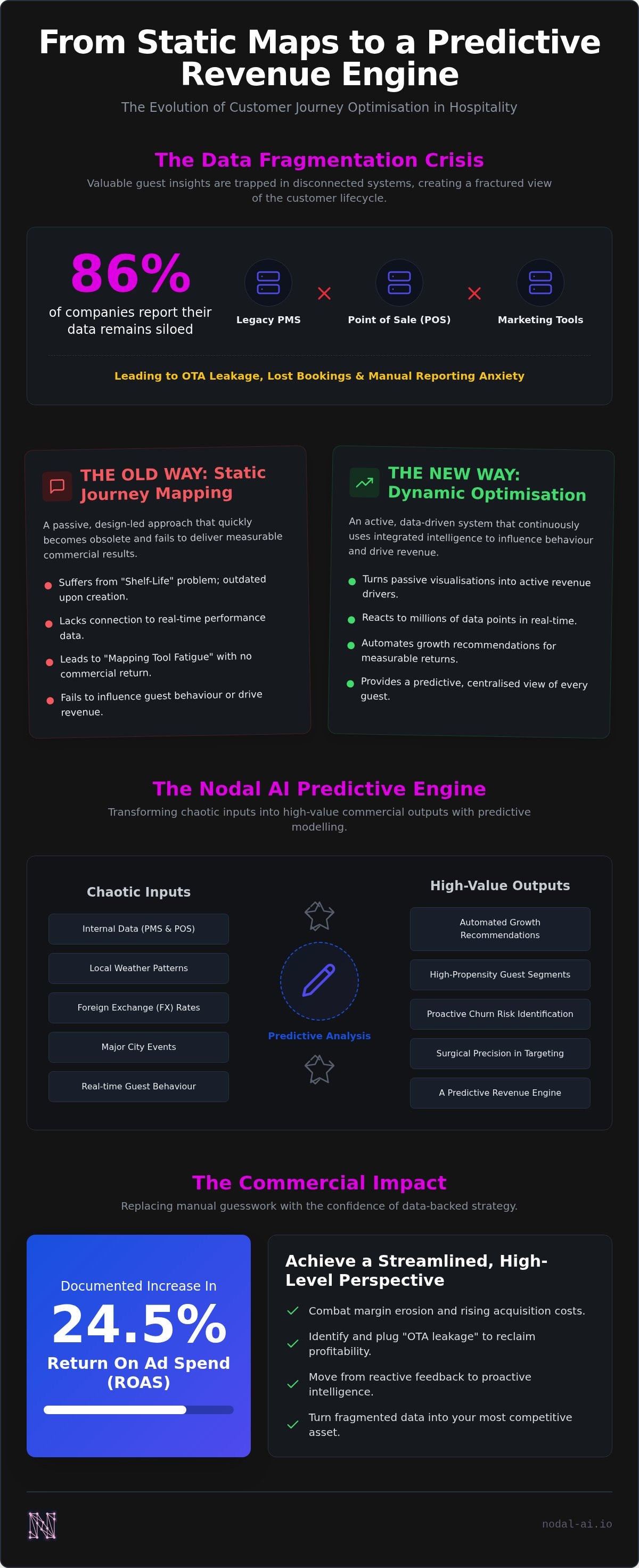
86% of companies using multiple guest experience tools report that their data remains siloed, which leaves them with a fractured and often invisible view of the guest lifecycle. You likely feel the weight of managing legacy PMS and POS systems that refuse to synchronise, leading to expensive OTA leakage and lost direct bookings. It is time to move beyond the anxiety of manual reporting and embrace the clarity of integrated intelligence. By implementing active customer journey optimisation, you can transform chaotic inputs into high-value commercial outputs.
This article provides the roadmap to evolve from static maps to a predictive revenue engine. Learn how to centralise every guest touchpoint into a single, actionable perspective that identifies churn risks before they impact your bottom line. We will explore how the Nodal Platform helps you make more and waste less by automating growth recommendations and delivering a measurable reduction in acquisition costs. Discover how to turn your data into your most competitive asset and achieve the streamlined, high-level perspective your organisation deserves.
Key Takeaways
- Shift your perspective from static journey mapping to dynamic customer journey optimization to turn passive visualisations into active revenue drivers.
- Discover how predictive modelling identifies high-propensity guest segments, allowing you to target revenue opportunities with surgical precision.
- Learn to bridge the gap between fragmented data sources like your PMS and POS to create a centralised, predictive view of every guest.
- Implement a modular intelligence engine to reduce acquisition costs and reclaim margins lost to OTA leakage.
- Move beyond mapping tool fatigue by focusing on automated growth recommendations that deliver measurable commercial returns.
The Evolution of Customer Journey Optimisation
Customer journey optimisation is the continuous process of using integrated data to influence guest behaviour and drive revenue. It marks a fundamental shift in how hospitality brands interact with their audience. For years, businesses relied on static journey mapping to visualise touchpoints. Today, that approach is no longer sufficient. You must move from visualisation to execution. True customer experience management requires a dynamic journey management system that reacts to data in real-time.
We are currently witnessing a "Data Fragmentation" crisis. Valuable guest insights are often trapped in disconnected silos, such as legacy PMS and POS systems. This separation creates a chaotic environment where marketing teams struggle to identify which guest segments are likely to churn. Adopting a modular architecture that connects essential operational and guest-facing systems is no longer a luxury; it is a commercial necessity. In 2026, the industry requires a move toward commercial intelligence rather than simple user experience design. You don't just need to know where your guests are; you need to know how to move them toward a direct booking.
The Limitations of Static Journey Mapping
Static maps are passive assets that fail to reflect the reality of a shifting market. They suffer from a "Shelf-Life" problem: a PDF map is effectively obsolete the moment you export it from a design tool. These visualisations are often design-led and lack a tangible connection to performance marketing data. While they might look impressive in a boardroom presentation, they offer no measurable path to growth. They leave teams with "Mapping Tool Fatigue," where the effort of documentation yields no commercial result. To win, you must replace these frozen diagrams with active, data-driven workflows.
The Commercial Case for Optimisation
Optimisation is the most effective tool to combat margin erosion and rising acquisition costs. By moving beyond static maps, you can identify and plug "OTA leakage" that drains your profitability. A centralised view of every guest touchpoint allows you to reclaim your margins and focus your spend on high-propensity guests. Think of this transition as a "Cognitive Upgrade" for your organisation. By using the Nodal AI platform, you replace manual, tedious analysis with automated growth recommendations. This shift allows you to make more and waste less, turning fragmented data into a predictive revenue engine that delivers a documented 24.5% increase in Return on Ad Spend (ROAS).
The AI Engine: How Predictive Modelling Powers Optimisation
AI acts as the bridge that transforms raw, chaotic inputs into high-value commercial outputs. While traditional systems simply record what happened, a modern modular engine predicts what will happen next. By leveraging predictive modelling, you can identify high-propensity guest segments before they even start their search. This foresight is the core of effective customer journey optimization. It turns passive data into an active revenue participant that works for your bottom line.
Intelligence shouldn't stop at your property's front door. A sophisticated AI engine incorporates external signals such as local weather patterns, FX rates, and major city events into your journey view. This allows you to spot early warning signs of low occupancy periods or sudden churn with surgical precision. You can then adjust your strategy instantly rather than reacting weeks too late. This level of foresight is why customer journey optimization has moved from a design goal to a commercial necessity. It is how you gain a competitive advantage and optimize your customer journeys across every digital touchpoint.
From Reactive Feedback to Proactive Intelligence
Traditional surveys provide a rear-view mirror perspective. They tell you why a guest was unhappy last week, but they don't help you save the booking today. AI-driven behavioural analysis looks at millions of data points in real-time to identify patterns that human analysts would miss in fragmented systems. You move from asking questions to observing actions. This transition from "what happened" to "what will happen next" allows you to intervene in the guest lifecycle at the exact moment it matters most. It replaces the anxiety of manual guesswork with the confidence of data-backed strategy.
Automated Growth Recommendations
The Nodal Platform takes this underlying complexity and simplifies it into actionable steps. It generates tailored growth recommendations automatically, removing the friction from your marketing workflow. You no longer need to spend hours on manual reporting or tedious spreadsheet analysis. This cognitive upgrade allows your team to focus on high-level strategy while the engine handles the heavy lifting. The results are concrete. By following these automated insights, brands have seen a 24.5% increase in Return on Ad Spend (ROAS). It's about working smarter to reclaim your margins. If you want to see how these predictive insights can work for your specific data set, you can book a demo to explore the platform's capabilities.
Mapping vs. Optimisation: Why Visualisations Are Not Results
A map is a picture; management is a process. Too many hospitality teams suffer from mapping tool fatigue. They spend months designing flowcharts that look impressive in boardrooms but fail to influence revenue. True customer journey optimization requires moving beyond the "what" to the "how." In a complex environment where guest data shifts between PMS and POS systems, a static diagram is a liability. You need a live platform that executes strategy, not a dead document that merely describes it.
Enterprise organisations require a modular architecture that bridges the gap between a visualisation and a live data feed. When your journey map is disconnected from your operational reality, it remains a passive asset. It gathers digital dust while your margins continue to erode. By choosing a management platform over a mapping tool, you turn passive visualisations into active participants in your business growth. This shift replaces the anxiety of disconnected data with the confidence of a centralised, high-level perspective.
The Role of Multi-Touch Attribution
Understanding the true path to purchase is impossible without mastering marketing attribution. Journey management platforms solve the "Walled Garden" problem by tracking interactions across every touchpoint, including those outside of standard ad platforms. This data turns a flat journey map into a dynamic commercial dashboard. It provides the clarity to see which interactions actually drive bookings and which are simply noise. This level of transparency is essential for any modern professional who needs results without deep technical specialisation.
Building a Modular Intelligence Engine
A modular approach allows you to scale your journey management as your organisation grows. By connecting Guest, Commercial, and Operational modules, you create a unified view that serves the entire business. This isn't about adding more software; it's about a cognitive upgrade for your existing infrastructure. Follow the "Make more, waste less" principle. Choose tools that integrate directly with systems like Oracle OPERA or Mews. This ensures your customer journey optimization strategy is rooted in operational truth rather than design theory. It creates a sense of frictionless progress, moving you rapidly from complexity to growth.
A Framework for Optimising Complex Hospitality Journeys
Success in customer journey optimization requires a structured approach that moves from technical integration to commercial execution. You cannot build a predictive engine on a foundation of broken data. Follow this five-step framework to transform your hospitality operations into a high-performance revenue driver that replaces manual guesswork with streamlined, high-level perspectives.
- Step 1: Audit your data silos. Identify exactly where guest information is being lost between your PMS and CRM. Transparency is the first step toward resolving the complexity that hampers your growth.
- Step 2: Connect fragmented sources. Unify your POS, booking engines, and web analytics into a single, centralised view. This removes the ambiguity of disconnected touchpoints and provides the clarity your team needs.
- Step 3: Define commercial KPIs. Shift your focus from vague satisfaction scores to concrete metrics like Average Booking Value (ABV) and acquisition costs. This ensures your customer journey optimization efforts deliver a measurable return on investment.
- Step 4: Implement AI-driven segmentation. Use predictive insights to target high-value guest segments with personalised offers. This moves you beyond generic marketing to surgical, high-impact interactions.
- Step 5: Automate reporting and alerts. Configure "Need Period" notifications to alert your team during low occupancy windows. This allows for rapid tactical adjustments that protect your margins during quiet times.
Addressing Data Fragmentation in Hospitality
Building a robust journey view depends on the seamless integration of your core systems. You must connect Oracle OPERA, Mews, Cloudbeds, and Salesforce to ensure no guest interaction goes unrecorded. Handling historical data ingestion correctly is vital; it provides the depth required for accurate predictive modelling by allowing the AI to learn from years of seasonal trends. Robust data governance maintains this clarity over time, preventing the return of chaotic, unreliable inputs. This structured integration turns your passive data into an active participant in your growth strategy, providing a cognitive upgrade for the entire organisation.
Optimising for Direct Bookings
Reclaiming your margins starts with reducing OTA reliance through sophisticated customer journey strategies. You must track the "Direct Booking Contribution" across every digital touchpoint to understand where your profit is actually generated. This transparency allows you to reallocate spend toward the most effective channels, replacing the anxiety of waste with the confidence of efficiency. Consider the results seen by Ovolo Hotels, which achieved a 20% increase in paid search revenue by optimising their journey targeting. By focusing on direct interaction, you replace high commission costs with long-term guest loyalty and significantly improved profitability.
Book a demo to see this framework in action
Nodal AI: Transforming Fragmented Data into Commercial Intelligence
Nodal AI provides the modular intelligence engine required to solve the persistent issues of scale and margin erosion. By unifying your hospitality data, the platform transforms fragmented inputs into clear commercial insights. This represents the ultimate stage of customer journey optimization. It turns your data from a passive archive into an active participant in your business growth. Marketing leaders can finally move from the anxiety of manual labour to the confidence of automated, high-level perspectives. The result is a frictionless, data-driven future where every guest interaction is accounted for and every marketing pound is spent with purpose.
The platform replaces the chaos of disconnected systems with a streamlined cognitive upgrade. While legacy tools leave you guessing which segments will churn, this modular approach provides total clarity. You no longer need to settle for surface-level visualisations that fail to impact your bottom line. Instead, you gain a partner that understands the commercial necessity of connecting journey data to profit margins. This shift allows your organisation to make more and waste less, ensuring long-term stability in an increasingly competitive market.
Hospitality-Specific Solutions
Nodal AI delivers specialised intelligence for sectors that traditional analytics tools often overlook. Whether you manage serviced apartments, hostels, or private members' clubs, the platform adapts to your specific operational needs. By integrating on-property spend data from POS systems, you gain a comprehensive view of guest value that extends far beyond the initial booking. This depth of insight allows you to optimise length-of-stay performance and significantly improve member retention. You can identify the exact behavioural triggers that lead to loyalty, allowing you to replicate success across your entire portfolio with surgical precision.
The Cognitive Upgrade: Next Steps
It is time to move beyond the limitations of spreadsheets and static diagrams. A 15.3% reduction in acquisition costs is not just a goal; it is the standard for success when you embrace automated intelligence. Reclaim the hours lost to manual reporting and redirect your team's energy toward high-level strategy. By implementing the Nodal Platform, you choose a future of measurable returns and operational excellence. You have already seen how customer journey optimization can bridge the gap between fragmented data and revenue growth. Now, it is time to see the technology in action and realise the full potential of your organisation's data.
Book a demo to transform your guest data into a revenue engine
Accelerate Your Path to Data-Driven Growth
Transforming your customer journey optimization from a design exercise into a commercial powerhouse is the most effective way to secure your organisation's future. By replacing static maps with a modular intelligence engine, you move from reactive observation to proactive revenue generation. You've seen how brands like Ovolo Hotels achieved a 24.5% increase in Return on Ad Spend (ROAS) by unifying their data across systems like Oracle OPERA and Salesforce. This isn't just about better analytics; it's a cognitive upgrade that allows you to make more and waste less through automated growth recommendations.
The transition from fragmented silos to a centralised view provides the clarity needed to reclaim your margins and eliminate manual reporting. It's time to turn your guest data into your most competitive asset and achieve the streamlined, high-level perspective you deserve.
Book a demo to transform your customer journey data into commercial intelligence
The future of hospitality belongs to those who master their data. Start your journey toward frictionless progress today and watch your commercial intelligence drive inevitable growth.
Frequently Asked Questions
What is the difference between customer journey mapping and journey optimisation?
Mapping is a static visualisation of touchpoints, while customer journey optimization is the active, continuous process of using live data to influence guest behaviour. While a map describes the current state, optimisation executes strategies to improve it. This shift turns a passive diagram into a functional revenue engine that reacts to real-time market changes rather than gathering digital dust in a PDF document.
How does customer journey optimisation software reduce guest acquisition costs?
The software identifies the specific interactions that lead to direct bookings, allowing you to reduce your reliance on high-commission OTAs. By focusing your performance marketing analytics on high-propensity segments, you eliminate wasted spend on unlikely converters. This surgical approach ensures that every marketing pound is directed toward the most profitable paths, which naturally lowers your overall guest acquisition costs and protects your margins.
Can Nodal AI integrate with legacy Property Management Systems like Oracle OPERA?
Yes, the Nodal Platform is specifically designed to unify data from legacy Property Management Systems like Oracle OPERA alongside modern alternatives like Mews. Our modular architecture acts as a bridge between these disparate sources, including POS and CRM systems like Salesforce. This integration ensures that your historical guest data becomes a valuable participant in your predictive modelling rather than remaining trapped in a disconnected silo.
What role does AI play in predicting future customer journey paths?
AI uses predictive modelling to identify patterns across millions of historical and real-time data points that human analysts would likely miss. It incorporates external signals like local events or FX rates to forecast the most probable next step for a guest. This allows you to move from reactive feedback to proactive intelligence, delivering the right offer at the exact moment a guest is ready to book.
How long does it typically take to see a return on investment from journey optimisation?
Many organisations begin to see measurable results within the first quarter of implementation. The initial return often comes from the relief of resolving complexity; automated reporting replaces hours of manual labour. As the AI engine learns from your specific data sets, the commercial gains from increased direct bookings and improved Return on Ad Spend (ROAS) become increasingly significant and sustainable through consistent customer journey optimization.
Why is data fragmentation the biggest hurdle to effective journey management?
Data fragmentation creates a "blind spot" where guest interactions are lost between disconnected systems like the POS and the booking engine. When your data is siloed, you cannot see the complete guest lifecycle or identify where churn is occurring. Resolving this chaos is the first step toward effective journey management, as a unified view is the only way to generate accurate, actionable commercial insights.
How does predictive modelling help hospitality businesses manage low occupancy periods?
Predictive modelling identifies upcoming "Need Periods" by analysing booking pace against historical trends and external market signals. Once a low occupancy window is detected, the system generates automated growth recommendations to target segments with a high likelihood of visiting during those dates. This allows you to fill rooms proactively rather than resorting to last-minute, margin-eroding discounts that damage your long-term profitability.
Is journey optimisation software only for large hotel chains or can smaller groups benefit?
Smaller groups and independent hospitality brands can benefit significantly from customer journey optimization due to its modular nature. You don't need a massive enterprise budget to start seeing the benefits of a cognitive upgrade. The platform scales with your organisation, allowing you to start by unifying core data sources and adding more complex operational or commercial modules as your portfolio grows.


