

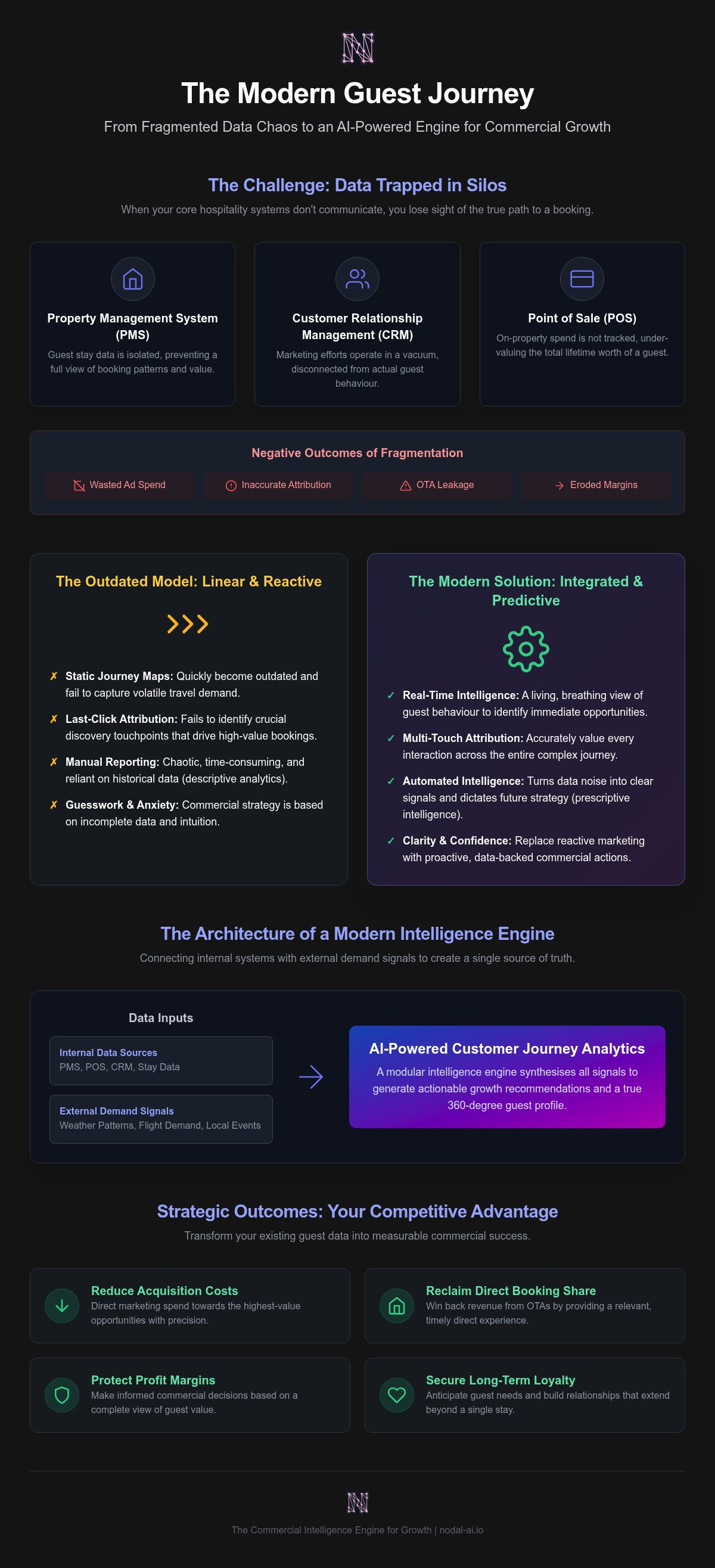
What if your PMS, CRM, and POS systems finally stopped working in isolation and started speaking the same language? For most hospitality leaders, guest data remains trapped in silos, making it nearly impossible to see the true path to a booking. You likely recognise the frustration of wasted ad spend and the anxiety caused by inaccurate marketing attribution. It's a common struggle to predict future guest behaviour when your tools don't talk to each other, often leaving you reliant on expensive third-party platforms that erode your margins.
You deserve a clearer perspective. This guide demonstrates how to harness customer journey analytics to transform fragmented data into a unified, AI-powered engine for growth. By integrating these disparate sources, you can finally reduce acquisition costs and reclaim your direct booking share from OTAs. We will explore the transition from chaotic manual reporting to streamlined predictive modelling, ensuring your commercial strategy is powered by clarity rather than guesswork. Discover how to turn your existing guest data into a competitive advantage that protects your profit and secures long-term loyalty.
Key Takeaways
- Understand why the traditional linear funnel is no longer effective and how to track the true complexity of modern guest interactions.
- Bridge the gap between operational and marketing silos by connecting your PMS with external demand signals, such as weather and flight data.
- Replace failing last-click models with multi-touch attribution to identify the discovery touchpoints that actually drive high-value bookings.
- Utilise a modular intelligence engine to transform chaotic data into automated reporting and actionable growth recommendations.
- Deploy a strategic framework for customer journey analytics to reduce acquisition costs and reclaim your direct booking share.
Understanding Customer Journey Analytics in the AI Era
Stop viewing your guest data as a series of unrelated events. Customer journey analytics provides the lens required to track and analyse every touchpoint a guest shares with your brand, turning chaotic interactions into a coherent narrative. It represents a fundamental shift in how hospitality leaders understand commercial value. The traditional linear funnel has collapsed, replaced by a complex web of digital and physical interactions that defy simple categorisation. By mapping the full customer journey, you move from descriptive analytics, which only recount history, to prescriptive intelligence that dictates future strategy.
In this high-velocity environment, AI is no longer a luxury; it is an essential requirement for processing the sheer volume of data generated by modern travellers. Every search, click, and physical interaction produces a signal. Without automated intelligence, these signals remain noise. By utilising customer journey analytics, you can synthesise these inputs to predict guest needs, optimise pricing in real time, and ensure your marketing spend is directed toward the highest-value opportunities. Explore the advanced features that enable this transition from manual tracking to automated intelligence.
The Evolution from Static Maps to Real-Time Intelligence
Manual journey mapping is a relic of a slower era. These static documents are often outdated before they are even finalised, failing to capture the volatile nature of travel demand. Real-time data ingestion replaces these snapshots with a living, breathing view of your guest behaviour. This allows you to identify immediate booking opportunities as they arise. AI-driven systems go a step further by identifying high-propensity segments before they even reach your website, allowing you to tailor your outreach with surgical precision. This proactive stance replaces reactive marketing with confident, data-backed action.
Why Hospitality Data Fragmentation Makes Analytics Essential
Fragmentation is the silent killer of hospitality margins. When guest data lives in isolated silos, such as the PMS, POS, and CRM, you lose the ability to see a complete profile. This lack of transparency leads directly to OTA leakage, where guests book through third parties because your direct experience lacked relevance or timing. Misinformed decisions based on incomplete guest profiles are expensive; they waste ad spend and erode long-term loyalty. Connecting these disparate sources is the only way to reclaim your direct booking share and ensure your commercial decisions are based on total clarity rather than guesswork.
The Architecture of Modern Journey Analytics: Connecting Siloed Data
Connecting your commercial systems requires more than just basic integration; it demands a modular intelligence engine. Most hospitality brands suffer from a profound disconnect between operational reality and marketing execution. While your PMS knows exactly who is staying and when, your marketing tools often operate in a vacuum. Bridging this gap is the primary goal of customer journey analytics. By centralising these disparate inputs, you move beyond the restricted "walled gardens" of Meta and Google. You take ownership of your first-party data, ensuring that your guest view remains clean, compliant, and commercially viable.
Integrating external signals adds a layer of predictive power that traditional analytics platforms simply cannot match. Weather patterns, flight demand, and local events aren't just background noise; they are active drivers of the guest journey. When you connect these signals to your internal data, you gain the ability to anticipate shifts in behaviour before they even manifest in your booking engine. This level of transparency allows you to view integrated features that turn raw data into high-value commercial intelligence. You replace the anxiety of guesswork with the confidence of a data-backed strategy.
Consolidating PMS, POS, and CRM Data
True clarity arrives when you synchronise stay data from systems like Mews or Oracle OPERA with your marketing spend. This alignment reveals the actual return on your investment across every channel. Tracking on-property spend in your pubs and restaurants is equally vital; it allows you to understand the total value of a guest rather than just the initial room rate. By building a 360-degree guest profile that updates in real-time across all locations, you eliminate the ambiguity that typically plagues multi-site operations. You replace fragmented snapshots with a continuous, actionable stream of guest intelligence.
The Role of Predictive Modelling in Journey Mapping
Predictive modelling is a tool for transforming fragmented data into future growth. By using historical patterns to forecast future demand, you can identify occupancy need periods with high precision and adjust your strategy accordingly. This foresight is particularly valuable for private clubs and wellness centres, where identifying churn risk early can save significant membership revenue. Predictive Modelling: Transforming Fragmented Data into Future Growth offers a deeper look at how these forecasts drive commercial stability. If you are ready to see how these systems work in tandem, you might book a demo to explore your specific data architecture.
Multi-Touch Attribution versus Traditional Journey Tracking
Relying on last-click attribution is like thanking the final door for a guest's arrival while ignoring the entire map that guided them there. For hospitality brands, this outdated model creates a dangerous blind spot by crediting the final booking engine interaction and ignoring the critical discovery phases. Advanced customer journey analytics moves beyond simple tracking to provide a multi-touch attribution (MTA) framework. This approach assigns value to every interaction, from the initial social media inspiration to the final direct booking. By visualising the complete path, you can finally measure incrementality: the proof that your marketing actually drove a booking that would not have occurred otherwise.
This clarity empowers hospitality leaders to make aggressive, data-backed decisions regarding their budget. Instead of over-investing in low-performing OTAs that command high commissions, you can reallocate capital toward high-value direct channels. You stop paying for guests who were already going to book and start investing in the touchpoints that truly influence guest behaviour. This transition from passive observation to active commercial optimisation ensures every pound of marketing spend contributes directly to your bottom line.
Solving the Walled Garden Attribution Problem
Modern privacy barriers and the decline of third-party cookies have turned platform data into "walled gardens" that hide the true guest path. Tracking journeys becomes even more complex when guests search on mobile devices but complete their bookings on desktops. AI-powered intelligence is now required to fill these gaps, stitching together disparate signals to reconstruct the guest path to purchase. By accounting for cross-device behaviour, you gain a transparent view of the journey that remains hidden from standard analytics tools.
Calculating True Marketing ROI and ROAS
Success in the hospitality sector requires a shift from vanity metrics, such as clicks or impressions, to concrete commercial metrics. Focus on bed yield, average booking value, and total guest lifetime value rather than surface-level engagement. Consider the impact of sophisticated attribution: Ovolo Hotels achieved a 24.5% increase in ROAS by identifying and doubling down on the touchpoints that actually converted. For a deeper dive into these strategies, read our guide on Mastering Marketing Attribution: The Definitive Guide for 2026. This level of precision transforms your marketing from a cost centre into a powerful engine for revenue growth.
Implementing a Data-Driven Journey Strategy for 2026
Moving from fragmented data to strategic clarity requires a structured implementation programme. You cannot build a predictive engine on a foundation of broken data. To thrive in 2026, hospitality leaders must adopt a rigorous five-step framework that aligns technical infrastructure with commercial objectives. This process begins with a comprehensive technical audit of every data source within your ecosystem. By defining commercial KPIs that bridge the gap between marketing spend and operational success, you ensure that your customer journey analytics strategy delivers measurable returns rather than just surface-level engagement.
Selecting the right modular tools is the final piece of the puzzle. As your portfolio grows, your analytics must scale without adding unnecessary complexity. A modular approach allows you to integrate specific features as needed, ensuring you only pay for the intelligence that drives growth. This transition ensures that your investment in customer journey analytics remains focused on immediate value and long-term stability. It replaces the anxiety of technical debt with the confidence of a future-ready organisation that treats data as its most valuable commercial asset.
Auditing Your Current Data Silos
Data fragmentation is often the result of legacy systems that were never designed to communicate. You must identify exactly where guest data is trapped, whether it is buried in the booking engine, the front desk logs, or the restaurant POS. Assessing the quality of your current CRM data is vital; inaccurate records lead to misinformed marketing and wasted spend. Determine which external signals, such as local event schedules or flight demand, are most relevant to your specific sector to ensure your data ecosystem is as comprehensive and actionable as possible.
Identifying High-Propensity Guest Segments
AI-driven segmentation allows you to focus your resources on the guests most likely to book direct. By analysing historical patterns, you can identify high-propensity segments and customise their journey accordingly. This level of personalisation is essential across all hospitality models, from budget-friendly hostels to upscale fine-dining establishments. For a deeper exploration of this process, consult The Definitive Guide to the Customer Journey: Mapping for Profitable Growth in 2026. Understanding these segments ensures your marketing feels like a conversational partner rather than a generic broadcast.
Book a demo to start your technical audit
Nodal Platform: The Commercial Intelligence Engine for Growth
The Nodal Platform acts as a cognitive upgrade for your entire organisation, transforming chaotic data inputs into high-value commercial intelligence. While traditional tools often stop at descriptive reporting, our modular engine provides actionable growth recommendations that actively protect your profit margins. By centralising your commercial assets, you replace the anxiety of manual data extraction with the confidence of automated, real-time perspectives. This is the ultimate evolution of customer journey analytics; it moves beyond simple observation to become an active participant in your business success.
Efficiency is the hallmark of the Nodal experience. For London-based enterprises managing complex portfolios, the platform is already delivering significant operational relief by saving teams over 20 hours a week through automated reporting. This recovered time allows your commercial leaders to focus on high-level strategy rather than tedious spreadsheet management. You transition from a state of data overwhelm to a position of streamlined, high-level control, ensuring every decision is backed by a unified view of the guest path.
Hospitality-Specific Modules and Integrations
Our architecture is built specifically for the nuances of the hospitality sector, featuring modular components that cover Guest, Commercial, Demand, and Operational data. This modularity ensures you only invest in the specific insights your business requires to scale. We maintain seamless integrations with industry leaders like Oracle OPERA, Mews, and Synxis, allowing you to synchronise your entire tech stack instantly. Check out our full list of features to see how we connect your hospitality assets to a single source of truth.
Make More, Waste Less: The Nodal Philosophy
The Nodal philosophy is simple: help hospitality brands balance occupancy with aggressive direct revenue growth. We empower hotels to reclaim their margins from third-party platforms while helping pubs and bars drive traffic by understanding specific trading periods with total clarity. This approach ensures you maximise every opportunity while minimising wasted marketing spend. You stop guessing and start growing with a partner that understands the pressure of modern commercial environments. Ready to transform your data? Book a demo with Nodal AI today to see our platform in action and secure your commercial future.
Secure Your Commercial Future with Integrated Intelligence
The transition from chaotic, siloed systems to a unified view of guest behaviour is no longer optional for hospitality brands seeking sustainable growth. By implementing sophisticated customer journey analytics, you replace the anxiety of manual reporting with the clarity of automated, high-value insights. You now understand how connecting operational data with external demand signals can protect your margins and reclaim your direct booking share from third-party platforms.
As a winner of the Performance Marketing Awards, Nodal AI provides a specialised hospitality modular architecture designed to solve the industry's unique data challenges. Our partners have already realised significant commercial returns; including a 15.3% reduction in acquisition costs. This is your opportunity to transform your data from a passive asset into an active participant in your business success.
Book a demo to see how Nodal AI can consolidate your hospitality data
Take the first step toward total commercial clarity and watch your organisation thrive in the new era of predictive intelligence.
Frequently Asked Questions
What is the difference between customer journey mapping and customer journey analytics?
Customer journey mapping is the static visualisation of a guest's path, whereas customer journey analytics is the real-time, data-driven analysis of every actual touchpoint. Mapping provides a theoretical framework for guest interactions; analytics provides the hard evidence of how guests truly behave. By using analytics, you move beyond guesswork and start making commercial decisions based on live data streams from your PMS and digital channels.
How does customer journey analytics help reduce OTA commission costs?
This technology identifies exactly where guests exit your direct booking funnel to complete their purchase on a third-party site. By pinpointing these "leakage" points, you can deploy targeted interventions to incentivise direct bookings. This precision allows you to reclaim your margins and has been proven to deliver a 15.3% reduction in acquisition costs for enterprise hotel groups. It ensures you only pay commissions when absolutely necessary.
Can Nodal AI integrate with my existing PMS and POS systems?
Yes, the Nodal Platform is designed to integrate seamlessly with industry-leading hospitality systems, including Oracle OPERA, Mews, and Synxis. Our modular architecture bridges the gap between your operational data and your marketing platforms. This synchronisation ensures that stay data and on-property spend are automatically reflected in your commercial intelligence, providing a unified view of guest value across your entire portfolio without manual data entry.
Is customer journey analytics compliant with GDPR and data privacy laws?
Privacy is a fundamental component of modern customer journey analytics. The Nodal Platform prioritises first-party data strategies, ensuring all guest interactions are tracked in a transparent and compliant manner. By moving away from third-party cookies and focusing on owned data, you protect your organisation from the risks associated with evolving privacy regulations. This approach builds guest trust while maintaining the high-level granularity required for effective marketing attribution.
How long does it take to see results from implementing journey analytics?
Most hospitality brands begin to see actionable insights within the first few weeks of data consolidation. While initial technical audits and system integrations happen quickly, the most significant commercial returns usually manifest within three to six months. During this period, the AI-powered engine identifies patterns that allow for the optimisation of ad spend, typically resulting in measurable improvements such as a 24.5% increase in ROAS.
Do I need a dedicated data science team to use the Nodal Platform?
No, you don't need deep technical specialisation to benefit from our intelligence engine. We designed the Nodal Platform to be accessible for commercial directors and marketing managers who require high-level perspectives without the complexity of manual data processing. The system automates the heavy lifting of data science, providing clear growth recommendations and automated reporting that allow your existing team to focus on strategic execution.
How does AI improve the accuracy of my marketing attribution?
AI bridges the visibility gaps created by cross-device behaviour and "walled garden" privacy barriers. Traditional models often lose track of a guest when they switch from a mobile search to a desktop booking. Our AI-driven multi-touch attribution reconstructs these fragmented paths, assigning accurate value to every interaction. This ensures you recognise the true discovery touchpoints that drive bookings, preventing the overvaluation of the final click.
Which hospitality sectors benefit most from journey analytics?
Any sector with complex guest paths and fragmented data silos will see significant value. This includes multi-site hotel groups, upscale restaurant collections, and membership-based organisations like private clubs or wellness centres. Whether you are balancing room occupancy or tracking trading periods for a pub estate, the ability to connect operational data with guest behaviour provides a cognitive upgrade that protects your margins and fuels long-term commercial stability.


