

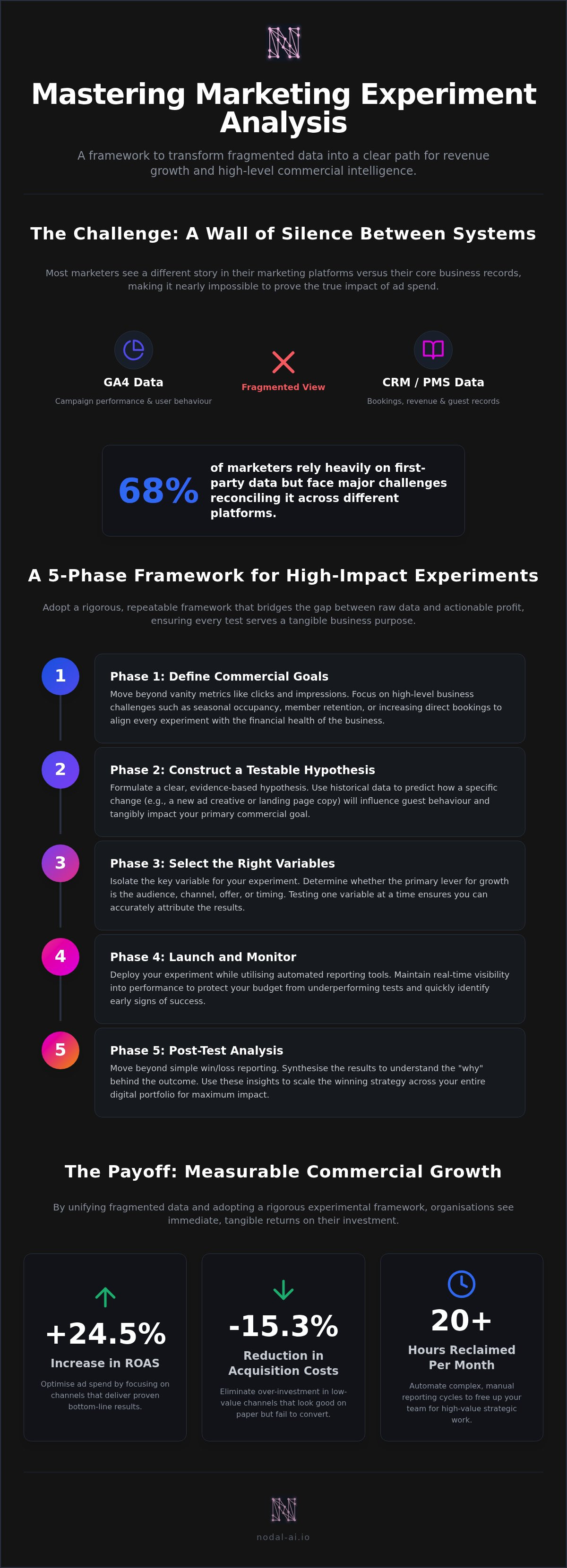
68% of marketers now rely heavily on first-party data, yet the majority still face a wall of silence when trying to reconcile GA4 with their internal CRM or PMS systems. You likely recognise the frustration of seeing a successful campaign in one dashboard only to find a completely different story in your core business records. It's nearly impossible to prove the true incrementality of your ad spend when your data is fragmented. Slow manual reporting cycles only delay your most critical decisions. This guide will show you how to master marketing experiment analysis to transform those chaotic inputs into high-value growth signals.
You deserve the confidence that comes from a streamlined, high-level perspective on your performance. We will provide a repeatable framework for analysis that replaces the anxiety of manual tasks with predictive intelligence and clear ROI reporting. By the end of this article, you will understand how to bridge the gap between disjointed data sources and a faster path to revenue growth, ensuring your organisation remains competitive and forward-thinking in a privacy-first landscape.
Key Takeaways
- Transition from gut-feeling decisions to high-level commercial intelligence by adopting a rigorous framework for marketing experiment analysis.
- Prioritise commercial goals over isolated marketing metrics to ensure every hypothesis is tethered to tangible business growth and revenue.
- Avoid the "last-click" trap and the distortion of walled gardens by unifying fragmented data from your CRM and PMS for a single version of truth.
- Enhance the accuracy of your insights by integrating external signals such as local events and currency fluctuations into your predictive modelling.
- Automate complex reporting cycles to reclaim over 20 hours per month while scaling your ability to generate actionable growth recommendations.
The Evolution of Marketing Experiment Analysis in a Fragmented Landscape
Marketing experiment analysis is the process of using statistical methods to evaluate the performance of different marketing variables. In 2026, this discipline has evolved from a luxury for data scientists into a core requirement for commercial survival. The era of relying on "gut-feeling" or superficial metrics like click-through rates is over. Modern commercial intelligence demands a shift toward rigorous, evidence-based decision-making that connects every digital interaction to a concrete financial outcome.
For those in the hospitality and F&B sectors, traditional analysis often hits a wall. Disconnected systems create a barrier to clarity. When your Property Management System (PMS) or Point of Sale (POS) data remains siloed from your marketing platforms, you lose the ability to see the full picture. This fragmentation slows down your decision-making and erodes profit margins. You cannot optimise what you cannot accurately measure. Marketing experimentation provides the structure needed to bridge these gaps, but only if the data feeding the analysis is unified and reliable.
Why Static Reporting is No Longer Enough
Descriptive reporting tells you what happened; it is a rearview mirror view of your performance. It shows you that bookings dropped or revenue rose, but it fails to explain the underlying "why." Marketing experiment analysis moves beyond these static observations by isolating variables to identify true growth drivers. Fragmented data sources often create blind spots in the customer journey, making it appear as though a guest appeared out of thin air. AI now plays a critical role in resolving this complexity. It acts as a cognitive upgrade, transforming raw, chaotic data into actionable growth recommendations by identifying patterns that manual reporting would inevitably miss.
The Commercial Cost of Inaccurate Analysis
Poor analysis is expensive. It leads to over-investment in low-value channels that look good on paper but fail to deliver bottom-line results. In hospitality, this often manifests as significant OTA leakage. If you cannot properly track the contribution of your direct booking experiments, you risk handing over a larger share of your margin to third-party platforms. Moving toward a "single view" of performance is no longer optional. Organisations that integrate their analytics see immediate returns. For instance, by unifying fragmented data, some hospitality brands have achieved a 15.3% reduction in acquisition costs and a 24.5% increase in ROAS. You can explore how to achieve these results through the features of the Nodal Platform, which unifies Oracle OPERA, Mews, and GA4 into a single intelligence engine. Stop guessing and start growing by securing a bespoke demo today.
A Step-by-Step Framework for High-Impact Marketing Experiments
Execution without a roadmap is merely noise. To achieve true commercial clarity, your organisation must adopt a rigorous, five-phase framework that bridges the gap between raw data and actionable profit. This structured approach to marketing experiment analysis ensures that every test you run serves a higher purpose than just increasing vanity metrics.
The framework follows a logical progression toward growth:
- Phase 1: Defining commercial goals. Move away from vanity metrics and focus on the financial health of the business rather than just marketing-specific targets.
- Phase 2: Constructing a testable hypothesis. Use historical data to predict how a specific change will influence guest behaviour or purchase intent.
- Phase 3: Selecting the right variables. Identify whether the audience, channel, offer, or timing is the primary lever for your next growth spurt.
- Phase 4: Launching and monitoring. Utilise automated reporting tools to maintain real-time visibility and protect your budget from underperforming tests.
- Phase 5: Post-test analysis. Synthesise the results to scale the winning strategy across your entire digital portfolio.
Setting Measurable Growth Goals
Aligning your experiments with high-level business challenges, such as seasonal occupancy or member retention, is the first step toward meaningful results. You must look beyond surface-level indicators like click-through rates, which often mask the true value of a campaign. Instead, focus your efforts on KPIs that directly impact the bottom line, such as average booking value and long-term customer value (LTV). This shift in focus ensures that your marketing efforts are viewed as a profit centre rather than a cost. A winning experiment is one that delivers statistically significant profit growth.
Designing the Test Architecture
Precision in your test design is what separates a visionary leader from a lucky amateur. You must establish clear control and treatment groups, especially in multi-channel environments where different touchpoints can overlap and confuse the results. Determining the correct sample size and statistical power is essential to avoid the trap of false positives, which can lead to costly strategic errors. Integrating predictive modelling allows you to forecast potential outcomes before you commit significant budget to a new campaign. While many teams rely on basic A/B testing to compare two versions of a landing page, high-impact experimentation requires a more holistic approach that accounts for the entire customer journey. You can begin this journey by booking a personalised demo to see how unified data transforms your experimental output.
Beyond A/B Testing: Identifying the Pitfalls of Traditional Analysis
Relying solely on basic A/B testing is a dangerous simplification in today's complex commercial environment. While comparing two versions of a creative asset provides some insight, it often ignores the underlying systemic issues that skew your results. True marketing experiment analysis requires you to look beyond the surface and identify the structural traps that lead to overconfident, yet incorrect, conclusions.
One of the most persistent hurdles is the "Last-Click" Trap. Traditional attribution models often credit the final touchpoint with the entire conversion value, which systematically undervalues top-of-funnel experiments designed to build brand awareness. Additionally, the "Walled Garden" effect of platforms like Meta and Google Ads creates fragmented data silos. These platforms report success within their own ecosystems, often ignoring how their ads interact with other channels. Without a unified view, your analysis will suffer from double-counted conversions and inflated ROI figures. You must also guard against the allure of vanity metrics. High engagement rates or click-throughs are meaningless if they do not translate to bottom-line revenue or increased occupancy. Finally, manual reporting introduces significant human bias into the process. We naturally look for data that confirms our existing beliefs, often overlooking the subtle signals that indicate a failed experiment.
The Limitations of Standard Attribution
To achieve accuracy, marketing attribution must be multi-touch. This approach allows you to identify the "halo effect" of brand awareness campaigns, where an initial social media interaction leads to a direct booking weeks later. By mapping the true path from first touch to final transaction, you gain a high-level perspective on which experiments actually drive long-term value rather than just temporary spikes in traffic. This clarity is essential for any organisation looking to move from chaotic inputs to high-value outputs.
Avoiding Statistical Noise in Clean Data
Even the most sophisticated analysis will fail if the underlying data is compromised. You must proactively identify and remove outliers, such as bulk corporate bookings or seasonal anomalies, that can skew your experimental results. Maintaining this level of integrity requires a robust data governance framework. By ensuring clean, integrated inputs from the start, you replace the anxiety of guesswork with the confidence of strategic clarity. This foundation allows the Nodal Platform to deliver the precise growth recommendations your organisation needs to stay ahead of the competition.
Integrating External Signals for More Accurate Experimental Insights
Internal data provides a narrow view of your commercial performance. To truly master marketing experiment analysis, you must account for the world outside your own dashboards. In the hospitality and travel sectors, guest behaviour is rarely isolated from environmental and economic shifts. If your analysis ignores these external forces, you risk misattributing success or failure to the wrong variables.
External factors act as the silent drivers of demand. Weather patterns, currency fluctuations, and local events can either amplify or suppress the results of a marketing test. For instance, flight demand and tourism trends directly influence booking propensity regardless of your ad creative. AI now allows us to weigh these external signals against marketing performance, ensuring that your conclusions are based on reality rather than statistical noise.
The Power of Contextual Analysis
Contextual awareness transforms raw data into strategic intelligence. Consider a PPC experiment for a luxury resort during a period of unexpected bad weather. Without accounting for the climate, your marketing experiment analysis might suggest that the campaign failed. In reality, the external conditions simply suppressed immediate intent. Similarly, FX rates dictate the efficiency of your international ad spend. When a domestic currency weakens, international booking trends often spike, making a standard campaign look like a stroke of genius. Identifying "need periods" requires you to overlay local event data with your current occupancy. This allows you to launch experiments exactly when the market is most receptive, rather than wasting budget during periods of natural saturation.
Book a demo to see how external signals drive your growth
Building a Single View of the Guest
Achieving total clarity requires you to consolidate data from your PMS, POS, and CRM systems. This integration allows you to understand the full value of a guest, from their initial digital search to their final on-property spend. Mapping the customer journey across both digital and physical touchpoints reveals the hidden connections between marketing experiments and actual revenue. By using audience segmentation, you can target high-propensity guests based on the very external signals that influence them most. This proactive approach replaces the anxiety of manual reporting with the confidence of a cognitive upgrade, ensuring your organisation remains obsessed with measurable, long-term returns.
Scaling Experimental Intelligence with the Nodal AI Platform
The Nodal Platform is the definitive bridge between fragmented operational data and actionable commercial growth. It functions as a modular intelligence engine specifically designed for the hospitality sector, replacing the overwhelm of manual data entry with the confidence of automated precision. By centralising inputs from your Property Management System (PMS) and Customer Relationship Management (CRM) tools, Nodal transforms your passive data assets into active participants in your business strategy. This allows your team to master marketing experiment analysis without the typical administrative burden that plagues traditional marketing departments.
Manual reporting cycles often delay decision-making by days or even weeks, leading to missed opportunities in fast-moving markets. Nodal automates these complex processes, saving marketing teams over 20 hours per month. This reclaimed time allows for a sharper focus on high-level strategy rather than tedious spreadsheet management. The impact of this efficiency is both measurable and significant. For example, Ovolo Hotels achieved a 24.5% increase in ROAS by leveraging these automated insights to refine their digital spend. This is the reality of turning chaotic data into a clear, high-value roadmap for revenue growth.
Modular Intelligence for Hospitality
You can configure the Nodal engine to suit your specific organisational needs using the specialised Operational, Demand, and Guest modules. This flexibility ensures that your intelligence stack is as unique as your business model. The platform integrates seamlessly with industry-standard systems such as Oracle OPERA, Mews, and SevenRooms, creating a unified ecosystem that eliminates data silos once and for all. You can explore the Nodal Platform features to see how this modular architecture unifies your existing data stack into a single, high-performance source of truth that is both enterprise-ready and approachable.
From Analysis to Action
Analysis is only valuable if it leads to immediate, profitable action. Nodal uses AI-driven insights to optimise your paid search and social spend in real-time, ensuring your budget is always directed toward the highest-propensity guests. This proactive approach has led to a 15.3% reduction in acquisition costs for our hospitality partners while simultaneously increasing the average booking value. By removing the guesswork from your marketing experiment analysis, you ensure every pound spent is a strategic investment in proven growth. Moving from manual testing to automated experimental intelligence is the most effective way to secure your organisation's future in a data-driven world.
Stop settling for fragmented insights and start building a scalable engine for growth. You can take the first step toward total commercial clarity by booking a bespoke demo of the Nodal Platform today.
Future-Proof Your Growth with Automated Intelligence
The transition from fragmented data silos to unified intelligence is the defining shift of 2026. By integrating external signals like weather and FX rates into your marketing experiment analysis, you remove the ambiguity that traditionally plagues hospitality reporting. You replace the anxiety of manual spreadsheets with the calm efficiency of automated insights, ensuring every pound spent drives measurable profit. It's how our partners have already realised significant gains, including a 15.3% reduction in acquisition costs and a 24.5% increase in ROAS through bespoke hospitality data integrations.
The path from chaotic inputs to high-value growth recommendations is now clear. You've got the framework to identify true incrementality and the tools to scale your success across every channel. It is time to stop guessing and start leading with a platform built for the complexities of modern commerce. Embrace the relief of total clarity and position your brand as a visionary leader in your sector.
Book a demo of the Nodal Platform to see how we unify your marketing data
Frequently Asked Questions
What is the difference between A/B testing and marketing experiment analysis?
A/B testing is a tactical comparison of two variables, whereas marketing experiment analysis is the strategic process of evaluating performance across the entire commercial landscape. While a simple test might tell you which button colour converts better, a comprehensive analysis connects that interaction to long-term profitability. It integrates data from your PMS and CRM to reveal how specific changes influence the total guest journey.
How do I ensure my marketing experiments are statistically significant?
You ensure statistical significance by calculating the required sample size and confidence level before launching your test. This prevents "false positives" caused by small data sets or temporary spikes in traffic. Maintaining a rigorous control group is essential for isolating the true impact of your variables. By following this structured approach, you can be certain that your results are caused by your strategy rather than random chance.
Why is my marketing data different across various platforms?
Data discrepancies occur because different platforms use unique attribution models and tracking methodologies. For example, GA4 might use a data-driven model while your internal CRM records only final bookings. Fragmented data silos between Meta, Google, and your PMS often lead to double-counting conversions. Unifying these sources into a single source of truth is the only way to resolve these conflicts and achieve total clarity.
How can I track the impact of external factors like weather on my marketing ROI?
Track external factors by overlaying environmental data sets with your campaign performance records. You can use integrated systems to automatically ingest weather reports, currency exchange rates, or local event calendars. This contextual layer allows you to see if a drop in ROI was caused by a specific ad or simply a period of unexpected bad weather in your target market, providing a much fairer assessment of performance.
What are the most important metrics to track in hospitality marketing experiments?
The most critical metrics in hospitality experiments are Average Booking Value (ABV), Net Revenue Per Available Room (NetRevPAR), and Customer Lifetime Value (LTV). While click-through rates provide early signals, they don't always translate to bottom-line profit. Focus on tracking direct booking contributions to identify experiments that reduce your reliance on high-commission OTA channels and improve your overall margin.
How often should I run marketing experiments to see consistent growth?
Run experiments continuously to maintain a steady path toward revenue growth. High-performing teams often have multiple tests running simultaneously across different stages of the funnel. However, the exact frequency depends on your traffic volume; you must allow each test enough time to reach statistical significance. Aim for a consistent rhythm of testing, analysing, and scaling to keep your strategy competitive and forward-thinking.
Can AI help automate the analysis of my marketing experiments?
AI is the primary tool for automating marketing experiment analysis in complex data environments. It identifies subtle patterns across fragmented systems that manual reporting would inevitably miss. By using predictive modelling, these platforms transform chaotic inputs into clear growth recommendations. This cognitive upgrade allows your organisation to scale its intelligence without increasing the administrative workload on your marketing team.


