

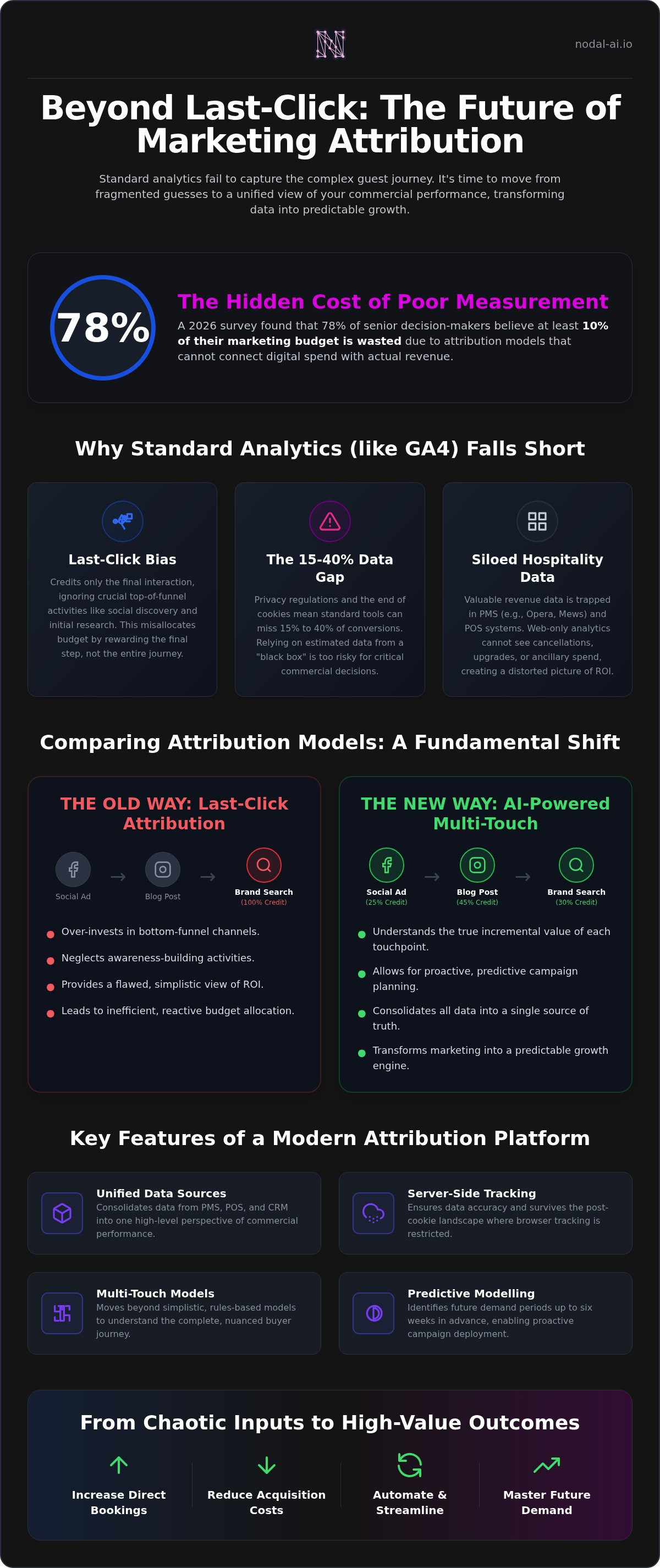
A 2026 survey of senior decision-makers found that 78% believe at least 10% of their marketing budget is wasted due to poor measurement. You likely feel this frustration every time you open a report that credits a single, final click for a complex, multi-week guest journey. If your current data feels like a collection of fragmented guesses, it's time to find a google analytics alternative for marketing attribution that prioritises commercial reality over platform bias.
Standard analytics tools often fail because they cannot see inside your PMS or POS systems, leaving you with inaccurate ROI and high commission costs from OTAs. We'll show you how to trade this manual complexity for streamlined, high-level perspectives. Discover why the most successful hospitality brands are moving beyond last-click models to embrace a single view of the guest journey. This article explores how to integrate your siloed data, reduce acquisition costs, and use predictive insights to master future demand periods with absolute confidence.
Key Takeaways
- Recognise why GA4’s last-click bias fails to capture the complexity of modern guest journeys and how this hidden data gap impacts your ROI.
- Evaluate the essential features of a google analytics alternative for marketing attribution, focusing on server-side tracking and multi-touch models.
- Discover how to unify fragmented data from PMS and CRM systems into a single, high-level perspective of your commercial performance.
- Learn how to leverage predictive modelling to reduce acquisition costs and increase direct bookings during critical demand periods.
- Map out a strategic transition to an AI-first platform that turns chaotic inputs into high-value growth recommendations.
Why GA4 Falls Short for Marketing Attribution in 2026
Marketing attribution is the strategic process of identifying which specific touchpoints contribute to a final conversion. In 2026, this task has become increasingly complex as guest journeys span multiple devices, platforms, and offline interactions. While Google Analytics 4 (GA4) remains a common starting point, many hospitality and F&B leaders now realise its architectural limits. The platform often functions as a walled garden, prioritising its own channels while struggling to provide a transparent view of the full customer journey. This lack of clarity is why brands are actively seeking a google analytics alternative for marketing attribution that can bridge the gap between digital clicks and physical revenue.
Privacy regulations and the retirement of various tracking APIs in late 2025 have further eroded standard tracking accuracy. Current research indicates that the data gap between GA4 and actual platform conversions can range from 15% to 40% depending on your audience's privacy settings. Relying on a "black box" model that fills these gaps with estimated data is no longer sufficient for high-stakes commercial decisions. You need a system that offers total transparency and integrates directly with your core operational platforms to ensure every pound spent is accounted for.
The Problem with Last-Click Bias
Most standard analytics setups default to last-click or Google-biased data-driven models. These frameworks often ignore the early awareness stages of the customer journey, such as social discovery or initial research phases. When you only credit the final interaction, you risk over-investing in brand search terms that users would have clicked anyway. This creates a cycle of inefficient spending where top-of-funnel discovery is neglected because it isn't "proving" its value. Last-click bias is a structural flaw that misallocates marketing budgets by rewarding the messenger rather than the architect of the sale.
Fragmented Data: The Hospitality Challenge
In the hospitality sector, the most valuable data is often trapped in legacy silos like Oracle OPERA, Protel, or Mews. GA4 cannot naturally see this information, meaning your marketing data never truly meets your actual revenue data. Web-only analytics fail to account for the full guest lifecycle, including cancellations, room upgrades, or ancillary spend at the bar. For QSR and physical locations, tracking footfall remains a significant hurdle for standard tools. This fragmentation leads to a distorted view of ROI, where a booking might appear successful online even if the guest never checks in. Transitioning to a dedicated google analytics alternative for marketing attribution allows you to unify these disparate sources into a single, high-value intelligence engine.
Essential Features of a Modern Attribution Alternative
Finding a google analytics alternative for marketing attribution requires looking beyond simple tracking pixels. You need a system that survives the post-cookie landscape by employing server-side tracking. This approach ensures data remains accurate even as browsers restrict third-party cookies, providing a stable foundation for your reporting. Adobe explains marketing attribution as a way to understand the complete buyer journey, which is why multi-touch attribution (MTA) is now a baseline requirement for any serious enterprise. A modern platform must also be modular; it should adapt to your specific operational needs rather than forcing you into a generic marketing template. By integrating external signals like flight demand and local event schedules, your data becomes a proactive asset rather than a reactive record of past clicks.
Multi-Touch Attribution and Predictive Modelling
Simple rules-based models often fail because they rely on rigid assumptions about which channel won the sale. Moving toward AI-driven predictive modelling allows you to see the true incremental value of every touchpoint. These insights empower marketing teams to identify future need periods up to six weeks in advance. Instead of reacting to low occupancy when it's too late, you can deploy targeted campaigns to capture demand before it evaporates. This shift from manual observation to automated foresight transforms your marketing from a cost centre into a predictable growth engine.
Consolidating Disparate Data Sources
True commercial intelligence requires a bridge between your digital spend and your physical revenue. You must consolidate data from your Property Management System (PMS), Point of Sale (POS), and CRM into a single view. The Nodal Platform features modular integrations that pull these fragmented sources together. This consolidation is vital for reducing OTA leakage; when you understand the direct booking path, you can optimise your spend to bypass high-commission third parties. By turning passive operational data into active participants in your business strategy, you gain total clarity over your guest lifecycle. To see how this unified view could work for your organisation, explore our platform capabilities during a live walkthrough.
Comparing Attribution Models: Moving Beyond Last-Click
Selecting a google analytics alternative for marketing attribution requires a fundamental shift in perspective. You are no longer just tracking digital clicks; you are mapping the cognitive journey of your guests across multiple platforms. A sophisticated framework identifies vital customer touchpoints and evaluates them through the lens of incrementality. This concept has become the gold standard for ROI calculation in 2026 because it measures the bookings that would not have occurred without your specific marketing intervention. By focusing on incremental lift, you stop paying for conversions that were already guaranteed through brand strength or organic search.
Rules-Based vs AI-Driven Attribution
Static, rules-based models operate on fixed assumptions. First-click prioritises the introduction; last-click focuses on the final hand-off. While these are simple to implement, they are often too rigid for the modern hospitality landscape. AI-driven models, by contrast, use historical data to learn which combinations of touchpoints actually drive value. Our mastering marketing attribution guide provides a deeper dive into these technical nuances. Nodal AI goes beyond providing raw data by delivering actionable growth recommendations, allowing your team to pivot strategies in real time based on what the machine learns about your unique guest behaviour.
Measuring True Commercial Impact
Success in the hospitality and F&B sectors is measured by profit margin preservation, not just lead volume. You must look past the surface-level cost-per-click to understand the total cost of acquisition across every channel. This involves integrating your marketing spend with your actual PMS revenue to see the net value of every guest. True attribution must account for revenue shifted from OTAs to direct channels. When you can prove that a specific campaign moved a guest away from a high-commission third party and into a direct booking, you have achieved true commercial intelligence.
This level of insight is made possible through AI-driven audience segmentation. By identifying high-propensity guest segments, you can target individuals who are most likely to book during your specific need periods. Automated reporting then closes the loop, saving your team hours of manual spreadsheet work. Instead of spending days consolidating data, you can focus on high-level strategy and creative execution, confident that your attribution model is reflecting the commercial reality of your business.
Steps to Transition Marketing Data to an AI-First Platform
Migrating to a google analytics alternative for marketing attribution requires a structured roadmap rather than a simple one-click integration. The process begins with a comprehensive audit of your existing data ecosystem, including your Property Management System (PMS), CRM, and booking engines. You must define clear commercial goals from the outset, whether your primary focus is increasing occupancy during quiet periods or improving member retention. Mapping the customer journey across digital and physical touchpoints ensures that no interaction is left uncounted, creating a foundation for total clarity.
To maintain long-term data integrity, you must configure modular insights that align with your specific industry use case. A generic approach won't capture the nuances of hospitality revenue; therefore, your setup should reflect your unique operational reality. Establishing a robust data governance framework is essential for ensuring compliance and consistency as your organisation scales. This strategic preparation turns fragmented data into a cohesive participant in your business growth.
Technical Setup and Data Ingestion
Accurate predictive modelling relies on the ingestion of high-quality historical data. During the technical setup, professional onboarding teams work to map fragmented systems, ensuring that legacy data from sources like Oracle OPERA or Synxis is correctly synthesised. This step is critical because it allows the AI to learn from past patterns and identify future opportunities. By cleaning and normalising your data at the point of entry, you eliminate the ambiguity that often plagues standard analytics platforms.
Setting Up Custom Growth Dashboards
Once your data is unified, you can configure automated reporting tailored to different stakeholders. A CEO requires high-level commercial perspectives on profit margin preservation, while a Marketing Manager needs granular insights into campaign performance. These dashboards can also incorporate external signals, such as local flight demand or event schedules, to trigger proactive marketing campaigns automatically. This level of automation replaces manual spreadsheet tasks with a streamlined view of your commercial health.
Book a demo for a tailored setup walkthrough
Nodal AI: The Commercial Intelligence Engine for Hospitality
Nodal AI is the definitive google analytics alternative for marketing attribution for hospitality and F&B brands facing intense margin pressure. While generic tools stop at the website boundary, our platform bridges the gap by connecting directly to your core operational systems. We turn passive data from Oracle OPERA, Mews, and Synxis into active participants in your growth strategy. By unifying these fragmented sources, you gain a transparent view of how every marketing pound translates into actual revenue. Our modular intelligence engine ensures you make more and waste less, providing the clarity needed to reclaim your margins from high-commission third parties.
Stop guessing and start growing. Our technology replaces the anxiety of manual, tedious tasks with the confidence of streamlined, high-level perspectives. By identifying exactly where your direct booking contributions originate, you can optimise your ad spend to bypass expensive OTA leakage. This transition from chaotic inputs to high-value outputs allows your team to focus on strategic expansion rather than data reconciliation.
Tailored Insights for Hotels, QSR, and Wellness
Hospitality requires more than just click tracking; it demands a deep understanding of operational reality. Nodal AI provides tailored insights that address the specific pains of your sector, such as balancing occupancy for hotels or measuring physical footfall for QSR locations. We offer a guest-centric view that tracks lifetime value and ancillary spend across your entire estate. For private clubs or wellness centres, our platform identifies churn risk in membership models before it impacts your bottom line. This level of granular detail allows you to move from manual observation to automated, high-level foresight.
Proven Results in Performance Marketing
The impact of this cognitive upgrade is best demonstrated through real-world commercial performance. Ovolo Hotels utilised the Nodal Platform to achieve a 24.5% increase in ROAS and a 13.8% increase in total bookings. By identifying high-propensity audience segments, they also saw a 5.5% increase in average booking value. These results are underpinned by a 15.3% reduction in acquisition costs, proving that better attribution leads directly to higher profitability.
Nodal AI positions your brand as a visionary leader in its sector. We replace the stress of fragmented reporting with the clarity of a unified intelligence engine. To see how our Performance Marketing Analytics can transform your organisation, book a demo for a personalised walkthrough of your potential returns.
Mastering Commercial Intelligence in 2026
The shift toward true commercial intelligence requires more than just a tracking pixel. By moving beyond the structural flaws of last-click bias and unifying fragmented data from systems like Oracle OPERA and Mews, you transform passive records into active growth drivers. This evolution is why high-performing hospitality brands are adopting a google analytics alternative for marketing attribution that delivers actionable growth recommendations rather than just raw numbers.
The results of this transition are definitive. Ovolo Hotels achieved a 24.5% increase in ROAS by leveraging our modular architecture. Recognised with Gold at the Performance Marketing Awards, our platform replaces the anxiety of manual data reconciliation with the confidence of streamlined, high-level perspectives. You can now master future demand periods by identifying direct booking opportunities before they vanish into high-commission OTA channels.
Book a demo with Nodal AI to transform your marketing attribution
Take control of your margins and empower your organisation with the cognitive upgrade it deserves. The future of hospitality measurement is transparent, integrated, and obsessively focused on your commercial success.
Frequently Asked Questions
Is Google Analytics 4 good for marketing attribution?
GA4 serves as a functional starting point but often fails to capture the complexity of modern hospitality journeys. It relies heavily on Google-centric models and lacks visibility into offline revenue or operational data. Brands seeking a google analytics alternative for marketing attribution find that GA4 cannot access the critical information stored in PMS or POS systems, leading to a fragmented and often inaccurate view of the guest lifecycle.
What are the best alternatives to Google Analytics for multi-touch attribution?
The best alternatives are platforms specifically engineered to handle your sector's operational complexity. While generic tools track web sessions, a dedicated google analytics alternative for marketing attribution unifies digital signals with physical revenue. You should look for solutions that offer modular architecture and seamless integration with industry standards, such as Oracle OPERA or Mews, to ensure every touchpoint across the journey is quantified.
How does server-side tracking improve attribution accuracy?
Server-side tracking moves data processing from the user's browser to a secure server, bypassing the limitations of third-party cookies. This approach prevents data loss caused by ad blockers or browser privacy settings, which can skew reports by up to 40% in some environments. It ensures your attribution model remains stable and accurate in a post-cookie landscape, providing a reliable foundation for high-level commercial decisions.
Can I integrate my PMS data with a marketing attribution tool?
Yes, integrating your Property Management System is essential for achieving a single view of the guest journey. Advanced platforms connect directly to systems like Synxis or Mews to match digital spend with actual room revenue. This integration allows you to track cancellations, room upgrades, and ancillary spend, effectively turning passive operational data into an active participant in your performance marketing strategy.
What is the difference between rules-based and AI-driven attribution?
Rules-based models assign value based on static assumptions, such as giving all credit to the first or last click. AI-driven attribution uses machine learning to evaluate every touchpoint based on its actual incremental contribution to a booking. This dynamic approach learns from historical patterns, allowing your organisation to move from manual observation to automated growth recommendations that reflect the true commercial reality of your business.
How much does a professional marketing attribution platform cost?
Pricing typically varies based on your organisation's data volume and the number of required system integrations. Enterprise-ready platforms often use modular pricing structures that scale alongside your business needs. You should evaluate this investment against potential returns, such as the 15.3% reduction in acquisition costs achieved by leading hospitality groups, to understand the long-term commercial value of the service.
Will switching from Google Analytics affect my current ad campaigns?
Switching to a dedicated attribution platform will not disrupt your active campaigns, but it will fundamentally change how you optimise them. You can continue using GA4 for basic web metrics while relying on your new platform for commercial intelligence. This dual approach allows for a smooth transition while providing the high-level perspectives needed to reduce OTA leakage and increase your direct bookings.
How does Nodal AI help reduce OTA commissions?
Nodal AI reduces OTA commissions by identifying the specific digital paths that lead to direct bookings. By understanding which touchpoints successfully shift guests away from third-party platforms, you can reallocate your budget to the most efficient channels. This optimisation helps you reclaim your margins and ensures your marketing spend supports direct revenue rather than subsidising high-commission intermediaries like Expedia or Booking.com.


