

By 2026, 56% of organisations have adopted AI analytics, yet many marketing leaders still feel as though they are flying blind when it comes to their quantitative marketing analysis. You likely recognise the frustration of staring at fragmented data scattered across your PMS, POS, and CRM systems, wondering which channel actually drove that last booking. Inaccurate attribution isn't just a reporting headache; it's a direct leak in your revenue stream that leads to wasted ad spend and missed demand periods.
We understand that you need more than just charts; you need a single, clear view of your commercial performance. This guide will show you how to transform raw data into a cognitive upgrade for your entire organisation. You'll learn to implement advanced frameworks that reduce acquisition costs, automate reporting, and provide the predictive insights needed to capture growth before your competitors even see it coming. From multi-touch attribution to predictive modelling, we're moving beyond manual labour toward streamlined, high-level perspectives that turn chaotic inputs into high-value commercial intelligence.
Key Takeaways
- Define quantitative marketing analysis as the systematic driver of commercial strategy to move beyond basic metrics toward advanced statistical modelling.
- Unify fragmented data across PMS, POS, and CRM systems to create a single source of truth that eliminates inaccurate attribution.
- Implement a structured five-step framework for data ingestion and cleansing to ensure your commercial intelligence is built on a foundation of accuracy.
- Leverage the modular architecture of the Nodal Platform to bridge the gap between chaotic data inputs and measurable revenue growth.
- Use predictive modelling and multi-touch attribution to identify future demand periods and significantly reduce your guest acquisition costs.
Defining Quantitative Marketing Analysis in a Fragmented Landscape
Quantitative marketing analysis represents the systematic application of numerical data to inform and execute commercial strategy. While quantitative marketing research often focuses on broad market trends, the analysis phase transforms this data into actionable revenue levers. Modern marketers must move beyond surface-level metrics like clicks or impressions. These vanity figures provide a false sense of security while hiding the underlying patterns of growth. Real commercial intelligence requires deeper statistical modelling that unifies fragmented data.
Information is currently trapped in siloed systems; your Property Management System (PMS) doesn't speak to your CRM, and your Point of Sale (POS) data remains isolated from your ad spend. This fragmentation obscures the true path to purchase and leads to inefficient capital allocation. By resolving this complexity, you turn chaotic inputs into high-value commercial intelligence that drives measurable results.
The Shift from Descriptive to Predictive Analysis
The transition from descriptive to predictive analysis marks the difference between surviving and thriving. Descriptive analysis tells you what happened last month, essentially looking in the rearview mirror to understand past performance. Predictive modelling is the use of historical data to forecast future outcomes. AI-powered insights now replace the tedious manual spreadsheet analysis that once consumed hours of productivity. By automating these processes, you move from reacting to market shifts to anticipating them. This shift allows for the reallocation of budgets before demand peaks, ensuring your brand is always positioned for maximum return.
Why Hospitality and QSR Brands Require Specialised Frameworks
Hospitality and Quick Service Restaurant (QSR) brands face a unique set of variables that standard marketing models often ignore. Connecting PMS data directly with marketing spend is the only way to verify true ROI. Your quantitative models must also account for external signals such as weather patterns and flight demand, as these factors drastically influence guest behaviour. The primary objective for these sectors is the reduction of OTA leakage. By using data-driven direct booking strategies, you reclaim the guest relationship and improve margins. A specialised framework allows you to:
- Identify high-value segments across multiple touchpoints to prioritise spend.
- Optimise pricing based on real-time demand signals and inventory levels.
- Personalise guest experiences to drive repeat visits and long-term loyalty.
You can explore these capabilities further through the Nodal Platform features, which bridge the gap between raw data and measurable growth. Mastering these frameworks ensures that every pound spent is an investment in future demand rather than a shot in the dark.
The Core Components of a Modern Quantitative Framework
Traditional quantitative marketing analysis often focused on static surveys and limited sample sizes. In 2026, this approach is obsolete. A modern framework relies on real-time data ingestion from every commercial touchpoint. By consolidating data from your PMS, CRM, and digital ad platforms, you create a single source of truth. This removes the ambiguity that leads to wasted spend and conflicting reports, transforming passive data points into active participants in your business process.
Automated reporting is the engine of this framework. It eliminates the risk of human error inherent in manual spreadsheets and frees your team to focus on strategic growth rather than data entry. This efficiency allows you to measure guest value across the entire visitor lifecycle, from the first interaction to long-term loyalty, providing a cognitive upgrade for your entire marketing department.
Multi-Touch Attribution and Customer Journey Mapping
Last-click attribution provides a narrow and often misleading view of performance. It ignores the complex path guests take before booking. In 2026, the adoption of integrated Multi-Touch Attribution (MTA) and Marketing Mix Modelling (MMM) frameworks has reached 27 per cent, reflecting a shift toward fairer credit distribution across all channels. Implementing marketing attribution allows you to identify which top-of-funnel activities actually drive conversions, mapping the journey from initial discovery to repeat booking with total clarity.
Predictive Modelling for Demand Forecasting
Waiting for occupancy to drop before acting is a reactive strategy that costs revenue. Modern models identify "need periods" weeks or months before they occur. By integrating external signals like local events and even FX rates, these models provide a proactive roadmap for growth. You can explore the technical depth of these systems in our guide to predictive modelling. This foresight ensures that your marketing spend is always aligned with future demand rather than past performance.
AI-Driven Audience Segmentation
Broad targeting is a primary cause of high acquisition costs and wasted budget. AI-driven segmentation identifies high-propensity guest segments by analysing behavioural patterns in real time. This transition to precision-based marketing spend ensures you reach the right guest at the right moment. The result is a significant reduction in acquisition costs and a measurable increase in average booking value. If you are ready to see how these modules work together, you can book a demo of the Nodal Platform today to start your journey toward total clarity.
Quantitative vs Qualitative Analysis: Achieving Scale and Accuracy
Qualitative data captures the nuances of guest sentiment, yet quantitative marketing analysis provides the hard evidence required for large-scale capital allocation. Qualitative insights excel at explaining the "why" behind specific guest behaviours. However, they lack the statistical significance needed to scale a global marketing budget. To achieve true commercial intelligence, you must rely on the foundation of numerical data to drive your investment decisions. This quantitative approach transforms subjective feedback into objective growth levers.
Incrementality is the measure of truly additional revenue that would not have occurred without a specific marketing intervention. Identifying this requires a rigorous quantitative framework to separate genuine growth from organic traffic. This precision is essential when facing the "Walled Garden" problem. Major advertising platforms often hide granular data behind proprietary interfaces, making it difficult to see the full path to purchase. Advanced modelling bridges these gaps, allowing you to reclaim control over your performance data and bypass platform-specific biases.
When to Prioritise Quantitative Insights
Prioritise quantitative insights whenever your strategy requires rapid decision-making or significant resource allocation. Hard data removes the emotional bias that often clouds marketing discussions, replacing "gut feelings" with objective performance metrics. You will find that the customer journey is best understood through data at scale rather than through individual anecdotes. This high-level perspective ensures that you are optimising for the majority of your audience rather than reacting to a handful of vocal outliers. It represents a shift from anecdotal evidence to empirical certainty.
The Role of Statistical Significance in Marketing
Statistical significance is a vital concept for any commercial leader. In simple terms, it tells you whether a result is likely due to your actions or just a random fluctuation in the market. Without this metric, you risk making expensive pivots based on "noise," which is data that looks like a trend but is actually meaningless. Hospitality brands must look beyond simple booking numbers to find true value. You should analyse variables like bed yield and ancillary spend to understand the true impact of your campaigns. By focusing on these statistically significant levers, you ensure that every strategic change is a cognitive upgrade for your commercial performance.
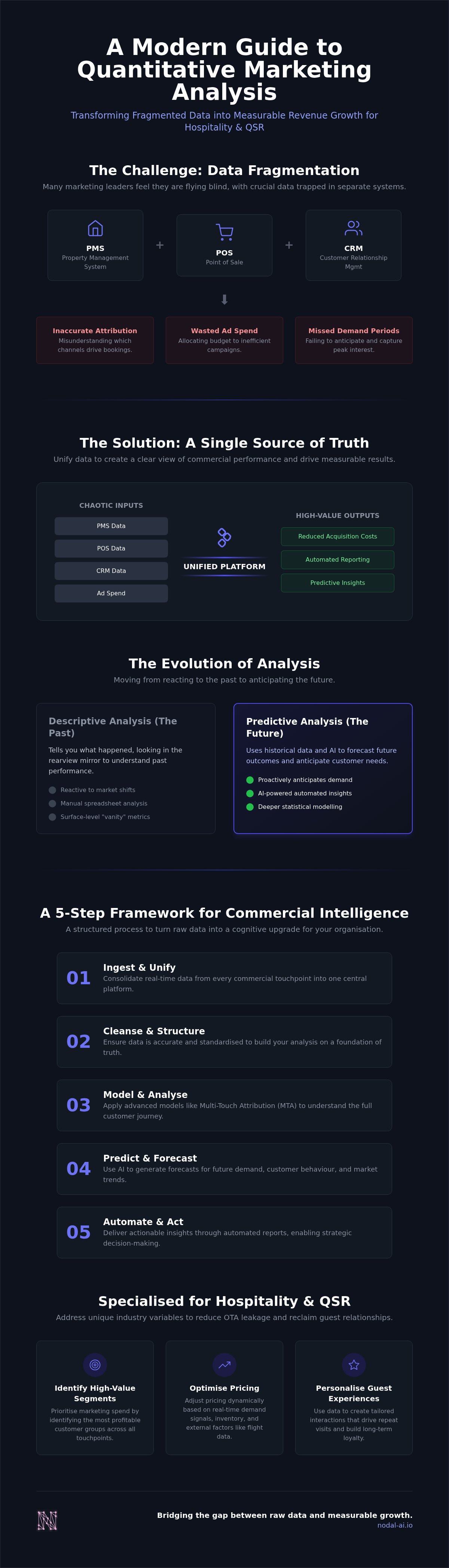
Implementing Quantitative Analysis: A Five Step Framework
Deploying a rigorous quantitative marketing analysis framework is the bridge between raw data and measurable revenue growth. This process begins with comprehensive data ingestion, connecting your PMS, CRM, and ad platforms into a unified intelligence engine. Once connected, you must prioritise data cleansing and consolidation to ensure that your commercial decisions rest on a foundation of absolute accuracy. To maintain this high standard over time, you should establish a data governance framework that prevents future fragmentation. By deploying modular intelligence engines, you can then translate these refined data points into automated growth recommendations that drive immediate value.
Step 1: Unifying Fragmented Data Sources
The primary technical challenge for hospitality leaders is integrating legacy systems like Oracle OPERA or modern platforms like Mews with digital analytics tools such as GA4. Relying on weekly manual exports is no longer sufficient; it's a slow, error-prone method that hides critical shifts in guest behaviour. Real-time data processing is essential to reveal the true cost of acquisition across every channel. This unification transforms passive records into active insights, allowing you to see exactly where your marketing spend is working and where it is being wasted.
Step 2: Defining Key Performance Indicators (KPIs)
Precision in goal setting is what separates successful brands from those merely collecting numbers. You must move beyond vanity metrics such as clicks or impressions and focus on commercial metrics like ROAS and RevPAR. Track guest segments by property to identify which demographics generate the highest long-term value. Custom dashboards should reflect these specific business goals, providing a high-level perspective that remains accessible to stakeholders who need results without deep technical specialisation. This clarity replaces the anxiety of manual tracking with the confidence of streamlined performance views.
Step 3: Generating Actionable Growth Recommendations
The final stage of the framework is the transition from observation to action. AI now identifies which promotions are truly increasing revenue versus those that are simply shifting existing demand to different dates. For QSR brands, this involves measuring the mix of delivery versus dine-in orders to protect profit margins from high commission fees. Automated reporting provides the relief of efficiency, saving teams over 20 hours of manual labour per month. This reclaimed time allows your experts to focus on high-level strategy while the Nodal Platform handles the heavy lifting of data processing.
Book a demo to see the framework in action
Driving Commercial Intelligence with the Nodal Platform
The Nodal Platform serves as the definitive solution to the data fragmentation that has historically hindered the hospitality sector. By acting as a modular intelligence engine, it unifies disparate data from PMS, POS, and CRM systems into a single, cohesive view. This transformation allows brands to move beyond the limitations of traditional quantitative marketing analysis and instead embrace a system where data actively drives commercial strategy. The platform architecture is designed for total flexibility, allowing organisations to select specific Operational, Demand, or Commercial modules based on their unique growth objectives.
The impact of this integrated approach is evidenced by the results achieved for Ovolo Hotels. By resolving their data silos, the brand experienced a 15.3 per cent reduction in guest acquisition costs alongside a 24.5 per cent increase in Return on Ad Spend (ROAS). These figures demonstrate the tangible value of moving from chaotic, manual inputs to a streamlined, high-level perspective. The platform prioritises direct booking strategies, which effectively reduces OTA dependency and protects profit margins from external leakage.
Tailored Insights for Hotels, Hostels, and Restaurants
Every hospitality vertical faces distinct operational challenges that require specialised analytical lenses. For hostels, the platform focuses on bed yield and occupancy optimisation, while for QSR brands, it tracks footfall and delivery mix to ensure long-term stability. A unique feature of the Nodal Platform is the integration of reputation data from sources like Google Reviews and TripAdvisor directly into commercial models. This ensures that guest sentiment is no longer a passive metric but a core component of your quantitative marketing analysis. You can experience these tailored insights firsthand by choosing to book a demo and seeing the platform in action.
The Future of Marketing Analysis: Make More, Waste Less
The future of the sector relies on the ability to make more while wasting less. Profit margin erosion is a significant threat, yet it is one that can be resolved through total clarity. Commercial intelligence is the ultimate competitive advantage in 2026, providing the cognitive upgrade needed to navigate a complex digital landscape. By consolidating fragmented data, the Nodal Platform ensures that your marketing spend is always tethered to concrete business outcomes and long-term stability. We invite you to explore the full suite of Nodal Platform features to begin your transformation from manual labour to automated, high-value growth.
Mastering Your Commercial Future through Precision Analytics
The transition from fragmented data silos to a unified intelligence engine is a commercial necessity. By mastering quantitative marketing analysis, you transform passive records into active growth levers that identify future demand periods before they arrive. This strategic shift has already delivered a 15.3 per cent reduction in acquisition costs for Ovolo Hotels, proving that total clarity leads to measurable financial performance.
The Nodal Platform provides the seamless integration required for modern hospitality brands, connecting directly with Oracle OPERA, Mews, and GA4. This Gold award-winning approach replaces the anxiety of manual reporting with the calm efficiency of automated, actionable insights. You now have the roadmap to reduce OTA dependency and reclaim your profit margins through precision analytics.
Book a demo of the Nodal Platform to transform your marketing data into commercial intelligence
Take the first step toward a cognitive upgrade for your entire organisation. It's time to make more and waste less by turning your data into your most powerful commercial asset.
Frequently Asked Questions
What is the primary difference between quantitative and qualitative marketing analysis?
Quantitative analysis focuses on numerical data to provide statistical significance and scalability, while qualitative analysis uses descriptive feedback to understand the underlying "why" of guest behaviour. In 2026, the convergence of these methods allows for the quantitative analysis of qualitative data, such as call transcripts or social media threads, at scale. While qualitative insights provide essential context, quantitative data serves as the objective foundation for making high-level investment decisions and budget allocations.
How does quantitative analysis help in reducing marketing acquisition costs?
Quantitative analysis reduces acquisition costs by identifying exactly which channels and guest segments deliver the highest return on ad spend. By removing the emotional bias from marketing strategy, you can reallocate budget from underperforming campaigns to high-propensity segments. This precision has led to a documented 15.3 per cent reduction in acquisition costs for partners like Ovolo Hotels. It turns your marketing spend into a targeted investment rather than a broad, speculative expense.
Can quantitative marketing analysis predict future customer behaviour?
Yes, quantitative marketing analysis predicts future customer behaviour by using predictive modelling to identify "need periods" before they occur. By integrating historical booking data with external signals such as flight demand and local events, these models forecast when occupancy might drop. This allows you to launch proactive campaigns that capture demand early. It moves your strategy from a reactive state to a proactive, forward-facing posture that secures revenue in advance.
What are the most important data sources for quantitative analysis in hospitality?
The most critical data sources include your Property Management System (PMS), such as Oracle OPERA or Mews, and your Point of Sale (POS) systems. These must be unified with your CRM and digital analytics platforms like GA4. Integrating external data, such as weather patterns or local flight arrival volumes, further refines your commercial models. This comprehensive ingestion ensures that your commercial intelligence is built on a complete view of the guest journey.
How much data do I need before quantitative analysis becomes statistically significant?
Statistical significance depends on your specific booking volume and the variables you are testing rather than a single fixed number. You need enough data to ensure that a result is likely due to your actions instead of random market fluctuations, often referred to as "noise." Modern intelligence engines use anomaly detection to identify when a trend is genuine. This allows you to make confident pivots without waiting for massive sample sizes that might delay your growth.
Is quantitative marketing analysis suitable for small to medium-sized businesses?
Modern quantitative marketing analysis is highly suitable for small to medium-sized businesses because automated platforms remove the need for deep technical specialisation. Previously, these frameworks required expensive data science teams, but modular intelligence engines now handle the complexity of data cleansing and reporting. This accessibility allows smaller brands to compete with larger chains by using the same level of commercial intelligence to optimise their guest acquisition and direct booking strategies.
What is the role of AI in modern quantitative marketing frameworks?
AI is the engine that drives modern frameworks by automating the tedious tasks of data ingestion and cleansing. It identifies patterns across millions of data points that would be impossible for a human analyst to spot manually. Beyond mere reporting, AI generates growth recommendations and identifies which promotions are truly shifting demand versus those that are simply eroding margins. This transition from manual labour to automated intelligence is a cognitive upgrade for your entire organisation.
How does quantitative analysis solve the problem of fragmented data?
Quantitative analysis solves data fragmentation by creating a single source of truth that bridges the gap between siloed systems like your PMS and CRM. By unifying these disparate sources, the analysis reveals the true path to purchase and the actual cost of guest acquisition. This removal of ambiguity replaces the anxiety of conflicting reports with the confidence of a streamlined, high-level perspective. It transforms passive, fragmented assets into active participants in your commercial strategy.


