

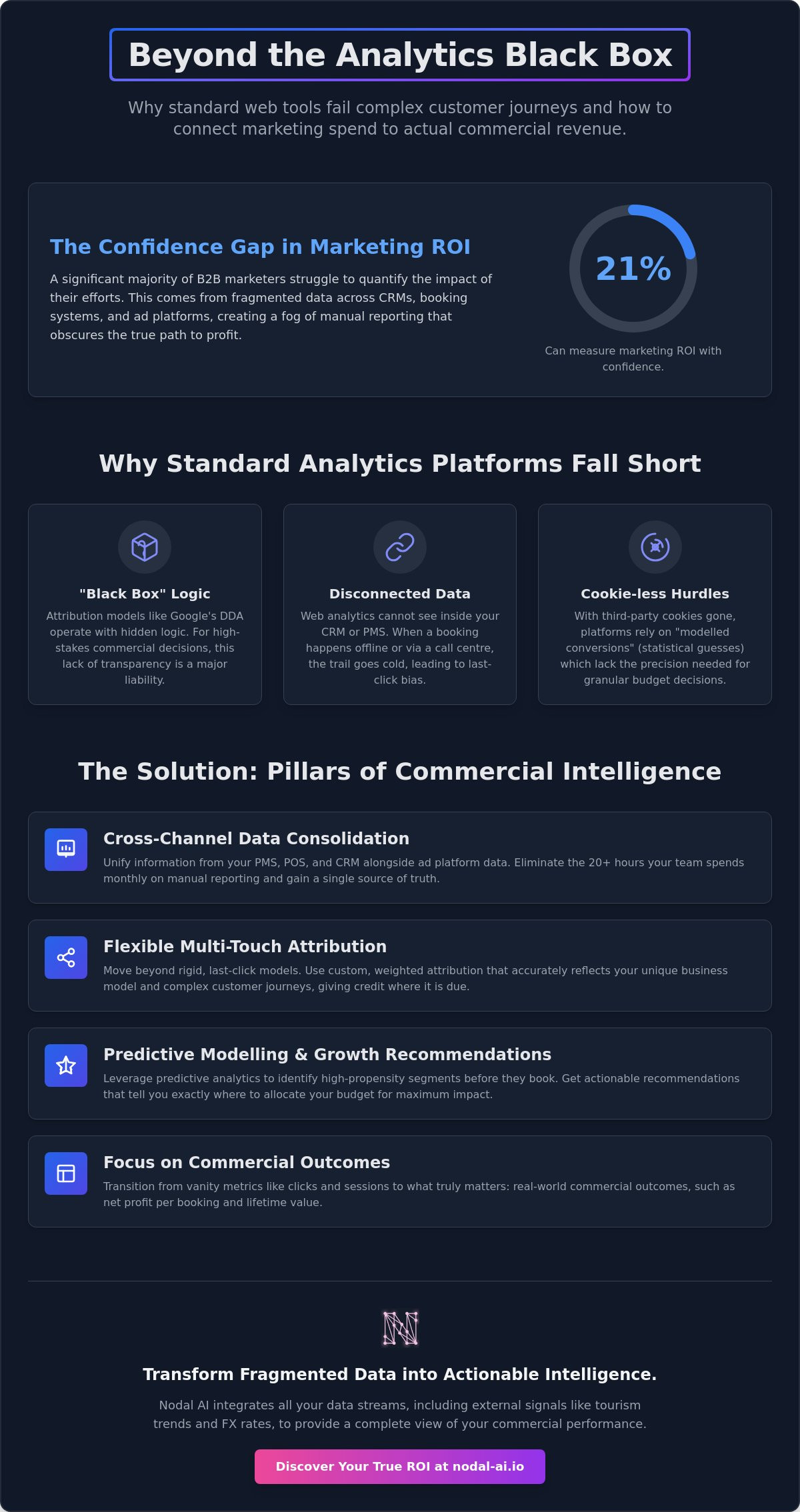
Only 21 per cent of B2B marketers can measure the ROI of their marketing efforts with confidence. You likely recognise the frustration of staring at dashboard data that fails to match your actual bank balance. Fragmented data across your CRM, booking systems, and ad platforms creates a fog of manual reporting that obscures your true path to profit. In a world where third-party cookies have vanished, relying on basic tracking is no longer a viable strategy for growth.
This lack of clarity is exactly why leading organisations are now prioritising alternatives to google analytics for attribution. You deserve a single, transparent view of the customer journey that replaces guesswork with commercial intelligence. This guide will show you why standard analytics tools fail complex customer journeys and how to select an attribution platform that connects marketing spend to actual commercial revenue. We will explore the sophisticated systems that automate your reporting and provide the confidence you need to scale your ad spend based on bottom-line results.
Key Takeaways
- Understand why the "black box" logic of standard web tools often fails to provide the transparency required for high-stakes commercial decisions.
- Discover how to evaluate alternatives to google analytics for attribution by prioritising platforms that unify PMS and CRM data into a single source of truth.
- Learn the critical differences between multi-touch attribution and marketing mix modelling to ensure you capture the full impact of both digital and offline activity.
- Follow a structured transition plan that moves your focus from vanity metrics like clicks to real-world commercial outcomes, such as net profit per booking.
- Explore how the Nodal Platform transforms fragmented datasets into actionable intelligence by integrating external signals like tourism trends and global FX rates.
Why Google Analytics 4 Struggles with Complex Marketing Attribution
Google Analytics 4 presents itself as a comprehensive solution, yet it often operates as a closed loop. Its Data-Driven Attribution (DDA) model functions as a "black box" where the logic remains hidden from the user. For high-stakes commercial decisions, this lack of transparency is a liability. You need to know exactly why a specific channel receives credit, especially when you are allocating significant budgets. This opacity is a primary driver for teams seeking reliable marketing attribution models that offer clear, verifiable insights.
The struggle deepens when you consider the fragmented nature of modern data ecosystems. GA4 tracks web sessions with precision, but it cannot see inside your Property Management System (PMS) or CRM. When a guest interacts with your site but completes a booking via a call centre or an offline system like Mews or Oracle OPERA, the trail goes cold. This gap creates dangerous blind spots. Without a unified view, you remain trapped in a cycle of last-click bias, where top-of-funnel channels that initiate the journey are consistently undervalued. Standard tracking is built for simple transactions; it's not designed for multi-device, multi-week guest journeys that span several touchpoints.
The disconnection between marketing clicks and commercial reality
You have likely noticed that GA4 revenue figures rarely align with your actual bank-recorded revenue. This discrepancy occurs because GA4 measures digital intent rather than commercial completion. Walled gardens, such as Meta and Google, often claim credit for the same conversion, leading to inflated ROAS reporting that distorts your strategy. Data fragmentation is the primary barrier to marketing ROI in 2026. By exploring alternatives to google analytics for attribution, you can bridge the chasm between a digital click and a confirmed booking.
The technical hurdles of the cookie-less era
The landscape has changed significantly with the 2026 updates to the California Consumer Privacy Act (CCPA) and the total deprecation of third-party cookies across all major browsers. GA4 attempts to fill these gaps with "modelled conversions," which are essentially statistical guesses. While useful for broad trends, these models lack the precision required for granular budget shifts. Relying on a single vendor to both sell you advertising and measure its success creates an inherent conflict of interest. True commercial intelligence requires an independent perspective that prioritises your bottom line over platform-specific metrics. You can explore modern performance marketing analytics that bypass these limitations to provide a clear view of your growth.
Essential Features to Look for in a Google Analytics Alternative
Selecting a platform requires moving beyond basic web tracking. You need a system that transforms passive data into active commercial participants. As you evaluate alternatives to google analytics for attribution, focus on five non-negotiable pillars. These features ensure your marketing spend is an investment with a visible return, rather than a speculative cost. The challenges of modern marketing require more than simple session logs; they demand a unified view of the entire customer journey.
True commercial intelligence begins with cross-channel data consolidation. Your platform must unify information from your PMS, POS, and CRM alongside your ad platform data. By bridging these gaps, you eliminate the 20+ hours your team likely spends every month manually stitching spreadsheets together. This automation replaces tedious labour with high-level perspective. You also require multi-touch attribution (MTA) flexibility. You should be able to move beyond rigid, linear models to custom weightings that reflect your specific business model and guest behaviour.
Advanced platforms now leverage predictive modelling to identify high-propensity segments before they even book. This allows you to focus your budget on the audiences most likely to convert, optimising your spend in real time. Instead of looking at what happened yesterday, these systems provide growth recommendations that tell you exactly where to move your budget now. The result is a cognitive upgrade for your entire organisation, replacing the anxiety of uncertainty with the confidence of data-backed precision.
Deep integration capabilities for hospitality and QSR
Your attribution engine must act as a bridge between digital activity and physical operations. It is not enough to track a click; you must understand how that click translates into a cover at a restaurant or a room night at a hotel. Ensure your tool "talks" directly to your booking engine and CRM. Modern solutions, such as the Nodal AI features, use modular architecture to integrate external signals like local events, weather patterns, and flight demand into your attribution logic.
Security and data governance in the UK market
Operating in the UK requires a rigorous approach to privacy. Any viable alternatives to google analytics for attribution must adhere strictly to UK GDPR standards. Prioritise first-party data ownership to protect your assets from the volatility of third-party platform changes. Implementing a robust data governance framework is essential for global teams to maintain transparency and security. If you are ready to see how these features work in practice, you can book a demo to explore our modular intelligence engine.
Comparing Attribution Methodologies: Multi-Touch vs. Predictive Intelligence
Traditional analytics tools often force you to look in the rear-view mirror. While standard Multi-Touch Attribution (MTA) tracks every digital touchpoint to assign value across the guest journey, it remains a reactive methodology. It tells you what happened, but it doesn't always explain why or what you should do next. As you explore alternatives to google analytics for attribution, you must distinguish between simple tracking and true commercial foresight. The 2026 standard has shifted toward revenue-based attribution models that prioritise predictive intelligence over historical reporting.
Marketing Mix Modelling (MMM) complements this by providing a top-down perspective. It measures the impact of offline activity and brand-building efforts that digital session tracking cannot capture. However, the most sophisticated teams now rely on incrementality testing to validate these models. This process determines which conversions were truly driven by your ad spend and which would have occurred organically. By combining these methods, you transform fragmented data into a cohesive strategy that protects your margins and fuels sustainable growth.
Why historical data is no longer enough
Performance marketing has evolved from a game of reaction to one of anticipation. Relying solely on historical data leaves you vulnerable to sudden market shifts and changing guest behaviours. Predictive intelligence turns your historical data into an active advisor, forecasting future performance based on complex patterns. For instance, predictive modelling identifies high-value guest segments during low-occupancy "need periods," allowing you to fill rooms when it matters most. It's a proven shift in efficiency; AI-driven insights can reduce acquisition costs by over 15 per cent by eliminating wasted spend on low-propensity audiences.
Choosing the right model for your business scale
Your choice of methodology should align with your organisational maturity and data volume. Smaller operations may find that flexible MTA provides sufficient clarity for tactical optimisations. However, as your complexity increases, you require the robust capabilities of a full predictive modelling engine. This level of sophistication is essential for balancing short-term ROAS with long-term guest lifetime value (LTV). Effective customer journey mapping helps you select the right strategy, ensuring your attribution model serves as a cognitive upgrade for your entire marketing department. If you're ready to stop guessing and start forecasting, moving toward predictive systems is the inevitable next step for your commercial success.
How to Transition from Google Analytics to a Dedicated Attribution Platform
Transitioning to alternatives to google analytics for attribution represents a strategic shift from passive tracking to active commercial intelligence. You aren't just changing software; you're upgrading your entire decision-making engine. This process replaces the anxiety of fragmented data with the confidence of a unified perspective. To ensure a seamless migration, follow this structured path toward clarity:
- Audit your data landscape: Identify every fragmented source, from Google Ads and Meta to your internal POS and PMS systems.
- Define commercial KPIs: Move beyond vanity metrics like clicks to outcomes that matter, such as net profit per booking or covers per site.
- Select a modular platform: Choose a tool that scales with you, offering everything from automated reporting to predictive modelling.
- Run a parallel tracking period: Compare your new attribution data against GA4 for at least 30 days to understand the discrepancies.
- Train for action: Shift your team's culture from merely reading reports to executing on specific growth recommendations.
This sequence turns a complex technical hurdle into a logical journey toward growth. By identifying where value currently disappears, you can begin to reclaim lost margins and scale your spend with precision.
Mapping the customer journey for successful implementation
Successful setup requires deep customer journey mapping before technical configuration begins. This process identifies "leaky buckets" in your booking funnel that GA4 often misses due to session timeouts or cross-device gaps. Ensure your new platform allows for historical data ingestion. This provides an immediate baseline for comparison, allowing you to realise the impact of your optimisations from day one.
Overcoming the technical onboarding hurdle
Professional implementation shouldn't be a source of anxiety. During onboarding, expect a dedicated partner to configure your custom dashboards and data engines to reflect your unique business logic. Technical support is vital for ensuring your attribution data remains fully compliant with UK regional standards, such as GDPR. By choosing a partner that understands the nuances of the UK market, you replace the complexity of setup with the clarity of streamlined results. If you are ready to start this transition, you can book a demo to see how we bridge the gap between data and profit.
Nodal AI: Transforming Fragmented Hospitality Data into Commercial Intelligence
The Nodal Platform represents the definitive evolution in commercial measurement. It is a modular intelligence engine designed specifically to connect the disparate dots of the hospitality landscape. While standard tools provide a generic overview, Nodal transforms your passive data into active participants in your business strategy. When you seek alternatives to google analytics for attribution, you are essentially looking for a way to replace fragmented noise with strategic clarity. This is where the Nodal Platform excels, by bridging the gap between digital intent and confirmed revenue.
Our approach goes far beyond simple web tracking. We integrate external signals such as FX rates, tourism trends, and local event data into your attribution logic. This creates a cognitive upgrade for your entire organisation, allowing you to understand how global shifts impact your local performance. By using AI-driven audience segmentation, you can optimise your marketing spend in real time, ensuring your budget is always directed toward the highest-propensity guests. The result is a transition from speculative spending to a high-value output that drives measurable growth.
The impact of this intelligence is already evident in the market. For example, Ovolo Hotels realised a 24.5 per cent increase in ROAS by leveraging Nodal AI insights to refine their targeting and budget allocation. This success illustrates the power of connecting your marketing spend to actual commercial revenue. By choosing the right alternatives to google analytics for attribution, you move from a state of reporting anxiety to the confidence of data-backed precision.
Solving the unique challenges of the hospitality sector
Hospitality requires a nuanced understanding of the guest journey. Our platform helps you reduce OTA leakage and improve direct booking contributions by identifying exactly which channels drive the most profitable stays. Whether you are measuring footfall across multiple QSR locations or tracking ancillary spend in hostels and apartments, Nodal AI handles the complexity. We ensure that every touchpoint, from the first click to the final checkout, is accounted for in your commercial intelligence engine.
Ready to see the full picture of your marketing performance?
Adopting a "make more, waste less" approach is the most effective way to protect your margins in a competitive market. Our automated reporting capabilities save London-based teams over 20 hours per month, replacing manual labour with high-level perspective. You no longer need to struggle with spreadsheets to find the truth about your performance. If you are ready to experience the relief of total clarity, we invite you to book a demo and see how the Nodal Platform can transform your data into a powerful engine for growth.
Bridge the Gap Between Clicks and Commercial Revenue
You no longer need to settle for the fragmented insights of a black-box analytics system. True marketing attribution requires a unified view that connects your digital spend directly to your PMS and CRM systems. By moving beyond session-based tracking, you replace the anxiety of guesswork with the clarity of predictive intelligence. Selecting the right alternatives to google analytics for attribution is the first step toward a cognitive upgrade for your entire commercial team.
The results of this shift are quantifiable. Our partners have realised a 24.5 per cent increase in ROAS through predictive modelling and a 15.3 per cent reduction in acquisition costs for Ovolo Hotels. With specialised integrations for Oracle OPERA, Mews, and Cloudbeds, the Nodal Platform ensures your passive assets become active participants in your growth strategy. It's time to stop stitching spreadsheets and start scaling your profit with confidence.
Book a demo with Nodal AI to transform your marketing data into actionable intelligence and reclaim control of your customer journey today.
Frequently Asked Questions
Is there a better alternative to Google Analytics for tracking marketing attribution?
Yes, dedicated platforms offer superior clarity by connecting digital touchpoints to actual commercial revenue. These alternatives to google analytics for attribution solve the "black box" problem by integrating directly with your PMS and CRM. While GA4 tracks sessions, a specialised engine tracks the entire guest journey. This ensures your marketing spend is always tied to a confirmed booking rather than a simple web click.
Can I use a third-party attribution tool alongside GA4?
You can certainly run a third-party tool alongside GA4 to maintain historical continuity. Many organisations use GA4 for high-level site traffic while relying on a dedicated platform for commercial decision-making. This dual approach allows you to compare modelled data against real-world revenue. It provides a safety net during the transition while you build confidence in your new, more accurate attribution engine.
How much does an enterprise attribution platform typically cost?
Enterprise solutions vary significantly based on data volume and the complexity of your integrations. Market-wide platforms often scale from mid-market tiers to high-level enterprise plans to accommodate global organisations. Instead of focusing on a flat fee, consider the return on investment. Replacing manual labour with automated reporting often recovers significant costs within the first year by identifying and eliminating wasted ad spend.
What happens if my attribution data does not match my Google Ads report?
Discrepancies are common because ad platforms often use self-serving logic to claim credit for conversions. A dedicated attribution tool provides an independent perspective by looking at the entire journey across all channels. If your reports don't match, it usually indicates that the ad platform is over-counting its influence. Trusting a neutral source of truth allows you to allocate your budget based on actual profit.
How does AI-powered attribution handle the loss of third-party cookies?
AI-powered systems handle the loss of cookies by prioritising first-party data and sophisticated pattern recognition. Instead of relying on individual tracking, these engines use predictive modelling to understand guest behaviour. This ensures your reporting remains accurate in a privacy-first environment. You can maintain total visibility without compromising user trust or falling foul of updated regulations like the CCPA.
Is multi-touch attribution necessary for a small hospitality business?
Multi-touch attribution is essential for any business looking to reduce OTA leakage and increase direct bookings. Even with a smaller budget, you need to know which channels are truly driving value and which are simply taking credit for organic intent. Understanding your customer journey mapping allows you to scale your spend with precision. It replaces the anxiety of limited resources with the confidence of efficient growth.
What is the difference between marketing attribution and marketing mix modelling?
Marketing attribution is a bottom-up approach that tracks individual digital touchpoints to assign value. Marketing mix modelling is a top-down method that uses aggregated data to measure the impact of offline and brand-building activity. Combining these methodologies gives you the most complete view of your performance. It ensures that both your tactical digital ads and your strategic brand investments are properly recognised.
How long does it take to implement a new attribution platform like Nodal AI?
Setting up a new platform usually takes a few weeks to ensure all data sources are correctly integrated. This period includes connecting your PMS, CRM, and ad platforms to the modular intelligence engine. Professional onboarding ensures your dashboards are configured for your specific commercial KPIs from day one. You'll quickly move from fragmented inputs to high-value outputs, saving your team hours of manual labour every month.


