

Compliance in 2026 is no longer a restrictive hurdle; it's the strategic foundation of high-integrity growth. You've likely felt the mounting pressure of fragmented data across your systems, especially as the loss of traditional attribution signals makes it harder to prove your ROI. It's a common anxiety, as the fear of falling foul of the Information Commissioner's Office and facing fines of up to £17.5 million keeps many marketing leaders awake at night.
This guide empowers you to master marketing compliance and data privacy uk by turning complex regulations into a streamlined roadmap for success. You'll learn how to navigate the Data (Use and Access) Act 2025 and maintain high-performance attribution in a privacy-first world. We'll explore the latest shifts in cookie consent, the relaxation of automated decision-making rules, and how to implement automated reporting that transforms chaotic inputs into a visionary perspective on your customer journey.
Key Takeaways
- Master the transition from standard GDPR to the Data (Use and Access) Act 2025 to ensure your marketing remains both legal and high-performing.
- Discover how to navigate marketing compliance and data privacy uk by leveraging the "soft opt-in" rule and the new legitimate interest clarifications for direct marketing.
- Solve the attribution signal loss caused by cookie deprecation by adopting server-side tracking and privacy-preserving measurement models.
- Build a robust data governance framework that integrates fragmented systems into a unified, compliant view of your entire customer journey.
- Use the Nodal Platform to automate your compliance reporting and unlock predictive modelling, turning complex regulations into a strategic growth engine.
Navigating the UK Marketing Compliance Landscape in 2026
Marketing compliance in 2026 has transformed into a high-value strategic asset. It marks the intersection of legal necessity and commercial precision. While the legal foundation still rests on the Data Protection Act 2018, the recent shift through the Data (Use and Access) Act 2025 has redefined the rules of engagement. This framework moves beyond the rigid structures of the original EU GDPR to offer a more flexible, pro-innovation environment. For any organisation operating in the British market, mastering marketing compliance and data privacy uk is now the primary differentiator between brands that scale and those that stagnate.
London-based enterprises must prioritise local data residency and processing to maintain absolute clarity. This isn't just about geography; it's about ensuring every byte of customer data remains within a jurisdiction that rewards high-integrity governance. By balancing consumer rights with business innovation, you transform compliance from a defensive cost into a powerful competitive engine. You don't just follow rules; you build a foundation of trust that customers value.
The Data (Use and Access) Act 2026: What Changed?
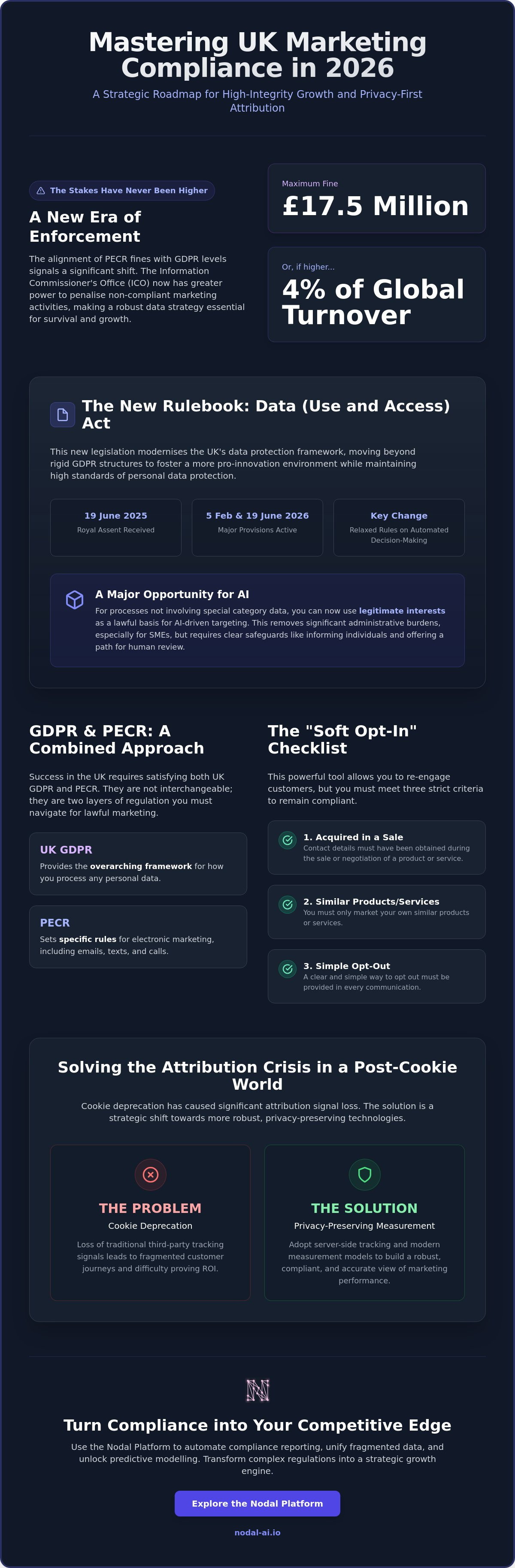
The Data (Use and Access) Act 2025, which received Royal Assent on 19 June 2025, saw its major provisions become active on 5 February and 19 June 2026. This legislation simplifies the landscape for modern marketers by introducing streamlined rules for data portability and significantly relaxing the requirements for automated decision-making. If your processes don't involve special category data, you can now use legitimate interests as a lawful basis for AI-driven targeting. This change empowers small and medium organisations to compete by removing the heavy administrative burdens that previously stifled growth. However, you must still implement clear safeguards. These include informing individuals when a decision is made automatically and providing a simple path for human intervention. This balance allows for rapid scaling without sacrificing the human element of the customer journey.
Why Privacy-Led Marketing is the New Standard
Stop treating compliance as a box-ticking exercise. Modern consumers demand radical transparency, and brands that provide it see a measurable reduction in churn. The financial stakes have never been higher. Breaches of marketing regulations now carry penalties of up to £17.5 million or 4% of global turnover, whichever is higher. This alignment of PECR fines with GDPR levels signals a new era of enforcement from the ICO. By building trust-based relationships, you replace the anxiety of potential fines with the confidence of long-term brand loyalty. Privacy isn't a barrier; it's the bridge to your most valuable customer segments. High-performance marketing thrives on the quality of data, not just the quantity. Clean, compliant data leads to more accurate predictive modelling and better growth recommendations.
Essential Data Privacy Regulations: GDPR, PECR, and Consent
Success in the UK market requires a precise understanding of how the UK GDPR and the Privacy and Electronic Communications Regulations (PECR) operate in tandem. While GDPR provides the overarching framework for processing personal data, PECR sets the specific rules for electronic marketing. It's a common misconception that one replaces the other. In reality, you must satisfy both to maintain marketing compliance and data privacy uk. This dual-layered approach ensures that your outreach is not only lawful but also respectful of the digital boundaries your customers have set.
Managing voice communications requires equal precision. Live marketing calls are generally permitted if the recipient hasn't opted out via the Telephone Preference Service (TPS). However, automated marketing calls are strictly prohibited unless you have obtained prior, specific consent. To safeguard your reputation and avoid the increased PECR penalties of up to £17.5 million, you must maintain a robust, centralised suppression list. This list acts as your primary shield, ensuring that every "stop" request is honoured instantly across all channels. If you're ready to turn these complex requirements into a streamlined growth engine, you can explore the features of a platform built for high-integrity analytics.
Understanding the Soft Opt-In for Marketers
The "soft opt-in" is a powerful tool for re-engaging existing customers without explicit prior consent. To use it effectively, you must meet three strict criteria. First, you must have obtained the contact details during the sale or negotiation of a product or service. Second, you must only market similar products or services. Third, you must provide a clear, simple way to unsubscribe at every touchpoint. Many organisations fail when they attempt to move leads from a general enquiry into an active marketing segment for unrelated offerings. Don't risk your deliverability on a technicality; ensure your segments are tightly aligned with the original context of the data collection.
Consent Management in a Multi-Channel World
Collecting informed consent across web, mobile apps, and physical locations is no longer a manual task. It requires a sophisticated Consent Management Platform (CMP) that integrates directly into your tech stack. These platforms ensure that consent data flows correctly into your customer journey mapping, providing a transparent audit trail for every interaction. By centralising these signals, you remove ambiguity and empower your team to act with confidence. A modern CMP doesn't just block cookies; it organises your first-party data strategy to ensure every marketing dollar is spent on a compliant, high-intent audience.
Privacy-Preserving Attribution: Measuring ROI Without Cookies
The deprecation of third-party cookies has created a measurement vacuum that traditional tracking can no longer fill. For years, marketers relied on client-side pixels to track users across the web, but the "Walled Garden" problem has made this approach obsolete. You can no longer depend on external platforms to provide a complete picture of your performance. To maintain marketing compliance and data privacy uk, you must shift your focus inward and take ownership of your data stream. This transition is not just a technical necessity; it is a strategic upgrade for your entire organisation.
Server-side tracking offers a compliant, high-performance alternative to invasive client-side pixels. By moving data processing from the user's browser to your own secure server, you regain absolute control over the information you collect. This method bypasses many browser-based tracking restrictions while ensuring that sensitive data never reaches third-party platforms without your explicit approval. It transforms a chaotic stream of signals into a clean, actionable dataset. While the Data (Use and Access) Act 2025 has relaxed consent requirements for some low-risk analytics cookies as of February 2026, server-side tracking remains the gold standard for accuracy and security.
As tracking becomes more restricted, marketing attribution must evolve. You shouldn't just look at the last click; you need to understand the incremental value of every touchpoint. This requires a transition towards Marketing Mix Modelling (MMM) and incrementality testing. These advanced techniques allow you to measure the true impact of your spend without relying on intrusive, individual-level tracking. You stop chasing ghosts and start investing in what actually drives revenue.
The Shift to First-Party Data Attribution
Your first-party data is your most resilient asset. In 2026, UK marketers must prioritise capturing high-intent signals directly from their own properties. By integrating data from your Point of Sale (POS) and Property Management Systems (PMS), you can close the loop between digital interactions and real-world outcomes. This holistic view provides the clarity needed to optimise budgets effectively. You don't need to follow users across the internet when you have a direct relationship with them on your own platforms. Focus on the data you own to build a future-proof measurement framework.
AI-Powered Predictive Modelling for Performance
The reality of 2026 is that some users will always opt out of tracking. Instead of accepting these data gaps, use predictive modelling to fill the silence. AI identifies high-propensity segments by analysing patterns in your existing, consented data. It allows you to predict future behaviour while strictly respecting privacy boundaries. This shift moves your team from reactive reporting to proactive growth recommendations. You stop guessing and start scaling with precision. If you want to see how this works in practice, book a demo to explore our multi-touch attribution capabilities.
Building a Modern Data Governance Framework
A robust data governance framework is the nervous system of a high-performance marketing operation. In the 2026 landscape, you cannot afford to let data sit in unmanaged silos. It must flow securely and purposefully. This framework provides the structural integrity required to maintain marketing compliance and data privacy uk while scaling your reach. It turns chaotic, fragmented inputs into a streamlined stream of high-value intelligence. Stop reacting to data chaos; start commanding it through a centralised system of record.
Managing third-party vendor risks is a critical component of this architecture. You must ensure that every partner in your tech stack adheres to your standards through rigorous Data Processing Agreements (DPAs). Before launching any initiative, conduct a "pre-flight" campaign audit to validate compliance. This audit should check for valid consent strings, verify suppression list integration, and ensure that data retention policies are strictly enforced. By establishing automated deletion protocols, you remove the risk of holding onto "toxic" data that no longer serves a legal or commercial purpose.
Mapping the Data Lineage
Hospitality brands with multiple locations face a unique challenge: data often lives in separate Property Management Systems (PMS) and Point of Sale (POS) terminals. You must track this data lineage from the moment of entry to the point of activation. Identify and eliminate "dark data," which is unclassified information that poses a significant compliance risk. By integrating these disparate sources into a single source of truth, you gain a visionary perspective on the customer journey. This clarity allows you to optimise your spend based on real-world revenue rather than disconnected digital signals.
Automated Compliance and Reporting
Reduce manual labour and eliminate human error through automated governance tools. These systems provide real-time monitoring for data anomalies, allowing you to address potential breaches before they escalate. From June 19, 2026, the new right for individuals to complain directly to controllers makes efficient reporting even more vital. You need the ability to generate comprehensive compliance reports for stakeholders and regulators at the touch of a button. This level of transparency builds internal confidence and protects your brand's reputation. To see how we unify these complex systems into a single source of truth, book a demo today.
Strategic Growth through Nodal AI: Compliance as a Competitive Edge
Transform your approach to marketing compliance and data privacy uk from a defensive shield into a precision-guided growth engine. Many organisations view regulation as a series of restrictive barriers, but visionary leaders realise it's actually a blueprint for a more resilient, profitable enterprise. The Nodal Platform acts as a modular intelligence engine, designed to turn the complexity of the Data (Use and Access) Act 2025 into a clear commercial advantage. By mastering your data environment, you move beyond the anxiety of manual reporting and step into a world of streamlined, high-level perspectives.
Passive data points become active participants in your revenue strategy when they are consolidated into a single, compliant view. The Nodal Platform bridges the gap between your digital marketing spend and real-world results. This is particularly vital for hospitality brands looking to reduce OTA leakage. By identifying the exact touchpoints that lead to high-value direct bookings, you can redirect your budget toward the most profitable channels. You stop paying high commission fees to third-party platforms and start owning the direct relationship with your guests. This isn't just about following rules; it's about a cognitive upgrade for your entire organisation.
Transforming Fragmented Data into Intelligence
Connecting your PMS, POS, and CRM data without compromising privacy is no longer a technical hurdle. The Nodal Platform automates the heavy lifting of data integration, ensuring every signal is processed within a secure, UK-compliant framework. This automation eliminates the friction of manual data entry, saving marketing teams 20+ hours weekly. Instead of wasting time on tedious spreadsheets, your team can focus on high-impact strategy and creative execution. Explore our full list of platform features to see how we turn chaotic inputs into strategic clarity.
Future-Proofing Your Marketing Strategy
Don't wait for a regulatory audit to expose vulnerabilities in your tech stack. The commercial advantage of being a privacy-first brand in 2026 is undeniable; it builds a level of customer trust that competitors simply cannot match. By prioritising transparency and security today, you insulate your brand against future legislative shifts. You gain the freedom to innovate with AI and predictive modelling, knowing your foundation is rock-solid. Take the next step toward total clarity and book a demo to see the Nodal Platform in action. It's time to replace complexity with growth.
Command Your Data Future: From Complexity to Competitive Advantage
Mastering the intricate landscape of marketing compliance and data privacy uk is no longer a defensive necessity; it is your primary vehicle for strategic growth. By integrating the Data (Use and Access) Act 2025 into your core operations, you transform regulatory hurdles into a high-performance foundation. You've learned how privacy-preserving attribution and robust governance frameworks replace the anxiety of manual tasks with the clarity of visionary intelligence. This transition ensures your organisation remains competitive in a world that values transparency above all else.
The journey toward 2026 success requires a partner who understands the specific commercial pressures of the UK market. Our London-based expert support has helped enterprises realise a 15.3% average reduction in acquisition costs through automated compliance reporting and advanced analytics. Stop struggling with fragmented silos and start commanding your data stream. Book a demo with Nodal AI to secure your data future and turn your compliance efforts into a cognitive upgrade for your entire business. Your most profitable era starts with high-integrity data.
Frequently Asked Questions
Do I need consent for postal marketing in the UK in 2026?
You do not generally require prior consent for postal marketing under the UK GDPR or PECR. Instead, you can rely on legitimate interests as your lawful basis, provided you have conducted a balancing test to ensure your interests don't override the individual's rights. You must always provide a clear way for recipients to opt out and check your lists against the Mail Preference Service (MPS) before sending.
What is the "soft opt-in" and when can marketers use it?
The soft opt-in is a specific rule that allows you to send electronic marketing to existing customers without explicit prior consent. You can use it if you obtained the contact details during a sale or negotiation, you are marketing similar products, and you provided a clear unsubscribe option at the point of collection. It remains a cornerstone of marketing compliance and data privacy uk for maintaining high-performance email campaigns.
How does the Data (Use and Access) Act 2026 affect marketing automation?
As of February 5, 2026, the rules for automated decision-making have been significantly relaxed for decisions that don't involve special category data. You can now use any lawful basis, including legitimate interests, for automated marketing processes like profiling or dynamic pricing. However, you must implement safeguards, such as informing the individual that a decision was made automatically and providing a simple way for them to contest it.
Can I still use Google Analytics 4 for compliant UK marketing?
You can still use Google Analytics 4 provided you implement it with a privacy-first configuration. This involves using Google Consent Mode v2 to respect user choices and leveraging server-side tagging to ensure you control exactly what data is sent to third-party servers. By moving away from purely client-side tracking, you align your measurement strategy with the latest UK data protection standards while maintaining accurate ROI reporting.
What is privacy-preserving attribution and why does it matter?
Privacy-preserving attribution is a measurement methodology that calculates the impact of marketing touchpoints without tracking individual users across the internet. It relies on aggregated data and techniques like Marketing Mix Modelling (MMM) to identify which channels drive growth. This approach matters because it allows you to maintain marketing compliance and data privacy uk while overcoming the signal loss caused by the deprecation of third-party cookies.
How long can I legally retain marketing data under GDPR?
The UK GDPR does not set a specific time limit for data retention; instead, it requires you to keep data only for as long as is necessary for the original purpose. Most high-growth organisations establish clear policies, such as deleting or anonymising customer records after 24 to 36 months of inactivity. Regularly purging stale data reduces your liability and ensures your marketing ecosystem remains lean and compliant.
Do I need a Data Protection Officer (DPO) for my marketing team?
You must appoint a DPO if your organisation carries out large-scale systematic monitoring of individuals or processes special category data. Even if these criteria don't apply to you, having a dedicated privacy lead is a strategic advantage for any marketing team handling high volumes of customer data. This role provides the expert oversight needed to navigate the evolving 2026 regulatory landscape and protect your commercial reputation.
What counts as "legitimate interest" for B2B marketing in the UK?
Legitimate interest is the standard lawful basis for B2B marketing to "corporate subscribers," which includes employees of limited companies, PLCs, and government bodies. Under PECR, you don't need prior consent to email these individuals, though you must still identify your business and provide a clear opt-out in every message. This provides a flexible path for B2B growth while ensuring you respect the professional boundaries of your prospects.


