

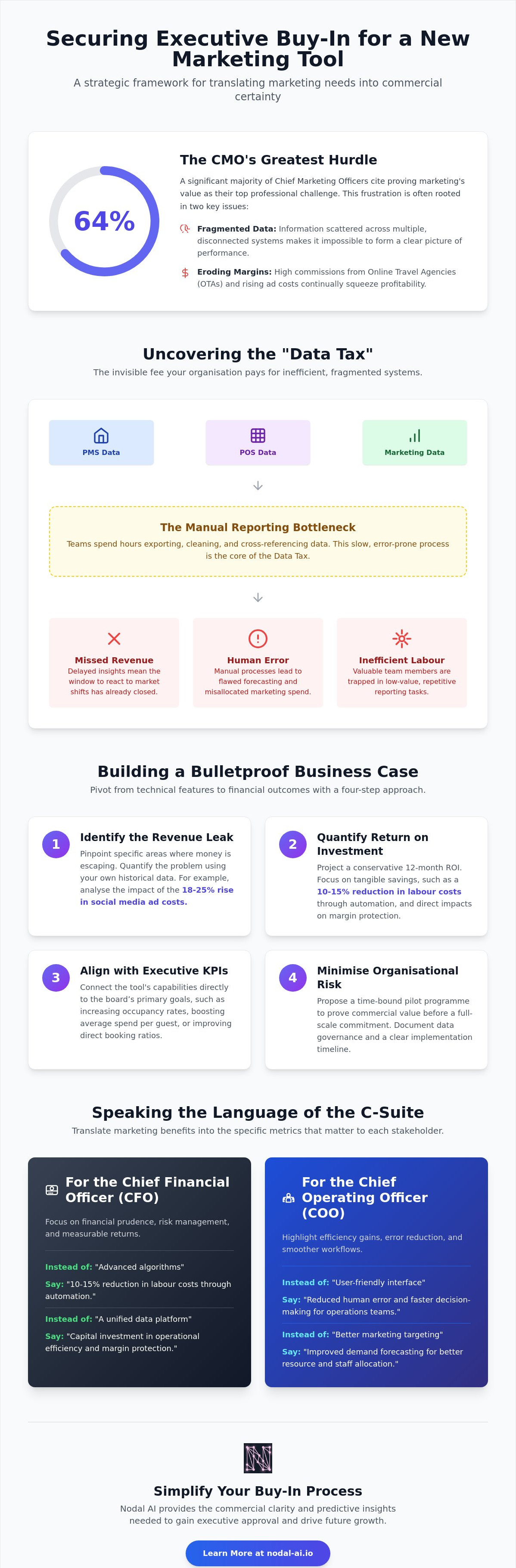
Did you know that 64% of CMOs still cite proving marketing’s value as their greatest professional hurdle? It is a frustrating reality when your data remains fragmented across multiple properties and high OTA commissions continue to erode your margins. You recognise that a more intelligent system could solve these issues, yet the boardroom only speaks the language of commercial certainty. Learning how to get buy-in for a new marketing tool requires more than a simple list of technical features; it demands a strategic translation of potential into protected profit.
We understand the weight of manual reporting and the anxiety that comes from an inability to prove exact ROI. This article provides the exact framework you need to transform chaotic data inputs into the high-value outputs required for executive approval. We will guide you through aligning your marketing goals with financial performance, reducing your reliance on manual labour, and securing the budget for the high-impact tools your organisation needs to thrive in 2026.
Key Takeaways
- Identify the hidden "data tax" within your current stack to reveal how fragmented information leads to missed revenue and delayed decisions.
- Translate complex technical features into the language of the C-suite by focusing on cost control for the CFO and operational efficiency for the COO.
- Discover the strategic framework for how to get buy-in for a new marketing tool through precise ROI quantification and revenue leak identification.
- Minimise organisational risk by executing a time-bound pilot programme that proves commercial value before you seek a full-scale budget commitment.
- Leverage modular architectures and external signals to build a predictive marketing engine that adapts to real-world shifts in demand.
Identifying the Commercial Friction: Why Your Current Stack is Costing You Revenue
Every minute your team spends manually exporting CSV files from a Property Management System (PMS) to cross-reference with Point of Sale (POS) data is a minute of lost revenue. This is the data tax. It is the invisible fee your organisation pays for fragmented systems that refuse to communicate. In the hospitality sector, where margins are already squeezed by third-party booking commissions, this inefficiency is more than a nuisance; it is a commercial threat. To understand how to get buy-in for a new marketing tool, you must first expose the cost of this friction to those who hold the budget.
When data is siloed, decision-making slows to a crawl. By the time a manual report identifies a dip in direct bookings or a spike in acquisition costs, the window to react has already closed. This delay results in an over-reliance on OTAs to fill rooms, further eroding your profitability. A new tool should not be positioned as a luxury for the marketing team. It is a business-wide solution designed to eliminate the manual labour that leads to human error and missed financial opportunities.
The Hidden Cost of Fragmented Data
Fragmented data creates a fog that obscures the true performance of your properties. When your PMS, POS, and marketing platforms operate in isolation, your team is forced into high-risk manual reporting. This process is not just slow; it is inherently flawed, often leading to inaccurate growth forecasting and misallocated spend. Accuracy is the foundation of commercial certainty. The cost of inaction is the cumulative loss of revenue caused by delayed data insights, which compounds every month you continue to rely on outdated workflows.
Shifting from Cost to Commercial Investment
Executive leaders often view new software as an expense to be managed rather than an asset to be leveraged. You must change this perception. Reframe a SaaS subscription as a capital investment in operational efficiency. By implementing predictive modelling, you move away from reactive tactics and towards long-term stability. This transition is essential for margin protection, ensuring that every pound spent on marketing is tethered to a measurable return.
A successful pitch requires understanding stakeholder analysis to ensure your arguments resonate with different departments. While marketing seeks better targeting, the board seeks risk mitigation. Proving that a tool can reduce labour costs by 10-15% through automation, as seen in recent AI demand forecasting studies, turns a technical request into a compelling financial case. Focus on the outcome of total clarity and the removal of ambiguity to secure the commitment you need.
Building the Business Case: Translating Features into Financial Outcomes
Executive boards do not invest in "advanced algorithms" or "user-friendly interfaces". They invest in the resolution of specific commercial pains. When you are determining how to get buy-in for a new marketing tool, your first task is to pivot from technical specifications to financial outcomes. Start by identifying a primary revenue leak, such as the 18 to 25% rise in social media ad costs reported in early 2026. By quantifying this drain using your own historical data, you transform a software request into a strategic necessity.
A robust proposal follows a structured building a business-case process to ensure every department recognises the value. You must align the tool's capabilities with the board’s primary KPIs, such as increasing occupancy rates or boosting the average spend per head. Propose a conservative 12-month ROI projection rather than promising overnight miracles. Finally, satisfy IT and legal requirements by documenting rigorous data governance standards and mapping an implementation timeline that avoids peak trading periods.
Consider these essential steps for your business case:
- Identify the Leak: Pinpoint exactly where revenue is escaping, such as high acquisition costs or abandoned bookings.
- Quantify ROI: Use historical data to project how the tool will improve margins over a 12-month period.
- Align KPIs: Match tool features to executive goals like RevPAR (Revenue Per Available Room) or customer lifetime value.
- Manage Risk: Document security protocols and ensure the implementation schedule doesn't disrupt busy seasons.
Quantifying the Return on Ad Spend (ROAS)
Effective marketing attribution is the key to budget optimisation. It allows you to stop guessing which channels work and start reallocating spend towards high-performing assets. To build a compelling case, calculate the potential increase in direct bookings by reducing OTA leakage. Showing a clear path to margin recovery makes the investment feel secure and inevitable. You can explore integrated features that turn these insights into active revenue drivers.
Solving the Data Fragmentation Problem
Modern hospitality relies on a complex web of systems, from Oracle OPERA to SevenRooms. A modular intelligence engine connects these disparate sources to create a single, unified view of the customer journey. This transition from raw data to actionable intelligence provides a distinct competitive advantage. It replaces the anxiety of manual spreadsheets with the confidence of automated, real-time reporting, allowing your team to focus on growth rather than data entry.
Navigating the Stakeholder Landscape: Speaking the Language of the C-Suite
Securing executive approval is not a matter of persistence; it is a matter of precision. When you are learning how to get buy-in for a new marketing tool, you must recognise that the C-suite is not a monolith. Each leader views your proposal through a different lens of risk and reward. A generic presentation will likely fail because it ignores the specific pressures faced by Finance, Operations, and IT departments. You must tailor your narrative to address their unique commercial anxieties and desired outcomes to move from a requester to a strategic partner.
Winning Over the Finance Department
The CFO prioritises cost control and the removal of ambiguity. To win their support, focus on how the tool improves the accuracy of financial forecasting. Present the tiered pricing model as a scalable solution that ensures costs never outpace value. Highlighting ai marketing analytics allows you to show how the system identifies high-propensity guest segments, turning marketing spend into a predictable revenue driver rather than a speculative expense.
Aligning with Operational Goals
For the COO, the conversation must revolve around efficiency and the protection of staff time. The Nodal Platform streamlines multi-location performance tracking, replacing manual data entry with automated clarity. Automated reporting can save marketing teams over 20 hours per month in manual labour. This recovered time allows for high-value strategy. Consolidated data also reduces the friction between marketing and front-of-house teams by providing a single source of truth for guest demand.
Finally, address the needs of the CMO and the IT Director. The CMO seeks growth and brand equity, requiring a system that scales marketing efforts without a linear increase in headcount. Conversely, the IT Director requires a guarantee of data security, API stability, and a frictionless onboarding process. By documenting how the tool integrates with the existing tech stack without creating new vulnerabilities, you satisfy the technical requirements while proving the tool is a cognitive upgrade for the entire organisation. This multi-faceted approach transforms your request into a company-wide strategic advantage.
Executing a Proof of Concept: Proving Value Before the Full Commitment
A surface-level free trial is rarely sufficient for enterprise-grade decisions. In the hospitality sector, where data integration is complex, a 14-day login does not provide the commercial certainty required for a full annual commitment. To master how to get buy-in for a new marketing tool, you must execute a structured, time-bound pilot programme. This Proof of Concept (PoC) allows you to isolate a single property or a specific marketing channel to demonstrate exactly how the platform resolves existing commercial frictions.
Professional onboarding is the catalyst for this success. It ensures that your data sources are integrated correctly from day one, transforming raw inputs into actionable growth recommendations. By presenting these initial wins to the board, you replace theoretical promises with documented performance. This evidence-based approach mitigates organisational risk and justifies the investment before you seek a company-wide rollout. It turns a speculative request into a proven strategy for revenue protection.
Setting Measurable Success Metrics
Success during a pilot must be quantified through specific, short-term metrics agreed upon by all stakeholders. Focus on high-impact indicators such as a reduction in customer acquisition costs or a measurable increase in click-through rates (CTR). We recommend a 90-day window for your PoC. This duration allows for sufficient historical data ingestion and the identification of seasonal trends, providing a robust foundation for a full business case. Using this pilot data, you can project the 12-month value with far greater accuracy than simple estimates.
Managing the Onboarding Process
Technical setup is not a hurdle; it is a strategic foundation. Custom dashboard configuration ensures that the insights you receive are immediately relevant to your operational goals. Dedicated support for mapping complex customer journeys reduces the burden on your internal teams, allowing them to focus on strategy rather than troubleshooting. Adhering to data governance frameworks maintains integrity throughout this transition, ensuring that every insight is built on a bedrock of reliable information.
To see how a structured pilot can transform your marketing performance and secure executive approval, book a demo of the Nodal Platform today.
How Nodal AI Simplifies the Buy-In Process for Hospitality Leaders
The final stage of securing approval relies on demonstrating that your chosen solution is both flexible and future-proof. Nodal AI addresses this through a modular architecture, allowing your organisation to start with specific modules and scale as you prove value. This approach is fundamental to how to get buy-in for a new marketing tool; it reduces the initial financial commitment while providing a clear path toward a total cognitive upgrade of your marketing operations. You don't need to overcomplicate the start to achieve a high-value finish.
What sets this platform apart is its ability to integrate external signals, such as local weather patterns and flight demand, into your existing data sets. These are not just passive data points; they are active participants in your demand forecasting. By transforming fragmented data into tailored commercial insights, Nodal AI provides the transparency required to satisfy the most cautious board members. It replaces the anxiety of guesswork with the confidence of predictive modelling, ensuring your marketing spend is always aligned with real-world shifts in guest behaviour.
Tailored Insights for Every Hospitality Niche
Different sectors within hospitality face unique pressures that require specific solutions. Nodal AI offers dedicated modules for demand forecasting in serviced apartments and member retention strategies for private clubs. For QSR brands, the platform measures footfall and revenue across multiple locations, providing a unified view of performance that manual reporting simply cannot match. The results are measurable and significant. Ovolo Hotels, for instance, achieved a 15.3% reduction in acquisition costs and a 24.5% increase in ROAS by leveraging these automated insights. Such concrete data points provide the weight needed to turn a tentative proposal into a confirmed project.
Taking the Next Step Toward Strategic Clarity
True commercial growth requires more than just better tools; it requires a shift in how you process and act upon information. Securing the necessary budget is ultimately about proving that a tool can turn chaotic inputs into high-value outputs. Understanding how to get buy-in for a new marketing tool becomes effortless when you can show a direct link between the software and protected profit. We invite you to explore the features that directly address your specific data fragmentation issues.
Nodal AI is designed to be your most capable partner, protecting your margins and streamlining your path to profitability. When you are ready to see these outcomes in the context of your own properties, book a demo to begin your journey toward total data-driven growth. Stop managing complexity and start leading with clarity.
Securing Your Organisation's Future with Commercial Certainty
Transforming your marketing operations from a cost centre into a revenue engine requires a shift from technical requests to commercial proof. You now have the framework to expose the hidden data tax, align with diverse stakeholder priorities, and execute a pilot programme that mitigates risk. Understanding how to get buy-in for a new marketing tool is the first step toward reclaiming your team's time and protecting your organisation's margins in an increasingly competitive landscape.
Nodal AI acts as the bridge between fragmented data and profitable growth. As a Gold winner in the Performance Marketing Awards, our platform provides a cognitive upgrade through seamless integration with industry standards like Oracle OPERA and Mews. By replacing manual workflows with automated intelligence, you can finally achieve the transparency required for executive confidence. It is time to replace ambiguity with absolute clarity and lead your organisation toward measurable growth.
Book a demo with Nodal AI to see how we transform your data into growth and begin your journey toward total commercial certainty today. Your future-facing strategy starts here.
Frequently Asked Questions
How do I handle the objection that we already have enough marketing tools?
Focus on the inefficiency of your current stack rather than its size. Most hospitality groups suffer from a "data tax" where tools don't communicate, leading to fragmented insights and manual errors. Position the new platform as a cognitive upgrade that integrates these silos into a single source of truth. Explain that you aren't just adding a tool; you are replacing chaos with commercial certainty.
What is the most effective way to present a marketing tool ROI to a CFO?
Speak the language of margin protection and risk mitigation. Avoid technical metrics like "engagement" and focus on concrete financial outcomes such as reduced OTA commission costs or labour savings from automated reporting. Present a conservative 12-month value projection that demonstrates how the investment protects the bottom line. This approach replaces speculative promises with the financial clarity that finance directors require.
How long does it typically take to see results from a new marketing analytics platform?
Initial insights often emerge within 30 days of successful data ingestion. However, a full 90-day window is usually required to identify seasonal trends and establish reliable predictive modelling. This period allows the system to process historical data and generate the growth recommendations needed for long-term stability. Patience during the pilot phase ensures that your subsequent scaling decisions are built on a bedrock of accuracy.
Is it better to ask for a monthly or annual subscription when seeking buy-in?
Propose a time-bound pilot programme before seeking a full annual commitment. This strategy reduces the perceived organisational risk and makes learning how to get buy-in for a new marketing tool much easier. Once the pilot proves value through increased direct bookings, transitioning to an annual contract becomes a logical step for securing long-term budget stability.
What happens if our current data is too messy to be used by a new tool?
Messy data is a primary reason to adopt a sophisticated intelligence engine. Modern platforms use automated protocols to clean and standardise information from disparate sources like PMS and POS systems. The tool itself provides the solution by establishing a rigorous data governance framework. It transforms your raw, chaotic inputs into high-value outputs, ensuring that your future decisions are never based on flawed information.
How can I ensure the new tool integrates with our existing PMS and POS systems?
Verify the provider’s native integration list for hospitality standards such as Oracle OPERA or Mews. A frictionless data flow is essential for achieving total clarity across multiple properties. During the procurement process, request documentation on API stability and data mapping support. Ensuring these technical foundations are secure from day one prevents the loss of productivity associated with manual data workarounds.
Can I get buy-in for a new tool during a period of budget cuts?
Yes, but you must position the tool as an essential efficiency driver rather than a marketing luxury. Highlight how to get buy-in for a new marketing tool by demonstrating its ability to optimise existing ad spend and identify revenue leaks. In a restricted economic climate, a tool that protects margins is seen as a strategic asset for survival and growth.
What documentation is essential for a successful marketing software procurement process?
You require a structured business case that includes a risk assessment, a security protocol review, and a clear implementation map. Document specific success metrics that have been agreed upon by Finance, IT, and Marketing stakeholders. Providing this level of transparency removes ambiguity and demonstrates that you have considered the operational impact. This professional preparation suggests that you are a pragmatic partner focused on measurable returns.


