

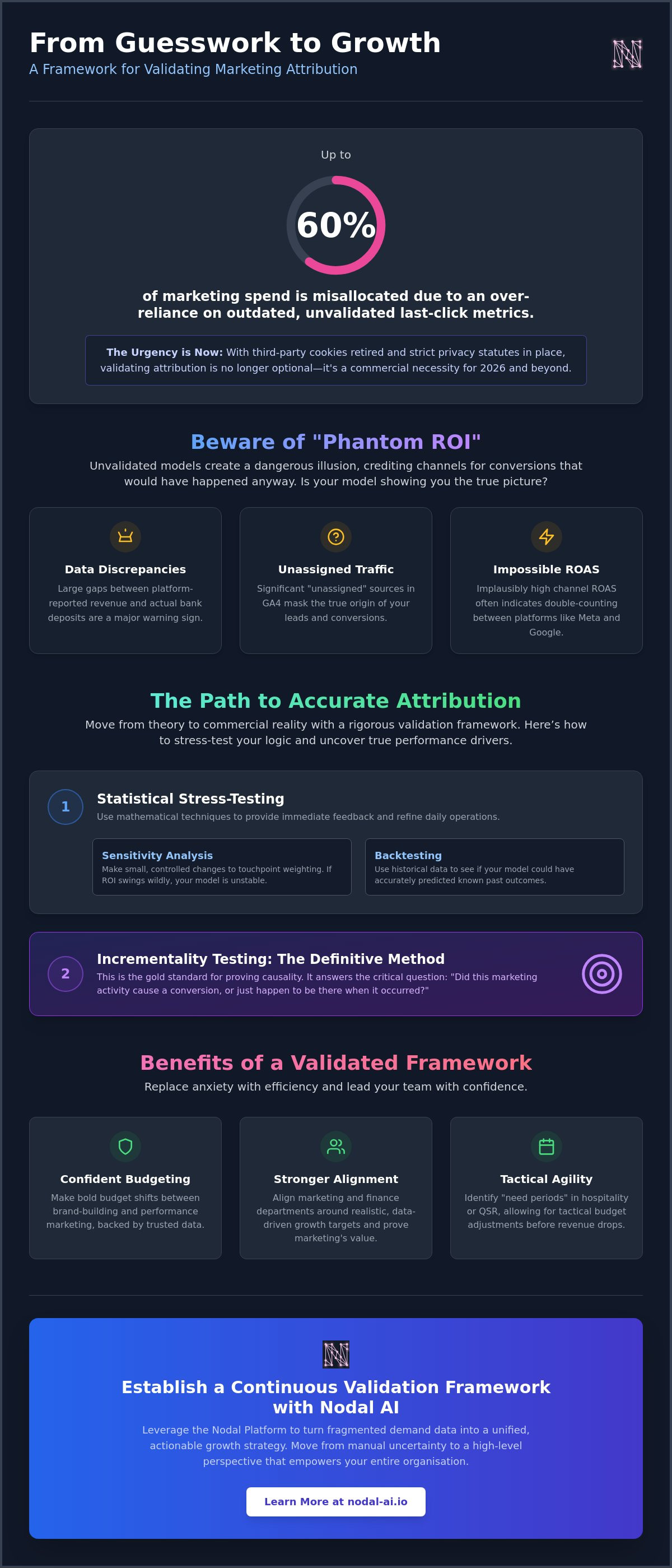
Did you realise that up to 60% of marketing spend is currently misallocated due to an over-reliance on outdated last-click metrics? In 2026, with twenty US states enforcing comprehensive privacy statutes and third-party cookies finally retired, the process of validating marketing attribution models has become a commercial necessity rather than a technical luxury. You likely feel the pressure of fragmented data across your CRM and internal systems, making it difficult to prove genuine incrementality to the board. It is a common source of professional anxiety, yet it is entirely solvable with the right approach.
This guide provides the clarity you need to transform chaotic inputs into high-value outputs. You will learn how to verify the accuracy of your marketing data and ensure your attribution models drive genuine commercial growth. We will explore a reliable framework for testing model accuracy, providing you with the confidence to make bold budget reallocation decisions while reducing your cost per acquisition. Master these future-facing analytics and move from manual uncertainty to a streamlined, high-level perspective that empowers your entire organisation.
Key Takeaways
- Eliminate the risk of phantom ROI by ensuring your attribution logic aligns with actual consumer behaviour.
- Deploy statistical methods such as backtesting and sensitivity analysis to verify the integrity of your performance marketing analytics.
- Adopt incrementality testing as the definitive method for validating marketing attribution models and proving causality to the board.
- Solve data fragmentation by connecting digital clicks to physical transactions for a unified view of the hospitality customer journey.
- Leverage the Nodal Platform to establish a continuous validation framework that turns demand data into actionable growth recommendations.
Why Validating Your Marketing Attribution Model is Essential for Growth
Accuracy is the only currency that matters in modern marketing. While most teams start with a foundational definition of marketing attribution to assign value to touchpoints, the logic often remains static and theoretical. Validation is the active bridge between that theory and commercial reality. It's the rigorous process of verifying that your attribution logic matches real-world customer behaviour. Without this verification step, your data is merely a collection of educated guesses that fail to reflect how people actually buy.
The cost of ignoring this step is high. We call the result of unvalidated models "phantom ROI." It's a dangerous illusion. When models aren't validated, they often credit channels for conversions that would have occurred regardless of the ad spend. Current research suggests that up to 60% of marketing spend is misallocated under outdated last-touch models. Validating marketing attribution models ensures that every pound you invest drives incremental growth rather than just claiming credit for existing momentum.
Validation allows you to move from purely descriptive data to predictive modelling. This transition is vital. It turns your marketing data into an active participant in your business strategy. When you trust your model, you can forecast future performance with precision. This shift relies entirely on data integrity. If you feed fragmented data from disconnected systems into an unvalidated model, the output remains chaotic and unreliable.
Common Signs Your Attribution Model is Failing
Identifying a broken model is the first step toward recovery. Look for these red flags in your current reporting:
- Large discrepancies between platform-reported revenue and actual bank deposits.
- Significant "unassigned" traffic in GA4 that masks the true source of your leads.
- Channel-specific ROAS that seems impossibly high, which usually points to double-counting between Meta and Google.
The Strategic Benefits of a Validated Framework
A validated framework replaces anxiety with streamlined efficiency. It provides the high-level perspective needed to lead a modern marketing department. Key benefits include:
- Increased confidence when shifting budgets between long-term brand building and short-term performance marketing.
- Stronger alignment between marketing teams and finance departments regarding realistic growth targets.
- The ability to identify "need periods" in hospitality and QSR sectors, allowing for tactical budget adjustments before revenue drops.
The Statistical Methods for Validating Attribution Accuracy
Testing the integrity of your data requires more than a cursory glance at a dashboard. It demands a rigorous, mathematical approach to ensure your insights reflect reality. Validating marketing attribution models is essentially a stress test for your logic. It moves you away from the trap of simply rewarding the channels that happen to appear at the end of every customer journey. Instead, it focuses on identifying the true drivers of conversion through structured statistical techniques.
Sensitivity analysis is a primary tool in this process. By making small, controlled changes to touchpoint weighting, you can observe how the final output shifts. If a minor adjustment in a mid-funnel weight causes a massive swing in reported ROI, your model is likely unstable. This instability often stems from a confusion between correlation and causation. While running incrementality tests remains the definitive way to prove causality, statistical cross-validation provides the immediate feedback needed to refine your daily operations. By comparing your current outputs against established marketing attribution benchmarks, you can identify specific areas where credit inflation is distorting your view of channel performance.
Implementing Backtesting in Your Analytics Workflow
Backtesting is the process of using historical data to see if your model could have predicted known outcomes. It transforms your data from a passive archive into an active validation tool. You can implement this by following a structured workflow:
- Select a hold-out data set: Set aside a portion of your historical data, such as a specific month of transactions, to test the model's accuracy against real outcomes.
- Measure Variance: Use the Mean Absolute Percentage Error (MAPE) to quantify the difference between what your model predicted and what actually occurred.
- Refine Weighting: Adjust your weights based on this historical accuracy rather than relying on generic industry averages that may not apply to your specific business model.
Comparing Multi-Touch to Baseline Models
Complexity is only valuable if it provides superior insights. Always use Last-Click and First-Click as "control" models to measure the actual value-add of your multi-touch approach. This comparison often reveals "credit inflation" in mid-funnel channels that appear frequently but contribute little to the final conversion decision. The Nodal Platform automates this complex comparison process to save your team hours of manual calculation. If you are looking to stabilise your reporting, you can explore our automated reporting features to gain a clearer perspective on your genuine channel performance.
Running Incrementality Tests to Prove True Marketing Lift
Incrementality is the true north of marketing measurement. It answers the fundamental question that haunts every marketing director: "How many of these conversions would have happened anyway?" While multi-touch models provide a granular view of the journey, they often suffer from selection bias. Lift testing is the gold standard of validation because it moves beyond reporting to prove causality. It is the final, essential step in validating marketing attribution models to ensure your budget is actually driving growth rather than just claiming credit for it.
Designing a clean test requires precision and a willingness to challenge your existing assumptions. You might use geo-testing to isolate specific regions or audience splitting to create a control group. Some brands even employ "dark periods" by pausing spend entirely in specific channels to observe the natural baseline of sales. These findings shouldn't live in a silo. You must feed these insights back into your AI marketing analytics to ensure your automated systems learn from real-world experiments. This creates a continuous feedback loop that replaces static logic with dynamic, validated intelligence.
Types of Incrementality Tests for UK Marketers
Matched Market Testing is particularly effective for UK-based organisations. You can compare performance in similar cities, such as Manchester and Birmingham, to see the actual lift of a regional campaign. Intent-based testing uses "ghost ads" to track a control group without showing them an actual ad. Finally, brand search suppression involves pausing bids on your own brand keywords. This reveals whether you are paying for clicks from users who would have found your organic listing anyway. It is a simple yet powerful way of validating marketing attribution models in high-intent environments.
Analysing the Results of a Lift Study
Successful validation requires looking at the "Incremental Cost Per Acquisition" (iCPA). This metric shows the true efficiency of your spend by only counting the conversions you actually caused. It often identifies "cannibalisation" where paid channels merely steal conversions from organic search. If your current reporting feels like it's taking credit for natural demand, it is time to upgrade your perspective. You can book a demo today to see how the Nodal Platform transforms these complex lift insights into actionable growth recommendations.
Solving the Data Fragmentation Problem in Hospitality Attribution
Hospitality marketing presents a unique challenge that standard analytics tools often fail to address. A customer might engage with a social ad in January but not complete a physical check-in until June. This delay creates a massive gap between digital clicks and real-world revenue. Validating marketing attribution models in this context requires you to connect disparate data points from Property Management Systems (PMS) and Point of Sale (POS) transactions. Without this link, your reporting remains a collection of disconnected signals rather than a coherent strategy.
The complexity increases when you consider external variables. Factors like local events, weather patterns, and FX rates act as powerful validation signals for your model. If an attribution model credits a surge in bookings to a specific ad campaign during a major local festival, you must verify if the ad drove the lift or if it was merely natural demand. Creating a unified customer journey allows you to filter out these external noise factors and identify the true impact of your marketing spend.
Integrating PMS and CRM Data for Total Clarity
True validation starts with mapping guest IDs across every booking engine and operational system you use. Don't settle for "ghost" conversions that appear in your ad dashboard but never result in a completed stay. By integrating your PMS data directly into your performance marketing analytics, you can verify digital touchpoints against actual transaction records. The Nodal Platform excels at this by consolidating these fragmented sources into a single, high-level perspective. It replaces the anxiety of manual data matching with the confidence of automated, real-time accuracy.
Overcoming the Walled Garden Blind Spot
Meta and Google often operate as "walled gardens," reporting conversion data that benefits their own platforms. You must use your first-party data to validate these claims and prevent credit inflation. This process requires a robust data governance framework to ensure you handle sensitive guest information in a privacy-compliant manner. Nodal AI employs advanced algorithmic processing to bridge these data gaps safely, ensuring your insights remain accurate without compromising security. If you are ready to eliminate the blind spots in your reporting, you can book a demo of the Nodal Platform today to see your true commercial performance.
Building a Continuous Validation Framework with Nodal AI
Static audits provide a snapshot of the past, but true commercial growth requires a dynamic view of the present. Building a continuous framework for validating marketing attribution models transforms your data from a passive record into an active growth engine. By moving beyond one-off audits to an automated, modular validation engine, you ensure your logic remains accurate as consumer behaviour shifts. This constant recalibration allows you to identify early signs of "need periods" before they impact your bottom line, enabling tactical budget shifts that protect your revenue.
The Nodal Platform specifically targets the inefficiencies that plague hospitality and wellness brands. For instance, by validating the effectiveness of direct booking campaigns, you can actively reduce OTA leakage and keep more profit within your organisation. This transition from manual guesswork to validated demand data turns chaotic inputs into immediate commercial action through our growth recommendations. It replaces the anxiety of unproven spend with the confidence of a model that evolves alongside your customers.
The Nodal Platform: Modular Intelligence for Commercial Teams
Success in 2026 requires a system that adapts to your specific sector. The Nodal Platform offers customised validation modules designed for the unique customer journeys of hotels, QSR, and wellness businesses. You can explore the features that allow for real-time performance tracking and automated reporting. This modular approach has already proven its value in the real world. For example, Ovolo Hotels achieved a 24.5% increase in ROAS by using our validated insights to refine their channel mix. They moved from fragmented data to a high-level perspective that prioritises genuine commercial returns.
Setting Up Your 2026 Validation Roadmap
Transforming your measurement strategy requires a structured approach. Start by auditing your current model to identify the biggest gaps in your data integrity. Follow these steps to build your roadmap:
- Prioritise data sources: Integrate systems based on their direct revenue impact, starting with your PMS and CRM.
- Establish a quarterly schedule: Run incrementality tests every three months to ensure your validating marketing attribution models process accounts for seasonal shifts.
- Automate your intelligence: Encourage your team to move away from manual spreadsheets and embrace automated, validated reporting.
Your journey toward total clarity begins with a single step. Audit your current logic, identify where "phantom ROI" is hiding, and prepare your organisation for a cognitive upgrade that turns data into a competitive advantage.
Master Your Commercial Growth Through Validated Intelligence
The future of marketing measurement belongs to those who replace guesswork with structured verification. By mastering the process of validating marketing attribution models, you transform fragmented data into a strategic asset that drives genuine commercial lift. You now have the framework to move beyond the limitations of walled gardens and the anxiety of unproven spend. This transition from manual reporting to automated, high-level perspectives is the key to sustainable performance in a privacy-first world.
Nodal AI provides the cognitive upgrade your organisation requires to thrive. Our platform has already delivered a 15.3% reduction in acquisition costs for Ovolo Hotels by leveraging AI-driven audience segmentation for high-propensity guests. Supported by our London-based expert team, you can resolve complex data mapping issues and reclaim control over your marketing budget. Book a personalised demo of the Nodal Platform today to turn your chaotic inputs into high-value growth. Your journey toward total clarity starts here.
Frequently Asked Questions
What is the most accurate marketing attribution model for hospitality?
Algorithmic models are the superior choice for hospitality brands. These models use machine learning to analyse the entire customer journey, from the initial digital click to the final physical check-in. This approach is more accurate than static rules because it accounts for the long lead times and multiple devices typical in hotel bookings. It replaces the simplicity of last-click with a high-level perspective on true commercial value.
How often should I validate my attribution model?
You should perform a comprehensive audit at least quarterly to align with seasonal shifts in demand. However, the most effective organisations use automated systems for the continuous process of validating marketing attribution models. This ensures your data remains accurate as privacy regulations and platform algorithms evolve. Frequent checks prevent the accumulation of "phantom ROI" that can lead to significant budget misallocation over time.
Can I validate my attribution model without a data scientist?
You don't need a dedicated data scientist if you use a platform designed for commercial accessibility. Modern tools automate the complex statistical processes of backtesting and sensitivity analysis. This allows marketing directors to move directly from fragmented inputs to clear growth recommendations. It turns a technical hurdle into a streamlined experience that empowers your team to make confident, data-backed decisions without deep technical specialisation.
What is the difference between model calibration and model validation?
Calibration is the internal process of fine-tuning your model's weights based on past data. Validation is the external verification step that proves those weights lead to accurate real-world predictions. Think of calibration as setting the dial and validation as checking if the dial is actually telling the truth. Both are necessary to ensure your performance marketing analytics drive genuine commercial stability and long-term growth.
How do I handle "dark social" or untrackable touchpoints in my validation?
You can capture the impact of "dark social" through a combination of incrementality testing and post-purchase surveys. These methods provide a cognitive upgrade to your tracking by identifying the hidden influence of word-of-mouth and private messaging. By comparing "dark" periods with active campaign phases, you can quantify the lift generated by channels that traditional digital pixels simply cannot see.
Why does Google Ads report different revenue than my internal CRM?
Discrepancies often arise because Google Ads typically uses a different attribution window than your internal CRM. Additionally, ad platforms often operate in "walled gardens" that claim credit for conversions even if other channels were involved. Validating marketing attribution models against your primary source of truth, such as your PMS or CRM, is the only way to eliminate this double-counting and ensure financial transparency.
Is multi-touch attribution still valid with the phase-out of third-party cookies?
Multi-touch attribution is still essential but it has evolved into a privacy-first methodology. With the deprecation of third-party cookies, the focus has shifted toward first-party data and server-side tracking. Algorithmic models now use AI to identify patterns in your own data, replacing the need for invasive cross-site tracking. This transition ensures your measurement remains enterprise-ready while respecting modern consumer privacy standards.
How can incrementality testing improve my marketing budget efficiency?
Incrementality testing identifies the conversions that would not have occurred without a specific ad spend. This process improves efficiency by revealing "cannibalisation" where paid ads are merely stealing credit from organic search results. By cutting spend on these low-impact touchpoints, you can reallocate your budget to channels with proven lift. This results in a measurable reduction in cost per acquisition and increased commercial momentum.


