

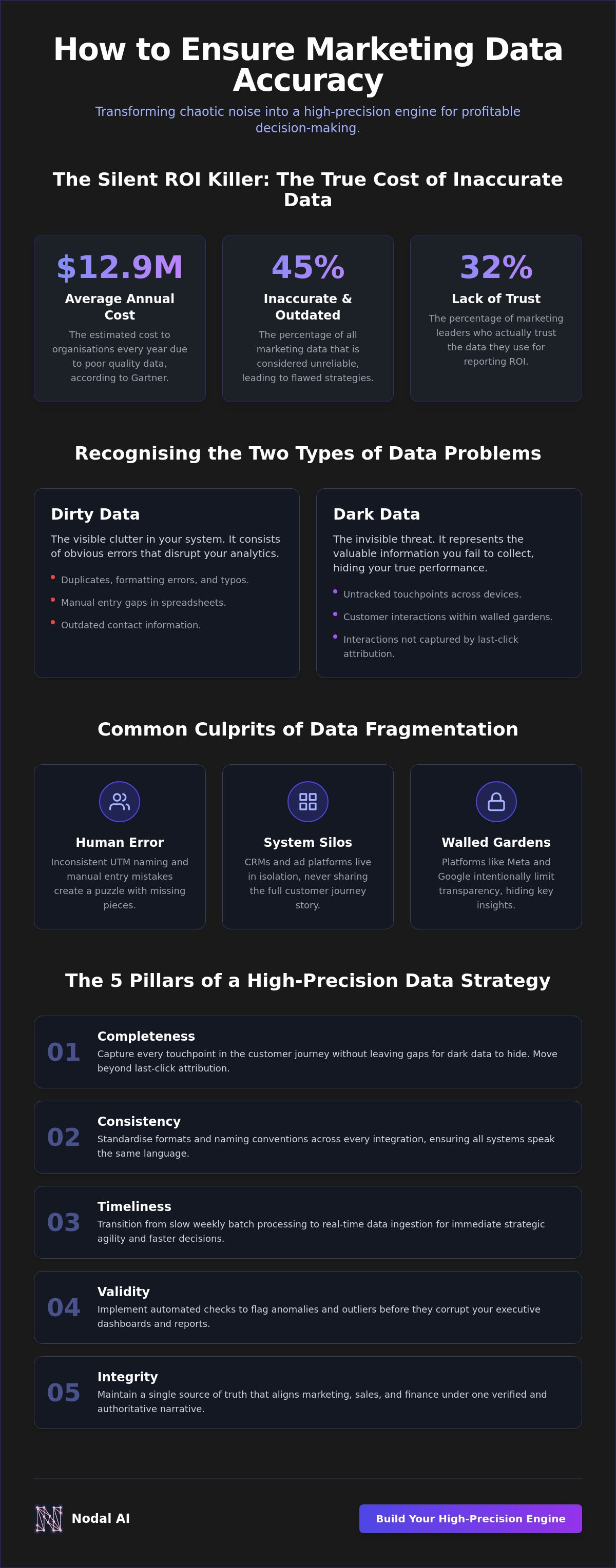
Gartner estimates that poor data quality costs organisations an average of $12.9 million every year. When 45% of all marketing data is considered inaccurate or outdated, your strategy isn't just leaking budget; it's flying blind. You likely feel the weight of this reality every time you face conflicting reports or spend hours manually scrubbing spreadsheets. Learning how to ensure marketing data accuracy is no longer a back-office maintenance task. It is the fundamental structural prerequisite for any brand that expects to turn passive data into an active participant in business growth.
We understand the anxiety of reporting ROI to the board when only 32% of marketing leaders actually trust the data they use. It's exhausting to watch ad spend vanish into poor targeting while your team drowns in fragmented inputs. This guide will show you how to transform that chaotic noise into a high-precision engine for profitable decision-making. We will explore the shift to AI-driven orchestration, the impact of 2026 privacy mandates like the Global Privacy Control, and the exact roadmap to unify your performance marketing analytics into a single, authoritative source of truth.
Key Takeaways
- Identify the "silent ROI killer" and learn why minor tracking inaccuracies lead to major strategic failures in your marketing spend.
- Master how to ensure marketing data accuracy by applying the five pillars of high-precision strategy to every stage of your customer journey.
- Escape the "audit trap" of manual spreadsheet cleaning by transitioning to AI-driven orchestration that identifies and repairs data gaps in real time.
- Establish a future-ready governance framework that uses a global taxonomy to standardise every integration and entry point in your ecosystem.
- Transform your analytics into a growth engine by using automated reporting and multi-touch attribution to drive profitable, high-level business decisions.
What is Marketing Data Accuracy and Why Does it Fail?
Marketing data accuracy is the pulse of your growth engine. It represents the degree to which your digital records correctly reflect real-world customer behaviour. High data quality is no longer a back-office concern; it is the difference between a scaling brand and a sinking ship. If you want to understand how to ensure marketing data accuracy, you must first recognise that your data is often actively fighting against your objectives.
We call this the "Silent ROI Killer." A mere 10% discrepancy in your conversion tracking doesn't just mean your reports are slightly off. It means your entire bidding algorithm is optimising for the wrong signals. In the 2026 landscape, fragmented data is the natural state of multi-channel marketing. If you don't actively intervene, you're making 100% of your strategic decisions based on a distorted reality. Stop guessing based on chaotic inputs and start leading with a high-precision engine.
To fix the problem, you must distinguish between "Dirty Data" and "Dark Data." Dirty data consists of duplicates, formatting errors, and manual entry gaps that clutter your spreadsheets. Dark data is more insidious. It represents the untracked touchpoints that happen across devices or within walled gardens. Both create a fog that hides your true performance and prevents you from identifying your most profitable channels. Recognising these gaps is the first step toward total clarity.
The True Cost of Inaccurate Marketing Insights
Faulty data leads directly to wasted ad spend. You target the wrong audience because your attribution model is feeding on ghosts rather than real customers. This leads to eroded trust across the organisation. When marketing reports show record-breaking leads but the sales board remains empty, the resulting friction paralyses your growth. Finally, consider the opportunity cost. You miss critical growth recommendations simply because the valuable signals were lost in the noise of inaccurate reporting.
Common Culprits: Why Your Data is Fragmented
Human error remains a persistent thorn. Inconsistent UTM naming conventions and manual entry mistakes turn your analytics into a jigsaw puzzle with missing pieces. System silos exacerbate this by creating a language barrier between your CRM and your ad platforms. These systems often live in isolation, never sharing the full story of the customer journey. Finally, the Walled Garden effect from platforms like Meta and Google limits transparency. They intentionally hide the very insights you need to scale your business efficiently.
The 5 Pillars of a High-Precision Marketing Data Strategy
Building a high-precision engine requires more than just cleaning up a few spreadsheets. It demands a structural overhaul based on five non-negotiable pillars. This framework is essential for any leader who wants to understand how to ensure marketing data accuracy at an enterprise scale. By moving away from fragmented, passive inputs, you can transform your analytics into an active participant in your business growth.
- Completeness: Capture every touchpoint in the customer journey without leaving gaps for dark data to hide.
- Consistency: Standardise formats across every integration and data source to ensure your systems speak the same language.
- Timeliness: Transition from weekly batch processing to real-time data ingestion for immediate strategic agility.
- Validity: Implement automated checks to flag anomalies and outliers before they hit your executive dashboard.
- Integrity: Maintain a single source of truth that aligns marketing, sales, and finance under one verified narrative.
Adopting these pillars replaces the anxiety of manual reporting with the confidence of streamlined, high-level perspectives. It is the only way to move from a defensive posture to a competitive, forward-thinking strategy that delivers measurable returns.
Completeness: Capturing the Full Journey
Last-click attribution is a symptom of incomplete data. It ignores the nuanced reality of modern buying. When you fail to map cross-device interactions accurately, you lose sight of the early-stage touchpoints that actually drive high-value conversions. Data completeness is the capture of every meaningful interaction from first touch to final sale. Without this full picture, your performance marketing analytics will always remain a partial fiction.
Consistency and Standardisation
Inconsistent naming conventions for campaigns and assets are a primary source of friction. You must harmonise disparate metrics, such as "Sessions" from one platform and "Visits" from another, into a single, transparent view. This alignment is a core part of Marketing's Data Quality Imperative. To achieve this, your team should follow a data governance framework that mandates a unified taxonomy for all marketing parameters. If you are ready to see this level of precision in action, you can book a demo to explore our multi-touch attribution capabilities.
Manual Audits vs. AI-Driven Data Orchestration
Many teams fall into the "Audit Trap" by treating data hygiene as a periodic cleaning project. This approach provides only a temporary illusion of accuracy. By the time you finish scrubbing your CRM or ad platforms by hand, the data is already outdated. To understand how to ensure marketing data accuracy in a way that actually scales, you must move beyond manual intervention. You need a system that doesn't just store data; it must actively manage it. Transforming chaotic inputs into high-value outputs requires a shift from reactive cleaning to proactive orchestration.
The Limits of the Manual Audit
Manual audits are fundamentally limited by human fatigue. In large-scale operations, oversight is inevitable. When your team spends hours cleaning spreadsheets, they aren't just losing productivity; they are making decisions on "clean" data that is often two weeks old. This lag time is a death sentence for strategic agility. Auditing the complex inputs required for predictive modelling by hand is also practically impossible. The sheer volume of variables makes human validation a bottleneck that prevents you from achieving true analytics success.
The AI Advantage in Data Quality
AI-driven orchestration introduces a self-healing layer to your data ecosystem. These systems use pattern recognition to spot tracking breaks and anomalies that a human eye would inevitably miss. This proactive approach ensures that your AI marketing analytics are built on a foundation of verified, high-precision signals. By automating deduplication and identity resolution across fragmented sources, you create a seamless flow of information that remains accurate regardless of how many new channels you add to your mix.
The efficiency gains are immediate and measurable. Implementing automated reporting can save your team 20 or more hours of manual labour every week. This reclaimed time allows your experts to focus on high-level growth recommendations rather than tedious data entry. Learning how to ensure marketing data accuracy at scale is no longer a question of hiring more people. It is a question of deploying the right technology to turn raw, passive assets into active participants in your business growth.
Implementing Your 2026 Data Governance Framework
Governance is the bridge between chaotic inputs and strategic clarity. To master how to ensure marketing data accuracy, you must move beyond occasional cleanups and establish a rigorous, automated rulebook. This framework ensures that your data remains an active, reliable asset rather than a liability. By following a structured journey, you can replace reporting anxiety with the confidence of high-level perspectives. Follow these five steps to build your foundation for growth.
- Step 1: Map your data ecosystem. Identify every entry point, from social platforms to your CRM, and document every integration in your stack.
- Step 2: Establish a Global Taxonomy. Create a universal naming convention for UTMs, campaign tags, and assets to ensure total consistency across channels.
- Step 3: Centralise fragmented data. Move away from platform-specific silos and unify your information into a single analytics platform.
- Step 4: Automate the validation layer. Deploy systems that catch errors at the source before they can distort your executive dashboards.
- Step 5: Define data ownership roles. Assign clear accountability within your marketing and RevOps teams to maintain the integrity of the system.
Standardising the Foundation
Precision starts with the tools your team uses every day. A master UTM builder is essential; it prevents "creative" tagging by different team members that otherwise leads to fragmented reporting. Your framework must also address the rigorous privacy landscape of 2026. This includes complying with new state laws in Indiana and Kentucky, as well as Oregon's strict geolocation data bans. A data governance framework is the rulebook that prevents fragmented data from re-emerging in your ecosystem. It ensures you are legally compliant while maintaining the high-precision signals needed for Performance Marketing Analytics.
Continuous Monitoring and Auditing
A static framework is not enough. You must implement "Data Health" alerts that trigger the moment conversion tracking drops or anomalies appear. This real-time vigilance allows your team to fix issues before they impact your quarterly results. Conduct quarterly stress tests on your attribution models to ensure they still reflect evolving customer behaviour. By using performance analytics to monitor integrity in real-time, you turn passive monitoring into a competitive advantage. If you want to see how an automated governance layer can protect your ROI, book a demo to explore the Nodal Platform today.
From Accurate Data to Profitable Decisions with Nodal AI
High-precision data is the only foundation for reliable marketing attribution. Without a verified baseline, your models are merely sophisticated guesses that risk misallocating millions in capital. The Nodal Platform replaces this uncertainty by automating the transformation of raw, chaotic inputs into high-value growth recommendations. By eliminating the "Attribution Gap," we help you move beyond the limitations of last-click reporting and into a new era of true multi-touch intelligence. This transition represents a cognitive upgrade for your entire organisation: your team stops acting as data janitors and starts leading as strategic architects.
Mastering how to ensure marketing data accuracy is not just about fixing errors; it is about empowering your leadership with 100% confidence in every report. When your data is an active participant in your business process, you can finally stop arguing over platform discrepancies and start focusing on market expansion. The Nodal Platform provides the streamlined, high-level perspective required to turn complex technical inputs into effortless commercial outcomes.
The Nodal Platform: Your Single Source of Truth
Our platform integrates fragmented sources into one clear, actionable dashboard that removes the fog of multi-channel marketing. By leveraging advanced AI, we identify hidden trends and predict future customer behaviour with a level of precision that manual analysis cannot match. This centralisation reduces the anxiety of decision-making. You no longer have to worry about reporting incorrect ROI to the board because your dashboard is powered by high-confidence, real-time data that has been validated at the source. It is the relief of total clarity in an otherwise chaotic landscape.
Achieving Scalable Growth
Accurate data enables precise ROAS calculation and ad spend optimisation that directly impacts your bottom line. With Nodal, you move from a "defensive" posture of constant data cleaning to an "offensive" growth strategy. You can confidently scale winning campaigns and cut underperforming channels with surgical precision. This shift is what separates market leaders from those struggling with wasted spend. If you are ready to turn your fragmented data into a high-precision engine for profitable growth, book a demo of the Nodal Platform today and experience the power of streamlined analytics.
Master Your Data to Scale Your Growth
The transition from fragmented tracking to high-precision intelligence is the defining competitive advantage of 2026. You now understand that manual audits offer only a temporary illusion of clarity, whereas AI-driven orchestration provides a self-healing foundation for your entire ecosystem. By establishing a rigorous governance framework and a unified taxonomy, you have the roadmap for how to ensure marketing data accuracy across every customer touchpoint. This structural upgrade replaces the anxiety of conflicting reports with the confidence of streamlined, high-level perspectives.
It is time to turn your passive assets into active participants in your business journey. With the right technology, you can move beyond last-click limitations to a state of total transparency and measurable returns. This cognitive upgrade empowers your organisation to stop acting as data janitors and start leading as strategic architects.
Transform your fragmented data into profitable growth with Nodal AI. Our platform provides AI-powered multi-touch attribution, automated reporting for London enterprises, and predictive growth recommendations based on high-precision data. Your path to frictionless progress starts now.
Frequently Asked Questions
How do I know if my marketing data is currently inaccurate?
You know your data is inaccurate when your advertising platforms report conversions that never appear in your CRM or bank account. Significant discrepancies between Meta Ads and Google Analytics are immediate red flags. If your team spends more time debating which report is "correct" than executing strategy, you are dealing with a fundamental breakdown in data quality.
What are the most common causes of data fragmentation in 2026?
Data fragmentation in 2026 is primarily driven by the rise of walled gardens and stricter privacy mandates like the Global Privacy Control (GPC). These regulations eliminate 30-40% of traditional trackable conversion signals. Additionally, system silos between performance marketing analytics and sales platforms prevent a unified view of the customer journey, leaving touchpoints untracked and disconnected.
Can AI really fix my historical marketing data errors?
AI cannot rewrite the past, but it can use predictive modelling to fill gaps in historical datasets through statistical inference. While it won't "fix" a broken pixel from last year, it can identify patterns in messy data to provide high-confidence estimates of past performance. For future growth, AI-driven orchestration ensures these errors don't recur by validating signals in real time.
How often should a marketing team perform a data audit?
You should move away from periodic audits toward continuous, automated monitoring. While a deep structural "stress test" is recommended quarterly, manual audits are often outdated the moment they are finished. Modern teams use automated reporting to flag tracking breaks immediately. This shift ensures you are always making decisions based on verified, high-precision signals rather than waiting for a scheduled cleanup.
What is the difference between data accuracy and data integrity?
Data accuracy refers to how closely your digital records reflect real-world customer behaviour. Data integrity is broader; it encompasses the consistency, security, and structural soundness of your data as it moves through your ecosystem. To understand how to ensure marketing data accuracy, you must first build a foundation of integrity where every integration follows a strict, universal taxonomy.
How does inaccurate data affect my multi-touch attribution models?
Inaccurate data paralyse multi-touch attribution by feeding the model "ghost" signals or missing critical early-stage touchpoints. If your tracking is incomplete, the algorithm will disproportionately credit the wrong channels. This leads to wasted ad spend as you over-optimise for low-value interactions while neglecting the true drivers of profitable growth. Precision is the only path to reliable attribution.
What are the first steps to building a data governance framework?
Start by mapping your entire data ecosystem to identify every entry point and integration. Once mapped, establish a global taxonomy for all marketing parameters, including UTMs and naming conventions. This "rulebook" prevents fragmented data from re-emerging. Finally, assign clear ownership roles within your RevOps team to maintain these standards and protect your performance marketing analytics.
Is manual data entry always the primary cause of errors?
Manual entry is a significant factor, but it is no longer the sole culprit. In 2026, technical silos and the loss of third-party cookies create systematic gaps that human effort cannot bridge. Learning how to ensure marketing data accuracy requires solving for these technical hurdles through automated orchestration rather than simply training staff to be more careful with spreadsheets.


