

Did you know that 91% of top-performing marketers are now using predictive strategies to secure their competitive edge? If you're still struggling to justify budget increases while staring at fragmented dashboards, you're not alone. It's exhausting to watch your marketing spend vanish into a black hole of inaccurate last-click attribution models that fail to reflect the true customer journey. Implementing predictive analytics for marketing budget allocation is no longer a luxury for the few; it is a fundamental requirement for any brand that values commercial stability.
We recognise the frustration of manual labour and the anxiety of reporting on disconnected metrics. This guide promises to show you how to eliminate data silos and accurately connect every marketing pound spent to final revenue using AI-driven predictive modelling. You will learn to establish a single source of truth for your performance, enabling you to allocate funds with total confidence and produce automated reporting that links your strategic spend directly to actual sales.
Key Takeaways
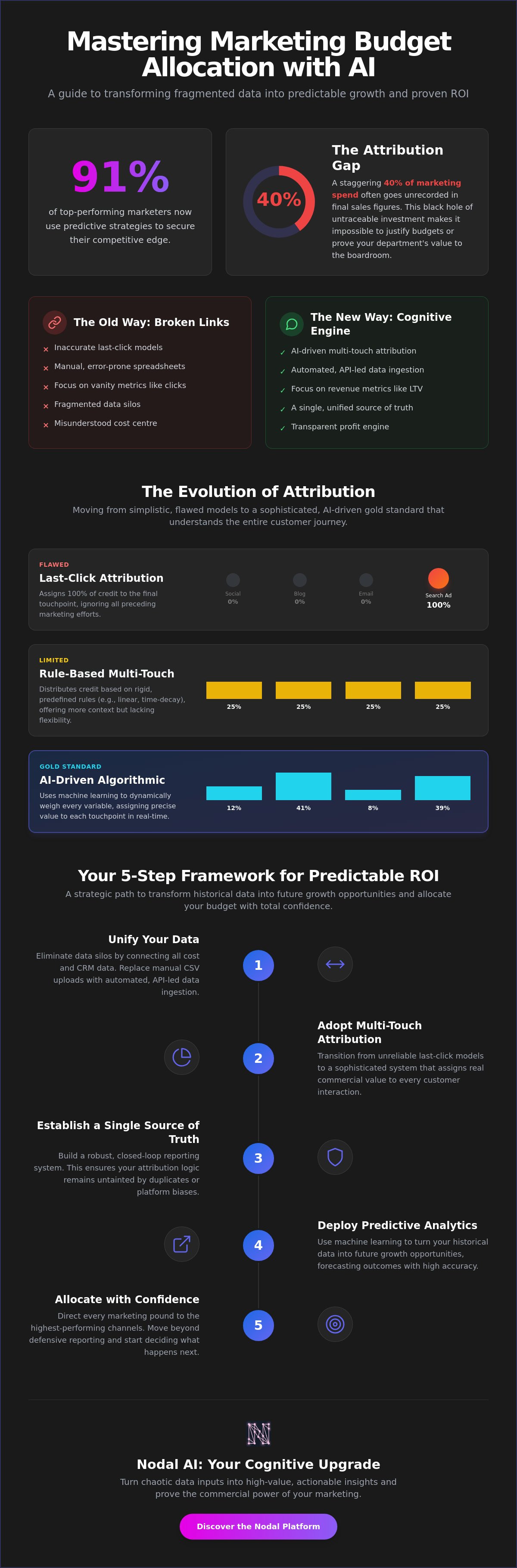
- Identify the hidden attribution gap where 40% of marketing spend often goes unrecorded; learn how to unify these fragmented costs with final conversion outcomes.
- Master the transition from unreliable last-click models to sophisticated multi-touch attribution that assigns real commercial value to every customer interaction.
- Build a robust, closed-loop reporting system by replacing manual CSV uploads with automated, API-led data ingestion between your CRM and advertising platforms.
- Deploy a strategic five-step framework using predictive analytics for marketing budget allocation to transform your historical data into future growth opportunities.
- Discover how Nodal AI acts as a cognitive upgrade for your organisation, turning chaotic data inputs into high-value, actionable insights.
The Fragmented Data Crisis: Why Linking Spend to Sales is Broken
Linking spend to sales is the process of unifying cost data with conversion outcomes. It sounds fundamental. However, for most marketing leaders in 2026, it remains an elusive goal. The modern enterprise is currently battling a fragmented data crisis that makes true visibility nearly impossible. Mastering predictive analytics for marketing budget allocation is the only way to survive this complexity and turn chaotic inputs into high-value commercial outputs.
The Attribution Gap is the primary culprit. Statistics indicate that 40% of marketing spend often goes unrecorded in final sales figures. This invisibility makes it impossible to defend your strategy or secure additional funding. When nearly half of your investment is untraceable, your budget is perpetually at risk. You aren't just losing data; you're losing the ability to prove your department's worth to the boardroom.
Traditional spreadsheets are failing because they are manual, tedious, and entirely static. They cannot capture the pulse of a market that moves at the speed of AI. To bridge this gap, businesses must integrate predictive analytics to turn historical chaos into future growth. Implementing predictive analytics for marketing budget allocation allows you to move beyond defensive reporting. You stop asking what happened and start deciding what will happen next with absolute precision.
This transformation requires a psychological shift. You must move away from vanity metrics like clicks and impressions. They feel good, but they don't pay the bills. The new standard is revenue metrics, specifically margin and customer lifetime value. This transition turns marketing from a misunderstood cost centre into a transparent profit engine that speaks the language of the CFO.
The High Cost of Data Silos in 2026
Disconnected platforms create a hall of mirrors. Social media tools and search engines often double-count the same conversion, leading to inflated reports that don't match the actual bank balance. This fragmentation destroys team morale and kills budget confidence. Last-click models are the enemy of true ROI; they reward the final touchpoint while ignoring the strategic work that actually built the demand and nurtured the lead.
The Evolution of the Multi-Channel Journey
Visibility is further clouded by the rise of dark social. Conversations in private groups and direct messages drive massive value but leave no digital footprint for basic tracking tools. Tracking touchpoints across social, search, and offline channels requires a more sophisticated, cognitive lens. The modern customer journey is a non-linear path from awareness to revenue.
The Mechanics of Predictive Analytics for Marketing Budget Allocation
Understanding the internal mechanics of predictive analytics for marketing budget allocation requires a shift from simple historical tracking to intelligent orchestration. While basic reporting tells you what happened, predictive systems identify the underlying patterns that dictate future success. This process begins with sophisticated marketing attribution, which assigns a specific financial value to every interaction a customer has with your brand across their entire journey.
Traditional budget planning often relies on rule-based models that are too rigid for the volatile 2026 market. Linear models distribute credit equally, which ignores the reality of high-impact touchpoints. Time-decay models favour the final steps, while U-shaped models prioritise the first and last interactions. These frameworks provide more clarity than a single-point view, yet they still lack the cognitive flexibility needed to account for real-time market shifts. To achieve total clarity, you must move toward AI-driven algorithmic attribution. This gold standard uses machine learning to weigh every variable, ensuring your capital is always directed toward the highest-performing channels.
Accuracy in these models is not accidental; it's a product of rigorous data governance. Without clean, unified data, even the most advanced predictive analytics for marketing budget allocation will produce skewed results. Establishing a single source of truth ensures that your attribution logic remains untainted by duplicates or platform-specific biases. If you're ready to see how these mechanics function in a live environment, you can explore our platform features to witness the transition from manual guesswork to automated precision.
Moving Beyond Last-Click Logic
Last-click logic is a dangerous oversimplification that overvalues bottom-of-funnel search while drastically undervaluing brand awareness. When you rely on this incomplete data set, you risk cutting top-of-funnel budgets that actually fuel your long-term pipeline. Multi-touch attribution solves this by providing a holistic view of the entire marketing ecosystem, acknowledging that a sale is rarely the result of a single isolated click.
Algorithmic vs Rule-Based Models
Static rules fail because consumer behaviour isn't static. Rule-based models are essentially "set and forget" guesses that cannot react to a sudden surge in social sentiment or a competitor's aggressive pricing strategy. In contrast, machine learning identifies the true weight of each touchpoint by analysing millions of data permutations. Algorithmic models adapt to real-time consumer behaviour shifts, ensuring your budget allocation remains optimised even as the market evolves.
Overcoming the Silo Barrier: Connecting CRM and Ad Platforms
The Walled Garden problem remains a significant hurdle for marketing leaders. Platforms like Meta and Google often restrict granular data access, which prevents you from seeing the full customer journey across different environments. To break these barriers, you must implement a Closed-Loop reporting system that bridges the gap between your advertising platforms and your CRM. This integration ensures that a lead generated on social media is accurately tracked until the final invoice is paid.
Relying on manual CSV uploads is a strategy destined for failure. It is slow, prone to human error, and creates a lag that makes real-time optimisation impossible. In contrast, automated API-led data ingestion transforms your data from a passive record into an active participant in your business growth. This seamless flow is the foundation of predictive analytics for marketing budget allocation, as it provides the high-fidelity inputs required for accurate forecasting. It replaces the anxiety of "best guesses" with the confidence of hard, integrated evidence.
Establishing a comprehensive data governance framework is essential for global teams. Without it, disparate naming conventions and fragmented tracking protocols will lead to data corruption. A unified framework ensures that every team member, regardless of location, contributes to a single source of truth. This level of organisation is what turns a collection of tools into a cognitive upgrade for your entire business.
Integrating Offline Sales Data
Connecting digital spend to offline conversions, such as phone calls or in-person meetings, requires a sophisticated approach to identity resolution. Use unique identifiers and hashed email matching to link these interactions while maintaining strict GDPR compliance. This allows you to protect consumer privacy while still gaining total clarity on which digital campaigns are driving high-value physical deals. By mapping these offline touchpoints, you eliminate the blind spots that often lead to undervalued marketing performance.
The Role of UTM Parameters and Tracking Templates
Standardising your UTM naming conventions is a non-negotiable requirement for data integrity. Poor implementation often breaks attribution chains, leading to "direct" traffic that masks the true source of your leads. For sectors like hospitality and retail, granular tracking templates enable SKU-level ROI analysis. This level of detail allows you to see exactly which product categories are responding to specific ad creatives. By refining your predictive analytics for marketing budget allocation through these precise tracking protocols, you move from broad guesses to surgical precision in your spend.
A 5-Step Framework for Strategic Budget Allocation
Transforming your marketing department from a cost centre into a profit engine requires a structured, logical journey. You cannot solve a fragmented data crisis with fragmented thinking. By following this 5-step framework, you can move from the anxiety of "best guesses" to the confidence of high-level strategic clarity. This process ensures that predictive analytics for marketing budget allocation becomes a cognitive upgrade for your entire organisation rather than just another disconnected tool.
- Step 1: Audit your current data sources and identify visibility gaps where your capital is leaking.
- Step 2: Implement a unified tracking protocol across all digital assets to ensure consistent data ingestion.
- Step 3: Centralise your data into a single ai marketing analytics platform for total transparency.
- Step 4: Deploy multi-touch attribution models to weigh the commercial value of every customer interaction.
- Step 5: Automate executive dashboards to provide real-time ROI visibility for faster decision-making.
Step 1 and 2: Auditing and Tracking
Data leaks often occur between your advertising platforms and your CRM, leading to skewed performance reports. To resolve this, you must identify where conversions are being lost or double-counted. In the 2026 landscape, traditional cookies are no longer sufficient for accurate tracking. You must pivot to server-side tracking to bypass browser limitations and ensure your data remains high-fidelity. Establishing a clean data foundation is the essential first step before attempting to apply any layer of artificial intelligence.
Step 3, 4 and 5: Centralising and Automating
Choosing between building an in-house analytics stack or using a SaaS platform like Nodal AI is a critical crossroads. For time-strapped London teams, the overhead of maintaining an internal system often outweighs the benefits. A dedicated platform provides immediate access to sophisticated predictive analytics for marketing budget allocation without the need for deep technical specialisation. This automation frees your team from manual, tedious reporting tasks, allowing them to focus on high-value strategy.
The final transition involves moving from historical reporting to predictive growth recommendations. Instead of looking at what happened last quarter, your dashboards will suggest where to move your capital tomorrow for maximum impact. If you are ready to see this framework in action within your own organisation, book a demo of the Nodal AI Platform today to begin your transition to profitable growth.
From Attribution to Intelligence: The Nodal Platform Advantage
The Nodal AI Platform serves as the cognitive upgrade required to master predictive analytics for marketing budget allocation. It acts as the definitive bridge between fragmented data and profitable growth, transforming your passive records into active participants in the business process. While the previous sections of this guide established the necessity of a clean data foundation, Nodal AI provides the engine that powers your transition from reactive reporting to visionary leadership.
Linking your spend to sales data is merely the first stage of the journey. The true competitive advantage lies in predictive modelling, which allows you to look beyond historical performance. By leveraging predictive analytics for marketing budget allocation, you move from defending past spend to dictating future success. This shift replaces the anxiety of manual data reconciliation with the calm efficiency of automated precision. Nodal AI automates these complex reporting tasks, saving your team over 20 hours of manual labour every month.
For London-based enterprises, strategic clarity is often obscured by the sheer volume of multi-channel data. Nodal AI provides a single source of truth that resonates in the boardroom, turning chaotic inputs into high-value commercial outputs. We don't just provide a tool; we act as a highly capable partner for organisations that are obsessed with measurable returns and long-term stability.
AI-Powered Growth Recommendations
Nodal AI identifies underperforming channels before they can waste your capital. Instead of waiting for a monthly review to spot a drop in ROI, the platform provides real-time alerts and growth recommendations. This is particularly powerful for hospitality need periods, where What-If scenarios allow you to simulate the impact of budget shifts before you commit a single pound. Your CMO gains access to board-ready revenue data, providing a clear path to growth that is backed by hard evidence rather than intuition.
Seamless Implementation and Onboarding
Technical setup should never be a barrier to intelligence. We reduce friction through dedicated professional support, ensuring your CRM and ad platforms are connected with surgical precision. Whether you are scaling from local campaigns to global performance analytics, our system adapts to your growing complexity. The transition from fragmented silos to total clarity is inevitable when you have the right infrastructure in place.
Secure Your Commercial Future Through Intelligent Data Orchestration
The transition from fragmented data silos to a single source of truth is a necessity for commercial survival in 2026. By bridging the gap between your CRM and ad platforms, you replace the anxiety of guesswork with the confidence of high-fidelity evidence. Implementing predictive analytics for marketing budget allocation allows your organisation to move beyond reactive reporting and start dictating future growth with surgical precision. You don't just see what happened; you decide what happens next.
As London-based multi-touch attribution specialists, we provide the cognitive upgrade your business needs to thrive. You gain access to AI-driven growth recommendations and dedicated professional support that turns your marketing from a cost centre into a transparent profit engine. This evolution ensures every pound spent is an investment in measurable revenue, providing total clarity for your strategic decision-making.
Book a demo of the Nodal Platform today to transform your disconnected metrics into actionable intelligence. The path to total clarity is ready for you. Take the first step toward a more profitable, data-driven future today.
Frequently Asked Questions
What is the most accurate way to link marketing spend to sales?
The most accurate method for linking spend to sales is implementing a closed-loop system that integrates ad platform costs directly with your CRM conversion data. By deploying unique identifiers and server-side tracking, you can bypass 2026 cookie limitations to ensure every pound spent maps to a specific transaction. This infrastructure removes guesswork from ROI calculations and provides a transparent view of the channels driving actual revenue rather than deceptive vanity metrics.
How does multi-touch attribution differ from last-click models?
Multi-touch attribution (MTA) distributes credit across all touchpoints in the customer journey whereas last-click models give 100% of the credit to the final interaction. Last-click often overvalues search and drastically undervalues brand awareness. Using MTA provides a realistic picture of how social ads, email, and direct visits work together to drive a conversion. This clarity allows for more strategic budget allocation across the entire marketing funnel.
Can I link offline sales data to my digital marketing campaigns?
You can link offline sales, such as phone bookings or in-person visits, by using hashed email matching and unique tracking numbers. Uploading this offline conversion data into a centralised analytics platform allows you to see which digital ads originally prompted the customer to reach out. This is vital for industries like hospitality and upscale F&B where the final transaction often occurs away from a digital screen.
Why is my CRM data often inconsistent with my ad platform spend?
Inconsistency usually arises from data silos and the different attribution windows used by Meta, Google, and your CRM. Ad platforms often claim credit if a user merely saw an ad while your CRM only records the final conversion. Without a centralised data governance framework and a third-party attribution tool, you will likely see double-counted conversions and mismatched revenue figures that make budget planning nearly impossible.
How much time can automated reporting save my marketing team?
Automated reporting can save marketing teams upwards of 20 hours per month by eliminating manual data extraction and spreadsheet merging. Instead of spending days cleaning data, your team can access real-time dashboards that link spend to sales automatically. This allows performance managers to focus on predictive analytics for marketing budget allocation and growth recommendations rather than administrative tasks, significantly increasing the overall productivity of the department.
Is AI-driven attribution compliant with GDPR and data privacy laws?
AI-driven attribution is fully compliant with GDPR when it utilises data prioritisation techniques like hashing and anonymisation. Modern platforms are designed to process data without storing personally identifiable information (PII) in a way that violates privacy standards. By moving to server-side tracking and first-party data strategies, organisations can maintain high levels of attribution accuracy while fully respecting the privacy rights of their customers.
What are the benefits of predictive modelling for marketing spend?
Predictive modelling allows you to move from reactive reporting to proactive planning by forecasting future outcomes based on historical patterns. It enables What-If analysis, allowing you to see how shifting budget from one channel to another might impact your total revenue. This reduces the risk of budget waste and helps you identify early signs of need periods, ensuring your marketing spend is always allocated to the highest-propensity guest segments.
How do I handle walled garden data from Meta and Google?
Handling walled garden data requires an independent analytics layer that ingests data from Meta and Google via APIs and normalises it alongside other channels. Since these platforms do not share granular user-level data, you must use algorithmic predictive analytics for marketing budget allocation to estimate incremental impact. An unbiased platform reconciles the claims of walled gardens with your actual CRM revenue to provide total clarity.


