

If your current measurement strategy relies on third-party scripts, you are likely missing up to 40% of your actual traffic due to ad blockers and privacy-focused browsers. It is an exhausting reality for marketers who are forced to defend ad spend while navigating the complex maze of the Delete Act and evolving GDPR mandates. You deserve strategic clarity, yet the fragmentation across walled gardens often leaves you with more questions than answers.
We are here to show you that privacy is not a data killer; it is a catalyst for a more intelligent way to measure success. By adopting modern privacy-first marketing analytics tools, you can transform fragmented, cookieless data into high-value growth insights using advanced AI-driven modelling. This article explores how to build a future-proof analytics stack that respects user consent while providing automated reporting that proves incremental ROI. We will move beyond the anxiety of compliance and into a new era of streamlined, high-level perspectives that turn chaotic inputs into predictable commercial value.
Key Takeaways
- Master the transition from intrusive tracking to aggregate, consent-based modelling to thrive in the era of the informed consumer.
- Discover how modern privacy-first marketing analytics tools use AI to transform anonymous signals into high-value growth insights.
- Reclaim data ownership by adopting privacy-preserving technologies and server-side tracking that outperform legacy systems.
- Implement a structured five-step framework to audit data leakages and consolidate fragmented sources into a unified intelligence hub.
- Leverage the Nodal Platform to map complex customer journeys while maintaining total compliance with global privacy mandates.
The Evolution of Privacy-First Marketing Analytics in 2026
The marketing world has fundamentally changed. We have moved from a period of intrusive, individual-level tracking to a sophisticated era of aggregate, consent-based modelling. In 2026, the death of the cookie is no longer a future threat; it is a permanent reality. This transition has birthed the Informed Consumer, a user who understands their data value and demands transparency. Consequently, privacy-first marketing analytics tools have shifted from being a compliance checkbox to becoming the primary engine for commercial growth. They turn chaotic, anonymous signals into high-value outputs that drive strategic clarity.
The Digital Markets Act (DMA) has further disrupted the status quo. It forces gatekeeper platforms to alter how they share data with marketers, often resulting in less visibility for those relying on legacy systems. This shift creates a massive gap in attribution. Your challenge is no longer about collecting as much raw data as possible; that era of digital hoarding is over. Modern success depends on transforming limited, privacy-compliant signals into actionable intelligence that drives ROI. The DMA forces gatekeeper platforms to change their data-sharing protocols, impacting marketers in several ways:
- Reduced Granularity: Marketers lose access to individual user-level identifiers previously used for retargeting.
- Consent Signals: Platforms require explicit, verifiable signals before passing data to third-party tools.
- Limited Attribution: Cross-platform conversion tracking becomes significantly more complex without persistent cookies.
Why Traditional Tracking Failed the Modern Marketer
Legacy measurement is broken. Last-click models provide a distorted view of reality, especially in a world where customer journeys span multiple devices and platforms. When you rely on these outdated methods, you ignore the complex influence of top-of-funnel touchpoints. The rise of Walled Gardens has created isolated data silos. Platforms like Meta and Google restrict data flow, leaving marketers with fragmented insights. This fragmentation is the primary barrier to profitable growth. It leads to wasted ad spend and missed opportunities because you cannot see the full picture of customer intent. Modern privacy-first marketing analytics tools bridge these gaps by using predictive modelling to reconstruct the journey without intrusive tracking.
The Legal Landscape: GDPR, CCPA, and Beyond
Navigating global regulations like GDPR and CCPA requires more than just passive compliance. While these laws set the boundaries, optimal performance requires a proactive strategy. Marketers are now leveraging Privacy-Preserving Technologies (PETs) to maintain visibility without compromising user trust. Simply staying safe is a recipe for stagnation. To achieve strategic clarity, you must integrate a data governance framework that prioritises both security and performance. This proactive approach ensures your analytics stack remains resilient against future mandates while delivering the clarity needed to scale confidently. It transforms your data from a liability into a competitive asset.
How AI Reclaims Insights from Fragmented, Cookieless Data
AI is the new bridge across the data divide. While privacy-focused browsers block traditional tracking, machine learning algorithms analyse anonymous signals to reconstruct a coherent story. This represents a fundamental shift from passive data collection to active data execution. Instead of waiting for a cookie to fire, privacy-first marketing analytics tools use pattern recognition to identify high-value paths. They turn fragmented inputs into a clear narrative of consumer intent.
The loss of direct tracking creates a visibility gap that manual analysis cannot fix. AI fills these voids by identifying correlations between disparate touchpoints. It treats privacy as a strategic advantage rather than a technical hurdle. By processing aggregate data, these systems reveal the hidden logic of consumer behaviour without ever needing to know a user's specific identity. This approach replaces the anxiety of missing data with the confidence of mathematical certainty.
Predictive Modelling vs. Reactive Reporting
Stop looking at the rear-view mirror. Reactive reporting only tells you where your budget went; it does not tell you where it should go next. We define predictive modelling as the engine of your future growth. It forecasts customer lifetime value (CLV) by analysing historical patterns and anonymous intent signals. This methodology moves your strategy from asking "what happened" to determining "what will happen if we increase spend by 20%." It provides the clarity to scale campaigns based on probability rather than gut feeling. You move from a state of constant reaction to one of proactive control.
The Mechanism of AI-Driven Attribution
AI-driven attribution is the mathematical weighing of touchpoints based on their specific incremental impact on the final conversion. The Nodal Platform uses neural networks to map the customer journey across fragmented sources, including social media impressions and final checkouts. This approach removes the ambiguity that plagues multi-channel tracking. It identifies which channels are genuine drivers of growth and which are merely taking credit for existing demand. If you want to see how this intelligence transforms your reporting, you can explore our features to witness the clarity of automated insights. By removing the guesswork, you ensure every pound of ad spend is working toward a measurable return.
Legacy Tracking vs. Modern Privacy-Preserving Technologies (PETs)
Legacy tracking is a liability. For years, marketers relied on browser-based scripts that are now routinely blocked by privacy-focused browsers and ad-blockers. This reliance creates a fragile foundation for your growth. Modern privacy-first marketing analytics tools replace this vulnerability with stability. They utilise Privacy-Preserving Technologies (PETs) to ensure data flows remain uninterrupted while respecting the user's right to anonymity. This is not just a technical change; it is a total strategic pivot toward data sovereignty. By moving away from intrusive tracking, you replace the anxiety of data loss with the confidence of a secure, future-proof stack.
The Rise of Server-Side Tracking
Moving your tracking from the browser to the server is the first step in reclaiming control. Server-side tracking improves site speed by reducing the number of heavy scripts firing on the front end. More importantly, it allows you to clean and pseudonymise data before it ever reaches a third-party platform. You own the data stream. By bypassing client-side restrictions, you achieve total clarity on campaign performance without violating global mandates. It turns a chaotic, blocked signal into a clean, actionable output. This transition ensures your measurement remains accurate even as browsers become more restrictive.
MMM vs. MTA: Finding the Right Balance
Traditional Multi-Touch Attribution (MTA) provides a bottom-up view of specific interactions. While valuable, it often misses the broader impact of offline channels or brand-building activities. Marketing Mix Modelling (MMM) offers a top-down, privacy-safe alternative that analyses aggregate data to determine ROI. In 2026, the most successful brands use a hybrid approach. This combination is the cognitive upgrade your organisation needs to maintain performance. It allows you to see the tactical details without losing sight of the strategic horizon. Choosing the right method depends on your specific budget and channel complexity:
- MTA (Bottom-Up): Use this for granular, tactical optimisations in high-frequency digital channels.
- MMM (Top-Down): Deploy this for high-level budget allocation and measuring the long-term impact of brand spend.
- Hybrid Intelligence: Integrate both to achieve a unified view of your entire marketing ecosystem.
Integrating these methodologies into a single framework ensures you never lose sight of the big picture. You can explore our guide on mastering marketing attribution to see how these methodologies work in tandem. This balanced approach removes the trade-offs between granularity and trust, allowing you to scale with confidence using advanced privacy-first marketing analytics tools. You move from fragmented guesses to total strategic clarity.
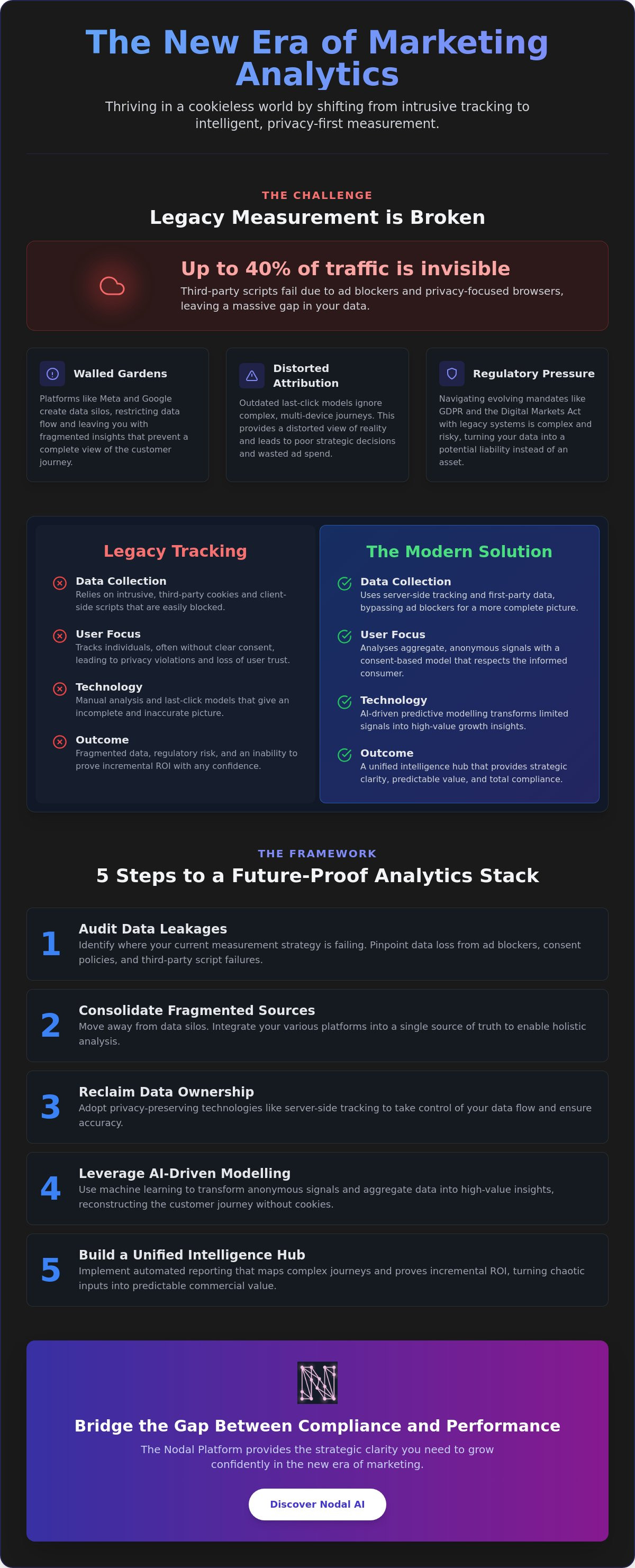
5 Steps to Implementing a Privacy-First Analytics Framework
Transitioning to a resilient measurement strategy requires a logical, multi-step journey. You cannot simply flip a switch; you must systematically replace fragile legacy systems with resilient alternatives. By adopting privacy-first marketing analytics tools, you transform your measurement from a point of technical failure into a cognitive upgrade for your entire organisation. Follow these five steps to move from chaotic inputs to high-value growth recommendations.
- Step 1: Audit your existing data leakages. Identify where ad-blockers and browser restrictions are currently silencing your conversion signals.
- Step 2: Consolidate fragmented sources. Move away from isolated silos and integrate your data into a unified AI marketing analytics hub for total clarity.
- Step 3: Deploy advanced consent mode signalling. Respect user choice without losing all signal by using modern protocols that bridge the gap between consent management and multi-touch attribution.
- Step 4: Shift to incremental growth recommendations. Stop chasing raw vanity metrics and focus on the mathematical weighing of touchpoints that actually drive new revenue.
- Step 5: Automate your reporting. Remove the burden of manual data entry and allow your team to focus on creative execution and high-level strategy.
Auditing for Data Leakage
Inaccuracy is the hidden tax on your marketing budget. If your analytics relies on third-party scripts, you are likely missing 20 to 40 per cent of your actual traffic due to ad-blockers and privacy-focused browsers. This loss creates a distorted view of your ROI and leads to wasted ad spend on underperforming channels. Use this checklist to identify your vulnerabilities: check for missing conversion events in Safari, compare server logs against browser-based reports, and identify "walled garden" dependencies that restrict your data flow. Resolving this technical debt with calm efficiency is the only way to reclaim strategic clarity.
From Fragmented Data to Strategic Clarity
The transformation from chaotic spreadsheets to high-value insights is where the real commercial value lies. When you consolidate your data, you replace manual, error-prone processes with a single source of truth. Advanced automated reporting provides the relief of instant visibility, allowing you to prove incremental ROI to stakeholders without the usual month-end anxiety. This streamlined perspective ensures that every decision is backed by predictive intelligence rather than gut feeling. It turns your passive data assets into active participants in your business growth. If you are ready to eliminate the ambiguity in your performance tracking, you should book a demo to see how we turn compliance into a performance engine. By automating the heavy lifting, you empower your team to focus on the creative work that truly moves the needle.
Nodal AI: Bridging the Gap Between Compliance and Performance
Compliance is not a barrier to growth; it is the foundation of a superior measurement strategy. While others treat privacy as a technical hurdle to overcome, Nodal AI positions it as a performance engine. We provide the tools to turn chaotic, anonymous signals into high-value commercial outcomes. By adopting privacy-first marketing analytics tools, you move beyond the anxiety of manual data collection and into a state of calm efficiency. Our platform allows you to map complex customer journeys with mathematical precision, ensuring you never lose sight of the path to conversion even in a cookieless world.
The true power of the Nodal Platform lies in its ability to generate proactive Growth Recommendations. We move your team from a state of constant reaction to one of strategic control. By analysing aggregate data through advanced predictive modelling, we identify revenue opportunities before they become visible in traditional reports. This approach delivers total peace of mind regarding global mandates while simultaneously increasing your ROI. You gain a streamlined, high-level perspective that transforms your passive data assets into active participants in your business success.
The Nodal Platform Advantage
Our AI-driven insights engine represents a fundamental shift in how brands measure success. It outperforms legacy multi-touch attribution software UK by using neural networks to reconstruct journeys that browser restrictions would otherwise hide. The onboarding process is designed as a frictionless journey from complexity to clarity. We remove the burden of technical debt, allowing your team to experience a genuine cognitive upgrade. You stop fighting with fragmented spreadsheets and start focusing on the creative execution that drives long-term stability. This transition ensures your measurement remains resilient, accurate, and fully aligned with the expectations of the modern, informed consumer.
Ready to Transform Your Analytics?
Complexity is the most common objection to upgrading an analytics stack. We resolve this by providing professional onboarding support that handles the heavy lifting for you. Our experts guide you through every step, ensuring your server-side setups and AI models are optimised for immediate impact. Reiterate your commitment to profitable growth by moving away from raw, inaccurate metrics. Turn your fragmented data into a single source of truth that empowers every department in your organisation. The era of guesswork is over; the era of strategic clarity has arrived. Book a demo of the Nodal Platform today and witness how we turn privacy compliance into your greatest competitive advantage.
Reclaim Your Strategic Clarity
The shift toward a cookieless world is now a permanent reality. You have seen how adopting privacy-first marketing analytics tools replaces the anxiety of data loss with the confidence of mathematical certainty. By moving from intrusive tracking to sophisticated AI-driven modelling, you transform passive data assets into active participants in your business growth process. You no longer need to choose between global compliance and commercial performance. Instead, you can achieve both through streamlined, high-level perspectives that turn chaotic inputs into high-value outputs.
Take the final step in your journey from complexity to clarity. Transform your fragmented data into profitable growth with Nodal AI. Leverage our AI-powered multi-touch attribution and predictive modelling to secure a future-proof foundation for your organisation. With our London-based expert implementation support, the transition from fragmented silos to a unified intelligence hub is effortless. The future of measurement is intelligent, transparent, and ready for you to lead the way with total strategic clarity. Your era of predictable, privacy-compliant growth starts now.
Frequently Asked Questions
What are privacy-first marketing analytics tools?
Privacy-first marketing analytics tools are platforms designed to measure campaign performance without relying on intrusive, individual-level tracking. They transform aggregate, anonymous signals into high-value growth insights through advanced mathematical modelling. This approach ensures your organisation remains compliant with global mandates while maintaining total strategic clarity on ROI. By prioritising user anonymity, these tools turn compliance into a competitive advantage for forward-thinking brands.
How does cookieless tracking work in 2026?
Cookieless tracking in 2026 operates through server-side signals and advanced AI pattern recognition. Instead of following a user via a browser-stored file, these systems analyse first-party data and context to reconstruct the customer journey. It turns fragmented, anonymous inputs into a coherent narrative of consumer intent without compromising personal privacy. This method ensures your measurement remains resilient even as browsers become more restrictive and ad-blockers more prevalent.
Can I still use Google Analytics 4 in a privacy-first way?
You can use Google Analytics 4 in a privacy-compliant manner by adopting a server-side implementation. This setup allows you to redact personally identifiable information before it ever reaches Google's servers. By combining this with advanced consent mode, you respect user choice while still capturing essential performance signals for your reporting. It transforms a standard tool into a secure, sovereign asset that aligns with modern data protection standards.
What is the difference between first-party and zero-party data?
First-party data is information your brand collects directly from user interactions, such as purchase history or website behaviour. Zero-party data is information that customers intentionally and proactively share with you, such as preference centre selections or survey responses. Both are essential assets for building a resilient, future-proof analytics stack. Prioritising these data types allows you to build deeper consumer trust while maintaining total clarity on your marketing performance.
How does AI help with marketing attribution when data is fragmented?
AI identifies mathematical correlations between disparate, anonymous touchpoints to reveal the hidden logic of consumer behaviour. It uses neural networks to weigh the incremental impact of each channel, even when browsers block direct tracking. This process replaces fragmented guesses with the confidence of mathematical certainty. It allows your organisation to scale campaigns effectively by identifying high-value paths that legacy systems would simply ignore or misattribute.
Is server-side tracking more compliant than client-side tracking?
Server-side tracking is significantly more compliant because it acts as a secure buffer between your users and third-party vendors. Unlike client-side tracking, which allows scripts to fire directly in the browser, server-side setups give you total control over data redaction. This ensures that only authorised, pseudonymised information is shared with external platforms. It reduces your liability while improving site speed and data security for every visitor to your domain.
How do I measure ROI without third-party cookies?
Measuring ROI without third-party cookies requires a shift toward Marketing Mix Modelling (MMM) and incrementality testing. These methodologies analyse aggregate data and first-party signals to determine the true commercial value of your ad spend. By focusing on top-down performance, you achieve a higher level of strategic clarity than legacy granular tracking provided. This approach ensures you are investing in channels that drive genuine growth rather than those merely taking credit for existing demand.
What is the Digital Markets Act (DMA) impact on marketing tools?
The Digital Markets Act (DMA) forces major platforms to restrict how they share data across their ecosystems, creating new visibility gaps for marketers. This mandate makes independent privacy-first marketing analytics tools essential for maintaining a unified view of your performance across different walled gardens. It transforms compliance from a technical hurdle into a catalyst for adopting more intelligent, sovereign data strategies. You regain the ability to see the full picture of your marketing ecosystem.


