

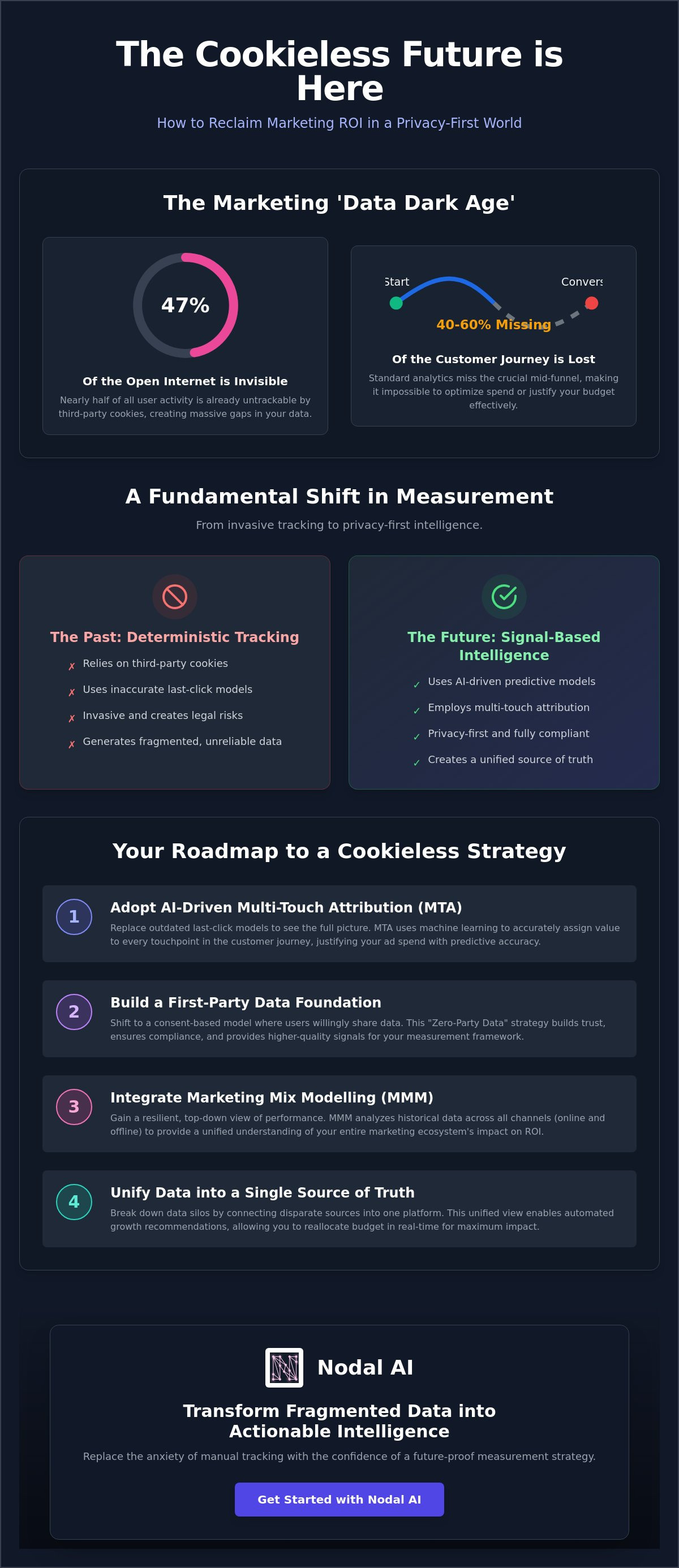
Nearly 47% of the open internet is already invisible to third-party cookies, yet many high-growth brands still rely on fragmented data to justify their scaling efforts. You've likely felt the sting of this shift through growing discrepancies between your ad platform metrics and your internal CRM revenue. It's exhausting to manage mid-funnel blind spots while staying ahead of the twenty different state privacy laws now in effect across the US. To solve this, leading organizations are shifting toward cookieless marketing measurement solutions that turn fragmented signals into clear, actionable intelligence.
We understand the pressure to maintain performance in a privacy-first world. This article outlines how to reclaim 100% visibility into your marketing ROI using AI-driven attribution and predictive modelling. You'll discover how to bypass browser restrictions and respect user consent without sacrificing accuracy. We'll preview the transition from manual, chaotic data collection to a streamlined, unified view of performance that justifies every dollar of your ad spend. This is your roadmap for building a compliance-ready architecture that treats data as a high-value participant in your business growth. It is time to replace the anxiety of manual tracking with the confidence of a future-proof measurement strategy.
Key Takeaways
- Transform fragmented signals into profitable outcomes by shifting from deterministic tracking to signal-based intelligence.
- Implement modern cookieless marketing measurement solutions to reclaim visibility across the 40 to 60 percent of customer journeys currently invisible to standard analytics.
- Replace outdated last-click models with AI-driven Multi-Touch Attribution to accurately justify your ad spend through predictive modelling.
- Build a resilient measurement foundation by integrating a robust first-party data strategy with real-time Marketing Mix Modelling.
- Unify disparate data sources into a single source of truth and use automated growth recommendations to reallocate budget for maximum ROI.
The State of Marketing Measurement in 2026: Why Cookies No Longer Matter
In 2026, the era of relying on third-party cookies has officially ended for brands that value precision. We have moved from a world of deterministic tracking to one defined by signal-based intelligence. Modern cookieless marketing measurement solutions represent this fundamental shift, moving away from individual user identification toward sophisticated pattern recognition. It's no longer about following a single person across the web; it is about modeling profitable outcomes from high-intent signals. This transition marks the end of invasive monitoring and the beginning of a more intelligent, privacy-respecting era of analytics.
Most growth teams are currently trapped in a "Data Dark Age." Standard analytics setups now fail to record between 40% and 60% of the customer journey, leaving massive gaps in your performance reports. This invisibility makes it impossible to see the middle of the funnel, where most of your brand building actually happens. When you can't see the journey, you can't optimize the spend. You're effectively flying blind through the most expensive parts of your marketing funnel, relying on incomplete data to make high-stakes budget decisions.
The regulatory environment has turned traditional tracking into a heavy liability. The GDPR and the UK Data Protection Act have made it clear that invasive tracking without explicit consent is a risk to your brand’s financial stability. Even Google's Privacy Sandbox, while helpful for basic targeting, acts as a partial fix rather than a complete measurement strategy. It keeps you locked within a specific ecosystem rather than providing a unified view of your entire marketing mix. You need a 2026 strategy that transcends individual platforms and their specific limitations to reclaim total visibility.
The Death of the Deterministic ID
Attempting to match a single user across their phone, laptop, and tablet via cookies is now technically and legally obsolete. Apple’s Intelligent Tracking Prevention (ITP) on Safari and similar protections in Firefox have systematically dismantled the old ways of measuring conversion. You can no longer count on a linear path from a click to a sale. Signal fragmentation is the core challenge for 2026 marketers. This fragmentation turns your data into a puzzle with missing pieces, requiring a more intelligent approach to reconstruct the full picture of your marketing ROI.
Consent-Based vs. Passive Tracking
We are seeing the rise of the 'Zero-Party Data' economy. In this new landscape, users choose to share their data in exchange for a better experience or direct value. This shift moves your brand away from passive, hidden monitoring and toward a transparent, trust-based relationship. The Nodal Platform transforms these explicit consent signals into actionable growth recommendations. By leveraging data that users actually want to share, you create a more accurate and compliant measurement framework. Turn your compliance requirements into a competitive advantage by building a data architecture that respects the user while driving performance.
From Deterministic Tracking to AI-Driven Predictive Modelling
Traditional last-click models are a relic of a simpler, less private internet. They attribute 100% of the value to the final touchpoint, effectively ignoring the complex journey that leads to a conversion. In a world without third-party cookies, this approach is not just inaccurate; it is dangerous for your ROI. High-growth brands are now deploying AI-driven Multi-Touch Attribution (MTA) to see the full picture. This shift moves your team from asking "What happened?" to answering "What will happen if we increase spend by 20%?". By leveraging machine learning, you can fill the gaps left by missing cookie data and turn fragmented signals into a coherent strategy.
When evaluating various cookieless measurement approaches, the most effective ones rely on pattern recognition rather than individual tracking. Machine learning acts as a cognitive bridge. It analyzes millions of data points to identify which channels truly drive revenue, even when a direct link is broken. This is the core of modern cookieless marketing measurement solutions. Instead of chasing individual clicks, you are modelling profitable outcomes based on historical performance and real-time market signals. This proactive stance allows you to stay ahead of the competition while respecting the user's right to privacy.
Probabilistic Attribution Mechanics
AI doesn't need to know who a user is to understand their value. By analyzing non-PII signals such as time of day, device type, and broad geography, algorithms can map customer journeys with remarkable accuracy. This probabilistic approach prioritizes incrementality. It proves whether an ad actually caused a conversion or if the customer would have bought anyway. This level of insight is only possible through advanced predictive modelling, which serves as the natural successor to legacy tracking methods. It transforms passive data into an active participant in your growth strategy.
The Accuracy Gap: Human vs. AI Analysis
Manual reporting is a silent killer of marketing performance. Relying on spreadsheets often leads to a 15% to 30% error rate in ROI calculations, largely due to human bias and the sheer volume of fragmented data. Automated reporting provides a necessary cognitive upgrade for your team. It replaces the anxiety of manual data entry with the confidence of real-time clarity. For instance, the Nodal AI platform automates these complex processes, saving high-performance teams over 20 hours per week. If you are ready to reclaim your time and accuracy, exploring a unified analytics platform is the next logical step in your growth journey. This transition ensures that your measurement is as technologically advanced as the ads you serve.
5 Essential Cookieless Measurement Solutions for Modern Enterprises
Stop chasing individual cookies and start building a resilient infrastructure. To reclaim your visibility, you must deploy a multi-layered strategy that prioritizes data ownership and signal intelligence. Modern cookieless marketing measurement solutions don't just replace legacy tracking; they upgrade your entire analytical capability. By shifting your focus from invasive monitoring to strategic modeling, you turn privacy requirements into a competitive advantage. Implement these five pillars to secure your brand’s growth in 2026.
- First-Party Data Strategy: Transform your CRM from a passive database into your primary measurement foundation. By capturing high-intent signals directly from your customers, you create a proprietary "Source of Truth" that no browser update can touch.
- Marketing Mix Modelling (MMM): Reclaim the "Gold Standard" of budget allocation. Modern MMM uses real-time AI to analyze how different channels interact, providing a high-level view of what actually drives revenue.
- Server-Side Tagging: Move your data collection from the vulnerable browser environment to a secure cloud server. This shift bypasses ad-blockers and ensures that you, not the browser, control your data flow.
- Contextual Intelligence: Measure engagement based on the content environment rather than a user’s browsing history. This respects privacy while ensuring your ads appear in high-relevance spaces that drive conversion.
- Data Clean Rooms: Use secure, neutral environments to match your brand data with platform-level insights from giants like Amazon or Google. This allows for deep analysis without exposing personally identifiable information.
Adopting these cookieless marketing measurement solutions requires a commitment to privacy-first measurement and attribution. This transition replaces the chaos of fragmented signals with a streamlined, high-level perspective on marketing ROI.
Leveraging Marketing Mix Modelling (MMM) in 2026
Legacy MMM was slow, quarterly, and often too late to influence active campaigns. In 2026, AI-powered MMM delivers real-time insights that allow for agile budget reallocation. It acts as the visionary leader of your measurement stack, identifying the true impact of top-of-funnel spend that standard analytics often miss. Integrate MMM with Multi-Touch Attribution to achieve a "Total Measurement" approach. This combination ensures that every pound spent is justified by a data-driven outcome.
The Power of Server-Side Measurement
The technical shift from client-side to server-side data collection is a cognitive upgrade for your organization. By moving tracking scripts off the browser, you significantly reduce page load times and improve the user experience. More importantly, server-side measurement bypasses the restrictions of ad-blockers and browser-based tracking preventions. This architecture provides enhanced security and ensures your data remains clean and compliant. For teams managing complex ecosystems, this is a vital component of a data governance framework that turns chaotic inputs into strategic clarity.
Implementing a Privacy-First Multi-Touch Attribution Framework
Transitioning to a privacy-first model requires more than just new software; it demands a fundamental restructuring of your data architecture. Start by auditing your existing data sources to identify exactly where your reliance on third-party cookies is highest. You'll likely find that your mid-funnel visibility is the first casualty of browser restrictions. To fix this, you must unify fragmented data into a central Source of Truth using an AI-powered platform. This consolidation allows you to move beyond siloed channel reporting and toward a holistic view of your marketing ROI. By deploying cookieless marketing measurement solutions, you turn silent data points into active participants in your brand's growth strategy.
Validation is the final piece of the implementation puzzle. Use incrementality testing to compare your model's predictions against real-world behavior in controlled environments. This ensures your attribution reflects actual growth rather than just correlation. Finally, establish a continuous feedback loop between your measurement platform and your media buying team. When your data flows back into your bidding strategies in real time, you create a self-optimizing engine that justifies every pound of ad spend.
Step 1: Data Source Integration
Your attribution model is only as powerful as the data that feeds it. Begin by ingesting data from your CRM, ad platforms, and offline sources without relying on fragile browser pixels. Historical data plays a critical role here; it provides the necessary context for training your AI to recognize patterns in the customer journey. This approach ensures that your measurement remains resilient even as privacy laws evolve. To maintain high-level protection of your assets, ensure all integrations follow a strict data governance framework. This structure transforms chaotic inputs into high-value outputs while keeping your organization compliant.
Step 2: Mapping the Predictive Journey
Traditional tracking fails to capture the nuance of modern buyer behavior. Use predictive customer journey mapping to identify the high-intent signals that precede a purchase. This allows you to assign accurate value to non-click touchpoints like video views and organic search queries that often go unrewarded in last-click models. In this framework, strategic clarity replaces manual guesswork to ensure every budget allocation is backed by mathematical certainty. By understanding the true path to conversion, you can scale your most effective channels with total confidence. If you're ready to stop guessing and start growing, it is time to deploy the Nodal Platform for your enterprise today.
Nodal AI: Transforming Fragmented Data into Actionable Intelligence
Nodal AI stands as the definitive partner for global enterprises navigating the decay of traditional tracking. As we've explored, the transition to cookieless marketing measurement solutions is not a hurdle; it is a strategic opportunity to outpace competitors who remain tethered to broken pixels. The Nodal Platform serves as the cognitive bridge that unifies your disparate signals into a single, high-definition view of your performance. It replaces the anxiety of data discrepancies with the calm efficiency of predictive growth. By turning your fragmented inputs into high-value outputs, we empower your team to make decisions with mathematical certainty.
Our proprietary Growth Recommendations engine acts as an active participant in your business process. It identifies exactly where to reallocate spend to capture diminishing opportunities or scale high-performing channels. Instead of drowning in manual reporting, your team gains access to automated insights that justify every investment. We handle the complexity of multi-channel attribution without the need for third-party cookies, ensuring your measurement architecture remains resilient against future browser restrictions. This is not just a tool; it is a visionary upgrade for your entire organization.
Why UK Enterprises Choose Nodal AI
London-based brands face a unique set of challenges, from the strict requirements of UK-GDPR to the hyper-competitive nature of the local tech ecosystem. Nodal AI provides the local expertise and technical sophistication required to thrive in this environment. We understand the professional's sense of overwhelm when ad platform data fails to match internal CRM revenue. For example, one London-based performance team successfully reclaimed over 20 hours per week by replacing manual spreadsheets with our automated insights. This is the new standard for ai marketing analytics, where technology resolves complexity so your experts can focus on high-level strategy.
Get Started with a Cognitive Upgrade
Stop letting fragmented data dictate your growth trajectory. It is time to move beyond legacy tracking and embrace a measurement strategy built for the 2026 landscape. By deploying robust cookieless marketing measurement solutions, you protect both your brand's integrity and its financial performance. Reclaim 100% visibility into your marketing ROI and turn your data into a competitive asset. Book a demo of the Nodal Platform today to see your true performance in a privacy-first world. Transform your fragmented data into profitable growth with Nodal AI today.
Secure Your Competitive Edge in a Privacy-First World
The transition to a post-cookie landscape isn't a threat to your growth; it's the catalyst for a more intelligent data strategy. By moving away from fragile browser-based tracking and adopting cookieless marketing measurement solutions, you reclaim control over your brand’s narrative. You've seen how AI-driven Multi-Touch Attribution and predictive modelling turn fragmented signals into clear, actionable intelligence. This shift replaces the frustration of data gaps with the clarity of a unified Source of Truth that justifies every pound of your ad spend.
It's time to transform your passive data into an active participant in your success. Our UK-based team provides the specialized support and implementation expertise needed to navigate the complexities of modern compliance. With AI-powered Growth Recommendations and automated reporting for enterprise teams, the Nodal Platform ensures your marketing ROI is always visible and verifiable. Stop guessing and start scaling with a cognitive upgrade for your organization. Book a demo of the Nodal Platform and reclaim your marketing visibility today. Your future growth depends on the clarity of your insights; let's build that foundation together.
Frequently Asked Questions
What are cookieless marketing measurement solutions?
Cookieless marketing measurement solutions are advanced frameworks that use non-personal signals and AI to track ROI without relying on third-party cookies. These systems move away from individual user tracking toward sophisticated pattern recognition. By analyzing data points like time, device, and geography, they reconstruct the customer journey while respecting user privacy. This shift replaces invasive monitoring with strategic modelling to ensure your performance data remains accurate in a privacy-first world.
How does multi-touch attribution work without cookies?
Modern multi-touch attribution works by using probabilistic modelling to connect disparate touchpoints. Instead of a cookie ID, algorithms look at clusters of signals to estimate the likelihood of a conversion path. This method identifies the true drivers of revenue across fragmented channels without needing a deterministic link. It transforms silent signals into active participants in your attribution model, providing a holistic view of your marketing impact and justifying your ad spend.
Is cookieless measurement GDPR compliant?
Yes, cookieless measurement is designed specifically to meet GDPR and UK-GDPR requirements. These solutions focus on aggregated, non-personally identifiable information rather than tracking individual browsing history. By removing the need for invasive third-party identifiers, you reduce your legal liability and build a more ethical data architecture. This approach ensures your marketing remains performance-driven while staying fully aligned with the latest global privacy regulations and state-level laws.
What is the difference between MMM and MTA in a cookieless world?
Marketing Mix Modelling (MMM) is a top-down approach that analyzes high-level budget allocation across all channels over time. Multi-Touch Attribution (MTA) is a bottom-up method that assigns value to specific digital touchpoints. In a cookieless world, these two work together to provide total clarity. MMM identifies long-term trends and offline impact, while MTA uses AI to optimize digital performance in real time, creating a unified view of your entire marketing mix.
Can AI really predict customer journeys accurately?
AI accurately predicts customer journeys by analyzing millions of historical data points to identify recurring patterns. It fills the gaps left by missing cookies by modelling the most likely path to conversion based on high-intent signals. This predictive capability turns your data into a cognitive upgrade for your organization. Instead of guessing, you use mathematical certainty to understand which interactions lead to profitable outcomes and where to reallocate your budget for maximum growth.
How long does it take to implement a cookieless measurement stack?
A standard enterprise implementation typically follows a structured timeline of several weeks to ensure total data accuracy. This process includes auditing your existing data sources, setting up server-side tagging, and training the AI model on your historical data. While the underlying technology is complex, the user experience is designed to be streamlined and effortless. Once live, the system begins delivering real-time growth recommendations that replace the anxiety of manual reporting with confidence.
Will my Facebook and Google Ads data still be accurate without cookies?
Ad platform data is increasingly inaccurate because browser restrictions block the pixels these platforms rely on. You'll often see a growing discrepancy between platform-reported conversions and your actual CRM revenue. Using cookieless marketing measurement solutions allows you to bypass these restrictions. By creating a neutral Source of Truth, you reclaim visibility into your true ROI and stop overpaying for misattributed conversions that don't reflect your actual business performance.
What is first-party data and why is it the foundation of cookieless measurement?
First-party data is information you collect directly from your audience through your own channels, such as CRM records, email sign-ups, and purchase history. This data is the gold standard because you own it and it remains unaffected by browser updates or third-party restrictions. It serves as the primary foundation for training AI attribution models. By leveraging these proprietary signals, you build a resilient measurement framework that turns passive assets into high-value strategic clarity for your brand.


