

Your CEO doesn't care about your latest increase in organic reach or your record-breaking click-through rates. In a 2026 landscape defined by the Delete Act and strict CCPA regulations, vanity metrics have lost their luster. If you can't connect your campaigns to the bottom line, your budget is a target. You likely feel the weight of fragmented data across a dozen platforms while trying to explain why B2B SEO ROI should hit the industry average of 748 percent. It's a common struggle for talented leaders who need to know how to prove marketing value to ceo stakeholders without getting lost in the weeds.
We're going to bridge the gap between marketing activity and boardroom reality. You'll learn to master the art of translating complex data into the financial outcomes your executive team demands. This guide provides a clear framework for financial reporting and the confidence you need for your next high-stakes budget negotiation. We'll explore how automated systems transform your passive data into an active profit engine, replacing the anxiety of manual reporting with predictive clarity and measurable returns.
Key Takeaways
- Bridge the Value Gap by mapping tactical engagement metrics directly to the financial outcomes your CEO prioritizes, such as EBITDA and Customer Acquisition Cost.
- Master how to prove marketing value to ceo stakeholders by shifting your focus from historical vanity metrics to predictive pipeline velocity.
- Move beyond flawed last-click models to uncover the hidden ROI of complex customer journeys using multi-touch attribution.
- Harness predictive modelling to forecast future conversion probabilities and identify patterns in high-value customer behavior.
- Streamline your workflow with the Nodal Platform to automate reporting and save your team over 20 hours of manual spreadsheet work every week.
The Value Gap: Why Marketing Language Fails in the Boardroom
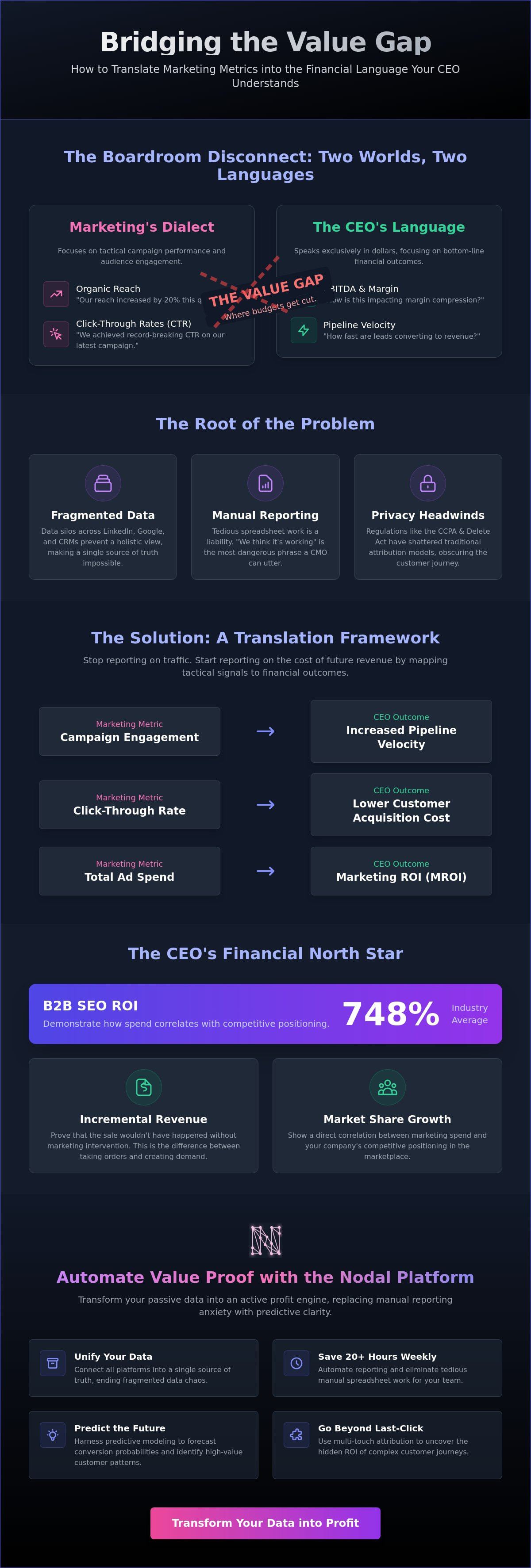
Marketing departments often speak in dialects; the boardroom speaks exclusively in dollars. This disconnect represents the Value Gap: a structural chasm between tactical campaign metrics and the financial outcomes that define organizational success. While a marketing lead celebrates a 20 percent increase in organic reach, a CEO is looking at EBITDA, margin compression, and pipeline velocity. In the eyes of a data-driven chief executive, reach and engagement are often dismissed as vanity metrics because they lack a direct, traceable link to the balance sheet.
Closing this gap is the fundamental challenge for leaders learning how to prove marketing value to ceo stakeholders who demand fiscal precision. This disconnect often stems from a lack of rigorous Marketing Accountability, where promotional activities remain untethered from the ledger. To survive a boardroom review, your reporting architecture must evolve from a cost centre narrative into a revenue driver framework. You must transform passive data points into active business intelligence that justifies every dollar spent.
The Cost of Ambiguity in Marketing Spend
Ambiguity is the fastest route to a budget cut. During periods of economic volatility, unproven spend is the first line item to be slashed. When marketing cannot explain a sudden dip in performance with hard data, it creates a psychological rift. The CEO loses confidence, viewing the department as a black box rather than a predictable engine. 'We think it's working' is the most dangerous phrase a CMO can utter. It signals a lack of control that no amount of creative awards can fix. Proving value requires moving past gut feelings toward documented financial impact.
Fragmented Data: The Invisible Wall
The technical reality of 2026 adds another layer of complexity. With the expanded CCPA regulations and the Delete Act now in full effect, privacy-first tracking has shattered traditional attribution. Marketing teams struggle to stitch together fragmented data from LinkedIn, Google, and internal CRM systems manually. These data silos prevent a holistic view of the customer journey, making it nearly impossible to provide a single source of truth. Manual reporting is no longer just tedious; it's a liability that obscures the very value you're trying to prove. If you want to know how to prove marketing value to ceo teams effectively, you must first dismantle these invisible walls and unify your data stream.
Aligning Marketing KPIs with the CEO’s Financial North Star
Stop speaking in platform-specific dialects. To bridge the Value Gap, you must implement a robust Translation Framework. This system maps tactical signals like click-through rates directly to Customer Acquisition Cost (CAC). For instance, if your B2B SaaS CAC averages $239, your reporting must demonstrate how marketing spend is actively driving that number down or improving lead quality. Understanding how to prove marketing value to ceo stakeholders means showing that a click isn't just a digit; it's a financial asset in motion. You're no longer reporting on traffic. You're reporting on the cost of future revenue.
Shift your focus from ROAS to MROI. While Return on Ad Spend measures specific campaign efficiency, Marketing Return on Investment measures total business growth. You must also prioritize Pipeline Velocity. CEOs care deeply about how fast a lead moves from the first touchpoint to a closed-won deal. High velocity suggests an efficient funnel that accelerates cash flow. Using marketing metrics your CEO wants to see, such as Customer Lifetime Value (CLV), allows you to prove that marketing isn't just capturing current demand. It's building long-term equity. To achieve this level of clarity, many leaders are turning to Performance Marketing Analytics to automate the link between spend and profit.
The Three Metrics Every CEO Actually Cares About
- Incremental Revenue: Prove that the sale wouldn't have happened without marketing intervention. This is the difference between taking orders and creating demand.
- Market Share Growth: Demonstrate how your spend correlates with competitive positioning. In 2026, where SEO ROI for B2B can reach 748 percent, you must show how this efficiency translates into dominating your niche.
- Profit Margin Protection: Use brand strength to reduce reliance on heavy discounting. A robust marketing strategy allows for premium pricing, which protects the bottom line during economic shifts.
Building a Shared Dashboard of Success
Ditch the 50-page slide deck. Replace it with a single, high-level perspective that provides total clarity. You must ensure finance and marketing agree on the definition of a 'qualified lead' to avoid friction during budget reviews. Real-time data access is essential for executive-level decision making in the fast-paced 2026 market. By integrating your systems into a unified Performance Marketing Analytics platform, you can replace manual guesswork with automated truth. This transparency builds the trust necessary to secure larger budgets and more ambitious growth targets.
Beyond Last-Click: Using Multi-Touch Attribution to Reveal Hidden ROI
Last-click attribution is the most pervasive fiction in modern marketing. It credits the final touchpoint while ignoring the 90 percent of the journey that actually builds intent. If you rely on this flawed model, you'll likely cut your most valuable top-of-funnel investments because they don't appear to convert on paper. Learning how to prove marketing value to ceo stakeholders requires a shift toward multi-touch attribution. This approach reveals the hidden ROI of your brand awareness and educational content. It proves that a 'failed' awareness campaign on LinkedIn UK might actually be the primary driver for a final Google search conversion weeks later.
Walled gardens like Google, Meta, and LinkedIn create a fragmented reality. In the 2026 privacy-first environment, these silos hide the true customer path, making manual tracking a liability. You need an integrated system that pierces these gardens to provide a single, transparent source of truth. Without a unified view, you're merely guessing which channels deserve your next pound of investment. Case study logic is your best ally here. Show the CEO a specific path where a high-value customer engaged with three different content pieces before converting. This visual evidence transforms an abstract 'spend' into a concrete 'investment' in the customer journey.
The Multi-Touch Attribution (MTA) Framework
Presentation is everything in the boardroom. Choose an attribution model that reflects your specific business cycle. Linear models share credit equally across all touches. Time-decay models reward the interactions closest to the sale. Position-based models focus on the 'bookends' of the journey: the first and last interactions. Modern AI now identifies 'hidden' touchpoints that traditional tracking misses, such as dark social or cross-device intent. Multi-touch attribution is the financial audit of the customer journey.
Proving Incrementality: The Gold Standard of Value
Incrementality is the ultimate weapon in any budget negotiation. It answers the one question your CFO is secretly asking: Did marketing create new demand or simply claim demand that already existed? By using A/B testing and holdout groups, you can prove the 'lift' your campaigns provide over the baseline. This is the only metric that cannot be argued away. It demonstrates that without your strategic spend, the revenue simply wouldn't exist. This level of proof turns marketing from an optional expense into a non-negotiable growth engine. Mastering how to prove marketing value to ceo leaders starts with proving that your results are incremental, not accidental.
From Reporting to Forecasting: Proving Value with Predictive Analytics
Most marketing reporting is a post-mortem. It tells the CEO what happened when it's already too late to change the outcome. To truly master how to prove marketing value to ceo stakeholders, you must move from the rearview mirror to the windshield. Predictive analytics turns your data from a passive archive into an active strategic asset. By 2026, 56 percent of marketing teams have already adopted AI-driven analytics to move beyond simple attribution and into the world of proactive growth. This shift replaces the anxiety of 'what if' with the confidence of 'what's next.'
Executing this transition requires a structured approach to your data architecture. Follow these five steps to transform your reporting into a forecasting engine:
- Step 1: Ingest historical performance data into a predictive modelling engine to cleanse noise from fragmented inputs.
- Step 2: Identify patterns in high-value customer journeys to predict future conversion probability with surgical precision.
- Step 3: Simulate different budget scenarios to show the CEO the 'Cost of Inaction.' Demonstrate how cutting spend today creates a revenue deficit six months from now.
- Step 4: Present Growth Recommendations based on data-backed probability rather than creative intuition.
- Step 5: Automate the feedback loop to refine predictions in real-time as market conditions shift.
The Power of Predictive Customer Journey Mapping
Anticipate customer needs before they manifest as a search query. A sophisticated customer journey analysis identifies churn risks before they happen. This allows for proactive intervention rather than reactive damage control. You're no longer just listing 'what happened' in a monthly deck. You're providing a clear roadmap for 'what will happen next,' positioning marketing as a visionary leader within the organization.
The 'Confidence Engine': Reducing Executive Risk
Predictive models act as a safety net for large-scale marketing investments. Instead of asking for a leap of faith, present 'Confidence Intervals' to the CEO. Differentiate between high-risk and low-risk growth paths with total numerical clarity. This transparency justifies aggressive scaling during market upswings because the risk is quantified and managed. When you can prove the probability of success, budget approvals become a formality. Ready to replace manual guesswork with future-facing certainty? Explore how Predictive Modelling can transform your reporting today.
Execution at Scale: How the Nodal Platform Automates Value Proof
Strategic clarity is impossible when your data is trapped in silos. While predictive models provide the roadmap, execution at scale requires an integrated infrastructure that translates raw inputs into commercial truth. The Nodal Platform serves as the essential bridge between fragmented marketing signals and profitable business decisions. By centralizing your intelligence layer, you eliminate the friction that usually occurs when trying to explain how to prove marketing value to ceo executives. You're no longer presenting a collection of disconnected stats; you're presenting a unified narrative of growth.
Efficiency is the ultimate proof of leadership. Implementing ai marketing analytics removes the manual labour that plagues most marketing operations. On average, this automation saves teams over 20 hours a week by eliminating manual spreadsheet work and cross-platform data stitching. This reclaimed time allows your team to focus on high-level strategy and budget agility through automated growth recommendations. To maintain boardroom trust in 2026, a robust data governance framework is non-negotiable. It ensures that every figure you present is accurate and compliant with the latest state privacy laws, such as the ICDPA and KCDPA, which took effect earlier this year.
Transforming Fragmented Data into Actionable Intelligence
Nodal ingests data from disparate sources, from LinkedIn UK to your internal CRM, creating a single intelligence layer. It transforms static, historical dashboards into dynamic growth engines that react to market shifts in real-time. This eliminates the common boardroom dispute over 'whose numbers are right' because the underlying data is unified and governed. When your data is indisputable, the conversation shifts from defending your budget to optimizing your returns. This cognitive upgrade for your organization ensures that every marketing asset becomes an active participant in the business process.
The Future of Boardroom Reporting
The next generation of reporting speaks the CEO’s language without human intervention. You gain real-time visibility into MROI and Pipeline Velocity, allowing you to answer executive questions instantly. This level of transparency is the definitive answer to how to prove marketing value to ceo stakeholders who value speed and financial precision. Automated systems now handle the heavy lifting of attribution and incrementality, providing a clear line from top-of-funnel investment to bottom-line profit. Stop spending your weekends in spreadsheets and start leading with data-backed confidence. Book a demo of the Nodal Platform to start proving your value today.
Master Your Boardroom Narrative
The era of defending your budget with surface-level engagement data is over. By aligning your marketing KPIs with the CEO’s financial North Star and adopting AI-powered multi-touch attribution, you transform your department from a cost centre into an essential revenue driver. You now have the framework to reveal hidden ROI and use predictive modelling for scalable growth. This shift doesn't just protect your budget; it elevates your standing in the boardroom by providing the transparent, data-backed evidence required for high-stakes decision-making.
Mastering how to prove marketing value to ceo stakeholders requires the right infrastructure to handle the complexity of 2026's privacy-first landscape. Nodal AI already saves London marketing teams 20+ hours on reporting every week by replacing manual labour with automated, high-level perspectives. You can now replace the anxiety of fragmented data with the confidence of streamlined, actionable intelligence. It's time to turn your passive assets into active participants in your company's financial success.
Transform your fragmented data into profitable decisions with Nodal AI. You're ready to lead your organization toward a future of measurable, predictable growth.
Frequently Asked Questions
Which marketing metrics do CEOs care about most in 2026?
CEOs prioritize financial outcomes over tactical signals. They focus on metrics like marketing-influenced revenue, pipeline velocity, and the Customer Lifetime Value (CLV) to CAC ratio. These figures demonstrate how marketing spend actively drives profitability and long-term enterprise value. By focusing on the Marketing Efficiency Ratio (MER), you speak the language of the boardroom rather than the platform.
How do I explain marketing attribution to a non-technical CEO?
Describe attribution as a financial audit of the customer journey. Explain that it's a system to track which specific investments actually contributed to a sale across multiple touchpoints. It ensures every pound spent is accounted for, showing how different campaigns work together like a relay team to move a prospect across the finish line.
Is MROI a better metric than ROAS for executive reporting?
MROI is superior for executive reporting because it provides a holistic view of business health rather than just campaign efficiency. While ROAS measures immediate returns on specific ad spend, MROI accounts for all marketing costs and long-term growth. This shift is essential when learning how to prove marketing value to ceo stakeholders who view the business through a wider financial lens.
How can AI help prove the value of brand awareness campaigns?
AI identifies hidden touchpoints and incremental lift that traditional tracking misses. It uses multi-touch attribution to bridge the gap between top-of-funnel activity and final conversions by identifying patterns in high-value customer journeys. This reveals the true incrementality of awareness spend, proving that it creates new demand that simply wouldn't exist otherwise.
What is the best way to handle 'messy' marketing data for reporting?
Centralize your data through an automated intelligence layer to eliminate manual stitching and human error. This process cleanses noise from fragmented inputs across walled gardens and internal CRM systems. By establishing a single source of truth, you remove ambiguity and ensure finance and marketing agree on the definition of success before the board meeting begins.
How often should I present marketing value reports to the board?
Present high-level value reports monthly to maintain alignment on pipeline velocity and CAC trends. Use quarterly meetings for deeper strategic reviews of market share growth and long-term growth recommendations. This consistent cadence ensures the board views marketing as a predictable revenue engine rather than a sporadic or optional expense.
What should I do if my marketing ROI looks lower than expected?
Analyze your data for hidden intent or longer sales cycles using multi-touch attribution. A low immediate ROI often signals a shift in customer behaviour or a more complex path to purchase. Demonstrating how to prove marketing value to ceo leaders involves explaining these nuances while presenting a data-backed plan to optimize efficiency and capture future revenue.
Can predictive modelling actually guarantee future marketing results?
Predictive modelling provides high-probability forecasts rather than absolute guarantees. It offers a roadmap based on historical patterns and real-time market signals to help you manage executive risk. These models significantly reduce uncertainty by replacing gut feelings with confidence intervals, allowing you to justify aggressive scaling during market upswings.


