

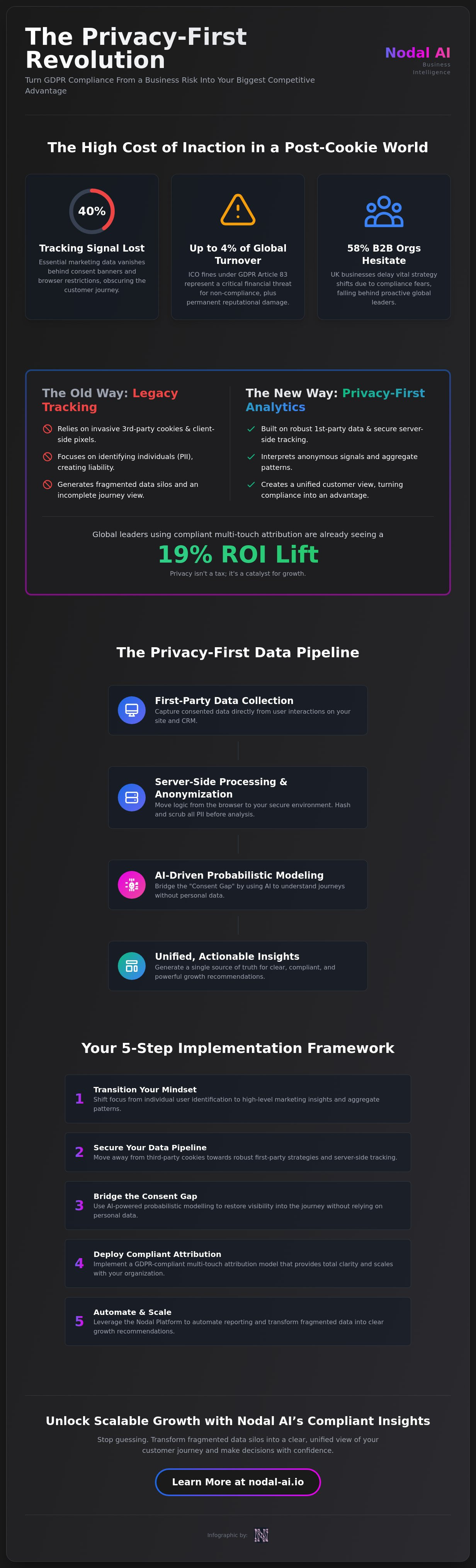
Privacy isn't a data tax; it's the catalyst for your most accurate, AI-driven predictive modelling yet. While 58% of UK B2B organizations hesitate to move because of compliance fears, global leaders are already capturing a 19% ROI lift through gdpr compliant multi-touch attribution. You don't have to choose between respecting user rights and hitting your growth targets. The era of guessing which half of your marketing budget is working ended the moment privacy became the priority.
We understand the frustration of watching 40% of your tracking signal vanish behind consent banners while the threat of ICO fines reaches 4% of your global turnover. It's time to replace that anxiety with the calm efficiency of a unified customer journey. This guide promises to show you how to maintain high-performance analytics and predictive insights while staying strictly within legal boundaries. We'll explore the shift to first-party data, the impact of the 2026 Digital Omnibus package, and how server-side tracking turns fragmented silos into a single source of truth.
Key Takeaways
- Transition from legacy tracking to a privacy-first approach that prioritizes high-level marketing insights over individual identification.
- Secure your data pipeline by moving away from third-party cookies toward robust first-party strategies and server-side tracking.
- Bridge the "Consent Gap" using AI-powered probabilistic modelling to restore visibility into the customer journey without relying on personal data.
- Deploy a structured 5-step framework to implement gdpr compliant multi-touch attribution that scales with your organization.
- Leverage the Nodal Platform to automate reporting and transform fragmented data silos into clear, actionable growth recommendations.
Understanding GDPR Compliant Marketing Analytics in 2026
Marketing success in 2026 is no longer measured by how much personal data you can harvest; it's defined by how intelligently you interpret anonymous signals. GDPR compliant marketing analytics is the process of gathering deep performance insights without ever needing to identify the individual behind the screen. Legacy tracking methods that relied on invasive third-party cookies have become toxic liabilities. Today, the Information Commissioner’s Office (ICO) in the UK maintains rigorous oversight, ensuring that every touchpoint respects user boundaries. While privacy-only analytics might keep you legal by simply turning off tracking, a privacy-first strategy uses sophisticated logic to maintain visibility while staying compliant.
The 2026 landscape demands a clean break from the past. With the proposed Digital Omnibus package clarifying the boundaries of personal data, businesses must move toward systems that prioritize aggregate patterns over individual profiles. This shift isn't just about avoiding trouble; it's about building a more resilient measurement model. By removing the reliance on PII (Personally Identifiable Information), you eliminate the single biggest point of failure in your marketing stack. You gain a clearer view of the customer journey because your data isn't subject to the same volatility as consent-heavy legacy systems.
The High Cost of Non-Compliance
Under the General Data Protection Regulation (GDPR), specifically Article 83, the financial stakes are absolute. Serious infringements can trigger fines of up to €20 million or 4% of a company's total global annual turnover, whichever is higher. Beyond the balance sheet, the reputational damage in a consumer market that values data sovereignty can be permanent. Consumers don't just want privacy; they expect it as a baseline of service. In 2026, Privacy-Led Marketing is the strategic alignment of data ethics with commercial growth to eliminate regulatory risk and foster brand integrity.
Consumer Trust as a Performance Metric
Transparent data practices do more than satisfy auditors; they build long-term customer lifetime value. Modern consumers reward brands that respect their digital space with higher engagement and deeper loyalty. By shifting from invasive tracking to observing aggregate behavior, you transform a defensive compliance posture into a competitive advantage. The Nodal Platform excels here by turning fragmented, anonymized data into actionable intelligence. It allows you to implement gdpr compliant multi-touch attribution that provides total clarity on the customer journey while keeping data residency and governance at the forefront of every decision. You aren't just following the law; you're leading the market through clarity and respect.
The Mechanics of Privacy-First Data Collection
The full deprecation of third-party cookies in 2026 has turned the browser into a black box for traditional marketers. You can't rely on client-side pixels to tell the whole story anymore. To build a robust gdpr compliant multi-touch attribution model, you must move the intelligence from the user's browser to your own secure environment. This transition involves a rigorous pipeline of hashing and anonymization. By scrubbing personal identifiers before they hit your analytics engine, you ensure that every insight is derived from behavior, not identity. Data residency is equally critical. For UK enterprises, storing data within UK borders isn't just a preference; it's a fundamental pillar of governance that satisfies both the ICO and your internal compliance teams.
Modern data pipelines must be built on the principle of minimal exposure. Every piece of information that enters your system should be processed through a one-way cryptographic hash. This ensures that even if a data breach occurred, the information would be useless to unauthorized parties. By adopting these mechanics, you transform a chaotic stream of raw data into a structured, high-value asset that powers your growth without compromising user rights. This is how you reclaim control in a fragmented digital world.
First-Party Data: Your Most Valuable Asset
First-party data is the bedrock of 2026 marketing strategy. It's the information your customers provide willingly through CRM sign-ups, direct site interactions, and purchase history. Research shows that high-quality, consented data has become incredibly valuable to marketers because it represents a direct, unfiltered relationship with the audience. You own this asset. You control its flow. To manage this effectively, you need a modern data governance framework that turns fragmented touchpoints into strategic clarity. Start by auditing your current collection points. Eliminate redundant trackers. Focus on the high-intent signals that actually drive conversion.
Server-Side Tracking and CAPI
Server-side tracking removes the browser as a single point of failure. Instead of relying on a user's browser to send data to ad platforms, your server handles the communication directly. This approach bypasses ad blockers and browser-based privacy restrictions while giving you total control over what data is shared. The Conversion API (CAPI) acts as the bridge here. It allows you to send offline and server-side events directly to platforms without exposing PII. This is how you achieve gdpr compliant multi-touch attribution in a world without cookies. The Nodal Platform integrates these diverse signals into a single source of truth. It cleans, hashes, and maps every interaction automatically. If you're ready to stop guessing and start measuring, see how Nodal AI streamlines this entire process.
AI-Driven Attribution: Filling the Consent Gap
The "Consent Gap" is the silent killer of modern marketing ROI. When users reject tracking, your visibility often drops by 40% or more, leaving you to manage budgets in the dark. While competitors struggle with fragmented data, a visionary approach turns this hurdle into a strategic advantage. By using AI to fill these gaps, you move from guessing to knowing. This isn't about circumventing rules; it's about using advanced mathematics to replace what cookies used to provide. You don't need to track individuals to understand the effectiveness of your media spend.
Adhering to ICO guidance on cookies is non-negotiable. However, strict compliance doesn't mean flying blind. AI uses probabilistic modelling to bridge the divide between consented and non-consented interactions. It identifies high-level patterns without ever needing to touch personal identifiers. This evolution marks the death of legacy last-click models. Instead of crediting the final touchpoint simply because it's the only one you can see, AI-powered incrementality testing measures the true lift of every channel. You gain a high-level perspective that turns chaotic inputs into high-value growth.
Predictive Modelling for Non-Consenting Users
Traditional sampling methods are too blunt for the 2026 market. They provide a blurry snapshot when you need a high-definition map. AI-driven predictive modelling analyzes the behavior of your consented users to extrapolate the actions of the non-consenting cohort. It looks at aggregate signals, like device type, time of day, and referral source, to predict conversion probability. This approach is significantly more accurate because it recognizes the underlying intent rather than just guessing based on a small sample. You gain a complete picture of performance while remaining fully invisible to the individual user. It's the relief of total clarity in an era of data scarcity.
Multi-Touch Attribution Without PII
Effective gdpr compliant multi-touch attribution in a post-cookie world relies on aggregated data sets. You don't need to know who clicked; you need to know what worked. By mapping the customer journey through these anonymous clusters, Nodal AI provides total clarity on channel effectiveness. Our Privacy-Preserving Attribution mechanism processes signals through a secure vault that strips away identity and leaves only the commercial value. This transforms your marketing from a series of disconnected bets into a streamlined engine for growth. Stop letting consent rejection dictate your performance. Embrace a system that turns privacy requirements into a cognitive upgrade for your entire organization.
Implementing a GDPR-Compliant Analytics Framework
Moving beyond legacy tracking requires a rigorous, 5-step transition. This isn't a simple software update; it's a fundamental shift in how your organization handles information. Start with a comprehensive Audit to Activation workflow. This structured approach, used by top-tier London enterprises, moves your data from fragmented silos into a secure, high-performance pipeline. You aren't just checking boxes; you're building a cognitive upgrade for your entire marketing department.
For organizations in the public and third sectors, such as councils and charities, navigating these shifts often requires tailored support to ensure audience growth remains ethical and effective; you can learn more about Throughmotion Ltd. to see how they assist with these specific challenges.
Before deploying any AI-driven tools, you must complete a Data Protection Impact Assessment (DPIA). This document serves as your blueprint for risk mitigation. It analyzes the nature, scope, and context of your data processing to ensure that your gdpr compliant multi-touch attribution model doesn't inadvertently expose personal identifiers. By identifying these risks early, you protect your global turnover from the 4% fine threshold while maintaining full visibility into your marketing performance. This proactive stance replaces the anxiety of potential audits with the confidence of professional governance.
The Data Governance Audit
Map every data flow from the moment a user lands on your site to the final growth recommendation in your dashboard. This visibility allows you to identify common data leak points, such as legacy pixels or unmanaged third-party scripts that siphon data without oversight. Assign a clear legal basis to every marketing activity. While Consent is the standard for cookies, certain high-level analytics can often be justified under Legitimate Interest when individual identification is removed. This clarity transforms chaotic inputs into high-value outputs, providing the strategic clarity needed for long-term stability.
Vendor Management and Data Residency
For UK-based organizations, data residency is a non-negotiable pillar of governance. You must know exactly where your data is stored. If your analytics provider processes information outside UK borders without adequate protection, you are liable. Distinguish clearly between data controllers and data processors in your contracts to define accountability. Use this checklist when evaluating new AI marketing partners:
- Verify UK-based data residency and storage options.
- Confirm the presence of a robust Data Processing Agreement (DPA).
- Audit the vendor's anonymization and cryptographic hashing protocols.
- Ensure the AI models do not ingest or retain PII during training.
Building the secure IT foundations required for these standards is essential for long-term compliance; to see how bespoke technology experts can help, learn more about Cornerstone Business Solutions.
Achieving total clarity shouldn't come at the cost of legal risk. A well-designed framework transforms your data from a passive liability into an active participant in your business growth. To see how we automate this entire workflow while keeping you strictly within ICO boundaries, explore the Nodal Platform's compliance features today.
Scalable Growth with Nodal AI’s Compliant Insights
Nodal AI bridges the gap between privacy and performance. It isn't just a tool; it's a strategic partner that transforms compliance from a hurdle into a competitive advantage. The Nodal Platform provides the infrastructure needed to maintain high-performance gdpr compliant multi-touch attribution while staying strictly within ICO boundaries. By being Compliant by Design, we ensure that your growth recommendations are generated through aggregate patterns rather than individual surveillance. This creates a resilient measurement model that scales with your organization.
Our approach removes the friction between data ethics and commercial results. By processing signals through an anonymised pipeline, Nodal AI identifies which channels drive actual lift without ever touching PII. You gain the ability to predict future performance based on clean, first-party data sets. This transition from chaotic tracking to structured intelligence provides the long-term stability your business requires in a volatile regulatory environment. You aren't just following the rules; you're setting a new standard for marketing excellence.
From Fragmented Data to Strategic Clarity
Stop wasting hours manually stitching together reports from disconnected silos. Nodal AI consolidates disparate data sources into a single, high-definition dashboard. This centralisation replaces the anxiety of manual data entry with the confidence of automated, real-time insights. The time-saving benefits of ai marketing analytics are profound; your team moves from data collection to strategic execution instantly. It's a cognitive upgrade for marketing leadership, allowing you to focus on high-value decisions that drive measurable returns. You gain a streamlined perspective that turns chaotic inputs into profitable outcomes.
Automated Reporting with Privacy Guardrails
Generating Board-ready reports shouldn't feel like a high-stakes gamble. Our platform automates this process, delivering clear visualisations of your performance without the risk of data leaks. Built-in compliance checks act as an invisible shield, preventing PII from ever entering your reporting environment. This ensures that your gdpr compliant multi-touch attribution remains robust and audit-proof at every level. You get the relief of total clarity and the peace of mind that comes from professional governance.
Embrace a forward-thinking approach to marketing attribution that respects the modern consumer. Nodal AI doesn't just solve today's tracking problems; it prepares your organization for the privacy-first landscape of 2026 and beyond. By focusing on profitable growth and stable data residency, you position your brand as a leader in both performance and ethics. The transition from complexity to growth is inevitable when you have the right intelligence partner by your side.
Future-Proof Your Marketing Performance
The transition from invasive tracking to intelligent observation is the most significant competitive advantage of 2026. You've seen how gdpr compliant multi-touch attribution transforms fragmented signals into a clear, actionable path for growth. By leveraging server-side tracking and first-party data, you eliminate the anxiety of the consent gap and replace it with the confidence of high-performance predictive insights. Compliance isn't a barrier to success; it's the foundation of a more resilient measurement model.
Don't let regulatory complexity stall your progress. With London-based expert support and a platform built specifically for the needs of UK enterprises, you can reclaim total visibility into your customer journey. Companies adopting these privacy-first models report an average ROI lift of 19% in their first year. It's time to turn your data from a passive liability into an active participant in your business process. Book a demo of the Nodal Platform and see privacy-first growth in action. Your journey toward strategic clarity starts today.
Frequently Asked Questions
Is Google Analytics 4 (GA4) fully GDPR compliant in 2026?
GA4 is a compliant tool only when your team configures it with strict data residency and anonymization protocols. While it defaults to data-driven models, you must still manage user consent according to ICO standards. Relying on default settings without a rigorous audit creates unnecessary risk for your organization. Professional configuration transforms this platform from a potential liability into a secure engine for growth.
Can I still do multi-touch attribution if users reject cookies?
You can maintain full visibility even when users reject cookies by using gdpr compliant multi-touch attribution powered by probabilistic modelling. This approach identifies aggregate patterns rather than individual identities. It turns a lost signal into a high-value data point without violating privacy boundaries. Stop guessing and start measuring with a system that doesn't rely on invasive tracking.
What is the difference between anonymous and pseudonymous data in marketing?
Anonymous data cannot be linked back to an individual under any circumstances, which makes it exempt from most GDPR restrictions. Pseudonymous data replaces identifiers with codes but can still be re-linked if someone has access to additional information. For marketers, true anonymization is the golden path to risk-free intelligence. It allows you to observe behavior while respecting the user's right to remain invisible.
How does server-side tracking improve GDPR compliance for marketers?
Server-side tracking improves compliance by moving data processing from the user's browser to your own secure server. This shift gives you total control over exactly what information is shared with third-party platforms. Think of it as a secure filter that strips away personal identifiers before they ever leave your environment. You gain clarity while protecting your most sensitive data assets.
Do I need a Data Protection Officer (DPO) for my marketing team?
You generally need a Data Protection Officer if your marketing activities involve large-scale systematic monitoring of individuals or processing sensitive data. Even if not legally mandated for your specific company size, having an expert oversee your analytics framework is a smart strategic move. Professional governance prevents manual errors from becoming expensive regulatory liabilities. It replaces anxiety with the confidence of streamlined, high-level perspectives.
How does Nodal AI handle data residency for UK-based companies?
Nodal AI ensures all data for UK-based enterprises is stored and processed strictly within UK borders. This residency policy satisfies ICO requirements and eliminates the complex risks associated with international data transfers. Your data remains a secure, active participant in your business process under local jurisdiction. We provide the peace of mind that comes from knowing your assets are protected by local laws.
Can AI-driven predictive modelling replace deterministic tracking?
AI-driven predictive modelling can effectively replace deterministic tracking by extrapolating behavior from consented clusters to the wider audience. While deterministic data is precise for a small group, predictive models provide a more accurate and representative view of your entire customer journey. It turns a fragmented, 40% snapshot into a high-definition map of your total marketing performance. This cognitive upgrade allows you to make decisions based on the whole truth.
What are the penalties for non-compliant marketing analytics in the UK?
Penalties for non-compliance can reach up to £17.5 million or 4% of your global annual turnover, whichever is higher. The ICO also has the authority to issue enforcement notices that can halt your data processing and marketing activities entirely. Protecting your organization requires a proactive shift to gdpr compliant multi-touch attribution before an audit occurs. Investing in compliance today prevents the chaotic fallout of a regulatory breach tomorrow.


