

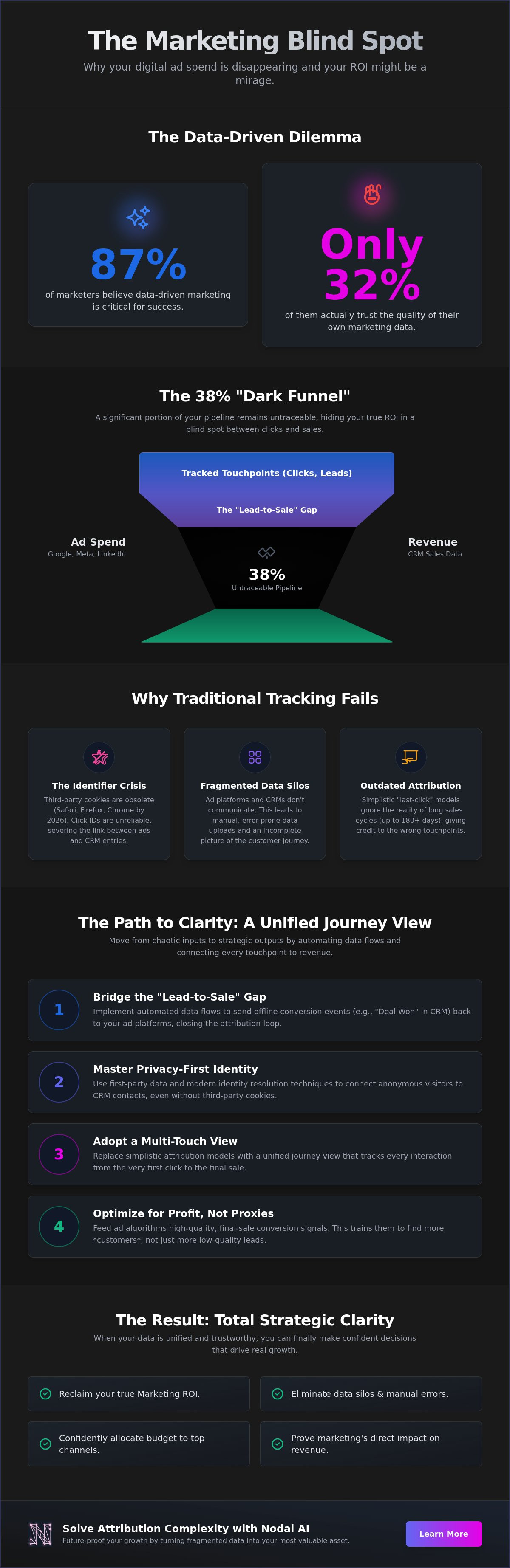
While 87% of marketers believe data-driven marketing is critical, only 32% actually trust the quality of their data in 2026. You likely feel this skepticism every time you look at a dashboard that doesn't quite add up. It's frustrating to watch your digital ad spend disappear into a "dark funnel" where 38% of your pipeline remains untraceable. You know that connecting marketing touchpoints to revenue is the only way to prove your worth, yet fragmented silos between your CRM and ad platforms make it feel impossible.
Stop settling for inaccurate ROAS and the anxiety of manual data uploads that never match. You can master the complexities of multi-touch attribution to eliminate these blind spots and finally reclaim your true marketing ROI. This guide explores how to bridge the offline conversion gap using automated data flows that optimize for profit instead of just leads. We'll show you how to build a unified view of the customer journey, from that very first click to the final handshake, ensuring every dollar you spend is backed by total strategic clarity.
Key Takeaways
- Identify the "Lead-to-Sale" gap where critical conversion data often vanishes between your ad platforms and CRM systems.
- Master privacy-first identity resolution as the primary method for connecting marketing touchpoints to revenue in a post-cookie landscape.
- Replace simplistic last-click models with a unified journey view that tracks every interaction from the first click to the final sale.
- Implement a structured data governance framework to eliminate manual errors and reclaim total clarity over your marketing ROI.
- Leverage predictive modelling to turn fragmented data silos into active participants in your organization's growth strategy.
The Offline Conversion Blind Spot: Why Your Digital ROI is Lying
Your digital dashboard shows a sea of green. Click-through rates are up, cost-per-lead is down, and your ad platforms report a healthy return on spend. Yet, the revenue in your CRM tells a different story. This discrepancy exists because your digital ROI is likely lying to you. The culprit is the offline conversion blind spot, a massive data gap where high-value transactions occurring via phone calls, in-store visits, or deep CRM stages simply vanish. The challenge of connecting marketing touchpoints to revenue is the final hurdle in achieving total commercial transparency.
Most attribution systems fail at the "Lead-to-Sale" gap. They track the initial click and the form fill, but they lose the trail the moment a lead enters the sales cycle. This fragmentation turns your marketing data into a collection of vanity metrics. While clicks and form fills feel productive, they are mere proxies for what actually matters: profit. Research indicates that an estimated 38% of the B2B pipeline comes from sources that are difficult to track digitally. Without a system for connecting marketing touchpoints to revenue, you are making million-dollar decisions based on incomplete evidence.
The cost of this inaction is steep. When you can't see which channels drive final sales, you misallocate your ad spend. You might scale a campaign that generates thousands of low-quality leads while pausing the one that actually drives your largest contracts. In a competitive 2026 market, this lack of visibility isn't just an inconvenience; it's a strategic liability that allows agile competitors to capture your missed growth opportunities.
The Transformation from Fragmented Data to Strategic Clarity
Managing disconnected spreadsheets and manual reports creates a constant state of operational anxiety. Marketing teams often spend more time cleaning data than acting on it. Moving toward unified tracking replaces this overwhelm with a sense of calm efficiency. When your data flows automatically from the first click to the final handshake, you gain the clarity needed to make faster, more confident investment decisions. This isn't just about better reporting; it's about turning chaotic inputs into high-value strategic outputs that prove your department's worth.
Why Proxy Events are No Longer Enough in 2026
In the past, marketers relied on proxy events like "button clicks" or "thank you page visits" to gauge success. In 2026, these signals are insufficient. Modern ad algorithms are hungry for data, but they need "final sale" signals to optimize effectively for profit rather than just volume. If you only feed an algorithm lead data, it will find you more leads, not necessarily more customers. Implementing a sophisticated marketing attribution strategy ensures your systems understand the full journey. By utilizing Marketing attribution, you bridge the gap between digital activity and commercial reality, allowing your marketing assets to become active participants in your business growth.
The Identifier Crisis: Why Traditional Tracking Fails in 2026
The digital marketing industry faces an identifier crisis that makes old-school tracking obsolete. For years, marketers relied on Click IDs to follow users across the web. However, Safari and Firefox have blocked third-party cookies since 2019 and 2020; Chrome’s 2026 user-choice model has further eroded the reliability of these signals. When these IDs are stripped away, the thread connecting marketing touchpoints to revenue snaps. This leaves you with a fragmented view of your performance that no amount of manual guessing can fix. Relying on traditional attribution models in this environment leads to skewed data and poor investment decisions.
This isn't just a technical glitch; it's an identity resolution problem. Matching an anonymous web visitor to a named entry in your CRM is now a complex puzzle. This challenge is magnified for B2B firms where sales cycles often span months. While most platforms default to a 7-day or 30-day attribution window, your actual conversion might happen 180 days later. The June 15, 2026, migration deadline for the Data Manager API highlights the urgency of this shift. If you haven't moved away from legacy Google Ads API uploads, your offline conversion imports will soon be blocked. This technical hurdle prevents you from connecting marketing touchpoints to revenue with any degree of accuracy.
Many teams try to fix this with manual CSV uploads. This approach is a recipe for disaster. Manual data reconciliation often results in deduplication nightmares and "dirty" data silos that confuse rather than clarify. You end up with multiple entries for the same lead, making it impossible to see the true path to purchase. This manual labor isn't just tedious; it's a massive drain on productivity. It keeps your best talent locked in spreadsheets instead of optimizing for profit.
From Cookies to First-Party Data Continuity
Survival in 2026 requires a shift toward first-party data continuity. Hashed emails and phone numbers have become the primary keys for matching user behavior to commercial outcomes. Server-side tracking is no longer optional for London-based enterprises; it is the only way to maintain a persistent connection. Server-Side Tagging is a privacy-compliant way to bypass browser limitations by processing data on your own server before sending it to ad platforms. Transitioning to this model turns your data from a liability into a strategic asset.
Data Silos: The Silent Killer of Marketing Growth
The disconnect between your Marketing Cloud and your primary CRM system is the silent killer of growth. When these systems don't talk, your customer journey remains a mystery. You lose hours to "spreadsheet gymnastics" trying to reconcile disparate reports. This creates a culture of doubt rather than a culture of data. If you're tired of the manual grind, it's time to explore automated analytics solutions that bridge these silos once and for all, providing the high-level perspective your organization needs to thrive.
Fragmented Data vs. Unified Journeys: The Multi-Touch Conflict
Relying on last-click attribution is like giving a trophy only to the person who crossed the finish line while ignoring the team that built the car. In the high-stakes world of enterprise sales, this model is dangerously incomplete. A typical 2026 journey often starts with a Google Search, followed by a LinkedIn Ad, a direct Phone Call, a product Demo, and finally a CRM Sale. If you only look at the final touchpoint, you miss the influence of the initial research and social proof. This fragmented view prevents you from connecting marketing touchpoints to revenue with any degree of honesty.
When middle steps vanish from your reports, top-of-funnel channels appear as wasted budget. You might feel tempted to cut the LinkedIn spend that actually warmed the lead for the final demo. This leads to a cycle of diminishing returns where you optimize for the end of the funnel while starving the top. The Nodal Platform serves as the essential bridge for these fragmented interactions. It links disparate data points into a single, cohesive narrative, ensuring every channel receives the credit it deserves for its role in connecting marketing touchpoints to revenue.
The Fallacy of Last-Click in High-Ticket Sales
High-ticket sales are never the result of a single interaction. That final phone call or demo is rarely the sole reason for a conversion; it's simply the final stage of a long persuasion process. Multi-touch models offer a more transparent view of channel performance by assigning value across the entire lifecycle. Understanding the User Path requires looking beyond the obvious to see how each touchpoint contributes to the final decision. Experience the relief of finally seeing the true path to purchase for your most valuable customers. Move from guesswork to certainty by acknowledging every step that leads to a closed deal.
Leveraging AI for User-Level Continuity
Manual tracking can't keep up with the complexity of modern buyer behavior. This is where ai marketing analytics becomes your most powerful asset. AI doesn't just record data; it identifies patterns in fragmented sources to predict conversion paths with high accuracy. It stitches together user sessions across devices and browsers, even when identifiers are missing. By using machine learning to fill in the gaps, you gain a massive competitive advantage. You'll know your true ROAS and profit margins before your competitors even realize their data is broken. Turn your fragmented data into a cognitive upgrade for your entire marketing organization.
A 5-Step Framework for Connecting Touchpoints to Revenue
Transitioning from fragmented data to a unified view of your ROI requires more than just a change in mindset; it demands a technical overhaul of how your data interacts. Moving beyond simple model selection, you must focus on data matching. This structured framework provides the roadmap for connecting marketing touchpoints to revenue with surgical precision. Follow these five steps to turn your marketing department into a predictable revenue engine.
- Step 1: Audit your current data silos. Map your entire funnel to identify exactly where identifiers like Click IDs are lost. Look for the "black holes" between your ad platforms and your CRM stages.
- Step 2: Establish a data governance framework. Implement strict standards for how data is collected and stored. This ensures privacy-first tracking that remains compliant with 2026 regulations while maintaining high data quality.
- Step 3: Deploy Server-Side API connections. Use a Conversion API (CAPI) to sync your CRM stages with ad platforms in real-time. This bypasses browser restrictions and ensures your ad accounts see the final sale, not just the lead.
- Step 4: Apply AI-driven attribution models. Use machine learning to attribute offline revenue back to specific digital touchpoints. AI identifies the hidden patterns in your customer journeys that human analysis often misses.
- Step 5: Automate your growth reporting. Stop building manual spreadsheets. Use automated reporting to deliver daily growth recommendations, allowing your team to pivot spend toward profit in hours, not weeks.
By following this sequence, you eliminate the manual friction that stalls growth. You move from defensive reporting to offensive strategy. Connecting marketing touchpoints to revenue becomes a streamlined process rather than a monthly struggle. To accelerate this transition, you can integrate the Nodal Platform into your existing stack for immediate visibility.
The Role of the Conversion API (CAPI)
The Conversion API acts as the digital handshake between your CRM and your ad algorithms. It sends data directly from your server to the ad platform, completely bypassing browser-based tracking and cookie-blocking software. Implementing "Enhanced Conversions" through CAPI allows for match rates that often exceed 90% by using hashed first-party data. This high-fidelity signal is what allows modern ad platforms to find your most profitable customers with incredible accuracy.
Optimising for Profit, Not Just Lead Volume
Stop rewarding your campaigns for generating "Form Submits" that never close. Change your campaign goals to "Qualified Revenue Events" based on actual CRM data. This creates a powerful feedback loop; better data leads to better AI-driven ad targeting and significantly lower customer acquisition costs. This shift transforms marketing from a perceived cost centre into a verified revenue driver. When you speak the language of profit in the boardroom, your strategic value to the organization becomes undeniable.
Future-Proofing Growth: Solving Attribution Complexity with Nodal AI
London-based enterprises face a unique set of pressures in 2026, from intensifying regional privacy regulations to the sheer volume of fragmented data generated by global campaigns. Navigating these hurdles requires more than just another dashboard; it demands a visionary partner. Nodal AI steps into this gap as an efficient expert, providing the high-level perspective needed for connecting marketing touchpoints to revenue. By transforming your passive data assets into active participants in your business strategy, we replace operational anxiety with the confidence of streamlined, high-level clarity.
Privacy-induced data gaps are no longer a theoretical threat; they are a daily reality. As third-party identifiers continue to decay, predictive modelling becomes your most critical defense. Nodal AI uses advanced machine learning to model the missing links in your customer journeys, ensuring that your attribution remains robust even when users opt out of tracking. This approach doesn't just fill gaps; it provides a cognitive upgrade for your entire organization, allowing you to stay ahead of the "identifier crisis" that stalls your competitors.
Efficiency is the hallmark of a modern growth team. Our Automated Reporting features are designed to eliminate the manual grind of data reconciliation, saving marketing teams 20+ hours a month. Stop wasting your most valuable human intelligence on "spreadsheet gymnastics" and manual CSV uploads. Instead, allow our platform to turn chaotic inputs into high-value, scalable profitable growth. When you master the art of connecting marketing touchpoints to revenue, your marketing spend stops being a gamble and starts being a predictable investment in your company's future.
Enterprise-Ready Security and Compliance
We understand that data security is your primary concern. Nodal AI adopts a protective and proactive approach to asset security, ensuring full GDPR compliance and high-level data encryption at every stage. You don't need to be a technical specialist to benefit from our expertise. Our professional onboarding process handles the technical implementation complexity for you, ensuring a frictionless transition to your new data reality. We protect your assets while empowering your growth, providing a secure environment for your most sensitive commercial information.
Your Journey to Total Clarity Starts Here
Embrace the relief that comes from having a single source of truth. Moving from fragmented silos to a unified journey is the ultimate competitive advantage in a crowded market. The ease of onboarding with Nodal AI means you can begin seeing the "true" path to purchase for your best customers almost immediately. This is your invitation to a cognitive upgrade that will redefine how your organization views marketing ROI. Stop guessing and start growing with a partner that is obsessed with your measurable returns. Experience the Nodal Platform today and transform your marketing data into your most powerful revenue driver.
Master the Future of Profitable Growth
The era of guessing which channels drive your bottom line is over. By bridging the offline conversion gap, you transform your marketing from an unpredictable cost into a precision-engineered revenue engine. You've learned that connecting marketing touchpoints to revenue requires more than just better tracking; it demands a strategic shift toward first-party data continuity and AI-driven intelligence. Reclaiming your true ROI starts with eliminating the identifier crisis and embracing a unified view of the entire customer journey.
Don't let fragmented silos and manual reconciliation stall your progress. You can achieve total strategic clarity through GDPR-compliant server-side tracking and an AI-powered multi-touch attribution engine. Our London-based team provides the expert implementation support needed to turn your complex data into actionable growth recommendations. It is time to replace operational overwhelm with the confidence of high-level perspective. Book a Demo of the Nodal Platform today to see how we turn chaotic inputs into scalable profit. Your path to total commercial transparency is ready for activation.
Frequently Asked Questions
What are the main challenges of tracking offline conversions in 2026?
The primary challenges are the decay of Click IDs and intensifying browser privacy restrictions. These factors create a "Lead-to-Sale" gap where attribution data vanishes between your ad platforms and CRM. You must resolve the identity resolution problem by matching anonymous web visitors to named CRM entries without relying on third-party cookies that are now blocked by default in major browsers.
How do I link a CRM sale back to a specific Google Ad click without cookies?
You link CRM sales back to ad clicks by using hashed first-party data like emails or phone numbers as primary keys. This method creates a persistent connection that bypasses traditional cookie limitations. By deploying a Conversion API, you send these identifiers directly from your server to the ad platform, ensuring your ad algorithms receive the "final sale" signal they need to optimize for profit.
Is connecting marketing touchpoints to revenue GDPR compliant?
Yes, connecting marketing touchpoints to revenue is fully GDPR compliant when you utilize privacy-first server-side tracking. This approach processes data on your own server and uses hashing to protect user identities before they reach ad platforms. It replaces invasive third-party cookies with secure, first-party data continuity, providing high-level protection of assets while maintaining total strategic clarity.
What is the difference between manual CSV uploads and a Conversion API (CAPI)?
Manual CSV uploads are a reactive, error-prone process while a Conversion API (CAPI) is a proactive, real-time automated flow. Manual reconciliation often leads to deduplication nightmares and "dirty" data silos that confuse your reporting. In contrast, CAPI acts as a digital handshake between your CRM and ad accounts, ensuring match rates remain high without the loss of productivity caused by manual labor.
Why are my offline conversion match rates so low in standard dashboards?
Low match rates usually stem from the identifier crisis and the lack of a persistent connection between your web tracking and CRM. Standard dashboards often lose the trail during long B2B sales cycles or when browsers strip away Click IDs. Implementing "Enhanced Conversions" via server-side tagging can restore these match rates to 90% or higher by using verified first-party signals.
Can AI help track customer journeys that happen mostly over the phone?
AI excels at stitching together customer journeys that move offline into phone calls or demos. By identifying patterns in fragmented data, AI-driven models predict conversion paths with high accuracy even when traditional digital threads are broken. This predictive modeling turns chaotic, offline inputs into high-value outputs, giving you a cognitive upgrade over teams relying on manual tracking.
How long does it take to implement a closed-loop revenue attribution system?
The implementation timeline for a closed-loop system depends on your current tech stack, but the transition from chaos to clarity is typically measured in weeks. Professional onboarding removes the technical hurdles that often stall these projects. Once the initial server-side connections are live, you immediately begin seeing a unified view of the customer journey from the first click to the final handshake.
Do I need a developer to connect my marketing touchpoints to my CRM revenue?
While connecting marketing touchpoints to revenue involves technical API configurations, you don't need to manage this complexity alone. Professional implementation support handles the server-side setup and CRM integration for you. This allows your marketing team to focus on high-level strategy and growth recommendations rather than getting lost in the weeds of deep technical specialization.


