

Barely one-third of CMOs believe their analytics influence real business decisions, according to a 2025 Gartner survey. It's a sobering reality for teams spending hours on manual reporting only to face skepticism in the boardroom. You've likely felt the frustration of watching follower counts climb while revenue stays flat. This confusion between high volume and high value is the primary barrier to growth. Mastering the art of avoiding vanity metrics in marketing is no longer optional; it's a requirement for any leader who needs to justify spend with concrete ROI.
You deserve a reporting structure that works as hard as you do. This guide will teach you how to strip away misleading data and focus on the actionable intelligence that drives bottom-line results. We'll provide a clear framework for ROI-focused reporting and show you how to transition from reactive charts to predictive analytics. You'll learn to stop chasing impressions and start capturing value. By the end, you will understand how to save time through automated, intelligent insights that turn your fragmented data into a unified engine for growth.
Key Takeaways
- Distinguish between passive indicators and financial performance to ensure your reporting reflects actual business health rather than hollow victories.
- Master the strategy of avoiding vanity metrics in marketing by replacing raw traffic counts with source-specific conversion rates and ROI-focused data.
- Unlock the power of multi-touch attribution to see the full customer journey and assign true value to every marketing touchpoint.
- Adopt a 2026 measurement framework that prioritizes North Star Metrics and incrementality testing to justify every dollar of marketing spend.
- Leverage automated growth recommendations to transform fragmented data into a cohesive, intelligence-driven engine for long-term stability.
The Seductive Trap: Why Marketers Obsess Over Vanity Metrics
Vanity metrics are the siren song of the modern marketing department. They represent passive indicators, such as raw impressions or total follower counts, that look impressive in a slide deck but lack a verified link to financial performance. Marketers often succumb to "Boardroom Bias," where simple, massive numbers provide a false sense of security to stakeholders. It's easier to report a 20% increase in reach than to explain a 2% drop in customer lifetime value. This reliance on fragmented data creates noise that masks underlying inefficiencies. When you prioritize these hollow victories, you ignore the friction in your customer journey that's actually costing you revenue. Signal is lost in the noise, and your strategy suffers for it.
The cost of inaction is higher than most realize. By focusing on the surface, you leave your customer journey unoptimized and your budget vulnerable. Avoiding vanity metrics in marketing requires a fundamental shift in how you define success. You must move away from data that merely "looks good" and toward actionable intelligence that informs your next move. Transforming your reporting from a list of numbers into a strategic roadmap is the only way to ensure long-term stability in a competitive market; for instance, you can learn more about Cornerstone Marketing Solutions and how they help clients build an online presence that translates to real growth.
The Psychology of "Shining Stars"
Human brains are naturally wired to prefer high-volume metrics. We see a "shining star" like a million impressions and feel an immediate sense of accomplishment. This psychological trap leads teams to use "feel-good" data as a shield to justify stagnant marketing budgets. If your team spends more time talking about reach than revenue, they're likely using data to hide from accountability rather than using it as a tool for growth. Stop using volume as a proxy for value. True leadership comes from identifying when your metrics are serving your ego rather than your bottom line. A robust Key Performance Indicator (KPI) should always point toward a concrete business outcome.
The Financial Impact of Misaligned Reporting
Resource drain is the inevitable result of chasing low-intent website traffic. When you optimize for clicks instead of conversions, you're essentially burning your budget to entertain window shoppers. This misaligned reporting leads to catastrophic ad spend allocation across channels. For instance, last-click attribution often encourages the pursuit of vanity because it ignores the complex touchpoints that actually drive a sale. Avoiding vanity metrics in marketing isn't just about cleaner reports; it's about protecting your profit margins. You must stop treating your data as a static record and start treating it as an active participant in your business process. Replace the anxiety of manual, tedious reporting with the confidence of high-level perspectives that actually drive growth.
Identifying the Top Offenders in Your Marketing Dashboard
Your dashboard is likely crowded with data points that feel productive but offer zero strategic value. To master the art of avoiding vanity metrics in marketing, you must first identify which numbers are lying to you. Raw traffic, for instance, is a hollow victory. A million page views mean nothing if your conversion rate by source is plummeting. You need to know which channels are actually feeding your pipeline, not just which ones are driving "window shoppers." For a comprehensive definition of vanity metrics, consider them any data point that cannot be linked to a specific, profitable action.
Social media likes are another common offender. These represent ego, not economy. While a post might go viral, it's the Customer Acquisition Cost (CAC) that determines if that viral moment was a financial success. Similarly, email open rates are deceptive. A high open rate suggests a catchy subject line, but revenue per subscriber tells you if your content actually drives sales. Finally, ad impressions are often used to mask poor performance. Visibility does not equal profitability; always prioritize Return on Ad Spend (ROAS) over raw reach. If you want to see how your data truly stacks up, you can explore integrated performance marketing analytics to find the signal in the noise.
The "Engagement" Delusion
Likes and shares rarely correlate with customer lifetime value because they require almost no commitment from the user. There's a massive difference between brand awareness, which is passive, and brand interaction, which is intentional. You might have a massive following that never buys, creating a drain on your creative resources. The Engagement Gap is the distance between a click and a conversion. Close this gap by focusing on metrics that track progress through the funnel rather than surface-level applause. Stop measuring how many people saw your brand and start measuring how many people were moved to act because of it.
The Traffic Trap
Volume is the ultimate vanity metric. In reality, 1,000 high-intent visitors will always outperform 100,000 low-intent users who bounce within seconds. You must use customer journey mapping to see where your traffic actually goes after they land on your site. Don't settle for a generic traffic report. Segment your visitors by behavior and intent to find the "Goldilocks" traffic that converts at the highest rate. Avoiding vanity metrics in marketing means having the courage to ignore the big, shiny numbers in favor of the smaller, high-value ones. This transition from chaos to clarity is what separates visionary leaders from those stuck in manual, tedious reporting cycles.
The Antidote: Multi-Touch Attribution and Actionable Intelligence
Identifying the problem is only half the battle. To truly succeed in avoiding vanity metrics in marketing, you must implement a system that sees the entire customer journey. Multi-touch attribution (MTA) is that system. It transforms your data from a series of disconnected snapshots into a coherent narrative. While traditional dashboards focus on the final click, MTA reveals the influence of every interaction. This level of clarity is essential for strategic decision-making. It ensures that your budget is allocated based on actual influence rather than just the last thing a customer happened to click.
Data governance is the foundation of accuracy. Without strict rules on how data is collected and categorized, your actionable metrics will be just as misleading as the vanity ones they replaced. Establish clear protocols for every channel. This removal of ambiguity is what allows you to trust your insights and act with confidence. Automated reporting removes the manual bias that often creeps into performance analysis. It ensures that your metrics are governed by logic, not by a desire to look good in a meeting. When you strip away the noise, you find the signal that actually drives growth.
Moving Beyond Last-Click Logic
Last-click logic is the primary driver of vanity metric reliance. It forces you to ignore the complex path a buyer takes before they finally convert. By implementing advanced marketing attribution, you can finally reveal the hidden value of your top-of-funnel content. Stop reporting on where a user came from and start analyzing what actually made them buy. This shift in perspective turns your marketing from a guessing game into a predictable growth engine. Shopify offers actionable advice on how to avoid vanity metrics by focusing on these deeper, intent-driven signals. You'll find that the channels you thought were underperforming are often the ones doing the heavy lifting in early brand awareness.
Synthesising Fragmented Data
Many London marketing organisations struggle with siloed data. Information is trapped in different platforms, creating a fragmented and often contradictory view of performance. You must create a single source of truth to achieve strategic clarity. AI plays a critical role here by cleaning and correlating disparate data points in real time. It turns chaotic inputs into high-value outputs, allowing you to focus on growth recommendations rather than data entry. Automated systems don't just save time; they protect the integrity of your strategy. They ensure that every decision is based on a clean, integrated dataset that reflects the reality of your market position. This cognitive upgrade allows your entire organization to move with speed and precision.
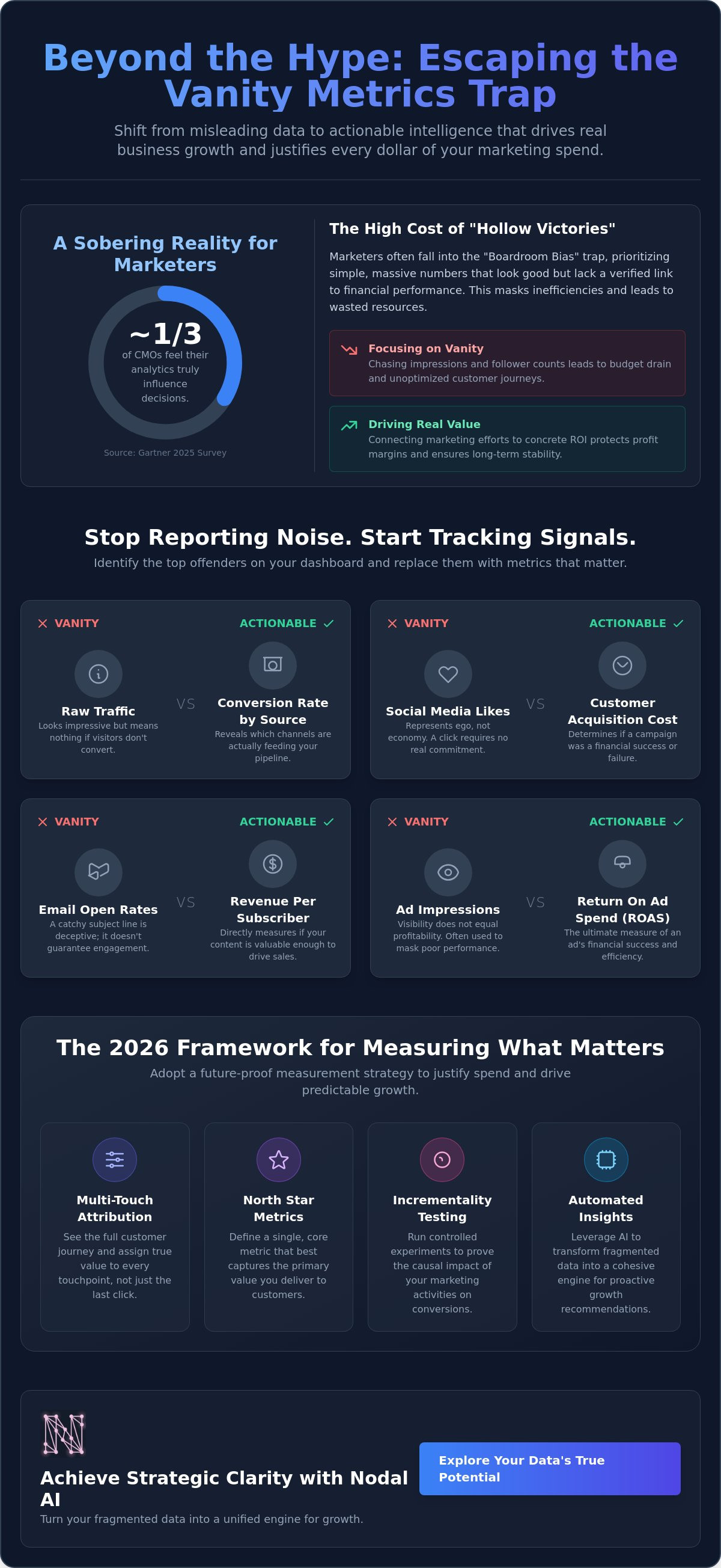
The 2026 Framework for Measuring What Matters
Legacy reporting acts like a rear-view mirror; it tells you where you've been, but it does nothing to help you navigate what's ahead. To lead in 2026, you need a windshield. This requires a shift from recording history to predicting the future. Achieving this level of strategic clarity starts with a structured framework designed to eliminate noise. By following a logical, multi-step journey, you can replace the anxiety of manual labor with the confidence of high-level perspectives. This is the definitive path for avoiding vanity metrics in marketing and reclaiming your team's productivity.
- Step 1: Define your North Star Metric. Stop obsessing over "leads" and focus on Revenue, Customer Lifetime Value (CLV), or Net Profit. Every other data point must serve this primary goal.
- Step 2: Implement incrementality testing. Prove marketing's true impact by determining which sales were actually driven by your ads versus those that would have happened anyway.
- Step 3: Shift to predictive customer journey mapping. Use your data to anticipate future sales cycles rather than just recording past transactions.
- Step 4: Automate the reporting cycle. Transition from manual data entry to generating automated growth recommendations. Your time is too valuable for spreadsheets.
- Step 5: Audit your data governance framework. Ensure your data collection is clean, transparent, and ready for long-term scalability.
Prioritising Incrementality
Incrementality is the ultimate defense against vanity reporting. It asks a simple, brutal question: Would this sale have happened without the ad spend? Many brands fall into the trap of claiming credit for customers who were already on the verge of buying. To validate your actionable metrics, run simple hold-out tests where you stop advertising to a small, controlled segment of your audience. If the conversion rate remains the same, your "shining star" metric is likely a vanity indicator. This process strips away the illusion of performance and reveals the true commercial value of your channels. It turns passive assets into active participants in your business growth.
The Power of Predictive Modelling
The UK market moves fast, and descriptive analytics are no longer enough to stay competitive. You must move from understanding what happened to mastering predictive modelling to see what will happen next. AI-powered systems can now identify subtle trends in customer behaviour long before they become obvious to the naked eye. This cognitive upgrade allows you to allocate budget toward future opportunities rather than chasing yesterday's wins. By synthesising fragmented data into a unified engine, you gain the foresight needed to dominate your sector. Stop reacting to the market and start shaping it. To see how these future-facing analytics can transform your organization, you can explore the Nodal Platform today.
Achieving Strategic Clarity with Nodal AI
The transition from fragmented data to strategic clarity requires more than just a change in mindset. It requires a cognitive upgrade for your entire organization. While traditional dashboards leave you drowning in "shining star" numbers, the Nodal Platform transforms your chaotic inputs into a unified growth engine. We turn your passive data assets into active participants in your commercial strategy. By focusing on the intelligence that actually drives revenue, you move beyond the surface level and start making decisions that impact the bottom line. This is the final step in truly avoiding vanity metrics in marketing.
Static, vanity-filled spreadsheets are the enemies of agility. They trap your team in a cycle of manual labor and provide a false sense of security. Nodal AI replaces these outdated tools with automated growth recommendations that evolve with your market. You gain the confidence of a visionary leader, backed by the precision of integrated systems. Stop wasting resources on reporting that nobody reads. Start using a platform that understands the modern professional's sense of overwhelm and provides the relief of total clarity.
From Data Chaos to Actionable Intelligence
Efficiency is the hallmark of a mastered marketing operation. Nodal AI automates complex reporting cycles, saving teams 20+ hours a week that were previously lost to manual data entry. This shift allows your talent to move from "tracking everything" to "understanding what matters." You don't need more data; you need better interpretation. Real-world applications of AI marketing analytics show that businesses focusing on high-intent signals see measurable revenue growth while reducing waste. Transform your reporting from a tedious chore into a competitive advantage.
Your Partner in Performance Marketing
London enterprises trust Nodal AI because we prioritize the removal of ambiguity. Our multi-touch attribution models provide the transparency you need to justify every pound of marketing spend to the board. We understand that your data is a high-value asset, which is why we provide high-level protection and security for your integrated systems. You aren't just buying a tool; you're gaining a highly capable partner obsessed with measurable returns. It's time to replace the anxiety of fragmented reporting with the calm efficiency of predictive intelligence. Book a demo of the Nodal Platform today to see your true ROI and start avoiding vanity metrics in marketing for good.
Reclaim Your Strategic Clarity
Strategic clarity is the cognitive upgrade your organization needs to dominate its sector. You've learned how to identify dashboard offenders and replace them with multi-touch attribution that reveals true channel value. By defining a North Star metric, you turn chaotic inputs into high-value outputs. Mastering the art of avoiding vanity metrics in marketing allows your team to stop chasing shadows and start capturing real commercial value. This shift replaces the anxiety of manual reporting with the confidence of a streamlined, high-level perspective.
Now is the time to transform your data into a unified growth engine. With enterprise-grade multi-touch attribution and AI-driven growth recommendations, you can finally see the full customer story. Our London-based expert support ensures you have a capable partner at every step of your journey. Eliminate your marketing blind spots, discover the Nodal Platform today and experience the relief of total transparency. Step into a future of frictionless progress and measurable returns.
Frequently Asked Questions
What is the difference between a vanity metric and an actionable metric?
A vanity metric is a passive indicator that provides a false sense of success without linking to financial performance. In contrast, an actionable metric is a data point that directly informs a business decision or strategy. While raw impressions might make a report look impressive, they don't tell you if your budget is being spent effectively. Actionable intelligence focuses on outcomes like Customer Acquisition Cost or Net Profit.
Why is website traffic considered a vanity metric in 2026?
Raw website traffic is often a hollow victory because high volume rarely correlates with high intent. In 2026, privacy regulations like GDPR have caused consent rates for marketing cookies to average between 40% and 60% across the EU. This means raw traffic numbers are frequently incomplete or misleading. Focus instead on high-value interactions and conversion rates to ensure your traffic is actually driving revenue growth.
How can I convince my stakeholders to stop focusing on vanity metrics?
Shift the conversation from volume to value by linking marketing data directly to the bottom line. Remind stakeholders that only one-third of CMOs believe their analytics influence real decisions, according to a 2025 Gartner survey. Present a clear framework that shows how avoiding vanity metrics in marketing leads to better budget allocation. Replace reach with incremental revenue to provide the strategic clarity the board actually requires.
Can vanity metrics ever be useful for a marketing team?
Vanity metrics can serve as secondary diagnostic tools or high-level health checks for your brand. They help you identify broad trends in awareness or creative appeal before a user enters the conversion funnel. However, they should never be used to measure success. A 2025 HubSpot analysis confirmed there is no meaningful link between follower growth and revenue performance. Treat these numbers as early-stage signals only.
How does multi-touch attribution help in avoiding vanity metrics?
Multi-touch attribution removes the last-click bias that often rewards vanity over value. It provides a transparent view of the entire customer journey, assigning credit to every touchpoint that influenced a sale. This process transforms fragmented data into a single source of truth. By seeing the full story, you can stop over-investing in channels that look good on the surface but fail to drive final conversions.
What are the best tools for tracking actionable marketing intelligence?
The best tools move beyond static dashboards to provide automated growth recommendations. The Nodal Platform is specifically designed to unify fragmented data into a single, AI-powered business intelligence engine. Look for platforms that offer multi-touch attribution, predictive modelling, and customer journey mapping. These features ensure you are tracking metrics that directly correlate with business outcomes like Customer Lifetime Value or Return on Ad Spend.
How do I start measuring incrementality in my campaigns?
Start by running simple hold-out tests to validate your marketing impact. Select a small, controlled segment of your audience and stop all advertising to them for a set period. Compare their conversion rates to your active audience to determine the lift your ads actually provide. This approach is the ultimate defense against vanity reporting because it proves whether a sale would have happened without the ad spend.
What is a "North Star Metric" and how do I choose one?
A North Star Metric is the single most important indicator of your company's long-term success. To choose yours, identify the one data point that most closely aligns with revenue and customer value. For most organizations, this is Customer Lifetime Value or Net Profit. Avoiding vanity metrics in marketing becomes much easier once your entire team is aligned around this one high-value objective.


