

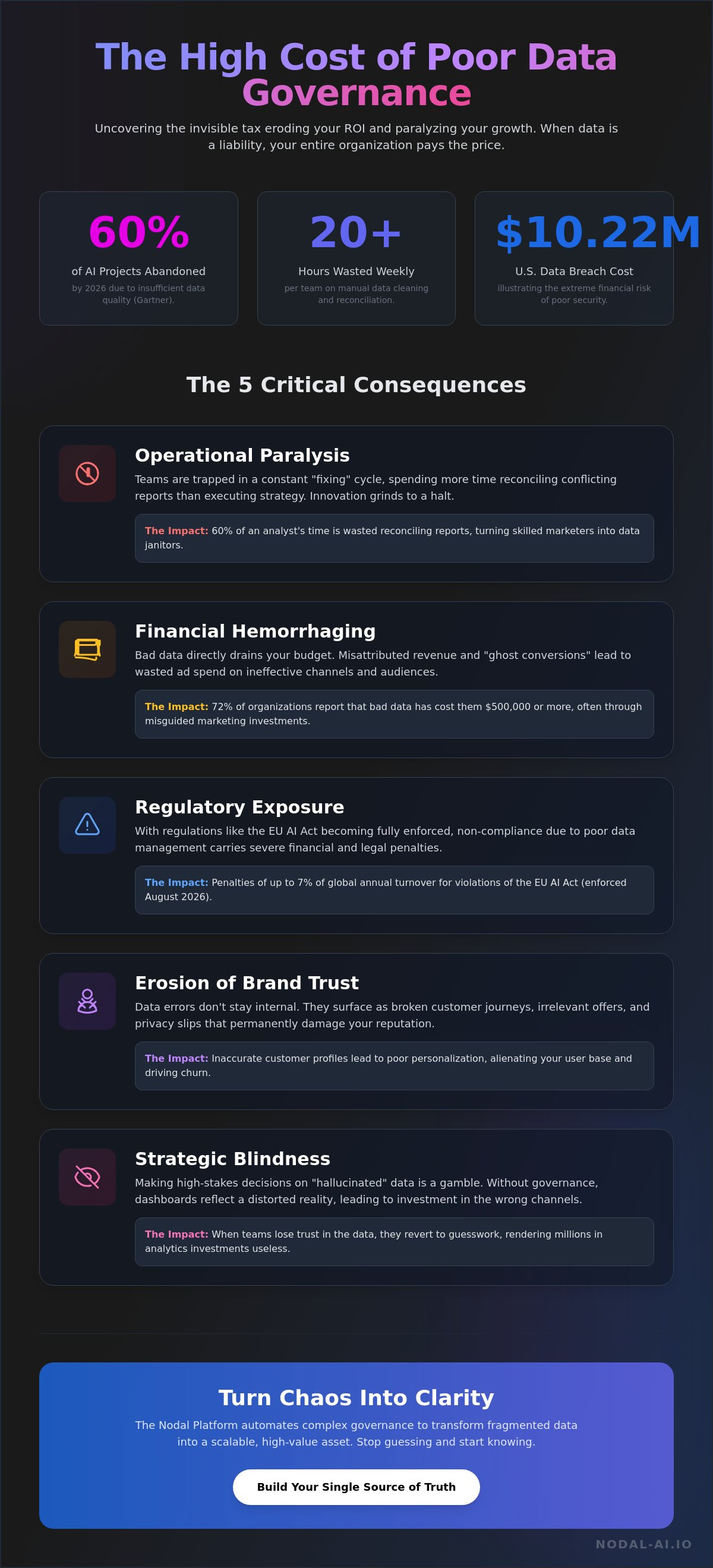
By the end of 2026, Gartner predicts that 60% of AI projects will be abandoned because of insufficient data quality. You're likely already feeling this friction in your daily operations. Your team probably spends over 20 hours every week manually cleaning spreadsheets, yet your marketing attribution still feels like guesswork. It's exhausting to watch ad spend vanish while departments clash over conflicting reports. These are the direct consequences of poor data governance, acting as an invisible tax on your entire organization.
Stop letting messy architecture dictate your bottom line. This article reveals how fragmented systems erode your marketing ROI and provides a strategic framework to transform technical debt into scalable growth. You'll gain a clear understanding of the risks of inaction, from record-high $10.22 million U.S. data breach costs to the strict enforcement of the EU AI Act. We'll then outline a path toward automated, clean insights that finally give you the clarity you need to lead with confidence. Turn your data from a liability into a high-value asset starting today.
Key Takeaways
- Identify the "invisible tax" of fragmented systems that drains team productivity and stalls strategic growth.
- Quantify the severe consequences of poor data governance to build a compelling business case for board-level investment.
- Uncover how "ghost conversions" and misattributed revenue create a false ROI mirage that wastes your advertising budget.
- Master a strategic framework to conduct a data friction audit and establish a Single Source of Truth across your marketing stack.
- Learn how the Nodal Platform automates complex governance tasks to transform chaotic inputs into scalable, high-value intelligence.
The Invisible Tax: What Poor Data Governance Actually Means in 2026
Data governance isn't just a compliance checklist or a set of rules for the IT department. It's the structural bridge between chaotic raw inputs and strategic clarity. In 2026, this bridge must be automated and resilient to handle the sheer velocity of incoming signals. Understanding What Poor Data Governance Actually Means requires a shift in perspective. It's the difference between a business that guesses and one that knows. When your data flows through a governed environment, it transforms from a passive liability into an active participant in your growth strategy.
Think of messy data as an "invisible tax" on your entire organization. You won't see it on a balance sheet, but you'll feel it in your marketing efficiency. The severe consequences of poor data governance manifest every time a campaign launches based on incomplete customer profiles. This tax is paid every hour your analysts spend manually cleaning spreadsheets instead of identifying growth opportunities. Fragmented silos act as a ceiling on scalability; they prevent you from replicating success because you can't pinpoint exactly where it came from. Reclaiming this lost value is the first step toward true enterprise intelligence.
To support this transition toward enterprise intelligence, you can discover Kagool and their expertise in unifying complex data environments across SAP, Microsoft, and Databricks platforms.
The Anatomy of Fragmented Data
Fragmentation starts small with duplicate entries and conflicting system signals. However, the real threat is "Data Dark Matter." These are the unmanaged, unstructured assets that sit outside your primary analytics view. When your marketing tech stack doesn't share a common language, you end up with "ghost signals" that mislead your strategy. In 2026, you can't afford inconsistent data definitions. If your sales team and marketing team can't agree on what constitutes a "qualified lead," your growth engine will inevitably stall. This lack of transparency creates friction that slows down every decision you make.
From Technical Debt to Growth Inhibitor
Poor governance compounds over time like high-interest debt. Every "quick fix" or manual workaround adds to a mountain of technical debt that eventually becomes impossible to manage. One of the most dangerous consequences of poor data governance is the erosion of internal trust. When your team stops believing in the accuracy of their dashboards, they stop using them. They revert to intuition and "gut feelings," which makes your advanced analytics tools useless. You must transition to the modern data governance framework to stop this hemorrhaging. By turning these technical hurdles into automated workflows, you move from simply surviving the chaos to driving measurable, scalable growth.
The 5 Critical Consequences of Poor Data Governance
Ignoring your data architecture isn't just a technical oversight; it's a strategic failure with measurable costs. In 2026, the consequences of poor data governance ripple through every layer of the enterprise. Organizations that fail to implement clean, automated structures face five critical risks that can derail even the most aggressive growth targets.
- Operational Paralysis: Teams become trapped in a "fixing" cycle. When 60% of their time is spent reconciling conflicting reports, they've stopped being marketers and started being data janitors.
- Financial Hemorrhaging: Bad data is a direct drain on liquidity. Research shows 72% of organizations report that bad data has cost them $500,000 or more, often through wasted ad spend on misidentified audiences or mismanaged sales incentives; for example, computermarketresearch.com helps automate these payouts to prevent the overpayment risks associated with manual tracking.
- Regulatory Exposure: The stakes have never been higher. With the EU AI Act reaching full enforcement on August 2, 2026, violations can trigger penalties of up to 7% of global turnover.
- Erosion of Brand Trust: Data errors don't stay internal. They manifest as broken customer journeys, irrelevant offers, and privacy slips that permanently damage your reputation.
- Strategic Blindness: Making high-stakes decisions on "hallucinated" data is a gamble. Without governance, your dashboards reflect a distorted reality, leading to investments in the wrong channels.
If these risks sound familiar, it's time to evaluate your current systems. You can explore how the Nodal Platform automates these safeguards to protect your bottom line.
The Collapse of AI Performance
Modern predictive models are only as good as the historical data they ingest. If you feed an algorithm inconsistent signals, you'll receive inaccurate growth recommendations in return. This "Garbage In, Garbage Out" reality is the primary reason why many ai marketing analytics initiatives fail to deliver ROI. Poor governance creates biased outputs that can lead you to abandon profitable segments or over-invest in low-value traffic. High-performance AI requires a foundation of integrity that only strict governance provides.
Operational Friction and Talent Drain
The human cost of messy data is often the most difficult to recover. In London-based marketing teams, where the pace is relentless, top-tier talent expects sophisticated tools. When skilled analysts are forced to spend 20+ hours a week on manual reporting, frustration peaks. This operational friction leads to a significant talent drain as your best people move to organizations with better governance hygiene. You aren't just losing productivity; you're losing the intellectual capital required to compete in a data-driven market. Clean data isn't just for the machines; it's for the people who drive your business forward.
The Marketing Attribution Crisis: Why Your ROI is a Mirage
Your marketing dashboards might look healthy, but without a foundation of integrity, those numbers are likely a mirage. The consequences of poor data governance manifest most aggressively in your attribution models. When data isn't standardized across your stack, you end up with "Ghost Conversions," where multiple channels claim credit for the same sale. This doesn't just inflate your reports; it inflates your costs. You're effectively paying for the same result twice while losing sight of the true value of each touchpoint. It's impossible to scale what you can't accurately measure.
True marketing attribution requires a clear map of data lineage. You need to know where a data point originated, how it changed, and why it's being counted. In a chaotic environment, last-click models become a dangerous crutch because they're easy to measure, even though they ignore the complex reality of modern buying. Governance fixes this by cleaning the pipes through which your data flows. It ensures that every signal is unique and verifiable, turning your attribution from a guessing game into a precision tool.
Broken Customer Journeys
Friction occurs when your CRM and ad platforms speak different languages. If your social tracking pixels and your internal sales records don't share a common identifier, the customer journey breaks. You lose the ability to track a user from their first impression to their final purchase. Fragmented identity resolution means you're treating returning customers like strangers, which leads to poor experiences and wasted retargeting spend. Use a definitive guide to the customer journey to spot these governance gaps before they alienate your audience. Clean data is the only way to maintain a seamless, high-value relationship with your customers.
Misallocated Budgets and Wasted Spend
Small errors in data collection lead to massive failures in budget allocation. Consider a scenario where a 10% error in tracking leads to a 50% misallocation of your quarterly budget. If your data incorrectly suggests a non-incremental channel is driving growth, you'll pour money into a vacuum. You might think you're scaling, but you're actually just funding "organic" sales that would have happened anyway. This is one of the most expensive consequences of poor data governance in a competitive market. Strategic data governance acts as the definitive security layer that validates every pound of marketing ROI in 2026. Stop gambling with your ad spend and start investing based on verified intelligence.
Turning Chaos into Clarity: A Modern Framework for Data Integrity
Stop reacting to data fires and start building a resilient architecture. Transitioning from chaos to clarity requires a proactive framework that treats data as a strategic asset rather than a byproduct of your tech stack. Begin with a comprehensive "Data Friction Audit." This process involves identifying exactly where your information leaks occur, from duplicate CRM entries to broken tracking pixels. By mapping these friction points, you can quantify the hidden costs of your current inefficiencies. You're no longer just "fixing data"; you're reclaiming lost marketing margin.
Establishing a Single Source of Truth (SSOT) is the next non-negotiable step. In 2026, a fragmented stack is a liability you can't afford. Your marketing analytics, sales records, and customer success signals must flow into a unified environment where definitions are standardized. This alignment ensures that when a dashboard shows a "conversion," every department agrees on what that means. Without this unity, you'll continue to suffer the consequences of poor data governance, such as misallocated budgets and conflicting reports that paralyze your leadership team.
Shift your mindset from defensive governance to an offensive data strategy. Defensive governance focuses on avoiding penalties, like the €35 million fines associated with the EU AI Act. Offensive strategy focuses on growth. It uses clean data to fuel predictive models and personalized customer journeys that your competitors can't replicate. Secure your competitive advantage and protect your ROI by integrating the Nodal Platform into your growth engine today.
Automating the Stewardship Process
Manual data entry is the enemy of integrity. It's slow, prone to human error, and creates the very silos that stall your progress. Modern ecosystems in 2026 rely on AI to tag, categorise, and clean fragmented inputs in real time. Automated validation loops act as a digital immune system; they identify and quarantine "dirty" data before it ever reaches your reporting layer. This real-time monitoring ensures your intelligence remains sharp and your recommendations stay profitable. You don't need more data janitors; you need better automation.
Building a Culture of Data Accountability
Technology alone won't solve a culture of neglect. You must train your marketing teams to understand that data hygiene is a revenue driver. Stop setting KPIs solely on lead volume and start rewarding data accuracy and completeness. When pitching governance to the C-suite, frame it as a cognitive upgrade for the entire organization. High-quality data reduces the 241 days it typically takes to identify and contain a breach, while simultaneously improving your marketing ROI. Transform your data from a passive archive into an active participant in your business success.
The Nodal Approach: Automating Governance for Scalable Growth
Governance shouldn't be a separate project that slows your team down. It must be the foundation of your analytics engine. The consequences of poor data governance stop being a threat the moment your infrastructure becomes self-healing. The Nodal Platform integrates these safeguards directly into your data pipelines. It transforms fragmented, noisy inputs into a unified stream of actionable intelligence. You no longer have to worry about whether your reporting is accurate; you simply focus on what the data is telling you to do next.
London's leading enterprises choose Nodal because we solve the multi-touch attribution puzzle that others ignore. By establishing a governed foundation, we enable advanced predictive modelling that actually works. Most AI models fail because they're fed inconsistent signals. Nodal ensures every data point is verified and standardized before it ever reaches the modeling layer. This transition from technical debt to strategic clarity is what separates market leaders from those struggling with "ghost conversions" and wasted spend.
From Raw Data to Growth Recommendations
Filter out the noise and find the trends that actually drive profit. Nodal AI scans your entire marketing stack to identify high-value opportunities that manual analysis would miss. Our automated reporting eliminates the 20+ hours of manual labor your team currently wastes on spreadsheets every week. Reclaim that time for high-level strategy. Move your organization from a reactive "What happened?" posture to a proactive "What should we do next?" mindset. When your data is clean, your path to growth becomes obvious.
Future-Proofing Your Marketing Stack
Scale your operations without increasing your complexity. As your data volume grows, Nodal grows with you, maintaining total transparency and integrity at every step. We treat security and compliance as built-in features rather than afterthoughts. With the EU AI Act enforcement beginning August 2, 2026, you need a partner that protects your assets automatically. Don't let the consequences of poor data governance define your future. Request a demo today to see your data in a new light and start your journey toward frictionless progress.
Reclaim Your Strategic Clarity
The cost of chaos is no longer a theoretical risk. In 2026, the consequences of poor data governance translate directly into record-breaking fines and eroded marketing ROI. You've seen how fragmented silos act as a ceiling on your scalability and how ghost conversions can turn your attribution into a mirage. It's time to stop paying the invisible tax on your growth and start building a resilient, automated foundation.
By implementing a modern framework and adopting automated validation loops, you transform your data from a passive liability into an active participant in your success. Nodal AI provides the cognitive upgrade your organization needs to thrive in a complex regulatory landscape. Benefit from our London-based expert support and AI-driven automated reporting to finally achieve total clarity across your marketing stack. As a multi-touch attribution specialist, we ensure every pound of your ad spend is accounted for and optimized.
Transform your fragmented data into growth with Nodal AI. You have the tools to replace overwhelm with streamlined efficiency. Start leading with confidence today.
Frequently Asked Questions
What are the most common signs of poor data governance?
Discrepancies between departmental reports and manual data cleaning marathons are the most obvious red flags. If your marketing team spends more time debating which spreadsheet is "correct" than discussing strategy, your governance is failing. You'll also notice duplicate customer records and ghost conversions that inflate your ROI without adding real revenue. These symptoms suggest a lack of structural integrity across your stack.
How much does poor data governance cost the average enterprise?
The financial impact is staggering. Research indicates that 72% of organizations report bad data has cost them $500,000 or more. In the United States, the average cost of a data breach has reached a record high of $10.22 million in 2026. These figures represent both direct losses from wasted ad spend and the indirect costs of operational inefficiency that stall your growth.
Can AI fix poor data governance issues automatically?
AI is a powerful tool for cleaning and tagging data, but it isn't a standalone cure. While the Nodal Platform uses AI to automate reporting and validate inputs, you still need a strategic framework. AI can accelerate the transition from fragmented data to actionable intelligence; however, it requires a governed foundation to prevent the cycle of garbage in, garbage out from repeating.
What is the difference between data management and data governance?
Data management is the tactical execution of handling information, while data governance is the strategic framework of rules and authority. Think of management as the plumbing that moves data through your systems. Governance is the set of standards that ensures the water is clean, safe, and flowing to the right destination. One handles the how, while the other defines the who, what, and why.
How does poor data governance impact GDPR compliance in 2026?
It creates severe legal vulnerabilities. In 2025 alone, approximately €1.2 billion in GDPR fines were issued, and cumulative fines have now surpassed €7.1 billion. Without strict governance, you can't guarantee data minimization or accurate deletion requests. These failures are direct consequences of poor data governance that can lead to upper tier penalties of 4% of global annual revenue.
What are the first steps to improving data governance in a marketing team?
Start by conducting a Data Friction Audit to identify where your reporting breaks down. Establish a Single Source of Truth across your marketing stack to eliminate conflicting signals. Once your definitions are standardized, move toward automated validation loops. This shift replaces manual labor with streamlined, high level perspectives that empower your team to focus on scalable growth and measurable returns.
How does poor data quality affect marketing attribution models?
It renders them useless. When your customer journey map is built on fragmented identity signals, your attribution becomes a mirage. You'll likely over invest in non incremental channels or fail to see the true impact of top of funnel touchpoints. High quality governance ensures every conversion is unique and verifiable, providing the clarity needed for accurate multi touch attribution and profitable decision making.
Why is data lineage important for marketing performance?
Lineage provides the biography of your data. It tracks where a lead originated, how it was processed, and why it's being counted in your current report. This transparency is essential for debugging performance drops and justifying budget increases to the board. Without lineage, you have raw numbers; with it, you have a verifiable narrative of success that transforms passive assets into active participants.


