

What if your most valuable commercial data is currently trapped in a digital graveyard of static cells and broken formulas? Research indicates that 94% of finance leaders admit to making strategic software decisions they now regret, often because they failed to outpace the complexity of their own data. Moving from spreadsheets to automated reporting is the only way to escape this cycle. It allows you to bridge the gap between fragmented PMS, POS, and ad platform data, replacing the constant risk of human error with absolute clarity.
You likely feel the weight of the "Excel ceiling" every time a performance report takes days instead of seconds to compile. We understand the frustration of manual workflows that drain your team's productivity and leave you without real-time visibility. This guide provides a strategic roadmap to transition your business to a unified, AI-driven system that powers commercial growth. You will learn how to establish a single source of truth for all data and leverage automated workflows that finally free your team for high-level strategy. We will preview the cognitive upgrade of AI-driven recommendations that turn your reporting from a passive log into an active engine for your entire organisation.
Key Takeaways
- Identify the "Excel Ceiling" to reclaim the hours lost to manual processing and regain clarity on your commercial growth path.
- Discover how moving from spreadsheets to automated reporting replaces the friction of manual CSV downloads with seamless API integrations.
- Transform static reports into active commercial intelligence by adopting AI-driven analytics that suggest specific, high-value growth actions.
- Execute a high-impact migration roadmap that audits your current reporting ecosystem and secures a single source of truth for the entire organisation.
- Utilise predictive modelling to forecast performance, ensuring your commercial strategy is built on future insights rather than past logs.
The Excel Ceiling: Why Manual Reporting Fails Modern Enterprises
The Excel Ceiling is the invisible barrier where your data volume exceeds your team's human processing capacity. It is the point where growth halts because your systems can no longer keep pace with your ambitions. For many hospitality and performance-led organisations, this ceiling is reached when data is scattered across Property Management Systems (PMS), Point of Sale (POS) terminals, and various advertising platforms. Attempting to consolidate these silos manually is not just difficult; it's impossible at scale. You end up with a fragmented view of your commercial health that obscures the very insights you need to thrive.
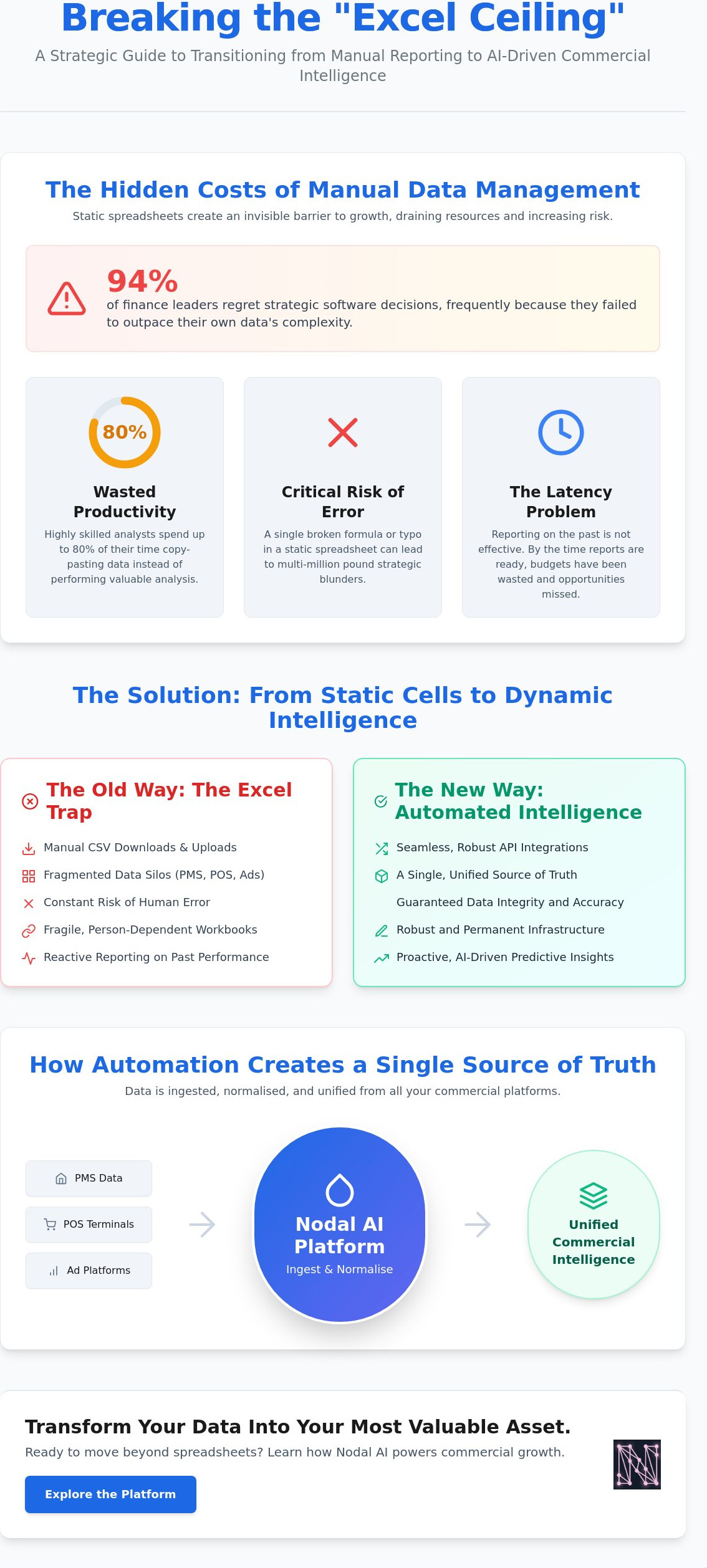
The hidden costs of staying below this ceiling are staggering. Highly skilled analysts often spend 80% of their time copy-pasting data and cleaning cells rather than performing actual analysis. This represents thousands of pounds in lost salary hours every month. Beyond the financial drain, there is a profound opportunity cost. While your team is buried in rows and columns, they aren't identifying new revenue streams or optimising spend. Moving from spreadsheets to automated reporting transforms your data from a static burden into an active participant in your business strategy. It replaces the fragility of person-dependent workbooks, which often become useless the moment a key analyst leaves the company, with a robust and permanent infrastructure.
To see how these automated systems resolve complex data challenges, you can explore our platform features designed to dismantle these silos once and for all.
The Risk of Human Error in Static Cells
A single broken formula in a hidden tab can lead to multi-million pound strategic blunders. Traditional spreadsheets lack the rigorous audit trails and version control found in professional Business intelligence (BI) environments. When your commercial decisions rely on manual data entry, integrity is the first casualty. In 2026, the complexity of multi-channel marketing means that even a minor typo in a spreadsheet can distort your entire understanding of customer acquisition costs. Automated systems eliminate this risk by pulling data directly from the source, ensuring that your "single source of truth" is actually true.
The Latency Problem: Reporting on the Past
Latency is the silent killer of performance marketing. If your performance report arrives a week late, you have already wasted significant budget on underperforming ad sets or missed a surge in booking demand. Moving from spreadsheets to automated reporting shifts your organisation from reactive logs to proactive intelligence. Modern commercial environments require real-time visibility to make adjustments as they happen. You cannot steer a ship by looking at the wake it left behind; you need a clear view of the water ahead to make high-value decisions that drive immediate growth.
Transitioning from Static Spreadsheets to Dynamic Data Flows
Moving from manual grids to dynamic data flows requires a fundamental shift in how you perceive your commercial data. Instead of treating data as a series of isolated snapshots, you must view it as a continuous, living stream. Static spreadsheets rely on the frequent, manual download of CSV files from platforms like GA4 or Oracle OPERA, a process that is inherently prone to error and delay. True automation replaces these manual touchpoints with robust API integrations. These connections ingest data directly from the source, ensuring that your reporting is always current and completely untainted by human interference.
The core of this transition is data normalisation. In a fragmented ecosystem, different platforms often have conflicting definitions for the same metric. For example, "revenue" in a marketing dashboard might include tax and shipping, while your PMS reflects net room rates. Without normalisation, your consolidated report is essentially a collection of incompatible figures. The Nodal Platform unifies these disparate sources, ensuring that every metric is aligned and every stakeholder is looking at the same reality. This structural alignment is the first step toward turning chaotic inputs into high-value commercial outputs.
If you are ready to see how these automated pipelines can transform your specific data sets, you can book a demo to explore the possibilities.
Replacing VLOOKUPs with Automated Mapping
While VLOOKUPs were once the standard for connecting data, they are notoriously brittle and incapable of handling the complexity of modern customer journeys. AI-driven mapping replaces these manual formulas by intelligently linking touchpoints across multiple platforms. This allows for sophisticated Multi-Touch Attribution, moving beyond the simplistic last-click models that often lead to poor investment decisions. Automated systems also handle historical data ingestion with ease, providing a deep context for trend analysis that manual workbooks simply cannot sustain. Moving from spreadsheets to automated reporting ensures that your historical insights are just as accessible and accurate as your real-time performance.
Establishing a Single Source of Truth
A single source of truth (SSOT) is a central repository where all commercial data is validated and accessible to every stakeholder. This eliminates the "boardroom bickering" that occurs when different departments present conflicting figures from their own private spreadsheets. When everyone trusts the data, the focus shifts from questioning the numbers to acting on the insights. Maintaining this standard requires a robust data governance framework, which acts as a protective layer for your assets. This framework ensures that as you scale, your data remains secure, compliant, and consistently accurate across the entire organisation.
Beyond Automation: Turning Reporting into Commercial Intelligence
Mechanical automation is merely the baseline of modern operations. While saving time is essential, the true competitive advantage of moving from spreadsheets to automated reporting lies in the transition from descriptive logs to active commercial intelligence. Most legacy tools simply accelerate the delivery of "what happened" reports. However, a cognitive upgrade through ai marketing analytics shifts the focus toward what you should do next. It turns data into a conversational partner that actively identifies opportunities for growth.
In the hospitality sector, this distinction is critical. A human analyst might miss the subtle, early signals of upcoming "need periods" in occupancy until it's too late to react. Nodal AI scans these fragmented data sets in real-time, detecting shifts in booking pace and market demand before they impact the bottom line. This allows leadership to move beyond reactive damage control and embrace prescriptive strategy. You no longer just see a drop in revenue; you receive a validated path to prevent it. It's the difference between looking at a map of where you've been and using a GPS to navigate where you're going.
This proactive approach to data is equally vital in high-stakes sports; for instance, ArmIQ provides coaches and players with software solutions to monitor baseball arm health, using real-time data to prevent injuries before they occur.
The Power of Growth Recommendations
The real value of an intelligent system is its ability to reduce the cognitive load on C-suite leaders. Instead of wading through tabs to find an underperforming campaign, you receive specific Growth Recommendations that suggest immediate budget shifts to optimise ROAS. These insights are tailored to your unique commercial goals, whether you are aiming to increase average spend per head or maximise occupancy during a low season. By automating the "why" and the "how," the system empowers your team to execute high-impact decisions with total confidence. It replaces the anxiety of guesswork with the certainty of data-backed optimisation.
Visualising the Customer Journey
Traditional spreadsheets are fundamentally incapable of mapping a modern customer journey that spans weeks and multiple devices. These journeys are non-linear and complex, involving numerous touchpoints that static cells simply cannot connect. By visualising the entire path-to-purchase, you can pinpoint exactly where friction occurs and where guests are likely to churn. Nodal AI bridges these gaps, linking guest profiles with commercial and operational modules to provide a 360-degree view of the experience. This level of clarity allows you to identify high-value acquisition channels that last-click models ignore, ensuring your marketing spend is strategically aligned with long-term commercial stability.
A Practical Roadmap for Your Migration Strategy
Successful migration requires more than just new software; it demands a structured shift in organisational culture. Begin by auditing your current spreadsheet ecosystem to identify which reports are the most critical and time-consuming. This isn't just about counting files. It's about quantifying the hours lost to manual labour and identifying where the "Excel Ceiling" is most restrictive. Define your commercial KPIs clearly, ensuring they are measurable through your existing data sources before you attempt to build new pipelines. If you can't measure it in a cell today, you must fix the data source before you automate the output.
Selecting the right partner is the most vital step in this journey. Choose a platform that offers professional implementation and onboarding to handle the underlying technical complexities. This ensures your data architecture is robust from day one, preventing the "garbage in, garbage out" trap. To maintain total confidence across the C-suite, run the new automated system in parallel with your legacy spreadsheets for at least one reporting cycle. This allows you to validate the outputs and prove the accuracy of the automated model. Finally, invest time in training your team to move away from the drudgery of data preparation and toward the high-value work of strategic execution.
To see how this roadmap fits your specific organisational structure, book a demo to start your migration and reclaim your team's time.
Identifying Key Data Integrations
In the hospitality sector, your roadmap must prioritise integrations that directly impact revenue and margin. Essential connections usually include your Property Management System, such as Mews, alongside distribution tools like Synxis and marketing platforms like Google Ads. Don't overlook the value of connecting reputation data from sources like TripAdvisor with your commercial performance. This creates a powerful feedback loop, allowing you to see exactly how guest satisfaction scores correlate with your average daily rate and long-term commercial stability.
Ensuring Compliance and Security
Security is a primary driver for moving from spreadsheets to automated reporting. Emailing workbooks containing sensitive guest data is a significant compliance liability that many organisations ignore until it's too late. Automated platforms provide a far more secure environment, ensuring strict GDPR compliance through encrypted data transfers and centralised storage. Role-based access control further protects your commercial secrets, allowing you to grant specific permissions to team members while keeping high-level financial data restricted to authorised leadership.
Scaling with Nodal: The Future of Automated Performance Insights
Moving from spreadsheets to automated reporting marks the definitive shift from a legacy mindset to a future-ready operation. It is the moment your organisation stops wrestling with data and begins to master it. Nodal AI stands as the essential partner in this evolution, helping you to make more and waste less by refining chaotic data into precise commercial instruments. By moving beyond the fragility of manual workbooks, you unlock the power of predictive modelling. This capability provides a level of long-term commercial stability that spreadsheets simply cannot offer; it transforms your outlook from a historical log of what happened to a proactive forecast of what will happen next.
The experience of Ovolo Hotels provides a concrete blueprint for this success. By transitioning away from fragmented manual systems, they achieved a unified view of their performance that empowered their teams to act with unprecedented speed and accuracy. This shift replaced the drudgery of data cleaning with the excitement of strategic discovery. You can secure this same level of clarity for your own organisation by stepping into an environment where every data point serves a purpose. We invite you to experience the relief that comes from a system that finally works as hard as you do through a tailored demonstration of our platform.
From Data Fragmentation to Strategic Clarity
Nodal AI unifies your disparate systems into a single, actionable view that eliminates the friction of data silos. Our modular architecture is designed for scalability, allowing your business to expand its analytical intelligence as your commercial requirements grow more complex. This ensures that your reporting infrastructure is never a bottleneck for your growth. Nodal AI is the bridge between raw data and commercial success.
Take the First Step Toward Automation
Break the cycle of manual reporting today and reclaim the hundreds of hours your team currently loses to spreadsheet maintenance. Our expert consultancy team ensures a seamless onboarding process, managing the technical complexities of integration so you can focus on strategic execution. The path to a more efficient, data-driven future is clear and accessible, providing the cognitive upgrade your organisation needs to thrive in 2026. Book a demo with Nodal AI to see how we can transform your reporting and power your commercial growth.
Master Your Data and Drive Commercial Growth
The transition from manual logs to automated intelligence is the most significant upgrade your organisation can make in 2026. By dismantling data silos and establishing a single source of truth, you replace the anxiety of broken formulas with the confidence of real-time visibility. Moving from spreadsheets to automated reporting allows your team to shift their focus from the mechanical task of data entry to the high-value work of strategic execution and growth. You have the roadmap; the next step is to replace your passive assets with an active engine for success.
Just as organisations are automating their internal workflows, individual tech professionals are increasingly utilizing AI platforms like QuickApply to streamline their career growth and job application strategies in this new digital era.
Nodal AI provides the modular architecture required to scale your commercial insights alongside your ambitions. As a Gold winner in the Performance Marketing Awards, our platform is a proven catalyst for efficiency; we helped Ovolo Hotels realise a 15.3% reduction in acquisition costs through smarter data utilisation. This level of clarity is no longer a luxury for the few, but a requirement for any brand obsessed with measurable returns and long-term stability. Stop the cycle of manual drudgery and start leading with data-backed precision.
Book a demo with Nodal AI today and experience the relief of total commercial clarity. Your future growth is waiting to be unlocked.
Frequently Asked Questions
How long does it take to move from spreadsheets to an automated platform like Nodal AI?
A typical migration usually takes between four and six weeks to complete. This timeline includes the initial audit of your existing reports and the full configuration of your automated data pipelines. Our expert consultancy team manages the technical integration, ensuring that your transition is seamless and does not interrupt your daily commercial operations.
Will we lose the ability to perform custom analysis if we stop using Excel?
You will actually gain more analytical freedom by moving from spreadsheets to automated reporting. While Excel is a familiar tool, it limits you to static snapshots; Nodal AI provides dynamic environments where you can filter and pivot data in real time. If you require a specific offline report, you can still export validated data for one-off presentations or niche calculations.
Can Nodal AI integrate with our specific Property Management System (PMS)?
Nodal AI is built to integrate with major hospitality systems including Oracle OPERA, Mews, and Synxis. We remove the burden of manual CSV downloads by establishing direct API connections with your PMS and POS platforms. This ensures that your revenue data is always accurate and perfectly aligned with your marketing performance metrics.
How does automated reporting improve our Return on Ad Spend (ROAS)?
Automation improves ROAS by identifying underperforming campaigns before they drain your budget. By providing real-time visibility into the customer journey, the system allows you to reallocate spend toward high-converting channels instantly. Our Growth Recommendations act as a cognitive upgrade, suggesting specific budget shifts that maximise your return based on live performance data.
Is automated reporting secure enough for sensitive hospitality data?
Automated platforms provide significantly higher security than traditional spreadsheets. Emailing workbooks containing guest information is a major compliance risk; Nodal AI uses centralised, encrypted storage and role-based access control to protect your assets. This ensures that sensitive data remains secure while meeting all modern GDPR and data privacy requirements.
Do we need a dedicated data scientist to manage an automated reporting platform?
You do not need a data scientist to operate the Nodal Platform. We have designed the user experience for commercial leaders and marketing teams who require results without deep technical specialisation. Our onboarding process handles the complex data architecture, leaving your team free to focus on strategic execution and profitable growth.
What happens to our historical spreadsheet data during the migration?
Your historical spreadsheet data is ingested and normalised as part of the migration process. Moving from spreadsheets to automated reporting does not mean losing your past insights; instead, it preserves them in a more accessible format. This allows you to perform deep trend analysis across several years, providing a robust context for your future predictive modelling and commercial strategy.


