

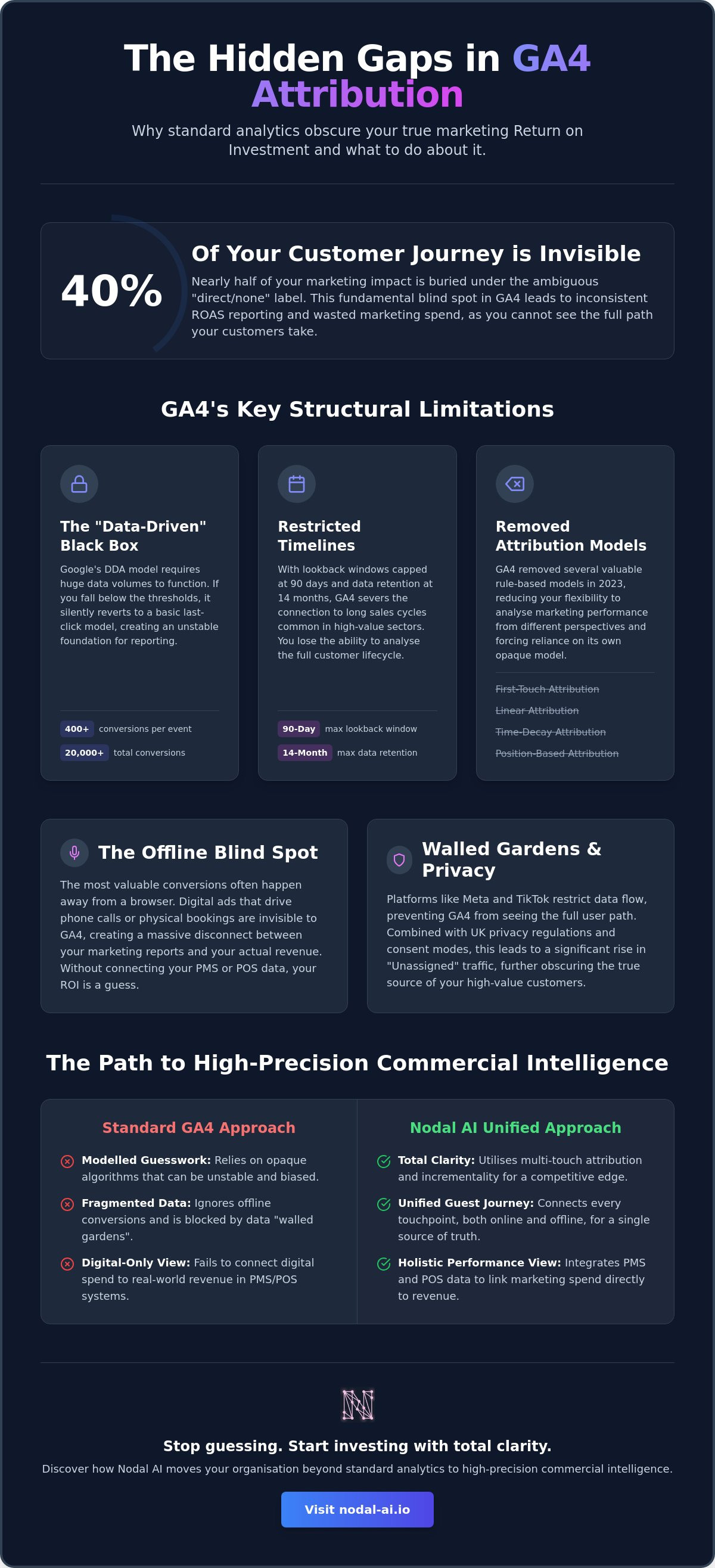
Nearly 40% of your customer journey is currently invisible, buried under the "direct/none" label that plagues modern analytics. You recognise the frustration of inconsistent ROAS reporting across platforms, where the numbers in your ad manager rarely align with the reality in your dashboard. These ga4 attribution limitations aren't just technical glitches; they are structural flaws that prevent you from seeing the full guest journey and lead to wasted marketing spend.
We understand that manual data reconciliation is a drain on your productivity and your peace of mind. This article promises to reveal the specific gaps in GA4 and provide a clear roadmap to move your organisation toward high-precision commercial intelligence. We will explore why the removal of linear and time-decay models has created a blind spot for high-value conversions. By the end, you will have the confidence to allocate your budget based on total clarity rather than modelled guesswork.
Key Takeaways
- Identify how the transition from Universal Analytics has introduced structural ga4 attribution limitations that obscure your true marketing ROI.
- Discover why digital tracking often fails to capture the offline guest journey, leading to significant gaps in your physical booking data.
- Understand how UK privacy regulations and consent modes contribute to a rise in "Unassigned" traffic and learn how to reclaim that lost visibility.
- Shift your focus from simple rule-based models to multi-touch attribution and incrementality to gain a competitive edge in spend allocation.
- Realise the potential of connecting your PMS and POS systems to marketing analytics for a streamlined, high-level perspective on performance.
Understanding GA4 Attribution Limitations in 2026
Attribution is the logic that assigns commercial value to specific marketing touchpoints. In theory, it provides total clarity; in practice, GA4 often delivers confusion. The shift from Universal Analytics was framed as a cognitive upgrade, yet it introduced structural visibility gaps that many organisations still haven't resolved. These ga4 attribution limitations stem from a move to an event-based model that prioritises individual actions over the cohesive guest journey. You are no longer analysing a person; you are analysing a disconnected series of events. Understanding marketing attribution models is the first step toward realising that GA4 is not a complete solution for high-precision intelligence.
The primary barrier to accurate ROI is data fragmentation. GA4 operates as a digital-first tool, meaning it often ignores offline interactions, phone calls, or physical visits that result from your digital spend. This creates a disconnect between your marketing reports and your actual bank balance. When your tracking is confined to the digital silo, you miss the commercial reality of how your customers actually behave.
The Shift to Data-Driven Attribution (DDA)
Google’s Data-Driven Attribution (DDA) acts as a sophisticated black box. It promises precision but demands high volume. To keep the model active, your property needs at least 400 conversions for a specific event and 20,000 total conversions across the lookback window. If your volume falls below these numbers, the system silently reverts to a basic last-click model. This creates a precarious foundation for your reporting. Additionally, the model is inherently biased. Built by an advertising platform, it naturally favours Google-owned channels, making it difficult to justify spend on alternative platforms with total confidence.
Lookback Windows and Long Sales Cycles
Standard GA4 properties offer lookback windows restricted to 30, 60, or 90 days. For high-value sectors like hospitality, where the path from inspiration to booking can take months, these windows are far too narrow. If a guest interacts with an ad in spring but books in autumn, the connection is severed. You lose the ability to track the full lifecycle of your customer. Data retention is another hurdle. Standard properties only keep data for 14 months, which restricts your ability to perform deep historical analysis or year-on-year comparisons. You are forced to operate in a perpetual short-term cycle, missing the long-term patterns that drive genuine growth.
To understand the current landscape, consider the models Google removed in late 2023:
- First-touch: No longer available for credit assignment.
- Linear: Removed, preventing equal credit distribution.
- Time-decay: Eliminated, making it harder to value touchpoints closest to conversion.
- Position-based: Scrapped, removing the ability to weigh the first and last interactions.
The Data Gap: Why Offline and Cross-Device Journeys Break GA4
Digital reporting often creates a false sense of security. While you might see a steady stream of clicks, the reality of the hospitality and experience sector is that the most valuable conversions often happen far away from a browser. These ga4 attribution limitations become glaringly obvious when a digital ad drives a physical booking or a phone call that the system simply cannot record. This "Offline Blind Spot" is where your ROI goes to die. Without a way to connect your Property Management System (PMS) or Point of Sale (POS) data back to your marketing spend, you are essentially flying blind. You might be spending thousands on a campaign that looks like a failure in GA4, yet it is actually driving high-value guests through your front door.
The problem is compounded by "Walled Gardens" such as Meta and TikTok. These platforms restrict the flow of data to Google, preventing GA4 from seeing the full path a guest takes before booking. When your data is trapped in these silos, you can't accurately assess which channel deserves the credit. Relying solely on these fragmented snapshots is a significant risk; many leaders now recognise that a GA4 vs. Multi-Touch Attribution: A Strategic Comparison reveals the necessity of looking beyond standard platform reporting to achieve true commercial intelligence. Moving toward a more integrated approach allows you to stop guessing and start investing in what actually moves the needle for your business.
The Challenge of Fragmented Customer Journeys
A guest might discover your brand through a mobile ad while commuting, but they won't pull out their credit card until they are on a desktop at home. GA4 frequently loses this signal, especially when users are not logged into a Google account across both devices. This fragmentation also occurs when a user moves from an in-app browser to a standard web browser, causing a total loss of tracking continuity. To stop these leaks, you must prioritise customer journey mapping to identify where your tracking signals are failing. Without this visibility, you are likely over-valuing the final click and under-valuing the inspiration phase that actually initiated the guest interest.
Integrating External Signals: Weather, Events, and FX
GA4 is an internal-looking tool. It tracks what happens on your site, but it remains oblivious to the external factors that actually drive demand in the real world. A sudden heatwave in London or a favourable shift in exchange rates can trigger a spike in bookings that your analytics might misattribute to a specific campaign. High-precision intelligence requires a platform that connects your internal metrics with these external variables to provide a cognitive upgrade for your entire organisation. If you want to see how your data can finally reflect the real world, you can book a demo of the Nodal platform today to see these connections in real-time.
Privacy, Consent Mode, and the Rise of Unassigned Traffic
Privacy is no longer a hurdle to be cleared; it is the fundamental environment in which modern marketing must operate. In 2026, the strict enforcement of GDPR and UK privacy regulations has made explicit consent the absolute standard. This shift has direct consequences for your visibility. When a user opts out of tracking, GA4 attempts to bridge the gap using Advanced Consent Mode, which relies on "cookieless pings" to estimate performance. These ga4 attribution limitations mean that a significant portion of your traffic is now categorised as "Unassigned," leaving you to guess which campaigns actually drove your revenue.
The common objection is that we simply need more data to make better decisions. This is a dangerous assumption. High volumes of poor-quality, modelled data can lead to a sense of overwhelm rather than clarity. You don't need more data; you need more intelligence. Relying on the silent projections of a platform built for advertisers often results in a disconnect between your reports and your actual business growth. True precision requires moving beyond the "Unassigned" noise to find the signals that matter.
The "(not set)" Problem: Causes and Consequences
The appearance of "(not set)" in your reports is a symptom of a broken journey. This often happens when a session_start event is missing or when UTM parameters are stripped away by privacy-focused browsers. While server-side tagging can mitigate some of these issues by moving the tracking logic away from the browser, it cannot override a user’s refusal to be tracked. Making budget decisions based on a dashboard where 30% of traffic is unassigned is a high-stakes gamble. You risk cutting spend on a channel that is actually your primary growth engine simply because GA4 could not identify it.
Predictive Modelling vs. Statistical Gaps
GA4 fills its statistical gaps with modelled conversions, but these models are often too generic for specialised sectors like hospitality. They lack the nuance required to understand complex, multi-touch paths. To gain a cognitive upgrade, you must integrate sophisticated predictive modelling that respects privacy while delivering commercial value. Robust data governance is essential here. By ensuring your internal data sources are clean and connected, you can replace the anxiety of manual reconciliation with the confidence of streamlined, high-level perspectives.
GA4 vs. Multi-Touch Attribution: A Strategic Comparison
GA4 is often marketed as a comprehensive solution, yet it remains fundamentally tethered to the Google ecosystem. For hospitality and QSR brands, this creates a significant visibility gap. When you rely solely on standard reporting, you are viewing your performance through a lens that prioritises digital clicks over commercial reality. These ga4 attribution limitations mean the platform struggles to measure incrementality (the actual incremental revenue generated by a specific marketing activity that would not have happened otherwise). Without this insight, you risk over-spending on channels that merely claim credit for bookings that were already destined to occur.
To achieve total clarity, visionary leaders are turning to sophisticated marketing attribution platforms that integrate Marketing Mix Modelling (MMM). While GA4 tracks the "what" of a session, MMM provides the "why" by accounting for broader trends, baseline sales, and the long-term impact of brand building. This combination replaces the anxiety of manual data reconciliation with a streamlined, high-level perspective on total performance.
Beyond Last-Click: Capturing the Full Value
Standard GA4 setups often over-attribute value to direct traffic or brand search. This happens because the system fails to recognise the "Halo Effect" of top-of-funnel activities, such as a high-impact social media campaign or a local PR event. A guest might see your brand on Instagram, visit your site twice through organic search, and finally book through a direct URL. GA4 frequently awards the credit to that final, direct interaction, effectively ignoring the inspiration phase. To evaluate your true return on ad spend (ROAS), you must look at the entire journey, ensuring that awareness-driving channels receive the credit they deserve for initiating the commercial process.
Commercial Intelligence vs. Web Analytics
It is vital to distinguish between web analytics and commercial intelligence. Web analytics tells you how people use your site; commercial intelligence tells you how people grow your business. The latter requires a union of operational data from your PMS, guest data from your CRM, and marketing data from your ad platforms. Web analytics is only one piece of this growth puzzle. To move beyond fragmented snapshots, you can explore the Nodal Platform features to see how we transform chaotic inputs into high-value outputs. By centralising your data, you create a cognitive upgrade for your organisation that ensures every pound spent is a pound optimised.
If you are ready to bypass the flaws of standard tracking and gain a single view of your performance, book a demo to see the Nodal Platform in action.
Navigating the Future with Nodal AI: Beyond Standard Analytics
The era of accepting incomplete data is over. While many organisations attempt to patch the holes in their tracking, the reality is that GA4 remains a fundamentally limited tool for complex, multi-touch journeys. Nodal AI offers a cognitive upgrade for your organisation by transforming your data from a passive asset into an active participant in your growth strategy. By bypassing the structural ga4 attribution limitations that have historically hindered your strategic vision, you can finally achieve total clarity. Our platform doesn't just report on what happened; it provides the high-precision intelligence required to predict what will happen next.
We solve the data fragmentation problem by creating a unified source of truth. The Nodal Platform seamlessly connects your Property Management System (PMS), Point of Sale (POS), and CRM data directly to your marketing performance. This integration replaces the anxiety of manual reconciliation with the confidence of streamlined, high-level perspectives. Our existing partners have already realised the benefits of this approach, achieving a documented 15.3% reduction in acquisition costs through more intelligent spend allocation. You are no longer guessing which ads drive physical bookings; you are seeing the direct link between every digital interaction and your bottom line.
Connecting the Dots Across Hospitality Performance
The modular architecture of the Nodal engine is designed to handle the unique complexities of the hospitality and QSR sectors. Our AI-driven audience segmentation identifies high-propensity guests by analysing patterns that standard analytics simply cannot see. This allows you to target your spend where it will have the most significant impact. Our automated reporting saves your team hours of manual labour each week, freeing them to focus on high-value strategic tasks rather than tedious data entry. This transition from chaotic inputs to high-value outputs ensures that your organisation remains competitive in an increasingly fragmented landscape.
Taking Action: Moving from Insight to Growth
Success requires more than just a new tool; it requires a strategic partnership. Our professional implementation and onboarding process ensures that your systems are perfectly aligned from day one. We build custom dashboards that provide immediate strategic clarity for C-suite leaders, turning complex datasets into actionable growth recommendations. It is time to replace uncertainty with measurable returns and future-facing analytics. To see the platform in action and discover how you can overcome the challenges of modern tracking, we invite you to book a demo with the Nodal team today. Take the first step toward a cognitive upgrade for your business and secure your commercial future.
Securing Your Competitive Edge with Total Clarity
The structural gaps in standard tracking are no longer just an inconvenience; they are a direct barrier to your commercial growth. By identifying the core ga4 attribution limitations, you've taken the first step toward reclaiming your visibility. You can now move from the anxiety of "Unassigned" traffic to the confidence of a unified guest journey that connects digital spend to physical revenue across every touchpoint.
Our partners have already transformed their reporting into a cognitive upgrade for their entire organisation. They've realised a 15.3% reduction in acquisition costs and a 24.5% increase in ROAS, results that earned us Gold at the Performance Marketing Awards. This level of precision isn't a luxury; it's the new standard for hospitality and QSR brands that refuse to leave their marketing spend to guesswork.
It's time to replace fragmented snapshots with high-precision intelligence and streamlined perspectives. Book a Nodal AI Demo to Fix Your Attribution Gaps and start turning your chaotic inputs into high-value outputs. We're ready to help you master your data and lead your sector with confidence.
Frequently Asked Questions
What are the main limitations of GA4 attribution models?
The primary ga4 attribution limitations include the removal of rule-based models like linear and time-decay, leaving only last-click and data-driven options. This restricts your ability to value early-funnel interactions that initiate the guest journey. Additionally, a 14-month data retention limit prevents long-term historical analysis, forcing marketers to rely on short-term snapshots rather than a continuous narrative of commercial growth.
Why does GA4 show so much "Unassigned" traffic in my reports?
"Unassigned" traffic typically appears when GA4 cannot identify the source of a session due to privacy restrictions or missing tracking events. In 2026, strict UK privacy standards mean many users opt out of cookies, forcing the system to group their activity into this anonymous category. You can mitigate this through better UTM governance, but it remains a significant visibility hurdle for standard analytics users.
Can GA4 track offline conversions from my physical locations?
Standard GA4 cannot natively track offline conversions from physical locations without complex manual uploads or third-party integrations. It is fundamentally a digital tracking tool that ignores the commercial reality of physical bookings or in-store visits. To bridge this gap, you must connect your PMS or POS data to a platform like Nodal, transforming disconnected offline actions into measurable marketing outcomes.
How does Consent Mode affect the accuracy of my attribution data?
Consent Mode uses predictive modelling to estimate the behaviour of users who decline cookies, which inevitably reduces data precision. While it provides a high-level view, you lose the granular detail required for high-precision commercial intelligence. This reliance on "cookieless pings" often leads to inflated "Unassigned" reports, making it difficult to allocate your marketing budget with total confidence.
Is GA4 data-driven attribution biased toward Google Ads?
Many industry experts believe data-driven attribution is inherently biased toward the Google ecosystem because it is built by an advertising platform. The model acts as a "black box," making it difficult to verify how credit is assigned to non-Google channels. This lack of transparency can lead to over-investment in search ads while under-valuing the social or offline touchpoints that actually initiated the guest journey.
What is the difference between GA4 and multi-touch attribution software?
GA4 is a web analytics tool designed to track site interactions, whereas multi-touch attribution software is a commercial intelligence platform that connects the entire guest journey. While GA4 operates in a digital silo, advanced software integrates your CRM, PMS, and POS data. This union provides a cognitive upgrade for your organisation, moving you from simple session tracking to high-precision financial modelling.
How can I fix the "(not set)" source and medium in GA4?
You can reduce "(not set)" values by auditing your UTM parameters and ensuring that session-start events fire correctly across all pages. This issue often stems from technical tagging errors or privacy-focused browsers stripping referral data. Moving to server-side tagging can offer more control over your data flow, but it remains a technical patch rather than a total solution for privacy-driven data loss.
Does GA4 support marketing mix modelling (MMM)?
GA4 does not support Marketing Mix Modelling (MMM) as it is built for session-based tracking rather than broad statistical analysis. MMM requires the integration of external factors like weather, local events, and baseline sales data to provide a holistic view of performance. To achieve this level of intelligence, you must look beyond standard analytics and adopt a platform that centralises all commercial signals.


