
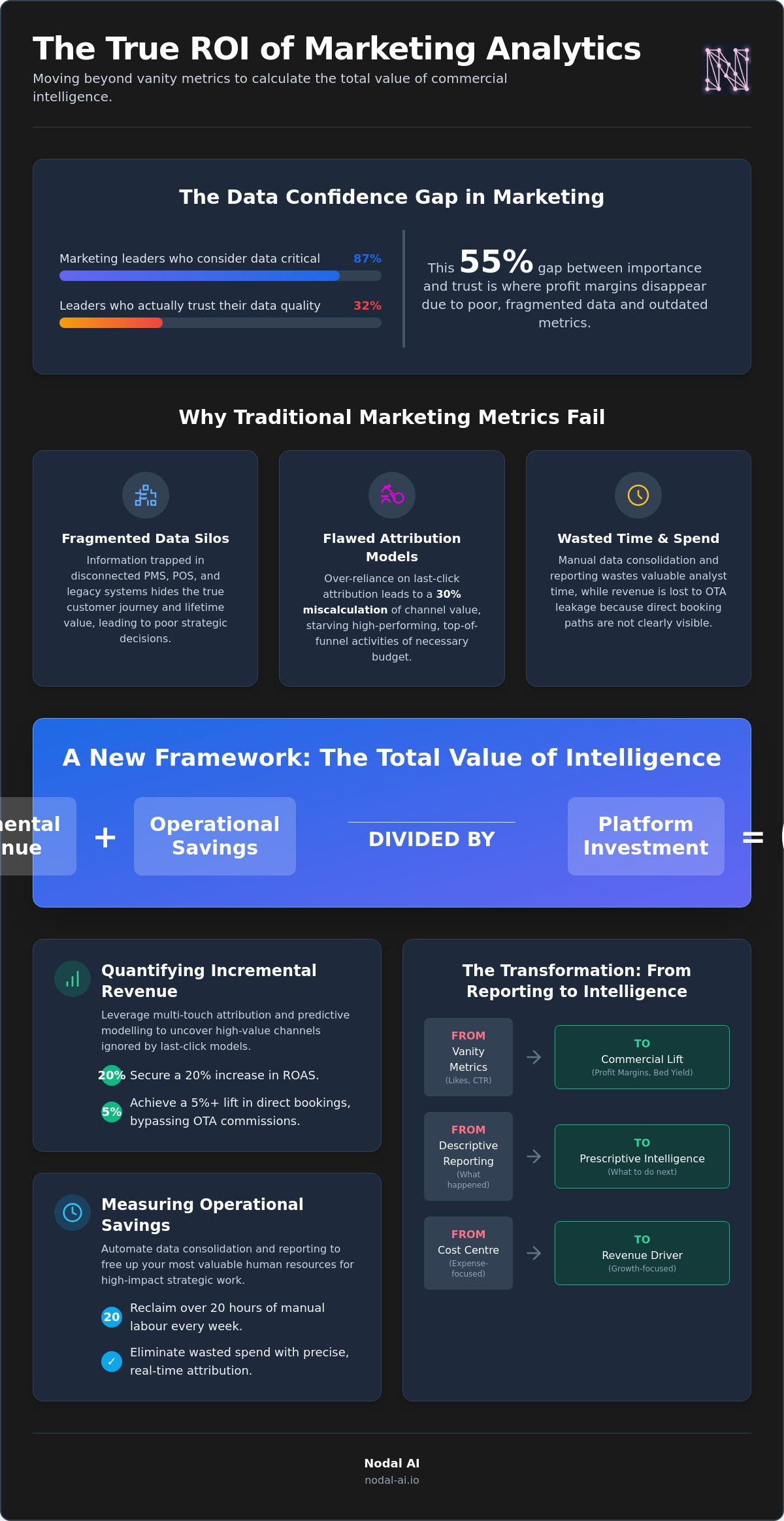
Did you know that 87% of marketing leaders consider data-driven decisions critical, yet only 32% actually trust the quality of their data? This confidence gap is where profit margins often disappear. You are likely tired of staring at fragmented data across PMS and POS systems while watching OTA leakage drain your revenue. It is frustrating to face board-level pressure when you cannot track the full customer journey or justify every pound of ad spend. You need the clarity that comes from turning chaotic inputs into high-value outputs.
This guide provides a clear framework for calculating roi of marketing analytics platform investments by moving beyond vanity metrics to true commercial intelligence. Discover how to quantify the financial impact of advanced analytics and optimise your entire marketing programme. We will show you how to secure a 20% increase in ROAS, eliminate wasted spend through precise attribution, and automate your reporting to reclaim 20 hours of your working week.
Key Takeaways
- Define strategic ROI as a direct driver of profit margins rather than a collection of superficial vanity metrics.
- Master a comprehensive framework for calculating roi of marketing analytics platform performance using the Total Value of Intelligence formula.
- Quantify the operational impact of automated reporting, which can recover over 20 hours of manual labour every week.
- Leverage predictive modelling and external signals to transform fragmented data into high-value growth recommendations.
- Streamline implementation by integrating core operational systems to achieve a single, transparent view of your commercial performance.
The ROI Gap: Why Traditional Marketing Metrics Fail in 2026
Strategic ROI is the measurable increase in profit margins achieved by transforming fragmented data into actionable intelligence. In 2026, relying on outdated versions of Return on Marketing Investment (ROMI) is no longer enough to satisfy a board focused on commercial lift. Traditional models often ignore the hidden costs of data fragmentation, especially within London enterprises and hospitality groups where information remains trapped in legacy systems. You must move beyond simply tracking what you spent to understanding what that spend actually built for the business.
Last-click attribution is a primary culprit for poor decision-making and wasted budget. Recent industry benchmarks suggest it leads to a 30% miscalculation of true channel value, causing brands to starve high-performing top-of-funnel activities while over-investing in bottom-of-funnel redundancy. You need to shift from descriptive reporting, which merely states what happened in the past, to prescriptive intelligence that dictates what to do next. This transition is the first step in calculating roi of marketing analytics platform investments that actually move the needle.
The Problem with Fragmented Data Silos
London hospitality groups often struggle with a labyrinth of disconnected systems. When platforms like Oracle OPERA, Mews, or Cloudbeds operate in isolation, they hide the true customer lifetime value. This fragmentation fuels OTA leakage where hotels pay high commissions to third parties because they cannot see the direct path to a booking. Manual data consolidation is a silent killer of marketing productivity. It forces your most talented analysts to spend hours in spreadsheets rather than executing strategy. You need to transform this chaos into a streamlined flow of high-value outputs that protect your margins.
Commercial Intelligence vs Standard Reporting
Vanity metrics like social media likes or basic click-through rates provide a false sense of security. They do not reflect bed yield or the average spend per head across your estate. Commercial intelligence is the bridge between raw data and strategic profit. It replaces the anxiety of manual, tedious tasks with the confidence of high-level perspectives. The Nodal Platform serves as the engine for this shift, allowing you to optimise your performance marketing analytics in real-time. By calculating roi of marketing analytics platform success through commercial lift, you move from being a cost centre to a primary driver of revenue. This cognitive upgrade ensures your organisation remains competitive and forward-thinking in a volatile market.
A Comprehensive Framework for Calculating Analytics Platform ROI
Standard ROI formulas often fall short because they treat marketing as a simple linear transaction. To truly master calculating roi of marketing analytics platform performance, you must adopt the Total Value of Intelligence formula: (Incremental Revenue + Operational Savings) divided by Platform Investment. This model captures the full commercial picture by including the money you generate and the money you stop losing through inefficiency. It transforms a cost-benefit analysis into a roadmap for long-term stability.
Accuracy lift is a critical but often overlooked component of this framework. By identifying where your budget currently bleeds into inefficient channels, you can reallocate spend to the touchpoints that actually convert. This is not about simply spending less; it is about spending with surgical precision. While you must account for professional implementation and onboarding fees, these are necessary investments that anchor your future growth. They ensure your data foundation is secure and your team is empowered from day one.
Quantifying Incremental Revenue Growth
Sophisticated multi-touch attribution reveals the high-value channels that traditional last-click models completely ignore. For a London hotel group, even a 5% increase in direct bookings represents a massive shift in bed yield when you bypass heavy OTA commissions. Precise audience segmentation further amplifies this by increasing the average booking value through targeted cross-selling. When you understand the full customer journey, you can deliver growth recommendations that resonate, turning passive assets into active revenue drivers.
Measuring Operational Efficiency and Time Savings
Manual data consolidation is a significant drain on your most expensive human resources. Consider the financial impact of three senior marketers spending 10 hours every week wrestling with spreadsheets. That totals 30 hours of high-level talent wasted on repetitive manual labour. Automated reporting typically recovers 20+ hours per week for London teams, allowing them to focus on high-impact strategy instead of data cleaning.
The Nodal Platform enables teams to act 5x faster by providing automated insights that remove the need for guesswork. Furthermore, a modular architecture ensures you avoid the crushing expense and technical debt of custom internal builds. You replace the anxiety of complexity with the relief of streamlined, high-level perspectives. If you want to see how these efficiencies apply to your specific estate, you can request a commercial impact assessment to visualise your potential returns.
The Multipliers: How Predictive Modelling and Attribution Drive Returns
True commercial intelligence requires you to look through the windscreen rather than the rearview mirror. When calculating roi of marketing analytics platform success, you must include forward-looking scenario planning. This shift moves your team from reactive adjustments to proactive market leadership. By integrating external signals such as weather patterns, FX rates, and global tourism trends, you transform raw data into a strategic shield. You stop merely spending a budget and begin investing in high-yield segments with the confidence of a seasoned expert.
AI-driven audience segmentation further refines this process by reducing acquisition costs and targeting high-propensity guests. You no longer cast a wide, expensive net. Instead, you focus your resources on the individuals most likely to drive long-term value. This cognitive upgrade ensures your marketing spend is always tethered to concrete business outcomes and financial stability.
Predictive Modelling as a Risk Mitigation Tool
Risk is the natural enemy of profit. You can use predictive modelling to identify emerging "need periods" up to six weeks in advance. This foresight allows you to stimulate demand before a gap becomes a crisis. Conversely, accurate forecasting prevents you from overspending on marketing during high-occupancy periods when your rooms would have filled anyway. Market intelligence provides the essential "why" behind shifting consumer behaviours, giving you the clarity to adapt your messaging in real-time. It replaces the anxiety of the unknown with the calm efficiency of a data-backed plan.
Multi-Touch Attribution: The End of Wasted Spend
Last-click attribution is a legacy habit that obscures the truth. It ignores the complex reality of how modern travellers actually book. Transitioning to sophisticated customer journey mapping allows you to see every interaction that influences a guest. Identifying these "assist" channels is often the difference between a failing campaign and a high-yield one. In fact, brands that master this level of attribution frequently see a 24.5% increase in ROAS.
Using the customer journey as a roadmap for budget optimisation ensures every pound works harder. You no longer guess which ads are driving value; you know. By calculating roi of marketing analytics platform returns through the lens of attribution, you ensure your organisation remains competitive and obsessed with measurable returns. This transparency removes ambiguity and empowers you to present a bulletproof case for future investment to the board.
Justifying the Investment: Overcoming Implementation Complexity
Complexity is often the gatekeeper to commercial clarity. While the technical hurdles of integration may seem daunting, they are the essential building blocks for calculating roi of marketing analytics platform success. By following a structured deployment path, you transform disparate data silos into a unified engine for growth. The transition from chaotic inputs to high-value outputs requires a logical, multi-step journey:
- Step 1: Conduct a technical audit and perform historical data ingestion to establish a reliable performance baseline.
- Step 2: Integrate core operational systems such as Oracle OPERA, Mews, or Cloudbeds to bridge the gap between marketing spend and guest stay data.
- Step 3: Map the customer journey across fragmented digital and physical touchpoints to identify every influential interaction.
- Step 4: Configure custom dashboards focused specifically on commercial KPIs that matter to the board.
- Step 5: Launch automated growth recommendations to drive immediate impact on your profit margins.
The Role of Professional Onboarding
Professional implementation is not a luxury; it is a fundamental requirement for complex data ecosystems. Dedicated support ensures your historical data is mapped correctly, preventing the "garbage in, garbage out" trap that ruins many analytics projects. Nodal AI handles the heavy lifting of data cleaning and system integration, allowing your team to focus on high-level strategy rather than technical troubleshooting. This expert guidance turns a potentially overwhelming transition into a streamlined process of improvement and stability.
Addressing the "Too Complex" Objection
Many leaders hesitate because they fear the technical burden of a new platform. It is more accurate to view the Nodal Platform as a cognitive upgrade that simplifies the marketer's job rather than adding to it. When you approach calculating roi of marketing analytics platform investments, you must account for the cognitive relief it provides your staff.
Compare the cost of a SaaS subscription to the overhead of hiring a full-time data science team. The financial choice becomes clear. Automated reporting removes technical barriers, enabling non-technical users to access deep insights without needing a specialised degree. You replace the anxiety of manual labour with the relief of automated precision. If you are ready to see how this transition works for your organisation, book a tailored demo to explore your specific integration path.
The Nodal Advantage: Executing a High-ROI Analytics Strategy
The Nodal Platform unifies fragmented hospitality data into a single, transparent view. This is the final, critical step in calculating roi of marketing analytics platform success. By moving away from isolated silos, you finally see the direct link between marketing activity and commercial profit. Our modular architecture ensures a rapid speed-to-value; this is essential for global brands that cannot afford long, stagnant deployment cycles. You replace the anxiety of wait times with the immediate confidence of live insights and streamlined perspectives.
Real-world results from our hospitality partners show a 15.3% reduction in acquisition costs. This outcome stems from the ability to identify and eliminate high-cost, low-yield activities in real-time. You stop guessing and start executing with the precision of a market leader. This isn't just about saving money; it's about reallocating resources to the segments that offer the highest potential for long-term loyalty and spend. It's the difference between passive tracking and active commercial growth.
Connecting the Dots Across Hospitality Performance
Position the Nodal Platform as the central nervous system for your commercial growth. It doesn't just collect data; it activates it. High-value features like automated reporting and predictive intelligence remove the manual burden from your team, allowing them to focus on high-impact strategy. This cognitive upgrade turns your data into an active participant in your business process. If you're ready to move beyond fragmented spreadsheets and manual errors, book a demo to see your own data transformed into a clear roadmap for profit.
A Strategic Partner for London Enterprises
The most successful organisations have shifted their focus from simply "making more" to "wasting less." This efficiency is the true driver of long-term stability in a volatile market. As a London-based partner, we provide the UK-based support and global data governance standards your enterprise requires. We understand the specific pressures of the local hospitality market and the complex regulatory landscape of 2026. You need a partner that understands the nuances of London hospitality, from bed yield to average spend per head.
This partnership provides more than just a tool; it's a commitment to total clarity and measurable returns. Calculating roi of marketing analytics platform investments becomes a straightforward exercise when your outputs are tethered to actual profit. You replace the overwhelm of data chaos with the relief of automated precision. Transform your fragmented data into a strategic growth roadmap today and lead your sector with confidence.
Master Your Commercial Future
Transitioning from data chaos to commercial clarity is no longer a luxury; it is a fundamental requirement for 2026 market leadership. By adopting the Total Value of Intelligence framework, you move beyond basic reporting to execute a strategy built on predictive accuracy and high-yield segments. You have seen how resolving fragmentation across systems like Oracle OPERA and Mews can turn passive data into an active driver of profit. Calculating roi of marketing analytics platform performance becomes effortless when you replace manual labour with automated precision.
The results are measurable and significant. We have empowered partners like Ovolo Hotels to achieve a 24.5% increase in ROAS, contributing to our status as a Gold winner in the Performance Marketing Awards. You don't need to navigate this technical complexity alone. Our platform acts as your cognitive upgrade, providing the high-level perspective required to protect your assets and optimise your spend. For organisations exploring the next frontier of asset management, the STO Foundation offers a comprehensive platform to tokenize real-world assets and launch compliant investment offerings. Take the first step toward total transparency and long-term stability today.
Book a Nodal AI Demo to Calculate Your Potential ROI
You now possess the framework to lead your organisation into a more profitable era. We look forward to helping you transform your fragmented data into a visionary roadmap for growth.
Frequently Asked Questions
How do I calculate the ROI of a marketing analytics platform?
You calculate ROI by using the Total Value of Intelligence formula: (Incremental Revenue + Operational Savings) divided by the Platform Investment. This method captures the direct revenue lift from optimised campaigns alongside the financial value of reclaimed staff hours. By calculating roi of marketing analytics platform performance this way, you account for both top-line growth and the 20 plus hours saved each week through automated reporting.
What is the difference between marketing ROI and ROAS?
ROAS measures the gross revenue generated for every pound spent on advertising, while marketing ROI accounts for the total cost of the investment, including platform fees and staff overheads. ROAS is a tactical metric focused on immediate campaign efficiency. In contrast, strategic ROI provides a high-level perspective on long-term commercial stability and the net profit margins achieved across your entire estate.
Why is data fragmentation a problem for calculating ROI?
Data fragmentation creates blind spots that hide the true customer journey and fuel expensive OTA leakage. When your PMS and POS systems operate in isolation from your marketing tools, you cannot accurately attribute revenue to specific touchpoints. This chaos often results in a 30% miscalculation of channel value, making it impossible to justify spend to the board without a unified, transparent view.
How long does it take to see a return on an analytics platform investment?
Most enterprises experience initial returns through operational efficiency within the first 30 days of implementation. Reclaiming significant time through automated reporting provides an immediate operational ROI. Commercial lift from reallocated ad spend and predictive modelling typically matures within three to six months as the platform ingests more historical data and refines its growth recommendations for your specific market.
Can I measure the ROI of brand awareness campaigns?
Yes, you can measure brand ROI by tracking the lift in direct branded search and subsequent conversion paths within a multi-touch attribution model. Instead of relying on vanity metrics like impressions, you should identify the "assist" value these campaigns provide to direct bookings. This transforms brand spend from an abstract cost into a measurable participant in the guest acquisition process.
What are the most important KPIs for a marketing analytics proposal?
Focus on commercial outcomes such as Bed Yield, Average Spend Per Head, and Customer Lifetime Value (CLV) rather than superficial clicks. Your proposal should also include operational KPIs like "Hours Saved on Manual Reporting" and "Reduction in Third-Party Commission Costs." These metrics provide the concrete weight needed to secure board-level approval for a cognitive upgrade to your marketing department.
Is multi-touch attribution necessary for hospitality brands?
Multi-touch attribution is essential because the guest journey is rarely linear and involves multiple digital and physical touchpoints. Relying on last-click attribution ignores the influential interactions that drive direct bookings over time. By mapping the full customer journey, you can achieve a 24.5% increase in ROAS and stop over-investing in redundant bottom-of-funnel channels that would have converted anyway.
How does predictive modelling improve marketing ROI?
Predictive modelling identifies emerging "need periods" up to six weeks in advance, allowing you to stimulate demand before a gap becomes a revenue crisis. It prevents you from wasting budget during high-occupancy periods when rooms would fill organically. This foresight ensures you are always calculating roi of marketing analytics platform success based on forward-looking profit rather than reactive, historical reporting.


