
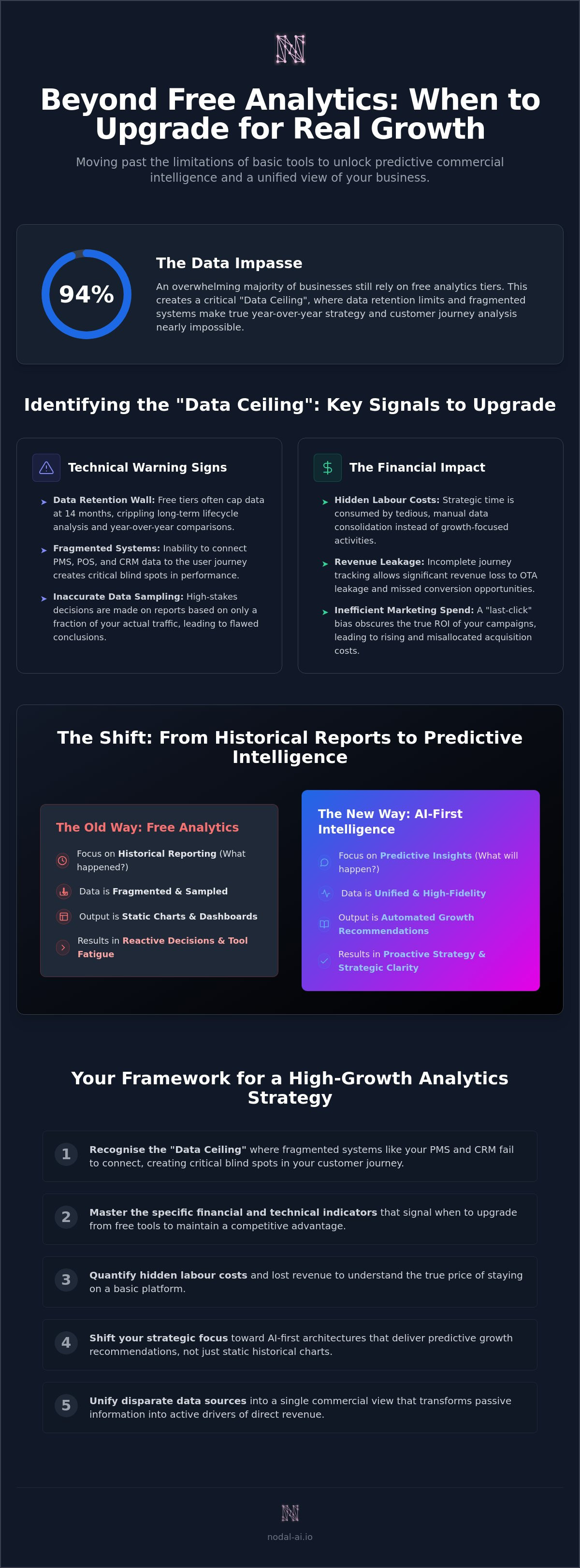
Did you realise that 94% of businesses still rely on free analytics tiers despite data retention limits that make year-over-year strategy nearly impossible? You likely feel the strain of this limitation every week as you manually consolidate data from your PMS, POS, and CRM systems. It is a tedious process that consumes hours of strategic time and still leaves you blind to the true customer journey. Deciding when to upgrade from free analytics tools is no longer just a technical choice; it is a commercial necessity to stop OTA leakage and rising acquisition costs.
We understand the frustration of managing fragmented touchpoints that fail to provide a clear picture of performance. This guide identifies the specific technical and financial signals that indicate your organisation has outgrown basic tracking. You will discover how to transition to a high-growth AI platform that replaces manual reporting with automated, predictive insights. Prepare to move past the chaos of disconnected data and secure a single, unified view of your entire commercial performance.
Key Takeaways
- Recognise the "Data Ceiling" where fragmented systems like your PMS and CRM fail to connect, creating a critical blind spot in your customer journey.
- Master the specific financial and technical indicators that signal when to upgrade from free analytics tools to maintain a competitive advantage in a privacy-first market.
- Quantify the hidden labour costs of manual reporting and the revenue lost to OTA leakage to understand the true price of staying on a basic platform.
- Shift your strategic focus toward AI-first architectures that deliver predictive growth recommendations rather than just static historical charts.
- Learn how to unify disparate data sources into a single commercial view that transforms passive information into active drivers of direct revenue.
The Evolution of Analytics and the Limits of Free Platforms
The history of Web analytics has shifted from simple hit counters to complex, event-based models. In the early stages of a business, free platforms provide a necessary entry point. They offer a baseline of visibility that feels sufficient for basic needs. However, as we move through 2026, the gap between historical reporting and predictive intelligence has widened into a chasm. Free tools are fundamentally built for generalists who need to see what happened yesterday. Specialists require the ability to predict what will happen tomorrow. This shift toward AI-driven predictive models is the hallmark of modern commercial intelligence, moving beyond the limitations of static, backward-looking reports.
The transition from basic tracking to true commercial intelligence marks a pivotal moment in organisational maturity. While free platforms have introduced advanced event tracking, they remain tethered to rigid structures that often fail to account for the nuances of your specific industry. You must recognise when to upgrade from free analytics tools: it is the exact moment your data becomes a passive record of the past rather than an active participant in your future growth strategy. Waiting too long to make this move results in a "Data Ceiling," where the sheer cost of managing and cleaning your data exceeds the utility you get from it.
Why Free Tools are the Starting Point, Not the Destination
Every business enjoys a honeymoon phase with free analytics. It feels empowering to see user counts and page views without an upfront financial commitment. Yet, these tools often incentivise a dangerous "last-click" bias. This obscures the true ROI of your marketing spend by ignoring the complex, multi-touch journey that actually drives a booking. Competitors often claim that free tools offer more control, but this "control" usually translates to endless manual maintenance and fragile custom workarounds. The Data Ceiling occurs when the friction of manual data consolidation begins to hinder your ability to make rapid strategic decisions.
Recognising the Symptoms of Tool Fatigue
Tool fatigue manifests as a persistent sense of unease during leadership meetings. You see different numbers in different dashboards, leading to heated debates about which source of truth to trust. Relying on sampled or incomplete data sets creates a fragile foundation for high-stakes decisions. When your team spends more time arguing over data accuracy than executing growth strategies, you have reached decision paralysis. This fatigue is a clear signal that your current stack can no longer support your commercial ambitions. Upgrading allows you to replace this anxiety with the calm efficiency of a unified, high-level perspective.
Identifying the Data Ceiling: Technical Signals it is Time to Scale
Knowing exactly when to upgrade from free analytics tools requires a cold assessment of your current technical infrastructure. For many organisations, the first warning sign is the hidden wall of data retention. In the free tier of Google Analytics 4, user-level and event-level data can only be stored for a maximum of 14 months. This limitation effectively cripples your ability to perform meaningful year-over-year analysis or understand long-term guest lifecycles. When your historical perspective is cut short by a software setting, your strategic planning becomes reactive rather than visionary.
Beyond retention, data sampling and event limits often distort the reality of your performance. Free platforms are built to handle high-level trends, but they frequently struggle with the granular nuances of high-value guest segments. If you find your reports are based on a fraction of your actual traffic, you are essentially making multi-million pound decisions based on a guess. Recognising these technical signals it is time to scale allows you to move away from fragmented snapshots toward a comprehensive, high-fidelity data environment.
Fragmented Data and the Struggle for a Single View
Data silos act as a silent tax on your growth. Marketing, operations, and finance teams often work from disparate dashboards that never quite align. The most common technical failure occurs when you cannot connect a specific booking in your Property Management System (PMS) to the original ad click. Integrating complex hospitality systems like Oracle OPERA or Mews into a free analytics environment is notoriously difficult and prone to error. To resolve this, you need a unified solution like the Nodal Platform, which bridges the gap between operational reality and marketing performance.
The Failure of Last-Click Attribution in a Multi-Touch World
Free tools default to last-click attribution because it is computationally cheap, not because it is accurate. This model systematically undervalues your top-of-funnel brand awareness efforts and over-attributes value to direct or branded search. In a privacy-first 2026 environment, where tracking across multiple touchpoints is increasingly complex, relying on the final click is a recipe for inefficient spend. You must understand incrementality; the measure of which marketing activities actually drove a booking that would not have happened otherwise. For a deeper look at solving this, explore our guide on mastering marketing attribution. If you are ready to see how unified data can transform your commercial outlook, you can book a demo to explore our predictive capabilities.
Calculating the Financial Impact of Outgrown Analytics
Free analytics tools often present a financial paradox. While the subscription cost is zero, the operational expense is staggering. You might believe you are saving budget; however, the reality is that you are subsidising these tools with expensive human capital. When your senior marketing talent spends half their week acting as data janitors, your actual cost of acquisition skyrockets. Identifying when to upgrade from free analytics tools is a matter of basic accounting. It is the point where the salary cost of manual data management exceeds the investment in a high-growth AI platform.
The financial drain of staying on a basic tier manifests in two primary ways: wasted ad spend and high OTA leakage. Without precise multi-touch attribution, you inevitably fund underperforming channels while starving the campaigns that actually drive high-value guests. This creates an efficiency gap. By the time your team identifies a drop in conversion rates through manual analysis, the opportunity to course-correct has often passed. This delay transforms your data from a strategic asset into a historical record of missed revenue.
The Hidden Labour Cost of Manual Reporting
Data professionals spend approximately 45% of their time on data preparation and cleaning, according to an Anaconda survey. This "Analyst Tax" drains your marketing department of its creative and strategic energy. Managing complex spreadsheets that break with every API update creates a significant mental load and introduces human error into your commercial reporting. Contrast this tedious process with automated reporting that delivers unified insights in seconds. By removing the friction of manual consolidation, you empower your team to focus on execution rather than extraction.
Opportunity Cost and the Problem of OTA Leakage
A lack of deep guest insights directly fuels an over-reliance on expensive third-party platforms. When you cannot see the true customer journey, you lose potential direct bookers to OTAs that charge high commissions. Better intelligence allows you to reclaim these guests. Predictive modelling can identify "need periods" before they occur, allowing you to deploy targeted campaigns that secure direct revenue. Industry professionals report that a 15% reduction in acquisition costs is achievable when moving from basic tracking to advanced commercial intelligence. This shift replaces the anxiety of rising costs with the confidence of measurable, scalable returns.
Establishing a Framework for Your Next Analytics Investment
Determining when to upgrade from free analytics tools is a strategic pivot that requires a focus on long-term scalability. You must move past simple feature lists and prioritise platforms that offer a modular architecture. This flexibility ensures the technology fits your specific industry use case rather than forcing your business into a generic template. A robust framework should ingest data from legacy systems while simultaneously processing external signals, such as weather patterns or FX rates, to provide a truly holistic commercial view. This transition turns your data from a passive record into an active participant in your growth.
Verify the level of implementation support before committing to a new provider. Free tools are "do it yourself" by design, often leaving your team to struggle with complex configurations. Enterprise-grade platforms are "done with you," offering dedicated onboarding and technical support that ensures your foundation is sound from day one. This partnership model replaces the anxiety of technical hurdles with the confidence of a streamlined, high-level perspective. It is the hallmark of an organisation that has mastered future-facing analytics and is ready to scale.
Moving from Passive Reporting to AI-Driven Insights
There is a fundamental difference between a dashboard and an intelligence engine. A dashboard merely shows you where you have been; an intelligence engine shows you where you are going. Growth recommendations carry far more commercial weight than raw data points because they provide actionable paths to revenue. By leveraging predictive modelling, you can future-proof your strategy against market volatility. This cognitive upgrade allows your team to stop reacting to yesterday's charts and start executing on tomorrow's opportunities.
Ensuring Data Governance and Global Compliance
In 2026, data privacy is a central pillar of commercial stability. New regulations in California and several other states have tightened rules around automated decision-making and data access requests. Implementing a data governance framework provides the security and GDPR compliance that free plugins simply cannot match. Enterprise tools offer high-level protection of your assets, ensuring that your growth is both rapid and secure. If you are ready to transition from fragmented data to strategic clarity, book a demo to see how our platform transforms your commercial outlook.
Transitioning to Nodal AI: From Fragmented Data to Strategic Clarity
Nodal AI serves as the definitive bridge between fragmented operational data and sustainable commercial growth. While basic tools merely track clicks, our platform tracks the entire guest journey by transforming passive assets into active participants in your business process. Deciding when to upgrade from free analytics tools becomes a straightforward commercial choice once you realise the impact of having your PMS, POS, and CRM systems talking to one another in real time. This integration replaces the anxiety of disconnected data with the confidence of a streamlined, high-level perspective.
Our "Make more, waste less" philosophy is rooted in measurable returns rather than abstract metrics. By moving beyond the limitations of free platforms, our partners have seen tangible results, including documented increases of 24.5% in Return on Ad Spend (ROAS). This cognitive upgrade for your entire organisation ensures that every marketing pound is tethered to a concrete business outcome. It is the transition from simply recording what happened to actively engineering what happens next.
How the Nodal Platform Unifies the Hospitality Tech Stack
The Nodal Platform is designed to ingest data from the most complex legacy and modern systems. We offer seamless integrations with industry leaders like Oracle OPERA, Mews, and SevenRooms, ensuring no touchpoint is left in the dark. By identifying high-propensity guest segments, Nodal allows you to optimise your spend toward the audiences most likely to convert. This level of precision is impossible with generic tools that lack hospitality-specific logic. We invite you to book a demo to see your own data unified into a single, profitable view.
Realising ROI through Predictive Modelling and Growth Recommendations
Transforming fragmented data into actionable commercial intelligence is the core of our mission. Nodal uses advanced predictive modelling to identify future revenue opportunities before they pass you by. This proactive approach is essential for reducing OTA leakage and improving bed yield across your entire portfolio. By replacing manual, tedious tasks with automated insights, your team is freed to focus on high-level strategy. For leaders ready to move beyond the narrow limits of free tools, the path to strategic clarity starts with a cognitive upgrade. Take control of your commercial future and ensure your organisation is built for the high-growth environment of 2026.
Secure Your Commercial Future with Unified Intelligence
You have identified the technical signals and calculated the hidden labour costs of manual reporting. The decision regarding when to upgrade from free analytics tools is ultimately a choice between remaining reactive or becoming predictive. By unifying your PMS, POS, and CRM into a single view, you transform passive data into an active driver of revenue. This shift replaces the anxiety of disconnected touchpoints with the confidence of a streamlined, high-level perspective.
Our hotel partners have already realised a 15.3% reduction in acquisition costs and an average 24.5% increase in ROAS. Nodal's modular architecture is specifically designed for the complexities of hospitality and F&B; it ensures your technology evolves alongside your commercial ambitions. It is time to replace decision paralysis with the strategic clarity of an AI-first platform that delivers measurable results.
Book a demo to see how Nodal AI unifies your fragmented data
Frequently Asked Questions
What are the main limitations of free analytics tools like Google Analytics 4?
Free tiers generally restrict event-level data retention to a maximum of 14 months and limit unique event names to 500. These technical constraints make long-term trend analysis nearly impossible for growing organisations. Additionally, data sampling occurs during high-traffic periods, which leads to skewed results. You lose the granular visibility needed to understand high-value guest segments, essentially making strategic decisions based on incomplete records.
How do I know if my marketing data is fragmented?
Fragmentation is evident when your Property Management System (PMS) shows a different revenue figure than your marketing dashboard. If your team spends hours every week manually exporting data into spreadsheets to see a single customer journey, your systems are siloed. This lack of cohesion prevents you from seeing which specific ad clicks actually resulted in a physical check-in at your property.
Can free analytics tools handle multi-touch attribution effectively?
Free tools typically default to last-click attribution models, which fail to account for complex, multi-touch journeys. This approach systematically undervalues your top-of-funnel brand awareness campaigns and over-attributes value to direct traffic. Without advanced multi-touch attribution, you cannot accurately measure the incrementality of your marketing spend, which leads to inefficient budget allocation across your digital channels.
What is the "hidden cost" of staying with free analytics software?
The hidden cost is found in the "Analyst Tax" where senior staff spend nearly half their time cleaning data rather than executing strategy. You are paying high salaries for manual labour instead of strategic growth. Understanding when to upgrade from free analytics tools is a matter of calculating these recovered labour hours and the revenue lost to high OTA commissions due to poor visibility.
How does an AI analytics platform differ from a traditional dashboard?
A traditional dashboard provides a historical look at what happened, whereas an AI platform acts as an intelligence engine. AI identifies patterns in your data to provide growth recommendations and predictive insights. It transforms passive charts into active participants in your business, allowing you to anticipate guest behaviour and market shifts before they occur.
Is it difficult to migrate from free tools to an enterprise platform like Nodal AI?
Transitioning is a streamlined process when you choose a "done with you" partnership model. Unlike the DIY nature of free tools, enterprise platforms provide dedicated technical support and onboarding specialists. We handle the complex data mapping and integration tasks for you, ensuring your systems are unified without disrupting your daily operations or requiring deep technical specialisation from your team.
What specific ROI can I expect from upgrading my analytics stack?
Upgrading your stack delivers a measurable increase in commercial efficiency. Our partners frequently realise a 24.5% average increase in ROAS and a 15.3% reduction in acquisition costs. By reclaiming direct bookings from OTAs and optimising your marketing spend through multi-touch attribution, the platform pays for itself through recovered revenue and the total removal of data ambiguity.
How does Nodal AI integrate with hospitality systems like PMS and POS?
Nodal AI features native integrations designed specifically for the hospitality and F&B sectors. We connect directly to systems like Oracle OPERA, Mews, and SevenRooms to pull real-time booking and transaction data. By linking this operational information with your marketing touchpoints, we create a single, unified view of your commercial performance across all properties and outlets.


