

If 60% of your customer journey data is invisible, your ROI reports aren't just conservative; they're fiction. With Apple's App Tracking Transparency opt-in rates hovering at a mere 15% and Chrome's privacy-first shifts, the debate over marketing mix modeling vs multi touch attribution has shifted from a technical choice to a survival strategy. You're likely facing intense pressure to justify ad spend while navigating fragmented data silos that refuse to speak the same language.
We understand the frustration of reporting on "ghost" conversions and the anxiety of manual, tedious data reconciliation. This guide empowers you to master the strategic differences between these frameworks to eliminate measurement blind spots and drive profitable growth. By the end of this article, you'll have a clear roadmap to a unified view of marketing performance that satisfies the board and accelerates your decision-making.
We'll move past the technical hurdles to show you how a hybrid approach turns chaotic inputs into high-value outputs. From historical data requirements to real-time optimization, discover the path to automated, reliable reporting that transforms your marketing from a cost center into a predictable revenue engine.
Key Takeaways
- Bridge the 40-60% data gap caused by privacy restrictions by evolving your measurement strategy beyond outdated last-click tracking.
- Leverage marketing mix modeling as a privacy-safe macro-lens to quantify the impact of seasonality and brand equity on your bottom line.
- Decode the individual path to purchase using granular attribution models that provide a clear map of the tactical customer journey.
- Evaluate the strategic balance of marketing mix modeling vs multi touch attribution to satisfy both tactical needs and board-level reporting.
- Transform fragmented data into a unified source of truth with automated reporting that delivers real-time growth recommendations.
Navigating the Measurement Crisis: Why the MMM vs MTA Debate Matters in 2026
The old ways of measuring marketing success have collapsed. In 2026, relying on last-click attribution is like trying to navigate a complex city with a map from a century ago. It's outdated, misleading, and dangerous for your bottom line. As third-party cookies have transitioned to a user-choice model in Chrome and Apple's App Tracking Transparency (ATT) opt-in rates remain stuck between 15% and 25%, the signals marketers once trusted have gone dark. This isn't just a technical glitch; it's a structural shift that demands a total rethink of your measurement framework.
Fragmented data has become the primary barrier to scalable growth for UK enterprises. When your social data lives in one silo, your offline impact in another, and your search performance in a third, you aren't seeing a customer journey. You're seeing a jigsaw puzzle with half the pieces missing. Understanding the strategic tension between marketing mix modeling vs multi touch attribution is no longer a luxury for the data-obsessed. It's the only way to move from reactive hindsight to predictive intelligence. You need to stop asking "what happened" and start commanding "what will happen next."
The Cost of Inaccurate Attribution
Miscalculated ROI is a silent profit killer. When you over-attribute revenue to the last touchpoint, you starve the top-of-funnel channels that actually fuel your growth. This leads to wasted ad spend on saturated audiences while your competitors capture the market you ignored. The psychological weight of this uncertainty is exhausting for marketing leaders who must justify every pound to the board in real-time. Achieving total transparency provides more than just better numbers; it delivers the confidence to scale aggressively without fear. You can trade the exhausting guesswork of manual spreadsheets for the calm efficiency of a single, unified truth.
Defining the Two Pillars of Modern Analytics
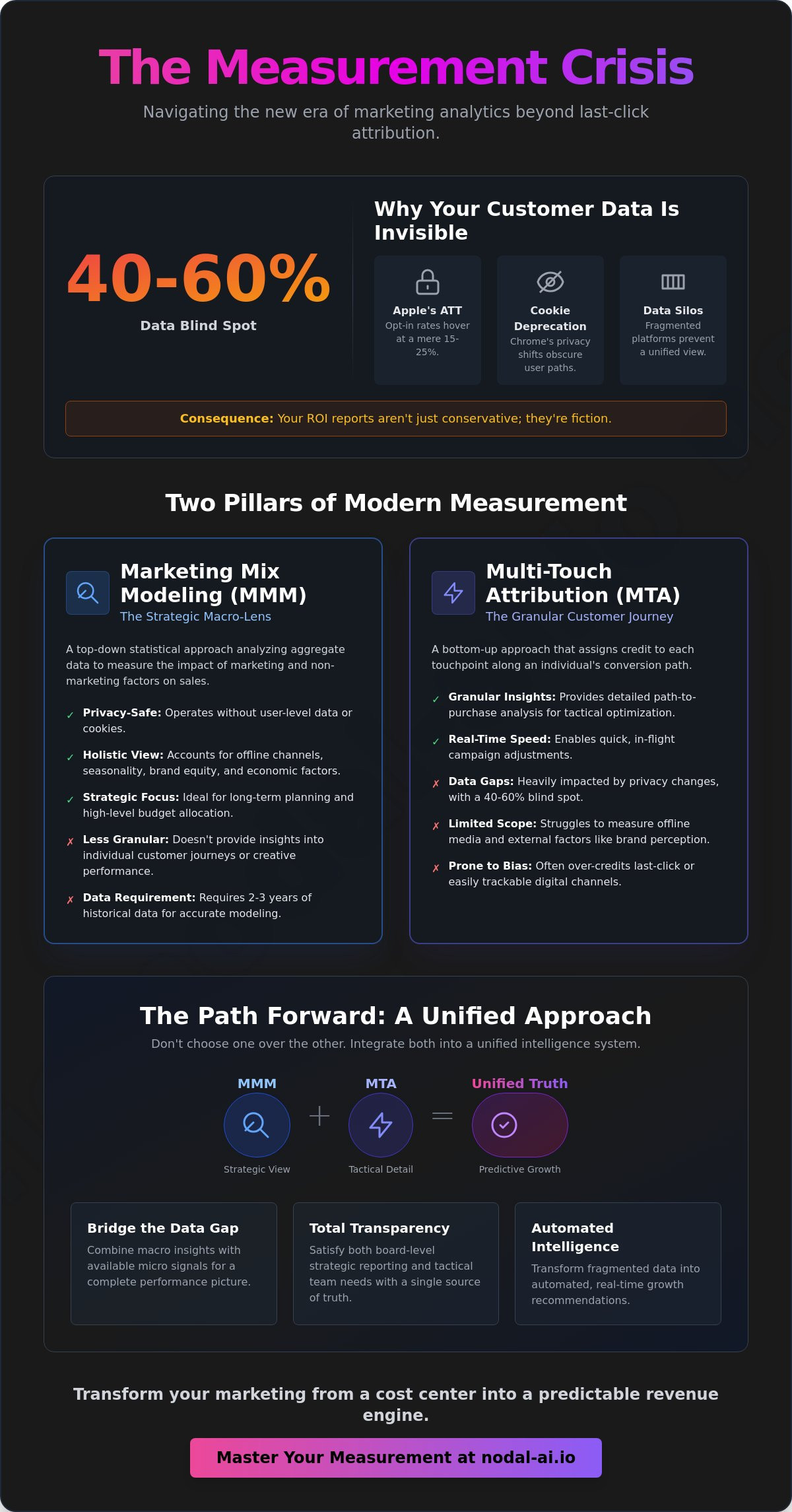
To survive the privacy-first era, you must adopt a dual-perspective approach. Think of Marketing Mix Modeling (MMM) as your strategic "top-down" lens. It uses historical data to account for non-trackable variables like seasonality, economic shifts, and brand equity. It doesn't need a single cookie to tell you which channels drive long-term value.
Conversely, Multi-Touch Attribution (MTA) remains your tactical "bottom-up" map. It attempts to trace the individual path to purchase, providing the granular detail needed for day-to-day optimization. While MTA has been weakened by an estimated 40-60% data loss due to privacy restrictions, it still offers vital clues for short-term performance. Winning in 2026 requires a cognitive upgrade. You don't choose one over the other; you integrate both into a unified intelligence system that turns chaotic signals into high-value growth.
Marketing Mix Modelling (MMM): The Strategic Macro-Lens for Growth
Stop chasing disappearing cookies and start measuring the forces that actually move your business. Marketing Mix Modelling (MMM) is the strategic anchor for the modern enterprise. It's a privacy-safe, Bayesian statistical approach that analyzes the relationship between your marketing spend and total sales. Unlike granular tracking, MMM doesn't care about individual user identities. It focuses on the aggregate truth. By treating your marketing channels as active participants in a broader economic ecosystem, it provides a stable foundation for long-term growth.
This macro-lens is the CEO's favorite for a reason. It handles capital allocation with a level of authority that digital-only dashboards can't match. MMM accounts for the untrackable variables that dictate your success: seasonality, economic shifts, and brand equity. While competitors are blinded by the 40-60% data loss in digital channels, MMM remains resilient. It turns your historical data into a predictive engine, allowing you to see how a 10% shift in TV spend or a rise in interest rates will impact your bottom line. The debate of marketing mix modeling vs multi touch attribution often ends at the boardroom door, where high-level stability is the only currency that matters.
Key Advantages of the Top-Down Approach
Modern MMM has evolved from slow, annual reports into a fast-paced intelligence tool. By utilizing predictive modelling, enterprises can now refresh their models monthly or even weekly. This allows you to measure the unmeasurable impacts of TV, Out-of-Home (OOH), and word-of-mouth. It provides total transparency across the entire media mix, ensuring no channel is left behind due to technical tracking limitations. To see how this looks in practice, consider how automated reporting can simplify these complex statistical outputs into clear growth recommendations.
The Limitations of Traditional Mix Models
Transparency comes with a price: data volume. To separate seasonal noise from media effects, you typically need 100 weeks of historical data, with 150 weeks being the gold standard for accuracy. This historical requirement can be a hurdle for newer brands or fast-moving digital teams who need instant answers. Traditional models also lack the granular, campaign-level detail required for daily tactical tweaks. It tells you that social media is working, but it won't tell you which specific creative is winning the day. It's a strategic compass, not a tactical GPS. Understanding this distinction is vital when weighing marketing mix modeling vs multi touch attribution for your 2026 framework.
Multi-Touch Attribution (MTA): Decoding the Granular Customer Journey
If Marketing Mix Modeling provides the telescope to view the entire horizon, Multi-Touch Attribution (MTA) offers the microscope. It's the granular map of the individual path to purchase. While MMM handles the high-level capital allocation, MTA dives into the weeds to assign value to every digital interaction. It's the engine that powers your daily tactical decisions, identifying which specific keyword, audience segment, or creative asset actually triggered a click. Without this level of detail, your performance teams are essentially flying blind, unable to optimize the levers that drive immediate conversion.
However, the 2026 landscape has turned MTA into a complex puzzle. The "Walled Garden" problem has intensified, with platforms like Meta, Google, and Amazon operating as black boxes that rarely share raw data. They often grade their own homework, claiming credit for conversions that other channels assisted. This lack of transparency, combined with a 40-60% loss in tracking data due to privacy restrictions, means traditional MTA models are breaking. The debate of marketing mix modeling vs multi touch attribution isn't about which one is "right." It's about how you use MTA to find the tactical wins that MMM is too broad to see.
Mapping the Modern Customer Journey
The path to purchase is no longer a straight line; it's a chaotic, circular loop. Effective customer journey mapping now requires AI to bridge the gaps left by cross-device fragmentation and diminished cookie signals. By prioritizing first-party data, you can maintain a clearer view of how users move from discovery to intent. We use advanced algorithms to stitch these disparate touchpoints together, turning broken data into a coherent story of user behavior. This evolution moves you away from simplistic models like "Linear" or "Time-Decay" toward Data-Driven Attribution (DDA), which uses machine learning to weigh the true incremental value of every interaction.
When MTA Outperforms Other Models
MTA remains the undisputed king of real-time bidding and daily budget shifts. When you need to know by noon if your morning ad spend is performing, MMM can't help you. MTA excels at identifying "assist" channels, those vital touchpoints that introduce a brand but don't get the final conversion credit in a last-click world. It reveals the hidden value in your mid-funnel content and social engagement. For performance teams, MTA provides the tactical hunt perspective needed to capture high-intent traffic and maximize immediate revenue. It transforms your digital presence from a passive storefront into an active, optimized machine that learns from every click.
MMM vs MTA: Choosing the Right Strategy for Your Organisation
Stop treating your measurement framework as a winner-takes-all battle. The choice of marketing mix modeling vs multi touch attribution isn't about picking a side; it's about matching the tool to the stakeholder. Your board demands high-level authority on where the next million pounds should go. Your performance managers need to know which creative is winning the auction right now. One provides the strategic compass, while the other offers the tactical GPS. Choosing the right path requires an honest assessment of your budget scale and data maturity.
If your annual spend is significant and you're navigating complex offline and online channels, the investment in MMM is no longer optional. It's a necessity for capital protection. However, you must have the data stamina to support it. Remember that accurate modeling requires at least 100 to 150 weeks of historical data to separate seasonal trends from true media impact. For smaller, digital-only teams, the granular focus of MTA might suffice for a time, but as you scale, the blind spots created by privacy restrictions will eventually force an evolution. The best teams don't choose; they find the truth in the middle.
Direct Comparison Table
To help you navigate this transition, use this guide to compare how each model handles your most critical data requirements. For a deeper dive into specific model types and their applications, explore our definitive guide on marketing attribution.
| Feature | Marketing Mix Modeling (MMM) | Multi-Touch Attribution (MTA) |
|---|---|---|
| Data Source | Aggregate Sales and Spend | Individual User Touchpoints |
| Granularity | Macro (Channel/Market) | Micro (Creative/Keyword) |
| Optimization Speed | Strategic (Monthly/Quarterly) | Tactical (Real-time/Daily) |
| Privacy Compliance | 100% Privacy-Safe | High Risk (Cookie Dependent) |
The bridge between these two worlds is incrementality. By running controlled experiments, you can validate the findings of both models, ensuring your tactical actions align with your strategic goals. You can explore our unified analytics platform to see how this triangulation works in a live environment.
The Concept of Unified Marketing Measurement (UMM)
Unified Marketing Measurement (UMM) represents the cognitive upgrade your organization needs in 2026. It uses AI to harmonise macro trends with micro actions, removing the friction between strategic planning and tactical execution. Instead of arguing over which model is "correct," UMM uses the triangulation method to cross-reference signals. It treats every data point as a participant in a larger story of growth. This approach replaces the anxiety of fragmented reporting with the confidence of a single, reliable source of truth. It transforms your data from a passive asset into an active participant in your business success.
Executing Unified Measurement with the Nodal Platform
Stop drowning in disparate spreadsheets and conflicting reports. The Nodal Platform resolves the tension between marketing mix modeling vs multi touch attribution by unifying them into a single, high-performance engine. While the industry debates which model is superior, we provide the technology to leverage both. You can finally stop playing referee between your strategic planners and your tactical execution teams. Our platform acts as a cognitive upgrade for your entire organisation, turning raw, fragmented signals into a clear roadmap for profitable growth.
Automate the complex and reclaim your time. Many enterprise marketing teams spend over 20 hours every week manually stitching data together just to justify their existence to the board. We replace this tedious labour with real-time dashboards that offer immediate clarity. By automating the ingestion and harmonisation of your data, the Nodal Platform allows you to focus on high-value strategy rather than manual entry. You move from a state of reactive reporting to a position of proactive command, where every pound of ad spend is backed by predictive intelligence.
Predictive modelling is the heart of this transformation. It allows you to identify your next sale before it even happens by analysing the subtle patterns across your entire media mix. Whether you're a London-based enterprise or a global brand, our bespoke onboarding ensures your specific market nuances are baked into the model from day one. We don't just provide a tool; we provide a partnership that protects your assets and accelerates your market share.
From Fragmented Data to Profitable Growth
Nodal’s ai marketing analytics engine removes the ambiguity that plagues modern measurement. By creating a single source of truth, we eliminate the anxiety of "ghost" conversions and platform over-reporting. Our clients don't just save time; they see a measurable increase in revenue by reallocating budget to the channels that actually drive incrementality. This is the relief of total transparency. You no longer have to guess which half of your advertising is wasted because you can see the entire journey in high definition.
Get Started: The Nodal Implementation Path
Transitioning to a unified framework is a streamlined, frictionless process designed for time-conscious professionals. We follow a proven 4-step journey to ensure your success:
- Integrate: Connect all your data sources, from Walled Gardens to offline sales, into one secure environment.
- Map: Use AI to stitch together the circular customer journey and bridge the gaps left by privacy restrictions.
- Model: Deploy Bayesian statistics and machine learning to find the strategic and tactical truth in your data.
- Grow: Execute on automated growth recommendations and watch your ROI scale with confidence.
The future of measurement isn't a compromise; it's a competitive advantage. Take the first step toward a unified view of your performance and eliminate the blind spots in your marketing mix modeling vs multi touch attribution strategy. Book your Nodal Platform demo today and see how we turn data chaos into strategic clarity.
Master Your Measurement Future
The era of choosing between macro-stability and micro-granularity is over. In 2026, the most resilient enterprises have stopped viewing marketing mix modeling vs multi touch attribution as a binary choice. They've embraced a unified intelligence framework that turns fragmented data into a competitive advantage. By harmonising long-term strategic planning with real-time tactical optimisation, you replace the anxiety of guesswork with the confidence of measurable returns.
Success now depends on your ability to bridge the privacy gap with advanced technology. You need a system that doesn't just report on the past but actively predicts your next growth milestone. Our London-based experts are ready to guide your implementation, ensuring your data becomes an active participant in your business success through AI-powered multi-touch attribution and predictive modelling for scalable growth. We turn complex inputs into high-value outputs so you can focus on leading your market.
Transform your fragmented data into growth recommendations with Nodal AI and reclaim your strategic clarity. It's time to move beyond manual reporting and start leading with automated, reliable insights. Your path to scalable, profitable growth is ready for activation.
Frequently Asked Questions
What is the primary difference between Marketing Mix Modeling and Multi-Touch Attribution?
Marketing Mix Modeling (MMM) is a top-down, aggregate approach that uses statistical analysis to measure the impact of marketing on total sales. In contrast, Multi-Touch Attribution (MTA) is a bottom-up, granular map of individual digital touchpoints. Think of MMM as your strategic telescope for long-term budget planning and MTA as your tactical microscope for daily campaign tweaks.
Is Multi-Touch Attribution still viable with the end of third-party cookies?
MTA remains a vital tactical tool, but its effectiveness has been hampered by an estimated 40-60% data loss. In 2026, successful attribution requires a shift toward first-party data and AI-driven modeling to bridge the gaps left by privacy restrictions like Apple's ATT. It's no longer about tracking every user; it's about using intelligent algorithms to stitch together the circular customer journey.
How long does it take to implement a Marketing Mix Model (MMM)?
The primary requirement for an accurate MMM is historical depth, typically needing 100 to 150 weeks of data to separate seasonal noise from media effects. The Nodal Platform streamlines the implementation process by automating the ingestion of these disparate data sources. This turns what was once a months-long manual project into a streamlined, tech-driven setup that delivers ongoing strategic clarity.
Can MMM and MTA be used together for better ROI?
Yes, and this integration is the gold standard for 2026 measurement frameworks. By balancing marketing mix modeling vs multi touch attribution, you can triangulate the truth across your entire media mix. This hybrid approach cross-references macro-economic trends with micro-level user actions, ensuring your tactical optimisations always align with your high-level financial goals.
What is Unified Marketing Measurement (UMM) and why is it important?
UMM is a comprehensive framework that harmonises macro and micro insights using AI to provide a single source of truth. It's important because it resolves the conflict between fragmented reporting silos. Instead of arguing over which dashboard is correct, your team can move from data chaos to strategic clarity, allowing for faster decision-making and more reliable ROI reporting.
How does AI improve the accuracy of marketing attribution in 2026?
AI uses advanced machine learning to stitch together fragmented journeys across devices and platforms where traditional tracking fails. It identifies patterns in broken data sets to assign value to "assist" channels that don't receive final-click credit. This transforms passive data into active intelligence, providing predictive recommendations that identify your next sale before it even happens.
Which model is better for a SaaS business with long sales cycles?
A hybrid approach is essential, but MMM is particularly effective for long cycles as it accounts for brand equity and external economic factors over time. MTA provides the granular detail needed to optimise the specific touchpoints that keep leads moving through the funnel. Together, they ensure you aren't just capturing intent but actively building it through every stage of the journey.
What data do I need to start with the Nodal Platform?
You need your historical sales data, marketing spend by channel, and any relevant external variables like pricing or economic indicators. Our platform integrates directly with your existing systems to automate the ingestion of both macro and micro data points. This removes the burden of manual reporting and allows you to start receiving growth recommendations with minimal friction.


