

Your current marketing reports are likely telling you a story that isn't true. If you still rely on the final click to justify your budget, you're effectively rewarding the person who ran the last mile of a marathon while ignoring the team that made the race possible. The limitations of last-click attribution have become a financial blind spot that forces you to over-invest in bottom-funnel channels while starving the brand awareness that fuels your pipeline. With B2B buyer journeys now averaging 6 to 8 touchpoints, ignoring the middle of the funnel is a systemic failure to capture value.
We understand the professional sense of overwhelm that comes from managing fragmented data silos amidst 2026's strict new privacy regulations. Your data should be an active participant in your growth, not a silent witness to lost revenue. This guide will show you how to transition from deceptive legacy models to high-precision, AI-driven attribution. We'll explore how to unify your customer journey mapping and use predictive modelling to gain a transparent view of your performance. It's time to replace manual guesswork with the confidence of streamlined, enterprise-ready analytics that prove exactly where your ROI is born.
Key Takeaways
- Identify why the industry's default measurement model acts as a "closer's trap" by ignoring the value created at the start of the customer journey.
- Uncover the five critical limitations of last-click attribution that lead to the systematic undervaluation of your top-funnel awareness campaigns.
- Learn how to detect "Efficient Failure" in your reporting, a state where you hit channel-level ROAS targets while total revenue growth remains stagnant.
- Audit your fragmented data silos to implement a multi-touch framework that accurately reflects the modern buyer's path to purchase.
- Leverage the Nodal Platform to transform chaotic marketing inputs into a single source of truth for high-precision budget allocation.
What is Last-Click Attribution and Why is it the Default Trap?
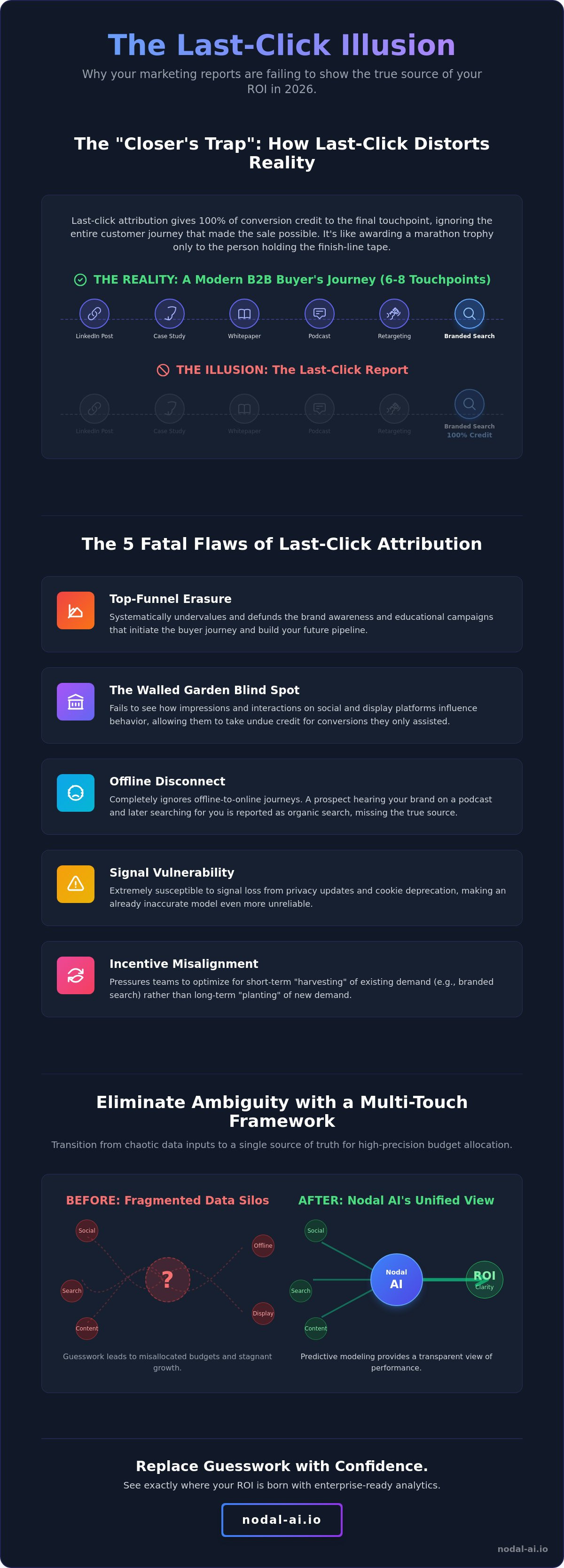
Last-click attribution is the digital equivalent of awarding a marathon trophy solely to the person who held the finish-line tape. This model assigns 100% of the conversion credit to the final interaction, effectively erasing every preceding touchpoint from your financial ledger. For decades, it remained the industry standard due to its sheer simplicity and the legacy influence of dominant search platforms. It was the "easy" button for marketing reporting; it required minimal setup and provided a clear, albeit narrow, answer to the question of where sales came from. To understand the broader context of these models, it helps to ask: What is Marketing Attribution?
In 2026, this convenience has become a dangerous trap. The modern buyer journey is a complex web of research, social proof, and multi-device interactions. Research shows that B2B buyer journeys now involve an average of 6 to 8 touchpoints before a conversion. When you stick with a legacy model despite these shifts, you aren't just being traditional; you're operating with a cognitive blindfold. The limitations of last-click attribution act as a barrier to true growth, rewarding the "closer" while starving the "creators" that actually fueled the interest.
The Mechanics of the Last-Click Model
Visualize a typical 10-touchpoint journey. A prospect discovers your brand through a LinkedIn thought-leadership post, watches two YouTube Case studies, reads three technical whitepapers, and receives a retargeting ad. Finally, they type your brand name into a search engine and click a branded search ad to convert. In a last-click world, that final search ad gets all the credit. The previous nine interactions, which did the heavy lifting of education and persuasion, are wiped from the record. This is the "Flat Earth" metaphor of marketing: the model is simple to navigate and looks correct on a small scale, but it's demonstrably false when you attempt to scale a global strategy.
Why Simplicity is Costing You Clarity
Choosing a measurement model based on ease of use is a false economy. It creates a systemic "closing-channel bias" in your reporting that distorts your entire budget allocation. When your data only highlights the final click, you naturally feel compelled to shift more budget toward bottom-funnel tactics like branded search or direct email. This creates a cycle of fragmented data where your top-funnel awareness campaigns appear to be failing, even when they're the primary drivers of new leads. You end up with a high ROAS on paper, but stagnant total revenue because you've stopped feeding the top of the funnel. Stop settling for the easy answer and start demanding the right one. Clarity comes from seeing the whole journey, not just the destination.
The 5 Fatal Flaws of Last-Click Attribution in 2026
Relying on a single-point measurement model in a multi-point world is a recipe for strategic stagnation. The limitations of last-click attribution are no longer just technical nuisances; they're structural failures that compromise your growth. These flaws distort your reality. They lead you to slash budgets for the very campaigns that create your future customers. To build a resilient strategy, you must acknowledge these five fatal blind spots:
- Top-Funnel Erasure: The systematic undervaluation of brand awareness campaigns that initiate the buyer journey.
- The Walled Garden Blind Spot: An inability to see how social and display impressions influence search behavior.
- Offline Disconnect: The failure to account for offline-to-online journeys, such as a podcast listener later searching for your brand.
- Signal Vulnerability: Extreme susceptibility to signal loss caused by aggressive browser privacy updates and cookie deprecation.
- Incentive Misalignment: Pressuring teams to optimize for short-term "harvesting" rather than long-term "planting."
The Death of the Linear Funnel
The modern customer journey resembles a chaotic web rather than a tidy line. Prospects bounce between LinkedIn discussions, dark social messages, and influencer endorsements before ever clicking an ad. Last-click ignores this entire ecosystem. It allows walled gardens to take undue credit for a conversion that was actually nurtured across a dozen unmeasured touchpoints. This creates a "closer's bias." You end up over-funding the channel that happened to be the final door the customer walked through, while the marketing that led them to the building is ignored. This isn't just bad reporting; it's a strategic liability that inflates your customer acquisition costs over time.
Privacy and Signal Loss: The 2026 Crisis
Privacy is the defining challenge for legacy measurement. With new comprehensive privacy laws taking effect in Indiana, Kentucky, and Rhode Island as of January 2026, and the mandatory adoption of Global Privacy Control (GPC) signals in states like California and Oregon, traditional tracking is crumbling. These significant limitations mean your browser-based data is increasingly fragmented. If your sales cycle lasts longer than the narrowing window of a standard cookie, last-click loses the thread entirely. You see a "Direct" or "Organic Search" conversion, but you miss the six months of paid education that made it possible. You can reclaim visibility into your data by moving toward a model that doesn't rely on fragile, single-point signals. Clarity requires a cognitive upgrade; it's time to stop guessing and start measuring the full weight of your marketing investments.
The Financial Impact: How Misattribution Distorts Your ROI
Last-click attribution isn't just a reporting preference; it's a financial liability that masks a phenomenon known as "Efficient Failure." You might celebrate a 10x ROAS on your dashboard while your total bank balance remains stagnant. This disconnect occurs because last-click rewards the channel that intercepted the customer at the very end, often ignoring the fact that the customer was already convinced. This leads to the "Cannibalization Effect." You end up paying for branded search clicks from users who would have navigated to your site regardless. From a data analyst perspective, this model fails to distinguish between correlation and causation, leading to a massive waste of marketing capital.
The limitations of last-click attribution create a systemic undervaluation of the very activities that build your pipeline. When you stop funding brand awareness because it doesn't show an immediate "click-to-convert" return, you're effectively liquidating your future growth for short-term reporting wins. This results in a long-term decay of your customer pipeline that becomes visible only when it's too late to easily fix. You must shift your focus from reported ROI to true incremental growth if you want to maintain a competitive edge.
Understanding Incrementality vs. Attribution
Incrementality is the only metric that truly matters to a growth-focused CFO. It asks a critical question: would this sale have happened if we hadn't shown this specific ad? Because of the inherent flaws in legacy models, your current reports likely can't provide this answer. They simply count the last interaction without weighing its actual influence. To survive the complexities of the coming year, marketing attribution must evolve from a passive counting exercise into an active, AI-driven engine that measures true incremental lift across every touchpoint.
The Hidden Cost of Budget Misallocation
Consider a common scenario. You see a low direct ROI on your top-funnel YouTube ads. You decide to cut that budget to "save" money. Two weeks later, your high-performing branded search volume collapses. You've just paid the "Attribution Tax." By over-bidding on the bottom of the funnel and starving the top, you've destroyed the demand you were previously harvesting. Some industry analysts observe that even a 20% error in attribution accuracy can lead to a 50% drop in overall growth over a six-month period. This is a risk you can't afford to take. Audit your spend now to identify where you're over-paying for customers who were already at your door.
Beyond Last-Click: Implementing a Multi-Touch Framework
The limitations of last-click attribution have forced a strategic reckoning in marketing departments. By April 2026, 47% of B2B teams have already migrated to multi-touch attribution, leaving the single-model approach as a minority practice. Transitioning to a high-precision framework requires a deliberate, five-step journey from fragmented chaos to total clarity. This evolution turns passive data points into active growth drivers.
- Audit Your Silos: Identify where your customer data is trapped. Fragmented inputs from CRM, social platforms, and ad managers must be unified to remove ambiguity.
- Adopt Multi-Touch Models: Move toward multi-touch attribution models like U-shaped or Time Decay. These acknowledge that the first handshake is just as valuable as the final signature.
- Layer in MMM: Integrate Marketing Mix Modelling for a top-down strategic view. This provides the macro-perspective that tactical click-tracking inherently misses.
- Deploy AI-Driven Analysis: Use predictive modelling to bridge the gaps left by privacy-first signals and cookie deprecation.
- Validate with Incrementality: Continuously test your channels to ensure every dollar spent is driving a sale that wouldn't have happened otherwise.
Comparing Advanced Attribution Models
Choosing the right model depends on your specific business goals. A U-shaped (Position-Based) model is ideal for aggressive growth; it assigns 40% credit to the first touchpoint and 40% to the last, ensuring you value both discovery and closing. For organizations with massive data sets, Data-Driven Attribution (DDA) uses machine learning to assign weight based on actual historical influence. If you have a short sales cycle, Time Decay might suffice by rewarding the touchpoints closest to the conversion. Match your model to your use case to ensure your reporting reflects your commercial reality.
The Role of AI in Modern Attribution
AI acts as the connective tissue in a world of signal loss. As browser privacy signals like GPC become mandatory, AI reconstructs fragmented journeys by identifying patterns that traditional pixels miss. This technology shifts your focus from retrospective reporting to prospective action. Instead of asking "What happened?" your team can now ask "What will happen if we shift 15% of our budget to top-funnel video?" These Growth Recommendations provide a cognitive upgrade for your entire organization. You can unify your customer journey mapping today and turn your marketing data into a high-value output that the CFO can finally trust.
Eliminate Ambiguity with the Nodal Platform
The era of manual data stitching is over. Managing fragmented inputs across dozens of platforms is no longer a viable strategy for the modern marketer. The Nodal Platform acts as the essential bridge between chaotic, raw data and actionable commercial intelligence. By moving beyond the limitations of last-click attribution, we unify your customer journey mapping and predictive modelling into a single source of truth. We transform your passive assets into active participants in your business process. Our automated reporting removes the friction of technical hurdles, saving your team over 20 hours of manual labor every month. This isn't just a functional tool; it's a cognitive upgrade for your entire organization.
Transforming Fragmented Data into Growth
Complexity shouldn't be a barrier to performance. Nodal integrates seamlessly with your existing stack to deliver high-precision ai marketing analytics that reflect the true weight of every interaction. Instead of drowning in spreadsheets, you receive clear Growth Recommendations based on actual performance data. We replace the anxiety of manual, tedious tasks with the confidence of streamlined, high-level perspectives. This shift allows you to move from being overwhelmed by fragmented data to being empowered by strategic clarity. You gain the ability to justify every pound of marketing spend to the CFO with absolute transparency. Our platform identifies hidden opportunities in your mid-funnel that legacy models systematically ignore, turning missed connections into measurable returns.
Your Roadmap to Strategic Clarity
It's time to move beyond the limitations of last-click attribution and embrace a future-facing measurement strategy. For London enterprises seeking to master the complexities of the 2026 landscape, Nodal AI provides the expertise needed to navigate rising regulatory scrutiny and signal loss. We help you map the complex, personalized customer journey with high precision, ensuring no touchpoint is left behind. This is the voice of an entity that has mastered future-facing analytics and is now inviting you to benefit from that expertise. Replace your financial blind spots with total visibility. Take the first step toward a more accurate way to measure ROI and secure your budget allocation decisions with a partner obsessed with measurable returns. Book a demo of the Nodal Platform today and see how we turn your fragmented data into profitable growth.
Secure Your Commercial Future with Predictive Clarity
The limitations of last-click attribution are no longer just a reporting inconvenience; they're a direct threat to your 2026 growth. By ignoring the complex web of the modern customer journey, you risk over-funding the final click while starving the awareness that actually feeds your pipeline. Transitioning to a multi-touch framework isn't just about better data. It's about gaining the confidence to make bold budget decisions that the CFO can finally trust.
Nodal AI provides the cognitive upgrade your organization needs to thrive in a privacy-first world. We deliver AI-powered insights for London's leading marketing teams, replacing manual guesswork with automated reporting that saves 20+ hours weekly. By turning fragmented data into high-value outputs through predictive modelling, we ensure your ROI is a verifiable truth rather than a legacy lie. Stop settling for chaotic inputs and start demanding high-precision results.
Your data is ready to become an active participant in your success. Take control of your customer journey and start building for scalable, transparent growth today.
Frequently Asked Questions
Is last-click attribution always bad for my marketing reports?
Last-click attribution works for simple, single-touch transactions where the discovery and purchase happen simultaneously. It fails for modern B2B or complex B2C journeys that require multiple exposures over weeks or months. Relying on this model for long sales cycles creates a dangerous blind spot that rewards the final interaction while ignoring the brand awareness that initiated the interest.
What is the difference between last-click and multi-touch attribution?
Last-click attribution assigns 100% of the conversion credit to the final touchpoint before a sale. Multi-touch attribution distributes that credit across every interaction in the customer journey, such as the initial social media discovery and the middle-funnel whitepaper download. This provides a transparent view of which channels actually drive growth rather than just which ones happened to be the final door the customer walked through.
How does last-click attribution affect my brand awareness campaigns?
It systematically undervalues them. Because awareness ads rarely result in an immediate final click, a last-click model reports their ROI as zero. This leads to the limitations of last-click attribution where you under-fund the top of your funnel, eventually causing your search and direct traffic to collapse because you've stopped feeding the pipeline.
Can I still use Google Analytics if it defaults to last-click?
You can use Google Analytics as a tactical tool, but it shouldn't be your single source of truth for strategic budget decisions. Most standard analytics platforms lack the deep CRM integration and offline data needed to map a complete 2026 buyer journey. Supplement these tools with a platform that can unify fragmented data into a cohesive growth strategy.
How much revenue am I losing by using an outdated attribution model?
You lose revenue through "Efficient Failure," a state where you hit channel-level ROAS targets while your total business growth remains stagnant. This happens because you're over-paying for customers who were already going to buy while missing out on new prospects. Some industry professionals report that even a 20% error in attribution accuracy can lead to a 50% drop in overall growth potential over a six-month period.
What is the best alternative to last-click attribution for a SaaS business?
The most effective approach is a dual-model framework. Use multi-touch attribution for day-to-day tactical decisions and Marketing Mix Modeling for high-level budget allocation. This combination accounts for long SaaS sales cycles and ensures you value the content and webinars that educate prospects before they ever reach your pricing page.
How does AI help solve the limitations of last-click attribution?
AI reconstructs fragmented customer journeys by identifying patterns that traditional tracking pixels miss due to privacy regulations. It uses predictive modelling to fill data gaps left by cookie deprecation and browser blockers like Global Privacy Control. This transforms chaotic, incomplete inputs into high-value growth recommendations that help you scale with confidence.
What is incrementality and why is it better than last-click?
Incrementality measures the true lift your marketing provides by asking if a sale would have occurred without a specific ad. It focuses on causation rather than just correlation. While last-click simply counts the last person to touch a lead, incrementality proves the actual financial value of your spend, making it a far more reliable metric for justifying budgets to your CFO.


