

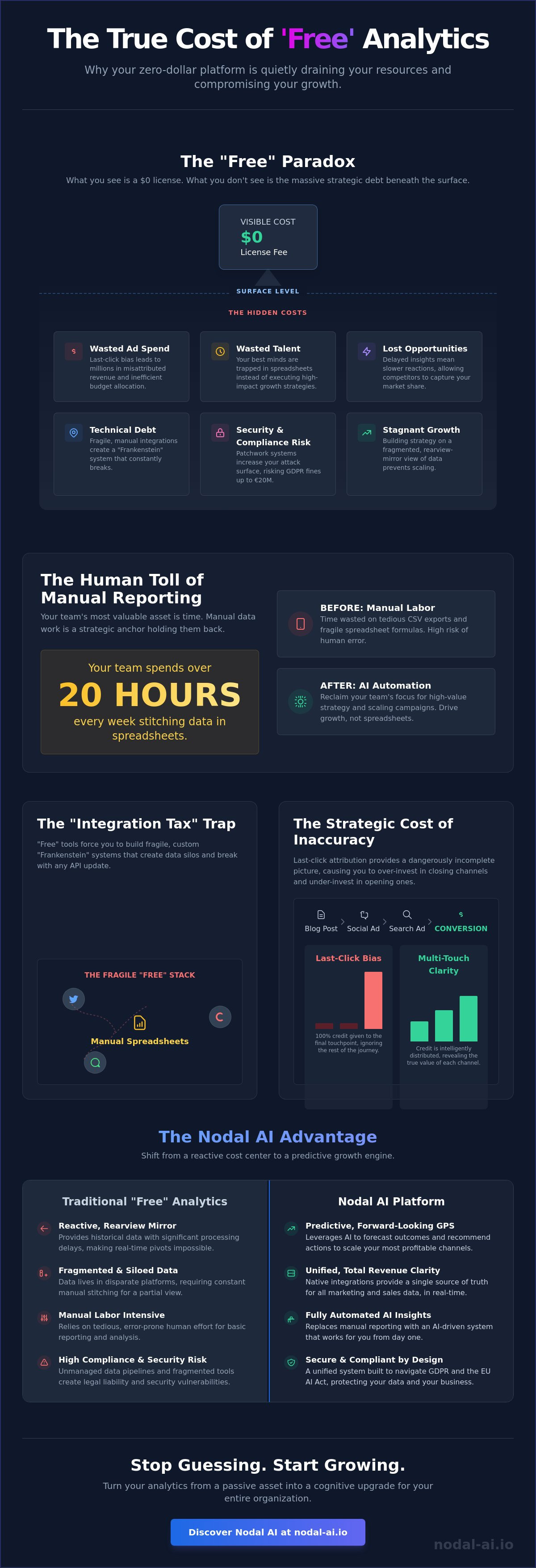
The most expensive line item in your marketing budget isn't your ad spend or your head of growth; it's the "free" analytics platform quietly draining your resources. While zero-dollar licensing feels like a win, the hidden costs of free analytics tools are often measured in millions of dollars of lost revenue and wasted talent. You likely feel the friction every Monday morning. Your team spends over 20 hours a week manually stitching data in Excel just to get a baseline view of performance. This manual labor isn't just tedious. It's a strategic anchor that keeps your best minds trapped in spreadsheets instead of scaling campaigns.
Transition from the anxiety of inaccurate attribution to the confidence of total revenue clarity. Relying on tools with shrinking data windows and configuration errors creates a liability, especially with the EU AI Act enforcement approaching in August 2026. This article reveals the true strategic, technical, and human price of staying on the free tier. Discover how to reclaim your time through automated reporting and transition to a high-ROI AI-driven model. Stop guessing which channels drive revenue. Start using predictive insights to scale growth faster and turn your data into a cognitive upgrade for your entire organization.
Key Takeaways
- Understand why zero-dollar licensing creates "Strategic Debt" that compromises your data integrity and long-term growth.
- Identify the "Integration Tax" that forces teams into manual data stitching and creates fragile, fragmented reporting systems.
- Uncover the hidden costs of free analytics tools by exposing how last-click bias leads to millions in wasted ad spend and inaccurate revenue attribution.
- Quantify the human toll of manual CSV exports and learn how automated reporting reclaims your team's focus for high-value strategy.
- Shift from passive measurement to active growth by leveraging predictive modelling to scale your most profitable customer journeys.
The "Free" Paradox: Why No-Cost Analytics is a Financial Illusion
Marketing leaders often fall for the most seductive trap in SaaS: the zero-dollar license. The "Free" Paradox describes the massive delta between a non-existent subscription fee and the staggering cost of execution. While your finance department sees a $0 line item, your marketing team is actually accruing "Strategic Debt." This debt represents the compounding interest of poor decisions made on incomplete or delayed data. Most foundational Web analytics tools were built for simple data collection; they weren't designed to optimize your profit margins in a hyper-competitive market.
By mid-2026, the gap between market leaders and laggards will be defined by AI-first ecosystems. Free tools simply can't keep pace with the intelligence required to navigate the EU AI Act or the shrinking effectiveness of third-party cookies. They provide a rearview mirror view when you need a predictive GPS. Relying on them means you're building your growth strategy on a foundation of fragmented insights. The hidden costs of free analytics tools become painfully clear when you realize your data is a passive asset rather than an active participant in your business growth.
The Illusion of Zero-Cost Subscriptions
"Free" is a strategic marketing tactic for cloud giants. They monetize your data or force you into expensive storage solutions like BigQuery to bypass GA4's 14-month data retention limit. As of May 2026, active storage and streaming export fees turn that "free" tool into a significant monthly bill. You're left with a heavy DIY burden; you must hire engineers to make the raw data usable. Contrast this with the Nodal Platform. We replace the "Frankenstein" infrastructure with a streamlined, high-value output that works from day one.
Opportunity Cost: The Price of Delayed Insights
Speed is the ultimate competitive advantage. If your team waits 48 hours for data processing while competitors react in real-time, you've already lost. In London's high-velocity marketing scene, fragmented data leads to "analysis paralysis" where teams are too afraid to pivot. Opportunity cost in analytics is the revenue lost while manually cleaning spreadsheets instead of scaling winning campaigns. Every hour spent in Excel is an hour your competitors spend stealing your market share.
The Technical Debt: Maintenance, Integration, and Data Fragmentation
Technical debt isn't just a concern for your engineering team; it's a silent killer of marketing ROI. When you rely on zero-dollar software, you're forced to pay an "Integration Tax" every single day. This tax is the manual labor required to connect Facebook, Google, and your CRM into a cohesive view. Most teams end up building "Frankenstein" reporting systems. These are fragile, custom-built pipelines that break the moment a platform updates its API. According to Forbes, a scalable tool stack is the backbone of growth, yet many brands settle for disparate platforms that create dangerous data silos. Understanding the hidden costs of free analytics tools is essential for any leader who wants to avoid this trap.
The hidden costs of free analytics tools also extend to security and legal liability. Managing unmanaged data pipelines in 2026 is a high-stakes gamble. With GDPR fines reaching up to €20 million or 4% of global revenue, the price of a "free" leak is astronomical. In 2025 alone, regulators issued approximately €1.2 billion in fines, and European authorities now receive an average of 443 breach notifications per day. Relying on a patchwork of free tools increases your attack surface and complicates compliance. You need a unified system that protects your assets while it processes your insights.
The Integration Tax: API Maintenance and Broken Links
Maintaining custom connectors is a full-time job your team didn't sign up for. "Free" connectors often suffer from significant lag times or restrictive data limits that mask the true performance of your campaigns. Your engineers should be building product features, not fixing broken API links in a spreadsheet. Nodal AI eliminates this burden with native integrations that turn chaotic inputs into a streamlined flow of information. It's time to stop troubleshooting and start scaling. You can explore how automated reporting saves engineering hours to see the difference for yourself.
Data Fragmentation and the "Single Version of Truth" Problem
It's a common frustration: Google Analytics shows one number, while your ad manager shows another. This fragmentation makes accurate customer journey mapping nearly impossible. Without a single version of the truth, your team wastes hours debating which data is correct instead of making growth-focused decisions. The Nodal Platform unifies these disparate sources into a single intelligence layer. It transforms passive, conflicting data points into a clear, actionable narrative for your entire organization.
The Strategic Cost of Inaccuracy: Multi-Touch Attribution vs. Last-Click Bias
"Our free tool says we are doing fine." This is the most dangerous sentence in marketing. It signals a complete reliance on a distorted reality. Most zero-dollar platforms default to last-click models because they are technically easy to track, but they represent a massive strategic liability. This inaccuracy is one of the primary hidden costs of free analytics tools. When you only credit the final touchpoint, you ignore the complex web of interactions that actually builds your brand and drives demand. You end up optimizing for the end of the journey while starving the beginning.
Last-click models inevitably over-credit direct traffic and brand search. This creates an "Attribution Debt" that leads to scaling failures. You see high ROI on brand search and assume you should double down there, while cutting spend on "unprofitable" social or display ads. In reality, those top-of-funnel channels were the engines driving the brand search in the first place. By the time you realize the funnel has dried up, you've already lost months of growth momentum. Poor marketing attribution doesn't just provide bad data; it actively destroys your ability to scale.
The Last-Click Trap: Why Your ROI is Likely Miscalculated
Last-click attribution is like giving all the credit for a goal to the person who made the final pass, ignoring the entire play. This model treats a customer's journey as a single event rather than a relationship. When you turn off channels that seem unprofitable on a last-click basis, you often kill the first touch that started the journey. This leads to a slow, silent decline in revenue that free tools are incapable of diagnosing. You aren't just losing data; you're losing the context required to make profitable decisions.
Multi-Touch Attribution (MTA) as a Profit Driver
Multi-Touch Attribution reveals the true value of every marketing pound spent. It transforms your data from a static list of clicks into a dynamic map of influence. AI plays a critical role here, especially in resolving the "Walled Garden" problem where Meta and Google refuse to share data. While free tools struggle with shrinking cookie windows and the 14-month data limits enforced by GA4, the Nodal Platform uses advanced modeling to bridge these gaps. We position your marketing as a unified growth engine rather than a collection of siloed campaigns. This shift from measurement to intelligence is the ultimate cognitive upgrade for your organization.
Quantifying the Human Toll: Manual Reporting vs. Automated AI Insights
Your most talented marketing managers are currently acting as overpaid data entry clerks. This is the "Reporting Churn," a relentless cycle of manual data preparation that consumes the hours your team should spend on creative testing and growth strategy. One of the most overlooked hidden costs of free analytics tools is the erosion of your human capital. When high performers spend their Monday mornings stitching together CSV files from four different ad platforms, they aren't just losing time. They're losing the cognitive bandwidth required to scale your business. This manual labor creates a culture of "What happened?" where teams are constantly looking backward instead of asking "What next?"
The retention risk is equally severe. Top-tier marketing talent in 2026 expects to work with sophisticated, AI-driven ecosystems that empower their decision-making. They don't want to be trapped in the fragility of a "Frankenstein" reporting system that breaks every time an API updates. If your organization continues to treat data as a manual hurdle rather than a streamlined asset, your best minds will eventually move to competitors who value their strategic input over their spreadsheet skills. Transforming your data into a cognitive upgrade for the team is the only way to maintain a competitive edge.
The 20-Hour Reporting Week: A Cost Analysis
Consider the math of manual prep. If a senior marketing manager spends 25% of their week on manual data manipulation, you're effectively paying a "Strategic Debt" tax on their salary every year. For a team of five, this inefficiency can easily cost an organization six figures in lost productivity alone. Beyond the salary drain, the cost of human error in manual spreadsheets is astronomical. A single broken formula can lead to millions in wasted ad spend. Nodal AI eliminates this risk by automating complex reporting tasks, turning chaotic inputs into high-value outputs instantly.
From Data Entry to Growth Strategy
Moving from manual chaos to calm efficiency changes the psychological state of your entire department. Instead of drowning in raw charts, your team receives actionable growth recommendations that guide their next move. By leveraging ai marketing analytics, you shift from reporting the past to predicting future trends. This proactive stance allows you to scale growth faster and with more certainty. It's time to stop fighting with your data and start using it as a partner in your success. You can reclaim your team's productivity with the Nodal Platform today.
The Nodal Advantage: Turning Analytics from a Cost Center into a Growth Engine
The Nodal Platform represents a fundamental shift in how your organization interacts with its own data. It moves you away from the "Free Tool Tax" and positions your marketing as a high-velocity growth engine. By consolidating chaotic inputs into a single intelligence layer, we provide a cognitive upgrade that empowers every level of the business. You stop struggling with fragmented spreadsheets and start benefiting from streamlined, high-value outputs. This is the end of analytics as a cost center and the beginning of data as your most competitive, active asset. It replaces the anxiety of manual labor with the confidence of professional, enterprise-ready insights.
Transitioning to Nodal AI means you're no longer just measuring the past; you're engineering the future. We've mastered the complexity of future-facing analytics so you don't have to. Our platform serves as a problem-solver that understands your sense of overwhelm and replaces it with a structured journey toward growth. Every feature is tethered to concrete business outcomes and long-term stability. Understanding the hidden costs of free analytics tools is the first step, but implementing a cognitive upgrade is the final move that secures your market position.
Predictive Modelling: The Final Frontier of Analytics
Traditional analytics focus on the past, telling you what happened when it's already too late to change the outcome. Nodal AI shifts the focus toward predictive modelling, allowing you to forecast the impact of budget changes before you spend a penny. While historical reporting documents the journey, growth intelligence anticipates the destination. Predictive modelling is the ability to transform fragmented data into a roadmap for future revenue. This foresight allows you to scale growth faster and with total clarity on which channels will drive the most significant returns in the months ahead.
The Nodal Implementation: Professional Setup for Enterprise Success
The transition from zero-dollar tools to a professional platform requires more than just a login; it requires a strategic foundation. Expert onboarding is an investment in your organization's long-term stability, ensuring that every data point is accurate and every dashboard is configured to your specific business goals. A custom setup removes the ambiguity that plagues "DIY" systems and replaces it with the confidence of enterprise-ready insights. Stop losing millions to the hidden costs of free analytics tools. It's time to transform your marketing data with Nodal Platform and start scaling your organization with absolute precision.
Reclaim Your Growth Momentum: From Strategic Debt to Total Clarity
The era of "free" measurement is over, replaced by the necessity of high-velocity growth intelligence. You've seen how the hidden costs of free analytics tools manifest as wasted ad spend, technical debt, and hundreds of hours lost to manual reporting churn. Staying on the free tier isn't a cost-saving measure; it's a strategic anchor that prevents your team from scaling with precision. Bridge the gap between fragmented data and profitable growth by transforming your analytics into a cognitive upgrade for your organization. Turn your data into an active participant in your business success rather than a passive liability.
Nodal AI provides the relief of automated reporting and the power of predictive growth recommendations. With our London-based expert support and AI-powered multi-touch attribution, you can finally stop guessing which channels drive revenue. Book a Nodal Platform Demo to Uncover Your True Marketing ROI and start building a roadmap for future revenue today. Replace the anxiety of manual labor with the confidence of streamlined, high-level perspectives. Your most profitable customer journeys are waiting to be discovered.
Frequently Asked Questions
What are the specific hidden costs of using Google Analytics 4?
Google Analytics 4 imposes a strict 14-month user-level data retention limit, which forces businesses to pay for external storage like BigQuery to maintain historical context. Starting in June 2026, a new 37-month rolling policy will also restrict granular API data. These storage and processing fees, combined with the technical expertise required to manage them, turn a no-cost tool into a significant recurring infrastructure expense.
How does free analytics software impact data privacy and GDPR compliance?
Free tools often lack the robust controls needed to navigate the EU AI Act and GDPR, increasing your risk of severe financial penalties. With European authorities receiving an average of 443 breach notifications per day, unmanaged data pipelines are a massive liability. Relying on platforms with ambiguous data transfer policies can expose your organization to fines of up to 4% of global annual revenue.
Can I use a free tool for multi-touch attribution (MTA)?
Most free platforms default to last-click models because they're technically simple, but they fail to capture the complexity of modern customer journeys. While some offer basic data-driven options, they lack the AI-driven intelligence required to resolve "Walled Garden" data gaps between Meta and Google. This leads to a distorted view of ROI and prevents you from identifying true incremental growth opportunities.
Is it worth paying for analytics if I only have a small marketing budget?
Professional analytics are actually more critical for smaller budgets because you have less room for wasted spend. Inaccurate data leads to poor scaling decisions that can quickly deplete a limited budget. Investing in a professional platform ensures every pound is allocated to high-performing channels, acting as a cognitive upgrade that helps you compete with larger organizations through superior efficiency.
How much time can my team save by switching from manual reporting to Nodal AI?
Marketing teams typically reclaim over 20 hours per week by moving away from manual data stitching and CSV exports. By automating these complex tasks through the Nodal Platform, you eliminate the "Reporting Churn" that keeps your best talent trapped in spreadsheets. This transition allows your team to shift their focus from looking at what happened to predicting what should happen next.
What is the risk of "data sampling" in free analytics tools?
Data sampling occurs when a tool analyzes only a subset of your traffic, which can lead to significant inaccuracies in your performance reports. This compromise on precision often masks the hidden costs of free analytics tools by providing "good enough" approximations that fail during high-stakes decision-making. You risk scaling the wrong campaigns because your data was based on a mathematical guess rather than the full truth.
How do I justify the cost of a paid analytics platform to my CFO?
Position the platform as a tool for "Strategic Debt" reduction and a safeguard against regulatory fines. Highlight the quantified hidden costs of free analytics tools, specifically the salary drain caused by manual reporting and the revenue lost to inaccurate attribution. Show how predictive modelling turns data into a roadmap for future revenue, transforming the analytics department from a cost center into a growth engine.
What happens to my historical data if I move from a free tool to Nodal AI?
Nodal AI integrates your existing historical sources into a unified intelligence layer, ensuring you don't lose valuable year-over-year context. We transform your passive historical records into active participants in your future growth modelling. You move from fragmented, siloed data to a single version of the truth, preserving your past insights while gaining the ability to predict future trends with total clarity.


