

If your marketing team still spends 20 hours every week on manual data entry, you aren't just losing time; you're operating on historical guesses while your competitors scale with predictive intelligence. It's exhausting to manage fragmented data across multiple platforms, especially as new 2026 privacy regulations in states like Indiana and Oregon make manual compliance a moving target. You need a reliable, step by step way to track campaigns that transforms these chaotic inputs into high-value growth recommendations.
We've designed this guide to help you master a repeatable, data-governed framework that eliminates reporting gaps and tracks every customer touchpoint with surgical precision. You'll learn how to replace the anxiety of inaccurate ROI with the confidence of automated reporting and multi-touch attribution. We are moving beyond basic historical reports to provide you with a clear blueprint for total clarity on marketing spend and predictive insights that drive strategic growth.
Key Takeaways
- Stop the revenue leak caused by "dirty data" by executing a comprehensive audit of your existing tracking gaps.
- Implement a unified UTM and metadata tagging strategy to establish a reliable, step by step way to track campaigns across every digital channel.
- Move beyond outdated last-click models and adopt multi-touch attribution to accurately credit every touchpoint in your customer journey.
- Transform passive reporting into active revenue by building stakeholder-focused dashboards that prioritize why performance shifts occur.
- Leverage automated data ingestion to eliminate manual labor and pivot your focus from cleaning data to executing high-value growth recommendations.
Why Fragmented Data is the Enemy of Campaign Performance
Dirty data acts as a silent tax on your marketing budget, draining resources through misallocated spend and missed opportunities. When your information lives in disconnected silos, your team spends more time debating which platform is "right" than actually driving growth. In 2026, the cost of this fragmentation is higher than ever. Relying on last-click attribution leads to poor budget allocation because it ignores the multi-touch reality of the modern customer journey. You might see a conversion on a search ad, but you'll miss the three social interactions and the email nurture that made that click possible. Moving from reactive reporting to proactive campaign intelligence requires a fundamental shift in how you view your digital assets.
Your goal is a single source of truth for every marketing pound spent. This isn't just about clean numbers; it is about the confidence to scale. Without a unified view, you are essentially gambling with your capital. Establishing a reliable, step by step way to track campaigns begins by acknowledging that your data is currently lying to you. Once you accept that platform-specific metrics are biased toward their own ecosystems, you can begin building a framework that prioritizes business outcomes over vanity clicks.
The Problem with Traditional Siloed Tracking
Platform-specific dashboards like Facebook or Google Ads are designed to maximize their own perceived value. They create artificial "win" scenarios by claiming credit for the same conversion, leading to reported ROI that often exceeds your actual bank balance. This fragmentation destroys customer journey visibility. When you can't see the path from discovery to purchase, you can't optimize it. Manual spreadsheets often become the "solution," yet they are a primary barrier to data-driven marketing. They are slow, prone to human error, and obsolete the moment they are saved. Understanding Web analytics fundamentals helps clarify why these silos fail to capture the full picture of user behavior across different environments.
Establishing a Data Governance Mindset
Tracking is not a technical task; it is a governance discipline. Your success depends on a robust data governance framework that dictates how information is captured, stored, and utilized. Start by setting rigid naming conventions across all digital and offline channels. If your UTM parameters are inconsistent, your analysis will be impossible. Additionally, ensure privacy compliance is baked into your tracking DNA. With new 2026 state laws in Indiana and Kentucky now in effect, your tracking must respect consumer rights from the first touchpoint. This disciplined approach is the only step by step way to track campaigns that survives the transition from chaotic inputs to high-value strategic outputs.
The Step-by-Step Way to Track Campaigns: A Technical Blueprint
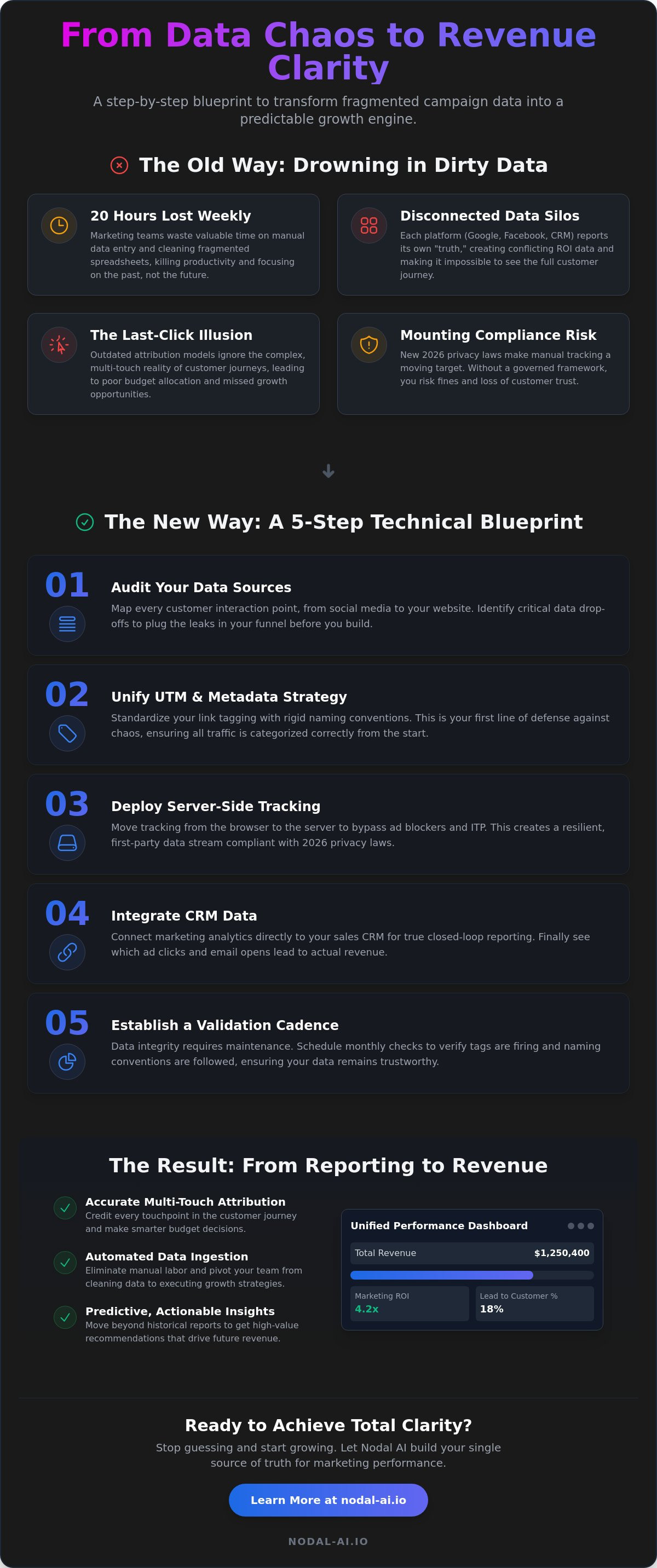
Building a technical blueprint is the only reliable way to ensure your marketing budget isn't vanishing into a black hole of untraceable clicks. You need a rigorous, step by step way to track campaigns that survives the death of third-party cookies and the tightening of global privacy regulations. This process turns your marketing department from a cost center into a predictable revenue engine. Follow these five essential steps to reclaim control over your data.
Step 1: Audit your current data sources. Begin by mapping every entry point where a customer interacts with your brand. Identify where data is dropping off; often, this occurs between social platforms and your web property. Step 2: Implement a unified UTM and metadata strategy. Standardization is your best defense against chaos. Every link must follow a pre-defined naming convention to ensure your analytics software can categorize traffic instantly. Step 3: Deploy first-party server-side tracking. To remain compliant with 2026 privacy updates while maintaining accuracy, move your tracking from the browser to the server. This bypasses ad blockers and provides a more resilient data stream. Step 4: Integrate CRM data. Connect your marketing analytics directly to your sales CRM. This enables closed-loop reporting, allowing you to see which specific campaign led to a final invoice. Step 5: Establish a validation cadence. Data decays quickly. Set a monthly schedule to verify that your tags are still firing correctly and that your naming conventions are being followed.
Mastering UTM Parameters and Naming Conventions
Precision in your UTM components; Source, Medium, Campaign, Content, and Term; is non-negotiable. Without this granularity, you're looking at a blurred image of your performance. Build a central tracking sheet to prevent tagging anarchy across different departments. Using dynamic parameters allows you to gain deeper insight into creative performance without manual labor. For organizations managing massive data volumes, following a framework similar to government web analytics standards can provide the structural integrity needed for enterprise-level reporting.
Bridging the Gap Between Online Clicks and Offline Conversions
The customer journey doesn't always end in a browser. You must pass unique identifiers from ad platforms directly to your CRM to track phone calls and physical store visits. This creates a holistic view of your impact in a digital-first world. When direct tracking isn't possible, use predictive modelling to fill the gaps and maintain a complete picture of your growth. To see how these complex inputs turn into clear growth recommendations, explore the Nodal platform.
Navigating the Multi-Touch Maze: Attribution in 2026
Attribution in 2026 isn't just about identifying where the last click originated; it's about understanding the entire influence chain. Multi-touch attribution (MTA) is the process of assigning credit to every touchpoint in a customer journey. Static attribution models like first or last-click are failing modern marketers because they ignore the messy reality of human behavior. Most buyers don't see an ad and purchase immediately. They research, compare, and get distracted across multiple devices. If you only credit the final touch, you'll likely starve the top-of-funnel channels that actually fueled the initial interest.
If you want a reliable, step by step way to track campaigns, you must move beyond the simplicity of the "last click." We've entered the era of algorithmic and AI-driven attribution. These systems don't just count clicks; they analyze patterns to determine which interactions truly shifted the needle. This approach also helps address the "dark social" challenge. While you can't always track a direct link shared in a private message, AI pattern recognition can estimate the impact of these hidden touchpoints on your overall growth trajectory.
Comparing Attribution Models: Which is Right for You?
Linear models give every touchpoint equal credit, which is fair but often unhelpful for optimization. Time-decay models reward interactions closer to the conversion, while position-based models focus on the "introducer" and the "closer." Enterprise teams are rapidly moving toward data-driven attribution (DDA). This model uses historical data to weigh interactions based on their actual contribution to the sale. You should also focus on calculating incrementality. This allows you to determine if a conversion would have happened anyway, ensuring you don't waste budget on customers who were already committed to buying.
Solving the Walled Garden Challenge
Google, Meta, and Amazon are notorious for double-counting conversions. Each platform wants to claim 100% of the credit for a sale, leading to inflated reports and wasted spend. You need an independent, third-party ai marketing analytics platform to see through these biases. By using Nodal AI, you can harmonise disparate data streams into a single, cohesive narrative. This eliminates the anxiety of overlapping reports and ensures your budget is allocated where it generates the most measurable return. This level of clarity turns passive data into an active participant in your business process.
From Reporting to Revenue: Actioning Your Campaign Data
Data is only as valuable as the decisions it informs. If your reports just sit in an inbox, they aren't assets; they're noise. A precise, step by step way to track campaigns creates the foundation for moving beyond "what happened" to "what should we do next?" In 2026, the competitive edge belongs to teams that use automated reporting to reclaim hours of strategic time. This shift allows you to identify high-performing audience segments that traditional, siloed tracking often misses. Instead of reacting to last month's performance, you start anticipating next month's opportunities.
The transition from historical reporting to predictive intelligence is where true growth happens. Traditional tracking often treats audiences as monoliths, but your data should reveal high-value cohorts with distinct behaviors. For instance, you might discover that users engaged via AI-personalized email campaigns exhibit a 4,400% ROI, as noted in recent 2026 industry studies. Identifying these specific drivers requires a tracking framework that connects every dot in the customer journey. When you eliminate the 20 plus hours a week spent on manual entry, your team can finally focus on the high-level strategy that drives revenue.
Building Revenue-Focused Reporting Dashboards
Stakeholders don't care about click-through rates; they care about contribution to margin. Map your KPIs directly to financial growth to speak the language of the boardroom. Visualise the entire customer journey to see exactly where prospects drop off. This "Growth Command Centre" approach enables real-time budget reallocation. If a specific channel is underperforming, move that capital instantly to a higher-yielding asset. By integrating the new cross-channel budgeting features available in 2026 platforms, you can optimize spend across Google, Meta, and TikTok from a single interface.
Leveraging Predictive Insights for Future Campaigns
Historical data is a rearview mirror. Predictive modelling turns it into a windshield. Use your tracking data to forecast future campaign ROI with surgical precision. Scenario planning allows you to ask, "What happens if we double our LinkedIn spend?" before you commit a single pound. This removes the anxiety of budget expansion. By automating growth recommendations through the Nodal Platform, you replace guesswork with mathematical certainty. You aren't just looking at what worked; you're building a roadmap for what will work next.
Ready to turn your fragmented data into a strategic growth engine? Master your performance marketing analytics with Nodal today.
Achieving Total Clarity: The Nodal AI Approach to Campaign Intelligence
Turning chaotic data into high-value strategic outputs is no longer a luxury; it's a survival requirement. Nodal AI acts as a cognitive upgrade for your organization, transforming passive data points into active participants in your growth strategy. By implementing our platform, you establish a permanent, automated step by step way to track campaigns that bypasses the friction of manual labor. We replace the anxiety of fragmented silos with the confidence of a unified perspective, ensuring every decision is backed by mathematical certainty.
Manual data ingestion and cleaning currently consume over 20 hours of your team's week. Nodal AI eliminates this waste through automated processes that ingest, clean, and validate your data in real-time. This efficiency allows your marketing leaders to pivot from spreadsheet management to high-level strategy. In a privacy-first world where new 2026 regulations in states like Indiana and Oregon restrict traditional tracking, our predictive modelling fills the gaps. You gain a complete picture of your ROI without compromising consumer trust or legal compliance.
The Nodal Advantage: Beyond Basic Tracking
The platform ensures seamless integration with your existing tech stack, including your CRM, ad platforms, and web analytics. This connectivity allows our AI-driven insights to identify performance trends before they become obvious to the naked eye. London's leading marketing teams are choosing these cognitive upgrades over functional tools because they prioritize speed and precision. Empower your team to make faster, more profitable decisions by leveraging technology that thinks as fast as the market moves.
Your Journey to Strategic Clarity Starts Here
The transition from fragmented data to strategic clarity happens in weeks, not months. Our onboarding process is designed for rapid deployment, ensuring you see the true value of your assets immediately. You'll have access to dedicated support for complex customer journey mapping, helping you navigate the multi-touch maze with ease. Stop guessing and start growing. Book a demo of the Nodal Platform today to witness the step by step way to track campaigns that delivers total clarity and surgical precision.
Secure Your Strategic Edge with Campaign Intelligence
The era of manual spreadsheets and fragmented data silos is over. You've transitioned from the anxiety of inaccurate ROI reporting to the clarity of a repeatable, technical blueprint. By mastering this step by step way to track campaigns, you've replaced historical guesswork with surgical precision. You now understand that tracking is not a one-time task but a continuous journey toward predictive intelligence. The relief of total visibility is finally within your reach.
Nodal AI provides the cognitive upgrade your marketing department needs to thrive in 2026. Our London-based expert support guides you through every complexity, from automated multi-touch attribution to AI-driven predictive modelling. We turn your chaotic inputs into high-value strategic outputs, freeing your team to focus on growth rather than data cleaning. The road to total clarity is clear. Transform your fragmented data into profitable decisions with Nodal AI. Your journey to effortless, data-governed scaling starts today.
Frequently Asked Questions
What is the most effective way to track marketing campaigns in 2026?
The most effective method is a unified, data-governed framework that combines first-party server-side data with multi-touch attribution. This approach provides a step by step way to track campaigns that survives the death of third-party cookies. By integrating your ads, CRM, and web analytics, you achieve surgical precision. You move from chaotic inputs to high-value strategic outputs, ensuring every pound spent is accounted for in your final revenue reports.
How do I track campaigns without relying on third-party cookies?
You must transition to first-party server-side tracking and leverage predictive modelling to fill gaps. This strategy bypasses browser restrictions and ad blockers that render third-party cookies useless. In 2026, this is essential for staying compliant with new regulations like the Indiana Consumer Data Privacy Act. It ensures your customer journey mapping remains accurate even as privacy standards tighten across global markets.
Can I track offline conversions in my digital marketing dashboard?
You can track these by passing unique identifiers from your digital ads directly into your sales CRM. This allows you to link physical store visits or phone inquiries back to the original digital touchpoint. Integrating these offline events into a performance marketing analytics platform provides total clarity on your marketing spend. It turns disconnected offline sales into active participants in your digital optimization process.
What are UTM parameters and how do they help with campaign tracking?
UTM parameters are specific tags appended to your URLs that track the source, medium, campaign name, content, and term. They are the fundamental building blocks of any step by step way to track campaigns. By using a standardized naming convention, you prevent data anarchy and ensure your analytics software correctly categorizes every click. This level of granularity is vital for identifying which specific creative assets drive the highest ROI.
How does multi-touch attribution differ from last-click attribution?
Multi-touch attribution assigns credit to every interaction a user has before converting, while last-click attribution only rewards the final touchpoint. Last-click is failing modern marketers because it ignores the complex research phases typical in 2026. Using a multi-touch model provides a more accurate reflection of the customer journey. It ensures top-of-funnel channels receive the credit they deserve for initiating the initial brand discovery.
Why is my marketing data fragmented across different platforms?
Fragmentation happens because ad platforms operate as "walled gardens," each claiming 100 percent credit for conversions. When these systems don't talk to each other, you end up with overlapping reports and double-counted sales. You need an independent analytics platform to harmonise these disparate sources. This replaces the anxiety of conflicting data with a single source of truth, allowing for more confident budget reallocation.
How much time can automated reporting save my marketing team?
Automation typically saves marketing teams more than 20 hours every week by removing the need for manual data cleaning and spreadsheet updates. This reclaimed time allows your staff to pivot from administrative labor to high-level strategic planning. Instead of looking at historical reports, your team can use automated insights to execute predictive growth recommendations. It is a cognitive upgrade that moves your organization from reactive to proactive.
Is AI-driven campaign tracking compliant with GDPR?
AI-driven tracking is fully compliant if it utilizes anonymized data and respects universal opt-out signals as mandated by 2026 updates like the Oregon Consumer Privacy Act. Your tracking DNA must include automated data retention and deletion procedures to satisfy the Delete Act. By baking these privacy protocols into your framework, you protect your company from GDPR fines while still gaining deep, actionable campaign intelligence.


