

If your performance team still spends 20 hours every week manually stitching spreadsheets together, you aren't just losing time; you're losing the market. With the global MarTech market hitting $1.03 trillion in 2026, the standard for a marketing analytics platform for performance teams has shifted from simple visualization to active execution. You've likely felt the frustration of fragmented insights that refuse to talk to each other, leaving you with inaccurate attribution and the lingering anxiety of wasted ad spend.
It's time to replace that manual grind with the calm efficiency of streamlined, high-level perspectives. You deserve total clarity on your marketing ROI and the predictive confidence to know exactly where to spend your next £1. This article reveals the top-tier business intelligence tools that transform chaotic data into automated, executive-ready dashboards and actionable growth strategies. We'll compare the latest 2026 pricing and capabilities for industry leaders like Power BI and Tableau, providing a clear roadmap to upgrade your organization's cognitive power and stop the leak in your performance budget.
Key Takeaways
- Modern BI in 2026 acts as a cognitive upgrade, transforming static data into active growth recommendations rather than just another dashboard.
- Mastering multi-touch attribution is essential for mapping complex customer journeys and eliminating wasted ad spend across fragmented channels.
- The right marketing analytics platform for performance teams can automate over 20 hours of manual data consolidation weekly, freeing your experts for high-level strategy.
- Implementation barriers have collapsed; learn how AI-assisted onboarding moves your organization from chaotic inputs to streamlined insights in days, not months.
- A specialized partner offers a competitive advantage over generic tools by delivering predictive modeling tailored specifically to performance marketing outcomes.
The Evolution of Business Intelligence Tools for Performance Teams
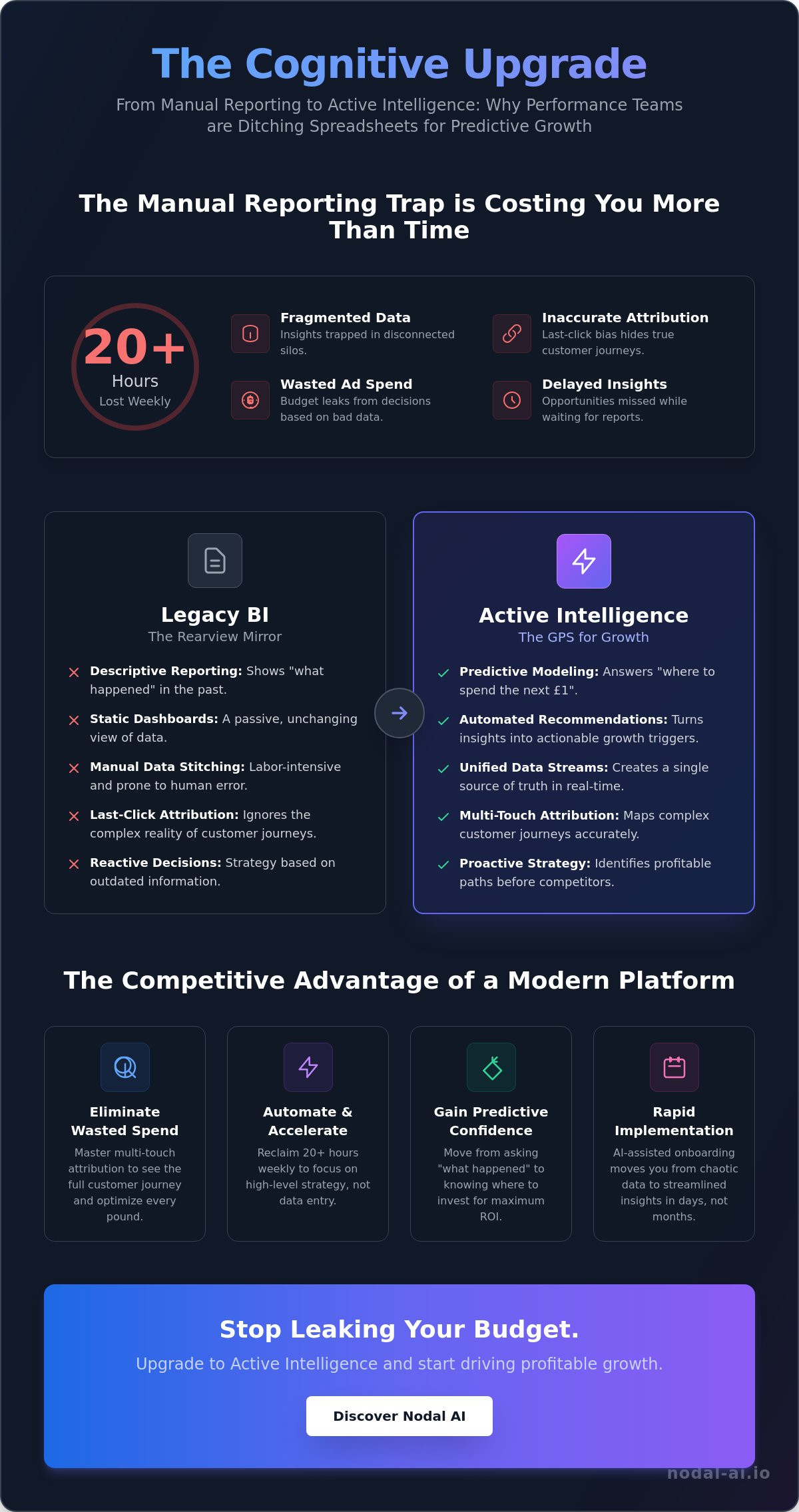
By 2026, the role of Business Intelligence (BI) has shifted from a back-office reporting function to the primary engine of marketing execution. It's no longer enough to simply visualize what happened last month. Modern performance teams require a cognitive upgrade that interprets chaotic data streams in real time. Legacy BI tools often feel like a rearview mirror; they show you where you've been, but they don't help you steer. To compete now, your marketing analytics platform for performance teams must act as a GPS for growth, identifying profitable paths before your competitors even see the map.
The standard has moved from descriptive reporting to predictive modelling. Instead of asking "which campaign had the highest ROI?", teams are now asking "where should we spend the next £1 to maximize incremental revenue?". This shift replaces the anxiety of manual data consolidation with the confidence of automated, high-value outputs. It turns passive data into an active participant in your business strategy.
Why Traditional Reporting is Failing Modern Performance Teams
Traditional reporting creates a "fragmented data" trap. When your Facebook ads, Google search data, and CRM insights live in separate silos, your team loses hours every week manually stitching spreadsheets together. This manual labor isn't just tedious; it's dangerous. It leads to inaccurate attribution and a heavy reliance on last-click bias, which ignores the reality of multi-device customer journeys. For London enterprises operating in hyper-competitive markets, real-time data is a baseline requirement. If your insights are 24 hours old, you're already behind. You need a marketing analytics platform for performance teams that resolves complexity instantly, allowing you to pivot budgets with surgical precision.
From Passive Dashboards to Active Intelligence
The era of the static dashboard is over. Today's high-impact teams utilize "Active Intelligence" systems that don't just display metrics; they trigger growth recommendations. Contrast a static bar chart with dynamic ai marketing analytics that alerts you to a sudden drop in conversion rates or a spike in acquisition costs before they drain your budget. This "Intelligence Layer" serves as the essential bridge between raw data and commercial profit. It replaces manual oversight with automated vigilance, ensuring that every pound spent is optimized for long-term stability and measurable returns. Stop looking at what happened and start deciding what happens next.
Critical Features to Evaluate in Your Marketing Analytics Platform
Selecting the right marketing analytics platform for performance teams requires moving past the vanity of pretty charts and focusing on commercial utility. Generic BI tools often fail because they treat marketing data like accounting data; static and historical. To drive growth, you need a system designed for the high-velocity world of ad auctions and shifting consumer behavior. This framework ensures your technology stack becomes a profit center, not a cost center.
Harvard Business School defines What Is Marketing Analytics? as the practice of measuring, managing, and analyzing marketing performance to maximize its effectiveness. In 2026, this means moving beyond 1-click connectors. You need deep data ingestion that handles the complexity of UK-specific data regulations while offering automated growth recommendations that tell you exactly where to pivot. It's the difference between seeing a problem and solving it automatically.
Multi-Touch Attribution and Customer Journey Mapping
Legacy reporting relies on last-click data, which is a recipe for wasted spend. High-performing teams now demand multi-touch attribution software UK to see the full picture. If a customer discovers you on Instagram, researches on Google, and finally converts via a direct visit, your platform must track every touchpoint. AI plays a critical role here, bridging the gaps created by "walled gardens" and privacy changes. By mapping the complete customer journey, you can identify which top-of-funnel activities actually drive bottom-line results. This clarity allows you to lower your customer acquisition cost (CAC) by cutting the dead weight from your media mix.
Predictive ROI and Forecasting Capabilities
Stop guessing and start simulating. The hallmark of a superior marketing analytics platform for performance teams is its ability to forecast outcomes through "what-if" analysis. Predictive modelling allows your team to test budget reallocations before a single pound is spent. If you increase your LinkedIn spend by 20%, what happens to your blended ROAS? Having these answers ready for quarterly planning or board-level reporting transforms your marketing department into a predictable revenue engine. This level of foresight effectively reduces the anxiety of scaling ad spend. It replaces "hope" with mathematical certainty. If you're ready to see how these features work in practice, explore the Nodal platform to see your data in a new light.
Top 5 Business Intelligence Tools for Marketing in 2026
The business intelligence market has fractured into two distinct camps: generic data visualizers and specialized growth engines. For high-impact teams, a generic tool often creates more manual work than it saves. You need a marketing analytics platform for performance teams that understands the nuances of CPA, incremental lift, and blended ROAS. We've curated this selection based on technical depth, automation capabilities, and the ability to turn fragmented data into high-value outputs without requiring a team of developers.
Mixpanel remains the leader for teams focused on product-led growth. It excels at deep user behavior analysis, allowing you to see exactly how customers interact with your application after the initial click. While powerful for retention, it often requires a companion tool to handle top-of-funnel ad spend attribution effectively. For enterprises that prioritize complex data modeling, Google Looker offers significant scale. It's a quote-based service where small teams can expect annual costs between $36,000 and $60,000, though it requires specialized LookML resources to unlock its full potential.
Tableau continues to be the gold standard for high-end visualization, with the Creator tier priced at $75 per user per month as of May 2026. It's built for organizations that need to create highly customized, beautiful reports, though it lacks built-in marketing logic. Microsoft Power BI remains the most accessible entry point. With the Pro tier starting at $14 per user per month, it's a cost-effective choice for basic visualization, even if it requires significant manual setup to handle complex marketing journeys. Rounding out the top five is the Nodal Platform, which bridges the gap between raw data and profitable execution.
Nodal Platform: The UK Specialist for Performance Insights
The Nodal Platform acts as the essential bridge between fragmented marketing data and profitable decisions. Unlike generic BI, it's built specifically for the London enterprise landscape, automating the complex reporting that usually drains your team's weekly capacity. Its unique "Growth Recommendations" engine doesn't just show you what happened; it uses advanced logic to suggest budget reallocations that maximize ROI. It's a cognitive upgrade for your organization, replacing manual oversight with streamlined, executive-ready intelligence.
Enterprise vs. Specialist Tools: Making the Choice
Choosing between a massive enterprise suite and a specialized marketing analytics platform for performance teams depends on your need for speed. While tools like Looker offer incredible depth for data scientists, Nodal provides the surgical precision performance managers crave for daily optimizations. If your priority is immediate value, local support, and predictive depth without a six-figure implementation cost, a specialist platform is the superior strategic choice.
| Feature | Nodal Platform | Google Looker | Microsoft Power BI |
|---|---|---|---|
| Implementation Speed | Days (AI-assisted) | Months (Developer-led) | Weeks (Self-serve) |
| UK-Based Support | Dedicated Partner | Ticket-based | Community-led |
| Predictive Depth | High (Performance-specific) | Moderate (Requires LookML) | Moderate (Requires DAX) |
Overcoming the Manual Reporting Trap: Implementation & Strategy
The biggest hurdle to upgrading your tech stack isn't the cost; it's the fear of a botched implementation. Many leaders stick with inefficient spreadsheets because they believe migrating to a new marketing analytics platform for performance teams will take months of developer time. In 2026, this assumption is obsolete. Modern onboarding has evolved from a grueling manual process into a streamlined, AI-assisted experience that moves your team from chaos to clarity in days, not quarters. You don't need a massive engineering team to gain a competitive edge; you just need a platform that does the heavy lifting for you.
Success starts with a robust data governance framework. Without clear rules for how data is collected and categorized, even the most advanced tool will produce inaccurate results. Professional onboarding acts as the strategic bridge here. It ensures your complex customer journeys are mapped accurately from the very first click. It's about building a foundation of integrity so that every growth recommendation is backed by a single, unshakeable source of truth. This shift replaces the anxiety of "maybe" with the confidence of "definitely."
The Step-by-Step Way to Unify Fragmented Data
Unifying your data requires a methodical approach that replaces guesswork with structure. Start by auditing every active source, from your CRM and social platforms to your web analytics. Once you've identified the silos, you must standardise your KPIs. If "conversion" means something different to your search team than it does to your social team, your insights will remain fractured. Finally, automate the ingestion process. By removing the human element from data entry, you eliminate the reporting errors that lead to wasted ad spend. This transition creates a frictionless flow where data moves automatically from the auction house to your executive dashboard without manual intervention.
Securing Executive Buy-in for New BI Tools
To win over a CFO, you must shift the conversation from technical features to financial performance. Focus on the hard numbers. Highlight the significant hours of manual labor saved every week and the projected ROAS lift from more accurate attribution. "Executive-Ready" dashboards are your best tool for these high-level conversations. They provide the streamlined perspective board members need without the clutter of granular metrics. For UK enterprises, emphasize that a modern marketing analytics platform for performance teams ensures strict GDPR compliance and data security. It protects your brand's reputation while it scales your revenue. If you're ready to eliminate the reporting grind, book a demo of the Nodal platform today.
Why Nodal AI is the Strategic Choice for Performance Teams
Nodal isn't just another software vendor; it's a cognitive upgrade for your entire marketing organization. While generic BI tools offer a blank canvas that requires months of configuration, Nodal provides a pre-built engine designed specifically for the high-stakes world of performance marketing. Choosing a specialized marketing analytics platform for performance teams means you stop building dashboards and start executing strategy. You gain the immediate advantage of a London-based partner that understands the specificities of the UK market, from regional consumer nuances to the strictest data governance requirements. This local expertise ensures your transition from fragmented data to strategic clarity is seamless and secure.
This partnership replaces the anxiety of manual data manipulation with the calm efficiency of automated insights. Instead of drowning in chaotic inputs, your team receives high-value outputs that directly impact your bottom line. We've mastered future-facing analytics so you don't have to, inviting you to benefit from a platform that treats your data as an active participant in your growth, not a passive record of the past. It's the difference between a tool that records history and a partner that helps you write it.
Growth Recommendations: Beyond Data Visualisation
Nodal AI goes where human analysts can't, identifying subtle trends and anomalies before they become obvious to the naked eye. Our "Growth Engine" doesn't just show you a chart; it suggests specific budget reallocations based on real-time performance and predictive modelling. It identifies which channels are over-performing and where your next pound will work the hardest to drive incremental revenue. Nodal AI acts as a 24/7 strategic partner that never sleeps and never misses an optimization opportunity. This proactive intelligence turns your marketing budget into a precision instrument, ensuring you maintain long-term stability while pursuing aggressive growth targets.
- Automated identification of high-performing audience segments.
- Real-time alerts for budget inefficiencies and CPA spikes.
- Dynamic reallocation suggestions to maximize blended ROAS.
Ready to Transform Your Marketing Performance?
The transition from manual reporting to automated clarity is simpler than you think. You've already seen how legacy systems fail and how modern features like multi-touch attribution can revolutionize your customer acquisition costs. Now, it's time to act. By choosing the Nodal Platform, you're not just buying a tool; you're reclaiming your team's weekly capacity and securing a future-proof foundation for your data. Stop letting fragmented insights dictate your strategy. Move from the overwhelm of manual labor to the confidence of AI-driven insights. The implementation process is designed for speed, ensuring you see measurable returns in days. Book a demo with Nodal AI today and see how we turn your data into your most powerful growth asset.
Master Your Marketing Intelligence Layer
The transition from manual reporting to automated growth is no longer a luxury; it's a commercial necessity. You've seen how legacy tools fail to bridge the gap between fragmented data and profitable action. By adopting a specialized marketing analytics platform for performance teams, you replace the anxiety of guesswork with the confidence of predictive modelling. You move from spending 20 hours a week on spreadsheets to spending that time on high-level strategy. This cognitive upgrade ensures every pound of your ad spend is optimized for measurable returns and long-term stability.
Nodal AI provides the London-based expert support and AI-driven growth recommendations needed to thrive in this hyper-competitive landscape. Our platform turns passive assets into active participants in your success. It's time to stop chasing data and start leading the market. Transform your fragmented data into profitable growth with Nodal AI. You've mastered the complexity. Now it's time to reap the rewards of total clarity and streamlined performance.
Frequently Asked Questions
What are the best business intelligence tools for marketing teams in 2026?
The best tools in 2026 include specialized growth engines like Nodal AI alongside enterprise staples such as Microsoft Power BI and Tableau. Top performers prioritize platforms that offer automated growth recommendations over simple data visualization. Look for systems that integrate deep marketing logic and predictive capabilities to ensure your team moves from passive observation to active strategy execution.
How do BI tools improve marketing performance and ROI?
BI tools improve ROI by identifying wasted ad spend and surfacing profitable opportunities before they become obvious. By consolidating fragmented data into a single marketing analytics platform for performance teams, you eliminate the reporting errors that plague manual spreadsheets. This clarity allows for real-time budget reallocations; this ensures every pound spent contributes to incremental revenue rather than getting lost in inaccurate attribution models.
Can business intelligence tools help with multi-touch attribution?
Modern BI platforms are now the primary vehicle for executing multi-touch attribution. They use AI to bridge the gaps created by privacy changes and walled gardens, tracking the complete customer journey from discovery to final conversion. This granular visibility helps you understand the true value of top-of-funnel activities, allowing you to lower customer acquisition costs by cutting inefficient channels.
What is the difference between product analytics and marketing BI?
Product analytics focus on how users interact within your application, while marketing BI tracks the commercial journey from lead generation to bottom-line profit. While tools like Mixpanel excel at retention and feature usage, a marketing BI platform prioritizes acquisition efficiency and multi-channel ROI. You need both to understand the full lifecycle, but BI is the essential layer for scaling your media spend.
How long does it take to implement a marketing analytics platform?
Implementation time has dropped from months to days thanks to AI-assisted onboarding. While legacy enterprise tools can still take a full quarter to configure, specialized platforms like Nodal automate the ingestion process to get you running almost instantly. This rapid setup removes the primary barrier to entry, allowing your team to focus on driving growth rather than managing technical hurdles.
Are these business intelligence tools GDPR compliant for UK businesses?
Top-tier tools designed for the London market are built with strict GDPR compliance as a baseline. For UK businesses, it's critical to choose a partner that understands local data residency requirements and security standards. This ensures your customer data remains protected while you benefit from high-level analytics, providing both legal peace of mind and commercial clarity.
How much do marketing BI tools typically cost for enterprise teams?
Pricing varies significantly based on technical depth and user volume. As of April 2025, Microsoft Power BI Pro costs $14 per user per month, while Tableau Creator is $75 per user per month when billed annually. Enterprise tiers for platforms like Looker or Domo often require custom quotes; these can range from $30,000 to over $100,000 annually depending on implementation needs and data capacity.
Do I need a data scientist to use a modern BI platform?
You don't need a data scientist to operate a modern, self-service BI platform. These systems are designed for performance managers and executives who need actionable insights without writing complex code. By automating the Intelligence Layer, the technology handles the heavy mathematical lifting, allowing your team to focus on what they do best: making strategic decisions that drive revenue.


