

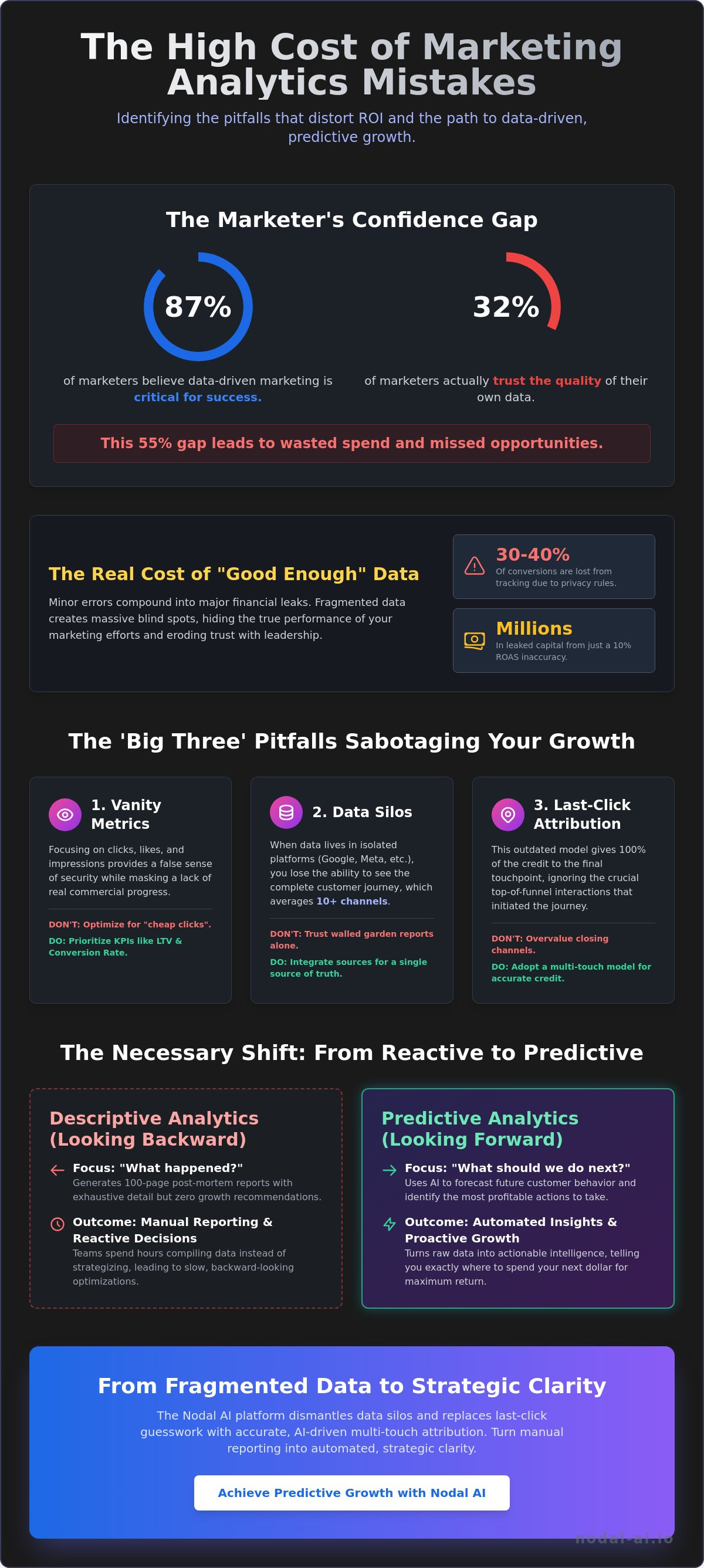
87% of marketers believe data-driven marketing is critical, but only 32% actually trust the quality of their own data. This massive confidence gap is fueled by common marketing analytics mistakes to avoid that turn strategic potential into expensive noise. You’re likely feeling the weight of fragmented data sources and the frustration of losing 30% to 40% of trackable conversions due to the latest privacy regulations.
It’s exhausting to pour hours into manual reporting only to find that inaccurate attribution is quietly draining your ad spend. You deserve better than a spreadsheet full of conflicting signals. This guide identifies the costly errors sabotaging your ROI and provides the roadmap to transition toward an AI-driven, predictive growth model. We’ll break down a framework for accurate multi-touch attribution, show you how to slash manual reporting time, and deliver the clear insights you need to justify your next budget increase.
Key Takeaways
- Shift your perspective from viewing analytics as a digital ledger to treating it as a high-performance engine for enterprise growth.
- Identify and dismantle the "hall of mirrors" created by vanity metrics, data silos, and attribution bias that distort your ROI.
- Move beyond descriptive post-mortems by adopting predictive modelling to forecast future customer behavior and channel performance.
- Implement a five-step data governance framework to integrate fragmented sources and eliminate the most common marketing analytics mistakes to avoid.
- Deploy the Nodal Platform to achieve accurate multi-touch attribution and turn manual reporting into automated, strategic clarity.
Beyond the Dashboard: The Real Cost of Marketing Analytics Mistakes
In 2026, marketing analytics is no longer a digital ledger used to record past events. It has transformed into a high-performance engine for growth. Despite this shift, many large enterprises remain trapped in a "data-rich but insight-poor" cycle. They collect billions of signals across fragmented platforms but lack the clarity to turn those signals into revenue. This disconnect is a primary driver of budget waste. When your analytical model is broken, every decision you make is based on a distorted reality.
Strategic clarity is the opposite of this fragmentation. It represents a state where every data point connects to a larger narrative of business health. Achieving this requires a sophisticated approach to customer analytics that accounts for the non-linear journeys modern buyers take. One of the most common marketing analytics mistakes to avoid is treating your dashboard as the final destination rather than a starting point for optimization. Minor errors in tracking or attribution don't just stay on the screen. They ripple through your entire organization, leading to misallocated resources and missed targets.
The Distinction Between Data and Actionable Intelligence
Most marketing teams suffer under the weight of 100-page reports that provide exhaustive detail but zero growth recommendations. Raw data is just noise without context. Actionable intelligence is the refined output that tells you exactly where to spend your next pound to trigger the highest return. It moves the conversation from "what happened?" to "what should we do next?". Actionable intelligence is data that triggers a specific, profitable business decision.
Why "Good Enough" Data is Costing You Millions
Falling into the trap of accepting "good enough" data is among the most common marketing analytics mistakes to avoid. A 10% inaccuracy in ROAS calculations might seem like a rounding error, but for an enterprise budget, it represents millions in leaked capital. Fragmented data sources create massive blind spots, hiding the true value of top-of-funnel interactions. This isn't just a technical problem; it's a leadership crisis. Messy data erodes the vital trust between marketing departments and the C-suite. If you can't provide a transparent, accurate account of how spend translates to growth, your ability to secure future budget increases disappears. High-fidelity data is the only foundation for high-velocity growth.
The 'Big Three' Strategic Pitfalls Sabotaging Your Growth
Performance marketers often find themselves trapped in a "hall of mirrors" where data reflects a distorted version of reality. This confusion isn't a result of too little information; it's the byproduct of specific strategic failures. Identifying these common marketing analytics mistakes to avoid acts as a cognitive upgrade for your entire department. It transforms your team from reactive reporters into proactive growth architects. By addressing these pitfalls, you align your strategy with the actual customer journey rather than a fragmented imitation of it.
Mistake 1: Prioritizing Vanity Metrics Over Commercial Value
Clicks, likes, and impressions feel good, but they don't pay the bills. These vanity metrics provide a false sense of security while masking a lack of genuine commercial progress. You must audit your current KPIs to ensure they correlate with business impact, such as conversion rates and long-term customer value (LTV). Optimizing for "cheap clicks" is a dangerous game. It often results in high traffic volume that never converts, effectively burning your budget for the sake of a prettier dashboard.
Mistake 2: Allowing Data Silos to Fragment the Customer View
Modern customers typically touch 10 or more channels before making a purchase. When your data lives in isolated silos, you lose the ability to see this cohesive path. Walled gardens like Meta and Google are designed to claim credit for every win, often leading to double-counting and inflated ROI claims. You need an independent, third-party view to reconcile these disparate sources. Facing marketing analytics strategy challenges head-on means dismantling these silos to reveal a single source of truth. If you're ready to bridge these gaps, exploring the Nodal Platform can provide the unified perspective you've been missing.
Mistake 3: Relying on Last-Click Attribution in a Multi-Touch World
Last-click attribution is the "original sin" of modern measurement. Relying on it is one of the most common marketing analytics mistakes to avoid because it ignores the complex reality of how people actually buy. Last-click attribution credits the goal-scorer while ignoring the players who made the assist. This model incentivizes you to over-invest in bottom-of-funnel tactics while starving the awareness campaigns that fueled the interest in the first place. Transitioning to sophisticated marketing attribution is essential for any brand that wants to scale profitably without guessing which half of their advertising is working.
Descriptive vs. Predictive: Why Looking Backward is a Forward-Facing Mistake
Driving a business solely on historical data is like navigating a motorway while staring only at the rearview mirror. You see exactly where you've been, but you're blind to the obstacles appearing through the windscreen. One of the most common marketing mistakes is treating analytics as a static archive of the past. While descriptive analytics tells you what happened last month, predictive modelling reveals what will happen next. This shift turns your data from a passive ledger into an active participant in your growth strategy. Modern enterprises must move beyond post-mortem reporting to maintain a competitive edge in volatile markets.
AI identifies subtle trends in raw data that human analysts often miss. It processes millions of signals in real time to find the profitable patterns hidden within the noise. By implementing Automated Reporting, you eliminate the manual labor that keeps your team trapped in spreadsheets. This transition doesn't just save time; it provides a cognitive upgrade for your entire organization. It replaces the anxiety of "what went wrong" with the confidence of knowing exactly where to pivot for maximum impact. Correcting these common marketing analytics mistakes to avoid ensures your strategy is always focused on future revenue rather than past errors.
The Limitations of Historical Reporting
Last month's performance is a poor predictor of next month's success. Relying on "reactive" marketing keeps you one step behind the consumer, forcing you to chase trends rather than set them. Historical data should serve as a foundation for future forecasts, not as the final word on your strategy. When you rely on backward-looking reports, you're always solving yesterday's problems. Shift your focus toward anticipating shifts in consumer behavior before they impact your bottom line.
The Rise of AI-Driven Growth Recommendations
AI transforms the "what" into the "why." It doesn't just report a drop in conversions; it identifies the root cause and suggests a fix. Modern platforms now offer Growth Recommendations that act as a strategic partner for your marketing team. You move from manual data processing to automated intelligence execution. This evolution allows you to spend less time questioning the data and more time acting on it. It’s the difference between having a map of where you were and a GPS for where you’re going.
Building a Resilient Data Governance Framework for 2026
Transitioning from data chaos to strategic clarity requires more than just better software. It demands a structured methodology. Fixing the common marketing analytics mistakes to avoid involves a deliberate shift from fragmented silos to a unified, resilient system. This five-step framework provides the roadmap to turn your analytics into a reliable engine for growth.
- Step 1: Audit and Integrate. Identify every fragmented data source and merge them into a single source of truth. This stops the "leakage" caused by conflicting reports.
- Step 2: Govern for Accuracy. Implement a data governance framework. High-fidelity data is the only foundation for AI-driven insights.
- Step 3: Map the Full Journey. Move beyond last-click models. Transition to multi-touch attribution (MTA) to see how every interaction contributes to the final conversion.
- Step 4: Automate the Mundane. Deploy automated reporting to eliminate human error. This frees your team from the spreadsheet grind and allows them to focus on high-level strategy.
- Step 5: Forecast the Future. Apply predictive modelling. Use your integrated data to anticipate customer needs and forecast channel performance before you commit your budget.
Ensuring Data Quality and GDPR Compliance
In 2026, accuracy is the non-negotiable prerequisite for marketing success. With the EU AI Act reaching full enforcement for high-risk systems, your data governance must be airtight. New state privacy laws in Indiana, Kentucky, and Rhode Island further complicate the landscape. You must prioritize first-party data collection. This strategy allows you to gain deep customer insights while staying compliant with strict regulations like the California Delete Act. Transparency isn't just a legal requirement. It's a competitive advantage that builds trust with your audience.
The ROI of Automated Intelligence
Many organizations suffer from a hidden "manual reporting tax." This is the cost of hundreds of hours spent by high-level talent on basic data collection rather than analysis. Automation changes the rhythm of your business. It allows for real-time optimization instead of waiting for monthly adjustments. When you have a single, unified view, every stakeholder stays aligned. The CFO sees the financial performance, the CMO sees the strategic growth, and the performance team sees exactly where to pivot. If you are ready to reclaim your time and eliminate the manual reporting tax, explore our automated reporting solutions today. This shift replaces the anxiety of messy data with the confidence of streamlined, actionable intelligence.
From Fragmented Data to Strategic Clarity with Nodal AI
Correcting the common marketing analytics mistakes to avoid is more than a process change. It requires a fundamental upgrade to your technical infrastructure. The Nodal Platform serves as the bridge between chaotic data inputs and high-value commercial outputs. For London enterprises navigating a landscape of shifting privacy laws and fragmented channels, Nodal AI provides the unified perspective necessary for survival. We transform your passive data assets into active participants in your growth engine.
Our solution targets the root causes of analytical failure. By deploying Multi-Touch Attribution, we reveal the hidden value in every customer interaction. We replace guesswork with Predictive Modelling, allowing you to forecast performance with surgical precision. Automated Reporting eliminates the manual labor that drains your team’s productivity, turning hours of spreadsheet work into seconds of strategic insight. This is how you move from a state of overwhelm to a state of total clarity.
Why Nodal AI is the Cognitive Upgrade for Your Team
Complexity is a weight that slows down decision-making. Nodal AI acts as a cognitive upgrade, lifting that burden and allowing your team to move faster than the market. You gain the relief that comes from knowing your data is accurate, compliant, and actionable. Our Growth Recommendations empower marketers to make profitable decisions with absolute confidence. Instead of reacting to yesterday's trends, you anticipate tomorrow's opportunities. This proactive stance is the ultimate competitive advantage. It turns your marketing department into a profit center that justifies every pound of investment through measurable, predictive returns.
Getting Started: Transforming Your Analytics Today
The journey to strategic clarity begins with a streamlined onboarding process. We start by integrating your fragmented data sources and mapping your unique customer journeys. Within the first 30 days of using AI marketing analytics, the fog of manual reporting begins to lift. You’ll see the "hall of mirrors" dissolve, replaced by a single source of truth that aligns the CFO, CMO, and performance teams. Stop letting common marketing analytics mistakes to avoid sabotage your ROI. Move from intuition to insight. Deploy Nodal AI and experience the confidence of data-driven growth. It's time to turn your fragmented data into your greatest strategic asset.
Master Your Data: The Path to Predictive Growth
The era of guesswork is over. You've seen how fragmented silos and backward-looking models drain your resources and erode executive trust. By implementing a resilient governance framework and embracing predictive modelling, you turn your analytics into a cognitive upgrade for your entire team. Identifying the common marketing analytics mistakes to avoid is merely the first step toward total clarity. The real transformation happens when you replace manual labor with automated intelligence that empowers every decision you make.
Trusted by London’s leading performance marketing teams, Nodal AI provides the visionary tools required for the privacy-first landscape of 2026. Our platform delivers AI-powered multi-touch attribution and automated reporting that saves your team 20+ hours per week. It’s time to stop chasing past data and start engineering future growth. You deserve the relief that comes from a streamlined, high-level perspective on your performance and a clear path to measurable returns.
Book a Nodal AI demo to transform your fragmented data into strategic clarity. You have the potential to lead your sector. Now you have the definitive tools to prove it.
Frequently Asked Questions
What is the most common mistake in marketing analytics?
The most frequent error is relying on siloed data that lacks a single source of truth. This is one of the most common marketing analytics mistakes to avoid because it leads to double-counting conversions and inflated ROI. When platforms like Google and Meta each claim the same sale, your budget decisions are based on a "hall of mirrors" rather than financial reality. Achieving strategic clarity requires integrating these disparate sources into a unified system.
How do I know if my marketing attribution is inaccurate?
Your attribution is likely inaccurate if the sum of conversions reported by your individual ad platforms exceeds the actual revenue in your bank account. This discrepancy usually occurs because of last-click models that ignore the 10 or more touchpoints a modern customer typically interacts with. If your digital reports don't align with your actual financial ledger, your measurement model is providing a distorted view of your performance.
Why are vanity metrics dangerous for long-term growth?
Vanity metrics like likes, clicks, and impressions provide an illusion of success without correlating to actual commercial value. Optimizing for these signals often leads to a high volume of "cheap clicks" that fail to convert into profitable customers. To achieve sustainable growth, you must shift your focus toward metrics that reflect real business impact, such as conversion rates and customer lifetime value (LTV).
Can AI marketing analytics help with GDPR compliance?
Yes, AI-driven platforms can automate data governance to ensure that first-party data collection remains compliant with evolving regulations like the EU AI Act and GDPR. These systems track data processing decisions and maintain transparency, which reduces the risk of legal penalties. By using AI to manage sensitive information, you protect your business assets while still gaining the deep customer insights needed for growth.
What is the difference between multi-touch attribution and last-click?
Last-click attribution credits only the final interaction before a sale, whereas multi-touch attribution (MTA) accounts for every touchpoint in the customer journey. Last-click ignores the vital "assists" from awareness campaigns, leading to poor budget allocation. MTA provides a holistic view, ensuring that top-of-funnel efforts are properly valued for their role in driving the final conversion. This shift is essential for scaling profitably in 2026.
How much time can automated reporting really save my team?
Automated reporting typically saves marketing teams 20 or more hours per week by eliminating manual data extraction and spreadsheet manipulation. This shift removes the "manual reporting tax" that keeps high-level talent occupied with tedious, low-value tasks. Instead of building reports, your team can spend their time acting on growth recommendations and refining high-level strategies that move the needle for your organization.
What are data silos and why do they happen in marketing?
Data silos are isolated pockets of information held by different platforms that don't communicate with each other. They happen because marketing tools are often implemented independently, creating fragmented views of the customer journey. Breaking these silos is essential to avoid common marketing analytics mistakes to avoid and to build a unified source of truth. Integration turns these passive data pockets into active participants in your business process.
How can predictive modelling improve my return on ad spend (ROAS)?
Predictive modelling improves ROAS by forecasting which channels and segments will deliver the highest future value. Unlike descriptive analytics that only looks at the past, predictive models identify trends and performance decay rates in real time. This allows you to proactively shift your budget toward high-performing opportunities before your competitors do, maximizing the efficiency of every pound spent on advertising.


