

Your marketing and sales alignment isn't failing because of a "culture clash" or poor communication. It's failing because your data architecture is fundamentally broken. You've likely sat through countless meetings where the CRM reports one reality and your marketing automation platform claims another. It's exhausting to defend lead quality when your budget feels like it's disappearing into unproven channels. You aren't alone in this struggle. In 2026, 75% of companies have shifted to multi-touch attribution to solve this exact problem. This guide will show you exactly how to align marketing and sales on reporting by building a single source of truth that both teams finally trust.
Stop the attribution wars and start focusing on growth. We'll show you how to replace fragmented data with a cohesive revenue engine that leverages predictive modelling to forecast outcomes with up to 96% accuracy. You'll learn to implement a unified dashboard that provides clear ROI on every dollar spent. We're moving beyond manual tracking and into a streamlined era of automated reporting. Let's transform your chaotic data into a high-value output that drives faster, more confident decision-making.
Key Takeaways
- Identify the hidden costs of the "Attribution Gap" and understand why traditional reporting models create internal friction between revenue teams.
- Discover exactly how to align marketing and sales on reporting by establishing a central data governance framework that eliminates fragmented silos.
- Implement multi-touch attribution to provide an objective view of the customer journey, ensuring both marketing awareness and sales execution receive proper credit.
- Execute a five-step audit to reveal "Dark Data" pockets and align your entire organization around one agreed-upon North Star Metric.
- Shift your strategy from reactive reporting to proactive growth using predictive modelling to forecast the revenue impact of every marketing dollar.
The High Cost of Fragmented Reporting in 2026
Fragmented reporting is the silent killer of the modern revenue engine. In most organizations, marketing claims credit for millions in generated pipeline while sales reports a fraction of that figure in closed deals. This discrepancy isn't just a rounding error; it's a fundamental misalignment of data architecture. When your systems don't talk to each other, you're left with a "reporting gap" that forces leaders to make high-stakes decisions based on guesswork. Understanding how to align marketing and sales on reporting starts with acknowledging that your current data silos are costing you more than just clarity. They're costing you capital.
The "Attribution Gap" creates a tug-of-war between departments. Sales teams typically favor last-click models because they highlight the final handshake. Marketing teams lean toward first-click models to justify the top-of-funnel awareness spend. This conflict results in a "Trust Tax." This is the collective time your best talent wastes in weekly meetings debating which spreadsheet is the "correct" one. In an era where 69% of customers will abandon a transaction due to data concerns, you cannot afford internal confusion. Transitioning from chaotic, manual inputs to high-value, automated outputs is no longer a luxury; it's a competitive necessity for survival in 2026.
The Psychological Impact of Data Silos
Conflicting data doesn't just break your reports; it breaks your culture. When teams operate from different playbooks, reporting becomes defensive. Marketers feel the need to "protect" their budget by over-reporting reach, while sales reps grow cynical about lead quality. You must replace this anxiety with the confidence of a unified perspective. By establishing a single source of truth, you shift the internal conversation from "Who is right?" to "How do we grow the business together?" This cognitive upgrade transforms your staff from data rivals into a cohesive revenue team.
Identifying the Revenue Leakage
Fragmented data leads to massive revenue leakage through double-counting or entirely missing key touchpoints. If your CRM and marketing automation tools aren't perfectly synced, you're likely overestimating the impact of some channels while ignoring others that actually drive conversions. This fragmentation makes accurate customer journey mapping impossible. Without a clear view of the path to purchase, your ad spend efficiency plummets. Organizations that fail to bridge this gap often see a significant drain on ROI, whereas those using integrated analytics see a 15-20% improvement in returns by eliminating these blind spots.
Building a Single Source of Truth for Revenue Teams
Stop treating software integrations as a cure-all. Many leaders believe that "syncing" their CRM and marketing automation platform is the final step in alignment. It's actually just a band-aid. Syncing without a unified logic simply accelerates the spread of fragmented data. If your marketing platform defines a "Lead" differently than your CRM, you aren't solving the problem. You're just automating the confusion. To master how to align marketing and sales on reporting, you must look past the surface-level integrations. Focus on your core data architecture instead.
A central data governance framework acts as the essential blueprint for this architecture. It ensures that every touchpoint is recorded, categorized, and valued according to the same set of rules. This transition requires moving beyond vanity metrics like MQLs toward Revenue-Generated leads. When you focus on the bottom line, both teams align their incentives around actual growth rather than departmental quotas. This is where AI provides a cognitive upgrade for the entire organization. It cleans, normalizes, and validates data across systems in real-time. It turns chaotic, manual inputs into high-value strategic assets that both teams can finally trust.
Standardizing the Data Vocabulary
Clarity starts with a shared language. You must establish universal definitions for every lifecycle stage, from initial lead to closed-won opportunity. If sales and marketing don't agree on what constitutes a Sales Qualified Lead (SQL), your reports will never match. Standardize your UTM and tracking parameters across every campaign to ensure consistency. Data normalization is the process of making disparate sources speak one language. This removes the ambiguity that leads to defensive reporting and wasted meeting time.
The Technology Infrastructure for Alignment
Your technology stack should follow a clear hierarchy. The CRM acts as the system of record for sales. Marketing automation handles the top-of-funnel engagement. However, these tools alone cannot resolve attribution conflicts or identify revenue leakage. The Nodal Platform serves as the neutral arbiter of truth. It sits above these systems to provide an objective, automated view of performance. By replacing manual data entry with automated ingestion, you remove human bias and ensure your reporting remains accurate. If you're ready to eliminate the guesswork, you can explore our automated reporting solutions to start unifying your revenue stream today.
Multi-Touch Attribution: The Arbiter of Marketing and Sales Peace
Attribution wars are a drain on your organization's energy. When marketing and sales fight over who "owns" a lead, the focus shifts from customer growth to departmental defense. To master how to align marketing and sales on reporting, you must move beyond binary credit models. Last-click models are inherently biased toward sales, while first-click models over-index on marketing's initial reach. Multi-touch attribution (MTA) provides the objective middle ground, validating the entire revenue chain from the first impression to the final signature.
Implementing advanced marketing attribution turns your reporting from a source of conflict into a source of strategy. It provides a fair credit framework that both VPs can sign off on, ensuring that every touchpoint is quantified. This transition moves your team from descriptive reporting, which merely looks at what happened, to prescriptive reporting, which tells you exactly what to do next. By 2026, 75% of companies have already adopted MTA to resolve these internal discrepancies and focus on unified growth.
Breaking the "Last-Click" Bias
Last-click reporting is a relic of a simpler, less fragmented era. In the complex B2B landscape, it inherently devalues marketing’s long-term contribution. Consider a prospect who engages with a LinkedIn ad six months before finally booking a demo through a direct search. Under a last-click model, marketing’s initial influence is invisible. A full-funnel view reveals this hidden value, proving that top-of-funnel spend is a catalyst for closed deals. By adopting this perspective, you build a culture of mutual respect where every team’s impact is visible and verified.
AI-Powered Attribution vs. Static Rules
Static rules like "U-Shaped" or "Time Decay" models are often too rigid for modern buyer behavior. They rely on arbitrary percentages that don't reflect the reality of your specific customer journey. This is where ai marketing analytics provide a significant cognitive upgrade. Instead of guessing, the algorithm assigns weight based on actual conversion probability. It identifies which touchpoints truly move the needle and which are merely noise. By letting the data find the truth, you remove human bias from the equation and finally end the internal debates over lead quality.
- Eliminate Bias: Shift from subjective opinions to objective, algorithm-driven data.
- Validate Every Stage: Give credit to the awareness ads that started the journey and the sales calls that ended it.
- Optimize Spend: Use prescriptive insights to reallocate budget to the channels that actually drive revenue.
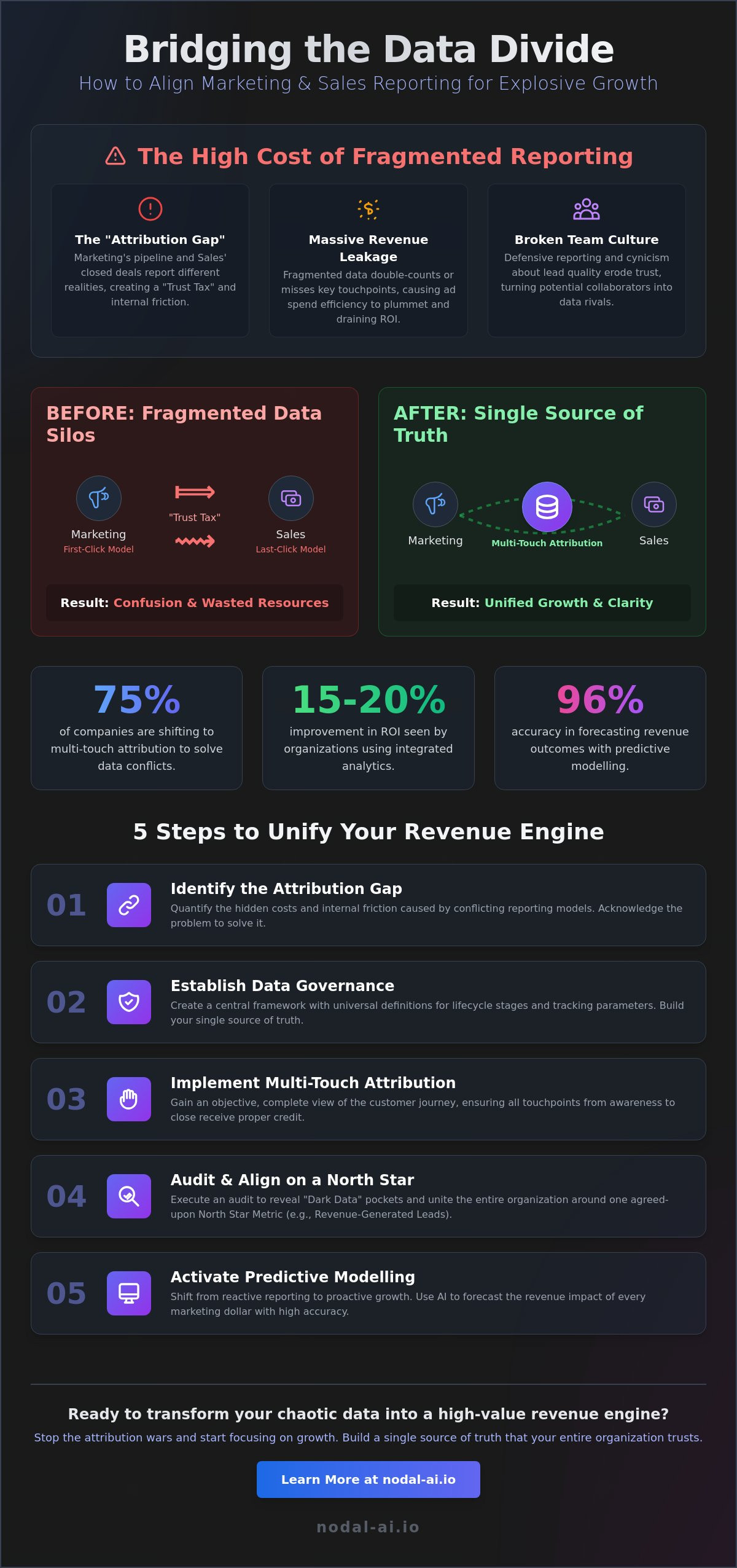
5 Steps to Align Your Reporting Strategy
Theory alone won't fix your revenue engine. You need a structured roadmap to move from fragmented silos to a unified growth perspective. This transition requires a blend of strategic leadership and technical precision. By following these five steps, you can finally solve the puzzle of how to align marketing and sales on reporting and turn your data into a competitive advantage. It is time to stop guessing and start executing with the confidence of an integrated data architecture.
Step 1 & 2: The Strategic Foundation
Begin with a comprehensive Data Truth Audit. This isn't a search for culprits; it's a search for "Dark Data." These are the untracked interactions, such as organic social touches, dark social shares, or indirect referrals, that currently skew your ROI. Identifying these pockets allows you to see the true customer journey without the blind spots that lead to wasted budget. Once the gaps are visible, you must define a North Star Metric. Move away from vanity lead counts and focus on Pipeline Contribution. This ensures both teams are incentivized by the same outcome: actual revenue. Remember, fragmented data is a leadership failure, not a technical one.
Step 3, 4 & 5: Technical Execution
Once your strategy is set, deploy the technology to support it. Implement a Multi-Touch Attribution layer directly over your existing CRM and marketing automation tools. This provides the objective data needed to settle attribution disputes before they reach the boardroom. To maintain this alignment, you must leverage automated reporting. This single move can save your team 20+ hours of manual spreadsheet work every month, replacing tedious labor with high-level analysis. Real-time dashboards ensure that marketing and sales are always looking at the same reality, at the same time.
Establish automated alerts to flag when data begins to diverge between systems. This allows you to catch technical glitches or tracking errors before they become cultural conflicts. Finally, institutionalize a monthly Revenue Review. This isn't a meeting to debate numbers; it's a session to optimize the future based on predictive insights. Use sales feedback on lead quality to refine your AI models, creating a feedback loop that makes your attribution increasingly accurate with every deal closed. If you're ready to stop the manual grind and start growing, unify your reporting with our automated platform today.
Future-Proofing Alignment with Predictive Modelling
Historical reporting tells you where you've been. Predictive insights tell you where you're going. Most organizations stay trapped in a reactive cycle, dissecting past failures instead of engineering future wins. Mastering how to align marketing and sales on reporting requires a fundamental shift in perspective. By integrating predictive modelling, you stop debating last month's numbers and start collaborating on next quarter's goals. This is the ultimate cognitive upgrade for your revenue team. It transforms passive data into an active roadmap for growth.
Predictive analytics doesn't just forecast revenue; it aligns departmental incentives. When both teams look at the same Growth Recommendations, budget planning becomes a shared strategic exercise rather than a battle for resources. You can finally answer the critical question: "What will happen if we increase spend by 20% in this specific channel?" This level of transparency removes the ambiguity that fuels internal friction. It replaces the anxiety of the unknown with the confidence of data-driven certainty. It positions your brand as a visionary leader that has mastered future-facing analytics.
Predicting the Pipeline with AI
The gap between marketing engagement and sales outreach is where potential revenue goes to die. AI closes this gap by identifying which current leads are most likely to convert within a specific window. Instead of sales reps digging through a mountain of cold MQLs, they receive a prioritized list based on actual conversion probability. Research shows that AI-driven predictive sales forecasting models can achieve accuracy rates as high as 85-96%. This is a massive leap from traditional methods that often hover between 50-70%. By aligning sales priority with marketing intelligence, you reduce the forecasting gap and accelerate your deal velocity.
The Final Transformation: From Silos to Revenue Unification
Your journey from chaotic inputs to high-value outputs is now complete. You've moved from the frustration of fragmented silos to the streamlined efficiency of revenue unification. The competitive advantage is clear. Teams that trust their data make decisions 10x faster than those stuck in the "Trust Tax" cycle. You no longer waste time in meetings debating whose report is correct. Instead, you spend that time optimizing the customer journey and scaling your most profitable channels. This is the power of a single source of truth. It's time to transform your fragmented data into actionable intelligence with Nodal AI and lead your organization into a new era of unified growth.
Mastering the Unified Revenue Engine
The era of defensive reporting is over. You've seen how fragmented data architecture creates a "Trust Tax" that stalls growth and erodes team culture. By implementing a central governance framework and adopting multi-touch attribution, you transform your passive data into an active participant in your business strategy. This isn't just about matching spreadsheets; it's about building a cognitive upgrade that empowers your entire organization.
When you master how to align marketing and sales on reporting, you replace manual grind with high-level perspective. Our London-based AI experts designed the Nodal Platform to handle the heavy lifting; it saves your team 20+ hours every week through automated reporting. You move from the anxiety of unproven channels to the confidence of clear, multi-touch attribution for enterprise growth.
Don't let another quarter slip away in the attribution wars. Take control of your revenue engine and start making decisions based on predictive certainty rather than historical guesswork. The path to a single source of truth is clear, and the results are measurable. Book a demo of the Nodal Platform and end the reporting wars today. You have the tools to turn complexity into a competitive advantage.
Frequently Asked Questions
What is the biggest obstacle to marketing and sales reporting alignment?
The primary barrier is the lack of a shared data architecture. When teams use siloed definitions for leads or opportunities, reporting remains fragmented and inconsistent. This gap forces leaders to waste time debating data accuracy instead of scaling growth. You must establish a unified governance framework to solve how to align marketing and sales on reporting effectively.
How does multi-touch attribution help align marketing and sales teams?
Multi-touch attribution acts as an objective arbiter by assigning value to every touchpoint across the customer journey. Traditional models favor one department over the other, which often creates internal conflict. This advanced model validates both marketing awareness efforts and sales execution. It ensures every team's contribution is visible and quantified within the revenue chain.
Can we align reporting if we use different tools for CRM and Marketing Automation?
You can certainly align reporting across different tools by implementing a neutral AI analytics layer. Syncing tools is often a band-aid; normalization is the actual cure. This layer sits above your disparate platforms to translate data into a single, cohesive language. It removes the technical hurdles that usually prevent a unified strategic perspective.
What metrics should marketing and sales report on together?
Revenue teams should focus on Pipeline Contribution and Revenue-Generated Leads rather than vanity metrics like lead counts. These metrics align incentives around actual financial performance. By reporting on shared outcomes, both departments prioritize lead quality and deal velocity. This shift turns reporting from a defensive task into a strategic growth driver.
How often should marketing and sales teams meet to review reports?
Teams should conduct a formal Revenue Review once per month to analyze long-term trends and adjust strategies. However, they must also have access to automated, real-time dashboards every day. Constant visibility prevents data divergence and ensures both teams are always operating from the same reality. Regular alignment reduces the friction of quarterly planning.
Is AI necessary for reporting alignment, or can we use spreadsheets?
Spreadsheets are a liability in 2026 due to manual errors and the high speed of data decay. AI provides a necessary cognitive upgrade by automating data ingestion and normalization in real-time. It also enables predictive modelling, which traditional spreadsheets cannot handle. Automated reporting saves over 20 hours of manual labor per week.
How do we handle "Dark Social" or untrackable touchpoints in our aligned reports?
Handling "Dark Social" requires advanced identity resolution and multi-touch models that look beyond simple UTM parameters. These systems correlate untracked engagement with specific account activity to provide a clearer picture. While no model captures every interaction, an AI-driven approach significantly reduces blind spots compared to traditional manual tracking methods.
What is the role of a "Single Source of Truth" in revenue growth?
A single source of truth acts as the foundation for scalable revenue growth. It eliminates the Trust Tax and allows for faster, more confident decision-making across the organization. When data is transparent and verified, teams stop protecting their budgets and start growing the business. This unified perspective is the ultimate competitive advantage.


