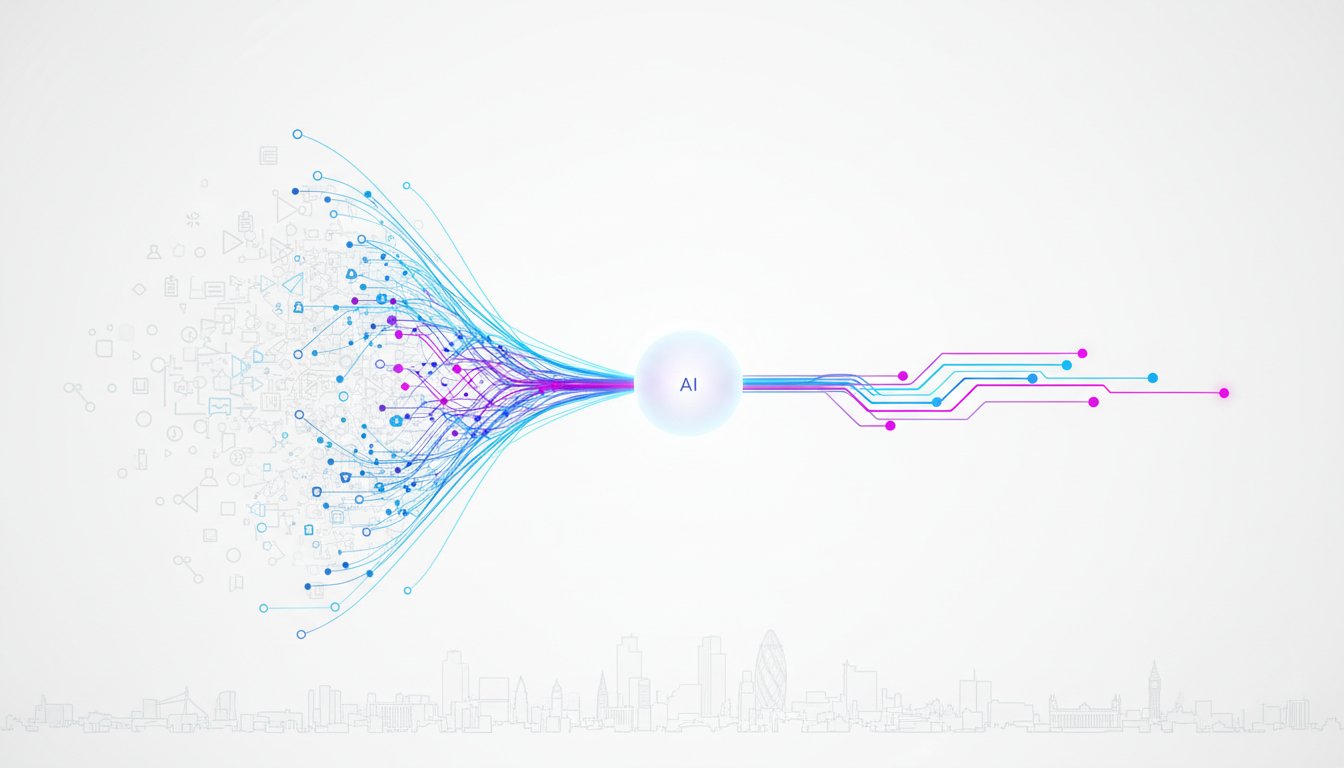
Why are 76% of consumers frustrated with their brand experiences when companies have more data than ever before? You already know the answer. You're likely buried under data silos and losing 3,000 hours a year to manual reporting that fails to show the true impact of your marketing. With new US privacy laws in Indiana and Kentucky effective as of January 1, 2026, the old ways of guessing are over. It's time to stop digging into spreadsheets and start building a personalized customer journey that actually converts.
This guide teaches you how to transform a fragmented data ecosystem into a unified engine for profitable decisions. You'll learn how to talk to your data to predict the next best touchpoint using agentic AI and real-time orchestration. We'll explore how to connect the dots between every interaction, moving from manual chaos to a seamless, AI-driven strategy that delivers proven ROI through multi-touch attribution.
Key Takeaways
- Move from static personas to dynamic, real-time individualization by evolving touchpoints based on live AI insights.
- Unify your fragmented data ecosystem using the "Connect the Dots" methodology to create a single customer ID across CRM, web, and social platforms.
- Apply predictive modelling to anticipate the next best action and build a personalized customer journey that eliminates user drop-offs.
- Replace misleading last-click metrics with multi-touch attribution to gain total clarity on which channels actually drive your growth.
- Transform complex data into automated growth recommendations on day one with a smarter partner designed for London-based enterprises.
What is a Personalised Customer Journey in 2026?
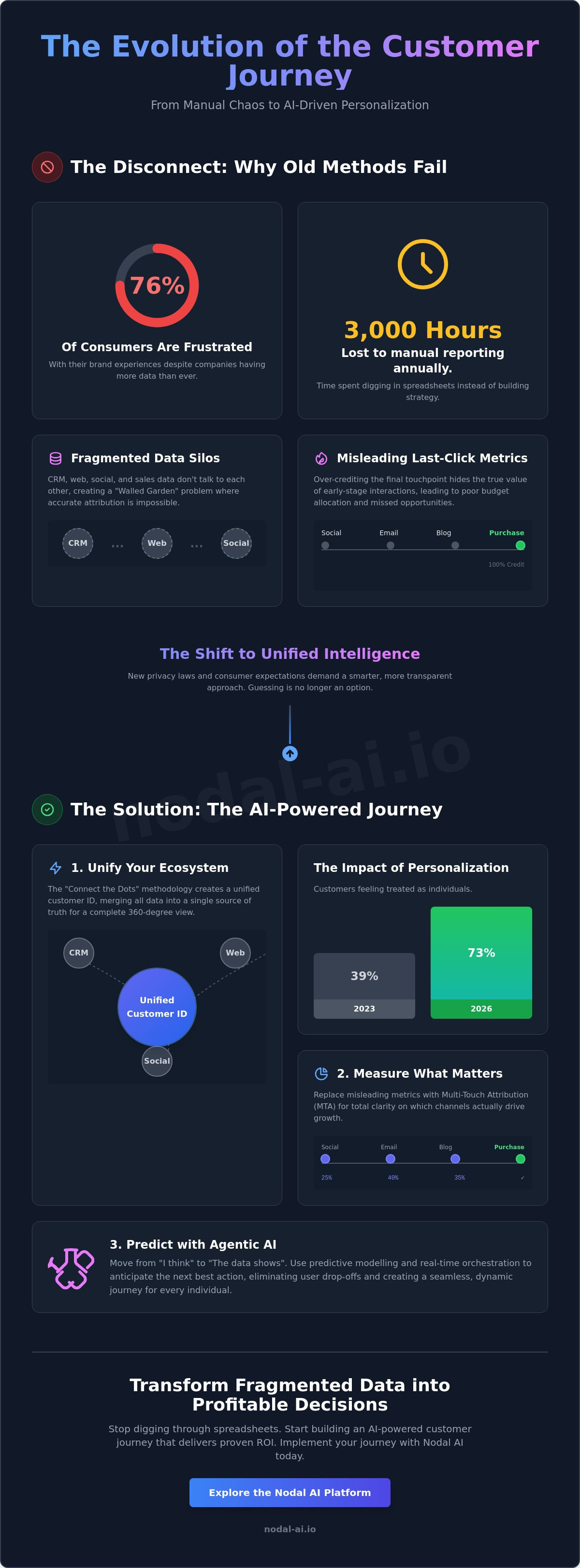
In 2026, a personalized customer journey isn't a pre-drawn map or a set of rigid marketing automation rules. It's a dynamic sequence of touchpoints that evolves in real-time based on live AI insights. Static personas are dead. Back in 2023, only 39% of customers felt brands treated them as individuals, but by May 2026, that number has climbed to 73%. This shift happened because businesses stopped reacting to yesterday's reports and started using predictive orchestration. Instead of losing 3,000 hours a year to manual data entry and fragmented reporting, growth teams now use AI to anticipate a user's next move before they even make it. This move from manual chaos to automated clarity is the only way to meet the 71% of consumers who now expect tailored experiences at every click.
The Core Elements of Modern Personalisation
Effective journeys require real-time data ingestion. If your data is 24 hours old, your journey is already broken. In 2026, 56% of brands use AI to personalize every single interaction, ensuring omnichannel consistency. Whether a customer is browsing on LinkedIn or reading a follow-up email, the message must feel like one continuous, intelligent conversation. This is where the Smarter Partner comes in. Moving from human intuition to AI-powered decisions allows you to scale without adding headcount. It replaces "I think" with "the data shows," providing the clarity needed to grow smarter. By 2025, AI was already handling 95% of customer interactions; today, the focus is on making those interactions feel human through deep context retention across every channel.
Why Fragmented Data is the #1 Growth Killer
Most companies struggle because their Facebook data doesn't talk to their CRM. This "Walled Garden" problem creates a fragmented data ecosystem where accurate attribution is impossible. Without a unified Customer Data Platform strategy, you're flying blind. The hidden costs of these data silos are staggering. Broken journeys lead to a 50% increase in customer acquisition costs and significantly lower retention rates. To fix this, Nodal AI helps you connect the dots across every platform. We turn disconnected metrics into a single source of truth, allowing you to build a personalized customer journey that drives measurable revenue rather than just vanity engagement. You don't need a PhD in data science to get results. You just need a system that turns fragmented data into profitable decisions.
Step 1: Unifying Your Fragmented Data Ecosystem
You can't build a personalized customer journey on a foundation of broken data. Most marketing teams struggle because their CRM, web analytics, social platforms, and offline sales data live in isolated silos. This fragmentation is why ROI often looks lower than it actually is. To fix this, you must adopt the "Connect the Dots" methodology. This involves creating a unified customer ID that follows a single user across every touchpoint, from their first LinkedIn click to their final purchase. By 2026, 80% of consumers are more likely to buy from companies that offer these tailored experiences, but you can only deliver them if you see the full picture.
Before you feed data into an AI engine, you must clean your historical records. Poor data quality leads to poor predictions. Establishing a data governance framework ensures that your insights remain accurate and actionable over the long term. This isn't just about technical hygiene; it's about strategic clarity. It turns a messy data ecosystem into a clean, profitable asset.
Breaking Down the Silos
Automating the ingestion process is the first step toward reclaiming your time. Manual data handling is a growth killer that wastes 20 hours or more of your team's week. In today's regulatory environment, including the California Generative AI Transparency Act (AB 2013) and new 30-day data breach notification rules effective as of January 2026, manual processes are also a major liability. A unified data environment allows for seamless compliance while verifying data integrity. If you're looking for a way to streamline this, you might want to explore how the Nodal platform automates data unification.
Research published by Forbes highlights that AI-powered personalization relies heavily on the ability to process diverse data types in real-time. Without this unification, your personalized customer journey will remain a collection of disjointed guesses rather than a predictive growth engine.
Talking to Your Data
Once your ecosystem is unified, you can finally talk to your data. Use natural language queries to ask complex questions, like "Where are users dropping off after the third email?" or "Which social channel leads to the highest retention?" This allows you to identify the "Golden Path," the specific sequence of events that most consistently leads to high-value conversions. Unified metrics are the single, standardized set of performance indicators that allow your entire organization to speak the same language and scale with confidence. This creates the momentum needed to move from fragmented data to profitable decisions.
Step 2: Mapping and Predicting the Journey with AI
Static journey maps are relics. They show you where your customers were, but they can't tell you where they're going. To build a personalized customer journey that actually scales, you must move from manual mapping to AI-powered journey analysis. While traditional methods focus on demographic segments, 2026 standards demand individualised paths. By applying predictive modelling, you stop reacting to historical failures and start anticipating the "Next Best Action" for every lead. This allows you to set up automated triggers based on deep intent signals, such as specific scroll depth or repeat visits to a high-intent page, rather than just simple clicks.
The goal is a total transition from "What happened?" to "What will happen next?" When you talk to your data, you discover exactly where users drop off and, more importantly, why. This clarity replaces the anxiety of guesswork with the confidence of actionable insights. 96% of companies now report that AI has significantly improved their personalisation ROI, proving that the move to predictive orchestration is no longer optional for growth-focused brands.
The 5-Step Execution Framework
Turning complex data into a seamless journey requires a structured approach. Follow these five steps to implement your model:
- Identify high-value conversion events: Define the specific actions that correlate most strongly with long-term revenue.
- Map the touchpoints: Account for the 5 to 12 touchpoints typically required for a B2B sale in 2026.
- Deploy AI for lookalike patterns: Use machine learning to identify new leads that mirror the behaviour of your best customers.
- Automate the intervention: Trigger a personalised email or a targeted ad the moment a high-value lead stalls in the funnel.
- Refine the model: Use continuous feedback loops to improve the ai customer journey based on real-world performance data.
Growth Recommendations: The AI Advantage
AI finds the "hidden" touchpoints that human analysts often miss. Often, the most influential interaction isn't the final click; it's a middle-funnel touchpoint that built trust weeks earlier. Moving from reactive reporting to automated growth recommendations allows you to shift budget to the channels that actually drive value. This eliminates the "Walled Garden" problem mentioned earlier, as the AI looks across your entire ecosystem to find profitable patterns. Automated media planning then uses these insights to optimize spend in real-time, ensuring your personalized customer journey remains both efficient and sustainable. You aren't just tracking a journey; you're orchestrating a cognitive upgrade for your entire marketing strategy.
Measuring Success: Multi-Touch Attribution (MTA)
Last-click attribution is the enemy of a personalized customer journey. It’s a narrow view that ignores the 5 to 12 touchpoints your customers actually take before converting. If you only give credit to the final interaction, you'll likely stop investing in the top-of-funnel content that actually builds trust. In 2026, where 76% of consumers feel frustrated by generic experiences, failing to measure the impact of early-stage personalization is a recipe for stagnation. Multi-touch attribution gives credit where it's actually due, allowing you to see how a specific LinkedIn post or a personalized email sequence contributed to the final sale weeks later.
Calculating the true ROI of your strategy requires moving beyond surface-level metrics. By leveraging ai marketing analytics, you can justify ad spend increases with hard data rather than gut feelings. This level of clarity is essential as the EU AI Act moves into its next implementation phase in August 2026, demanding higher transparency in how high-risk AI systems influence consumer behavior. You need to know exactly which levers are driving growth to remain both compliant and profitable.
MTA vs. Traditional Models
Choosing the right model depends on your specific sales cycle. While linear models spread credit equally, time-decay models favor interactions closer to the conversion. However, data-driven attribution is the modern standard. It uses your unified data ecosystem to identify "assisting" channels that don't get the final click but are vital for momentum. This approach effectively solves the "Walled Garden" attribution gap by using predictive engines to connect the dots across platforms like Meta and Google. It turns fragmented signals into a clear, actionable story of how your personalized customer journey is performing in real-time.
Scaling What Works
Attribution data is only valuable if it leads to profitable decisions. Once you identify which touchpoints are driving revenue, you can cut the "wasteful" spend that doesn't contribute to the journey. This isn't just about saving money; it's about reallocating resources to the "Golden Path" that maximizes retention. In 2026, incrementality is the gold standard for ROI because it measures the literal lift your marketing provides over a baseline of zero activity. To start seeing these insights today, you can get a custom multi-touch attribution report and stop guessing where your next customer is coming from.
Grow Smarter: Implementing Your Journey with Nodal AI
Transforming complex data into profitable decisions shouldn't take months of development. Nodal AI is the Smarter Partner for London-based enterprises that need to move fast. While your competitors are still digging into spreadsheets, you can move from fragmented data to growth recommendations on Day 1. Our platform is built to solve the specific pains of the modern marketer, replacing the anxiety of inaccurate attribution with the confidence of actionable insights. You don't just get a tool; you get a cognitive upgrade for your entire business.
The Nodal advantage lies in the integration of multi-touch attribution and predictive modelling within a single, unified interface. This combination allows you to build a personalized customer journey that isn't just a map of the past, but a forecast of the future. By connecting the dots between every touchpoint, you gain a unified view of the customer that traditional analytics tools simply can't provide. This is how you reclaim the 3,000 hours a year typically lost to manual reporting and redirect that energy toward sustainable growth.
The Nodal Platform Experience
Getting started is a streamlined process designed for efficiency. We provide seamless integrations with your existing MarTech stack, ensuring that your CRM and social data flow into a secure, unified environment. As the EU AI Act enters its next implementation phase in August 2026, our enterprise-level encryption and secure data processing ensure you remain ahead of the compliance curve. Our dedicated onboarding team works with you to map complex, multi-channel journeys, ensuring your unified metrics are set up correctly from the start. We turn the underlying complexity of your data ecosystem into a frictionless user experience.
Your Next Steps to Clarity
Clarity is a choice. You can continue navigating the "Walled Garden" problem alone, or you can start making smarter decisions today. The transition from manual chaos to automated growth happens in three simple steps: integrate your sources, talk to your data, and scale what works. This approach ensures that your personalized customer journey remains profitable and predictive as consumer expectations continue to rise through 2026.
- Book a discovery call: See your data "dots" connected in a live environment.
- Audit your attribution: Identify the hidden revenue leaks in your current model.
- Connect your stack: Move from fragmented signals to a single source of truth.
Talk to your data today with Nodal AI. Stop guessing and start growing with the platform that turns data into your most active business participant.
Connect the Dots to Profitable Growth
The shift from fragmented data to profitable decisions is the defining challenge for modern marketers. By 2026, building a personalized customer journey requires more than just a CRM; it demands an AI-powered engine that predicts intent and orchestrates touchpoints in real-time. You've learned that unifying your data ecosystem and adopting multi-touch attribution are the first steps to eliminating the 3,000 hours a year lost to manual data analysis. This transformation replaces the anxiety of spreadsheets with the confidence of actionable insights.
By using enterprise-level encryption and built-in predictive modelling, you protect your business while driving measurable growth. Nodal AI acts as your Smarter Partner, ensuring your marketing spend is never a gamble. Stop fighting with silos and start talking to your data to find the "Golden Path" to conversion. The infrastructure for sustainable growth is ready for you to plug in and scale with total clarity.
Connect your fragmented data and start growing smarter with Nodal AI
The future of business intelligence is here. Take the first step toward total clarity today and watch your sustainable growth accelerate.
Frequently Asked Questions
What is the difference between a customer journey and a personalized customer journey?
A standard customer journey is a static map of hypothetical steps, while a personalized customer journey is a dynamic sequence that adapts in real-time to individual behavior. In 2026, 71% of consumers expect these tailored experiences. Static maps focus on averages, but personalization uses AI to treat every user as a unique individual based on their specific intent signals and past interactions.
How does AI improve customer journey mapping?
AI replaces manual guesswork with predictive modeling to identify the "Golden Path" to conversion. It analyzes millions of data points to find hidden touchpoints that human analysts often miss. This allows you to transition from reactive reporting to proactive orchestration, ensuring you intervene at the exact moment a lead might stall in your funnel. It turns a passive map into an active growth engine.
Can Nodal AI integrate with my existing CRM and ad platforms?
Yes, the Nodal platform provides seamless integrations with your existing CRM, web analytics, and major ad platforms like Meta and Google. It's specifically designed to solve the "Walled Garden" problem that keeps your data siloed. By connecting these disparate dots, you create a single source of truth that eliminates the 3,000 hours a year typically lost to manual data aggregation and reporting.
How long does it take to see results from a personalised customer journey strategy?
You gain instant clarity and automated growth recommendations on Day 1 of integrating your data sources. While measurable revenue lifts from a personalized customer journey typically materialize within the first 30 to 60 days, the relief of seeing your unified metrics happens immediately. This fast-paced transition ensures you move from fragmented data to profitable decisions without the usual technical hurdles or delays.
Why is multi-touch attribution necessary for personalisation?
Multi-touch attribution is vital because last-click models ignore the 5 to 12 touchpoints usually required for a modern B2B or high-value B2C sale. Without MTA, you can't see the true ROI of your early-stage personalized content. It allows you to justify ad spend by proving exactly which interactions built the trust necessary for the final conversion, rather than just crediting the last link clicked.
Is AI-driven personalisation compliant with UK GDPR?
AI-driven personalization is fully compliant when built on a foundation of secure data and transparent processing. Nodal AI uses enterprise-level encryption and aligns with the 2026 shift toward legally enforceable governance frameworks like the EU AI Act. We ensure your data handling meets the strict 30-day breach notification requirements and mandatory cybersecurity audits effective as of January 1, 2026.
Do I need a data science team to use Nodal AI for journey mapping?
You don't need a PhD in data science or a dedicated internal team to use Nodal AI effectively. The platform is built for marketers and business owners who need actionable results, not complex code. It acts as your Smarter Partner, handling technical complexity so you can focus on making profitable decisions. If you want to boost your personal technical skills, you can check out Achieve With Nate for digital confidence coaching that empowers individuals to navigate the digital world with ease.
What is the 'Next Best Action' in marketing automation?
The "Next Best Action" is a predictive strategy that uses AI to determine the most effective touchpoint for a specific user at a specific time. Instead of sending generic follow-ups, the system triggers a tailored intervention based on real-time intent signals. This ensures every interaction adds value and moves the customer closer to a purchase by anticipating their needs before they even express them.


