

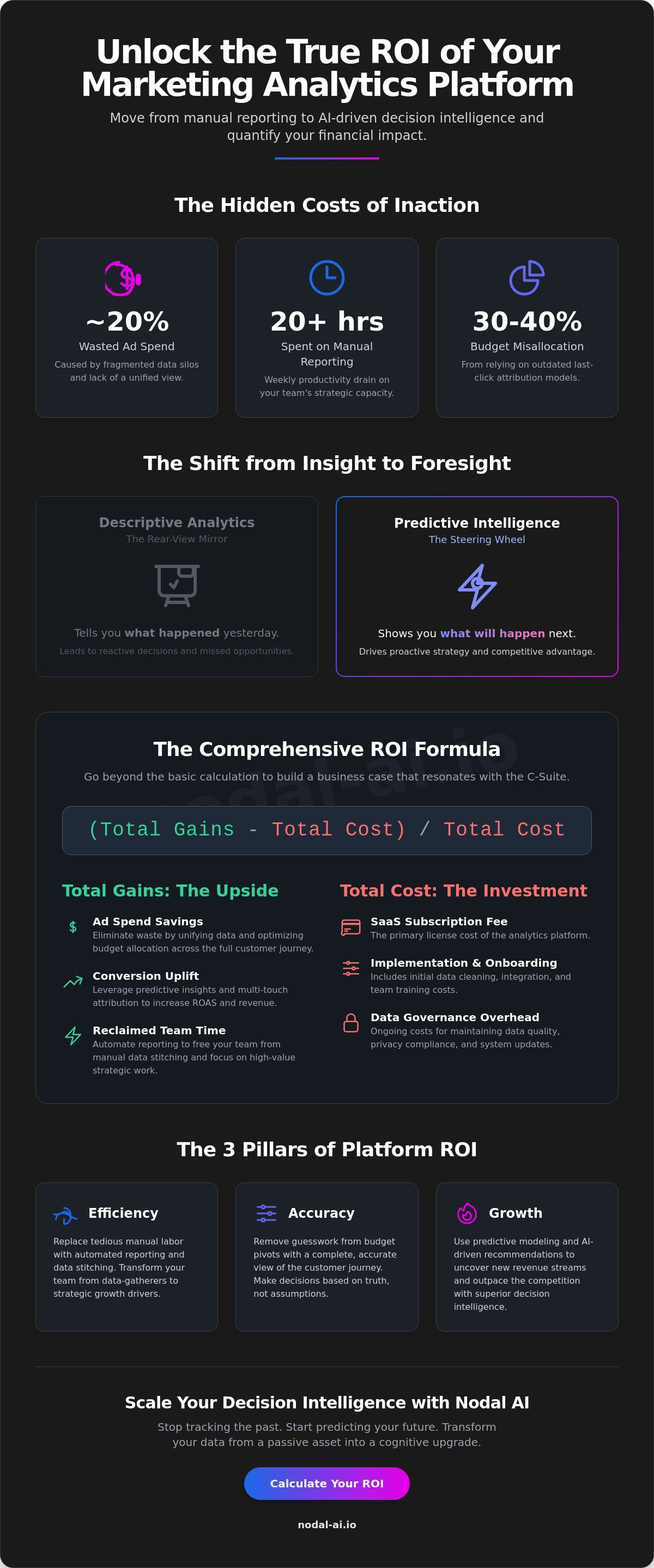
What if the 20 hours your team spends on manual reporting every week isn't just a productivity drain, but a direct leak in your bottom line? You already know that fragmented data silos cause roughly 20% waste in ad spend; yet explaining the value of 'data clarity' to a non-technical CFO remains a constant struggle. Mastering how to calculate roi of marketing analytics platform investments is the only way to bridge this gap. Stop tracking past performance. Start quantifying the financial impact of AI-driven decision intelligence.
You deserve a tech stack that pays for itself through precision rather than just dashboards. We'll show you how to master the precise formulas and strategic frameworks needed to secure faster approval cycles. This guide delivers a clear ROI formula for analytics platforms and a persuasive framework for board-level proposals. Learn to replace manual labor with automated reporting and predictive modelling. Transform your data from a passive asset into a cognitive upgrade for the entire organization and move from chaotic inputs to high-value outputs with confidence.
Key Takeaways
- Move beyond basic visibility by mastering how to calculate roi of marketing analytics platform investments through a formula that tracks ad spend savings and conversion uplift.
- Shift your perspective from tracking what happened to predicting what will happen by adopting AI-driven predictive intelligence over descriptive analytics.
- Quantify the "invisible" financial impact of automated reporting by measuring the time-to-insight metric and the elimination of manual data stitching.
- Construct a persuasive board-level proposal by conducting a pre-investment data audit and defining North Star KPIs that link directly to revenue.
- Turn your marketing team into a high-performance growth engine by utilizing automated recommendations and multi-touch attribution to drive 10x returns.
Beyond Last-Click: Redefining ROI for Marketing Analytics Platforms
In 2026, simply seeing your data is a commodity. If your platform only tells you what happened yesterday, it acts as a rear-view mirror rather than a steering wheel. Most strategic leaders fall into the "Commodity Trap" by equating visibility with value. True ROI comes from transforming chaotic inputs into high-value outputs. Mastering Return on marketing investment (ROMI) requires a fundamental shift from descriptive analytics to predictive intelligence. You aren't just buying a dashboard; you're investing in the ability to see what will happen next.
Fragmented data silos are more than a technical nuisance. They cost enterprises an average of 20% in wasted ad spend. This financial leak occurs when teams can't see the full picture, leading to redundant targeting and missed opportunities. When you evaluate how to calculate roi of marketing analytics platform investments, you must start by quantifying this recovered capital. A platform that unifies these silos pays for itself by instantly plugging these leaks.
The three pillars of platform ROI are Efficiency, Accuracy, and Growth. Efficiency replaces manual labor with automated reporting. Accuracy removes the guesswork from budget pivots. Growth uses predictive modelling to find new revenue streams. Together, these pillars move your team from being data-gatherers to being strategic growth drivers.
The Death of Last-Click Attribution in ROI Calculations
Last-click modelling is a relic that leads to a 30-40% misallocation of marketing budgets. It ignores the complex "dark funnel" where the majority of the customer journey takes place. Relying on this outdated method means you're likely overfunding the wrong channels. By mastering marketing attribution, you link every touchpoint to real revenue. This accuracy is the foundation of how to calculate roi of marketing analytics platform success, turning attribution into a direct driver of bottom-line profitability.
Selling Decision Intelligence to the C-Suite
CMOs and CFOs don't need more charts. They need the psychological relief that comes from total clarity. Stop selling "more data" and start selling "faster, better decisions." Position your platform as a cognitive upgrade for the entire organization. It transforms your team's output from tedious spreadsheets to high-level strategic insights. This shift reduces the anxiety of manual tasks and replaces it with the confidence of streamlined, high-level perspectives. You're offering a way to outpace the competition through superior decision intelligence.
The Comprehensive Formula for Marketing Analytics ROI
The standard math for how to calculate roi of marketing analytics platform success is straightforward. You take your total gains, subtract the platform cost, and divide by that cost. However, a strategic leader in 2026 knows that "Gains" is a multi-dimensional metric. It's the sum of ad spend savings from eliminated waste, the conversion uplift from predictive insights, and the massive amount of team time reclaimed from manual labor. When you stop losing 20 hours a week to reporting, you're not just saving time; you're buying back your team's strategic capacity.
Costs must be equally comprehensive to survive a CFO's scrutiny. Don't just list the SaaS subscription fee. Factor in onboarding, initial data cleaning, and the ongoing data governance overhead required by 2026's stricter privacy regulations. To truly justify the spend, move toward an "Incremental ROI" approach. This method isolates the specific revenue growth that wouldn't have happened without the platform's intervention. It transforms the conversation from "what does this cost" to "what is the cost of not having this intelligence."
Quantifying the 'Growth Gap'
Revenue often vanishes into the cracks of an inefficient customer journey. Identifying these gaps is the first step toward reclaiming lost profit. For example, a mere 5% increase in ROAS through better budget allocation can result in a massive bottom-line shift for enterprise-level spenders. Your current data architecture likely suffers from fragmented silos that trap insights and trigger a 20% waste in total ad spend. Closing this gap is the fastest path to a positive ROI.
The Multi-Touch Attribution Uplift
Standard ROAS calculations are often misleading because they over-credit the final touchpoint. To get an accurate picture, you need to compare standard metrics against MTA-adjusted ROAS. The Nodal Platform acts as the engine for this adjustment, providing the clarity needed to stop overfunding low-impact channels. While some benefits are instant, plan for a "90-day predictive window" to see the full impact of AI-driven optimizations. This period allows the predictive modelling to learn your unique market dynamics and deliver peak performance. If you're ready to start, evaluate your current attribution model to find immediate savings.
The Invisible ROI: Efficiency, Accuracy, and Data Governance
Direct revenue growth is the most visible metric, but it only tells half the story. To understand how to calculate roi of marketing analytics platform investments fully, you must look at the structural efficiency gained by your organization. The "Time-to-Insight" metric is a powerful indicator of this value. It represents the transformation from manual data stitching, which often takes days, into real-time visibility that takes seconds. This speed allows your team to pivot budgets based on current reality rather than stale reports from last week. You aren't just buying software; you're buying the ability to act before your competitors do.
Human bias often leads to expensive budget misallocations during high-pressure pivots. Integrating ai marketing analytics removes this emotional friction. It replaces gut feelings with objective, data-backed growth recommendations. This predictive accuracy provides the financial value of knowing where to deploy next month’s budget today. In a post-cookie landscape, having this level of precision isn't just an advantage; it's a requirement for survival. By removing the guesswork, you stabilize your marketing performance and ensure long-term stability.
Reclaiming the 20-Hour Work Week
Stop paying high-level strategists to clean spreadsheets. Manual reporting often consumes over 20 hours of team time per week, creating a massive drain on your most expensive resources. Calculate the cost savings of replacing these broken data exports with automated reporting. This "Relief Factor" is more than just a convenience. It allows your talent to focus on high-level strategy and creative optimization. You're effectively buying back half a work week for your entire marketing department, transforming them from data-entry clerks into strategic partners who drive actual value.
Protecting Assets with Data Governance
Data integrity is the prerequisite for any successful AI implementation. Without a robust data governance framework, your analytics are built on shifting sand. As of January 1, 2026, new CCPA regulations require mandatory risk assessments for businesses processing large-scale data. A platform that automates this compliance protects you from catastrophic fines and data loss. Treat clean data as a long-term corporate asset rather than a temporary campaign byproduct. By securing your data pipeline, you protect your organization’s future while building a foundation for scalable, automated growth.
Step-by-Step: Building Your ROI Business Case
Secure your budget by building a bulletproof business case that speaks the language of the C-suite. Boardroom skepticism often stems from a lack of concrete financial projections. To understand how to calculate roi of marketing analytics platform investments, you must follow a structured journey from initial audit to long-term projection. This process replaces uncertainty with the confidence of a data-backed roadmap, turning a potential cost into an inevitable profit engine.
- Step 1: Conduct a pre-investment data audit. Locate where your data is trapped. Identifying these hidden silos is the only way to reveal the true scale of your current operational inefficiencies.
- Step 2: Define North Star KPIs. Stop reporting on vanity metrics like clicks or impressions. Link your analytics directly to revenue-based KPIs that your CFO actually cares about.
- Step 3: Model the 'Cost of Inaction.' Quantify the 20% waste factor currently draining your ad spend. This is the financial penalty your organization pays every day you delay data unification.
- Step 4: Pilot a predictive modelling test. Use a specific subset of data to forecast future uplift. Proving small wins early makes the larger enterprise investment feel like a logical next step.
- Step 5: Present tiered ROI scenarios. Offer Conservative, Expected, and Aggressive outcomes. This level of transparency builds trust and demonstrates that you've mastered the risk-reward balance.
Identifying Data Silos
Ask yourself: Where is our fragmented data currently leaking value? Most organizations struggle because their CRM, Ad, and Web data live in separate, disconnected worlds. This fragmentation obscures the impact of "Dark Social," making your current ROI reports incomplete and misleading. Unifying these streams turns passive data into an active participant in your growth strategy. It provides the relief of total clarity and ensures every pound spent is accounted for. If you're ready to see the full picture, book a demo of the Nodal Platform to uncover your hidden growth opportunities.
Managing Implementation Expectations
A successful business case manages the journey, not just the destination. Phase your project clearly from the initial onboarding to the "First Insight" milestone. Don't overlook the importance of historical data ingestion. It's the secret sauce that fuels predictive accuracy and allows the platform to learn from your past performance. Establish a clear 12-month ROI roadmap for your stakeholders. This timeline ensures everyone understands that while some efficiency wins are immediate, the true cognitive upgrade happens as the system matures. You're building a foundation for long-term stability and measurable, compounding returns.
Scaling Decision Intelligence with Nodal AI
Scaling decision intelligence requires more than just a formula; it requires an engine that turns insights into action. Nodal AI serves as this engine, driving exponential marketing returns by automating the complex processes that typically stall growth. Mastering how to calculate roi of marketing analytics platform performance is only the beginning. Now, it's time to build. Our platform transforms your team's output from manual data management to high-level strategic execution. You aren't just calculating value; you're creating it.
Automating growth recommendations makes your team indispensable. Instead of presenting raw spreadsheets, they present profitable pathways. This shift from manual labor to automated reporting secures your position as a strategic leader. For London-based marketing leaders, joining the Nodal partner network offers a unique opportunity to collaborate with visionary peers who prioritize data integrity. Total clarity isn't just a metric; it's the ultimate retention tool. Whether you're an agency proving value to a client or an in-house team defending a budget, transparency eliminates the ambiguity that leads to churn. With 73% of CMOs planning to increase their analytics spending in 2026, the competitive advantage belongs to those who can prove their impact with precision.
Leveraging the Nodal Insights Engine
Use multi-touch attribution to justify every pound of ad spend with surgical precision. By identifying the exact touchpoints that drive conversion, you can eliminate the 20% waste often found in fragmented silos. Present AI-generated growth recommendations as strategic outputs that guide the organization toward long-term stability. This level of insight reduces client churn by providing a perspective they simply can't find elsewhere. You're no longer just a service provider; you're a cognitive upgrade for their entire business model.
Your Next Steps to Strategic ROI
The transition from chaotic inputs to high-value outputs is a structured journey. Start by downloading our ROI Calculation Template for CMOs to simplify your board-level proposals. To see the power of predictive modelling in action, book a demo of the Nodal Platform and discover how we turn passive data into active growth. Don't let fragmented data dictate your future. Transform your marketing ROI with Nodal AI today and replace the anxiety of manual tasks with the confidence of streamlined, high-level perspectives.
Master Your Strategic Advantage Through Total Clarity
You've moved beyond the commodity trap of mere visibility. By mastering how to calculate roi of marketing analytics platform investments, you've transformed fragmented data into a cognitive upgrade for your entire organisation. You now have the framework to eliminate the 20% waste in ad spend and reclaim 20 hours of manual labor every week. These aren't just savings; they're the building blocks of a high-performance culture that prioritizes precision over gut feelings. You've replaced the anxiety of manual reporting with the confidence of automated intelligence.
Our platform provides the AI-powered multi-touch attribution and predictive growth recommendations needed to stay competitive in 2026. Supported by London-based expert support, we ensure your data governance remains bulletproof while your revenue scales. It's time to turn your passive assets into active participants in your growth strategy. Stop tracking what happened and start deciding what happens next.
Scale your organisation's intelligence with the Nodal Platform
Step into a future of streamlined efficiency and measurable returns. Your roadmap to total clarity starts today.
Frequently Asked Questions
What is the average ROI for a marketing analytics platform?
Data-driven marketing decisions typically result in a 5x return on investment according to industry research. This gain stems from a combination of reclaimed team time and the elimination of the 20% waste factor common in fragmented ad spend. While initial results depend on your data maturity, most strategic leaders see the platform pay for itself within the first 90 days by identifying immediate budget misallocations.
How do I calculate ROI if my sales cycle is longer than 6 months?
Focus on leading indicators and customer journey mapping to bridge the gap in long sales cycles. Instead of waiting for final revenue, track micro-conversions and pipeline velocity improvements that correlate with long-term growth. Use predictive modelling to forecast the eventual value of early-stage leads. This approach allows you to quantify the platform's impact on your future revenue before the final sale actually closes.
What is the difference between ROAS and Marketing ROI?
ROAS measures the revenue generated for every pound spent on advertising, while Marketing ROI accounts for your total investment, including platform fees and team overhead. ROAS is a tactical campaign metric; ROI is a strategic business metric. Understanding how to calculate roi of marketing analytics platform success requires looking at the total cost of ownership compared to the bottom-line profit generated across all channels.
Can I calculate ROI using only Google Analytics 4?
GA4 provides basic visibility but often lacks the multi-touch attribution and CRM integration needed for a comprehensive ROI calculation. It struggles to track the "dark funnel" and complex customer journeys that occur across multiple devices and platforms. For a persuasive board-level proposal, you need a system that unifies disparate data sources into a single source of truth. Relying solely on GA4 often leaves significant revenue gaps unaddressed.
How much should we spend on a marketing analytics platform relative to ad spend?
Most enterprise organizations allocate between 2% and 10% of their total marketing budget to analytics and data infrastructure. This investment acts as a cognitive upgrade that optimizes the remaining 90% of your spend. If your ad budget is substantial, the platform cost is easily offset by the efficiency gains of automated reporting and the reduction in manual data stitching hours.
What are the most important KPIs to include in an ROI proposal?
Prioritize North Star KPIs like Customer Acquisition Cost (CAC) reduction, Time-to-Insight acceleration, and ROAS uplift. Avoid vanity metrics such as clicks or impressions that don't link directly to revenue. Your proposal should highlight how automated reporting reclaims team time and how predictive modelling identifies new growth opportunities. These metrics demonstrate a clear path from technical implementation to financial performance and long-term stability.
How does AI improve the ROI of marketing analytics?
AI enhances ROI by automating complex data transformations and delivering proactive growth recommendations. It removes human bias from expensive budget pivots and identifies patterns in the customer journey that manual analysis misses. By shifting from descriptive to predictive intelligence, AI allows you to optimize your spend in real-time. This shift replaces the anxiety of manual tasks with the confidence of streamlined, high-level perspectives.
How do I explain multi-touch attribution to a non-technical stakeholder?
Describe multi-touch attribution as a way to give credit to every player on the team instead of just the person who scored the final goal. It reveals the true value of early-stage brand awareness and mid-funnel engagement that eventually lead to the sale. This transparency prevents you from cutting budgets for channels that are actually driving your long-term growth. It turns your marketing spend into a documented, high-value output.


