

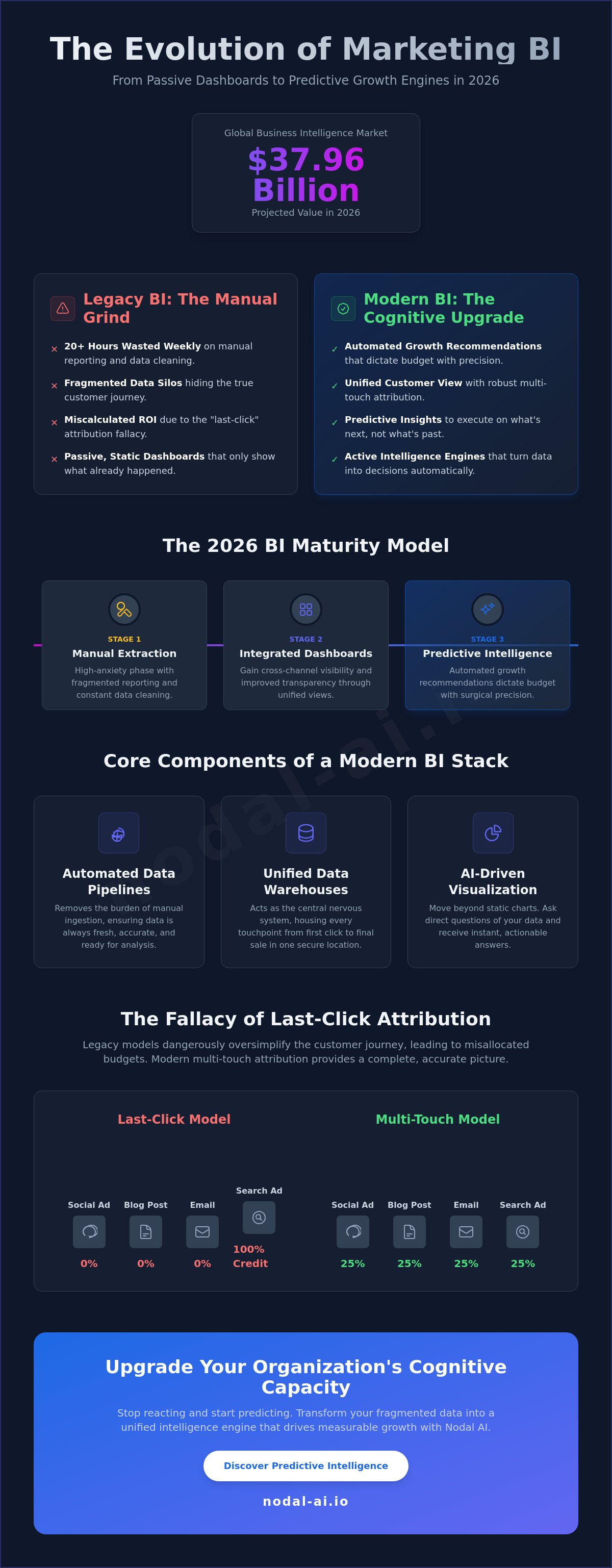
What if your data stopped being a passive asset and started acting as your most aggressive growth partner? With the global business intelligence market hitting $37.96 billion in 2026, it's clear that leading enterprises are no longer settling for static dashboards. You're likely exhausted by the manual reporting grind that steals over 20 hours from your work week. You're likely even more anxious about miscalculated ROI while your customer journey remains hidden behind fragmented silos. Now that third-party cookies are deprecated, legacy marketing business intelligence tools are no longer enough to stay competitive. You need a system that resolves complexity into high-value, predictive execution.
We understand the frustration of trying to find clarity in a sea of disconnected metrics. This article promises to show you how to transform those chaotic inputs into predictive insights that dictate your budget allocation with surgical precision. You'll discover how the next generation of analytics uses automated reporting and multi-touch attribution to reclaim your time and your confidence. We will explore the shift toward closed-loop execution and privacy-first data; this provides a roadmap to turn your information into a cognitive upgrade that fuels measurable growth.
Key Takeaways
- Shift from passive dashboards to active intelligence engines that drive automated growth recommendations.
- Discover how next-generation marketing business intelligence tools resolve the "last-click" fallacy using multi-touch attribution.
- Master the "Iceberg effect" by calculating the true total cost of ownership beyond simple subscription fees.
- Implement a robust data governance framework to ensure compliance while mapping complex customer journeys.
- Upgrade your organization's cognitive capacity by turning fragmented data silos into high-value predictive insights.
What are Marketing Business Intelligence Tools in 2026?
In 2026, the definition of success is no longer about how much data you collect. It's about how quickly you can turn that data into a decision. Modern marketing business intelligence tools have evolved from simple reporting dashboards into unified intelligence engines. They don't just show you what happened yesterday; they tell you exactly what to do tomorrow. This transformation marks the end of the era where marketers acted as data entry clerks. Instead, these platforms act as a cognitive upgrade for your entire organization, turning chaotic inputs into high-value strategic outputs.
Relying on traditional spreadsheets or single-platform analytics has become a commercial liability. These silos offer a distorted view of the customer journey, leading to misallocated budgets and missed opportunities. While foundational Business intelligence (BI) strategies once focused on descriptive analytics, the 2026 landscape demands prescriptive action. If your data doesn't provide an immediate growth recommendation, it's just noise that consumes your time without returning value. AI is now the catalyst that refines this raw information, replacing manual anxiety with automated clarity.
The 2026 BI Maturity Model for Marketers
This model illustrates your journey from data chaos to total control. It's a roadmap that moves you away from tedious labor toward high-level perspective.
- Stage 1: Manual Extraction. This is the high-anxiety phase where fragmented reporting and manual data cleaning steal 20+ hours a week.
- Stage 2: Integrated Dashboards. You gain cross-channel visibility through unified views, providing a sense of relief and improved transparency.
- Stage 3: Predictive Intelligence. The final stage where automated growth recommendations dictate your budget allocation with surgical precision.
Core Components of a Modern BI Stack
A powerful marketing stack relies on three pillars that eliminate friction and maximize output. First, automated data pipelines remove the burden of manual ingestion, ensuring your data is always fresh and accurate. Second, unified data warehouses act as the central nervous system of your marketing organization. They house every touchpoint, from the first click to the final sale, in one secure location. Third, AI-driven visualization moves beyond static charts into conversational data analysis. This allows you to ask direct questions of your data and receive instant, actionable answers that fuel your competitive edge. Stop looking at what happened and start executing on what's next.
The Architecture of Clarity: Multi-Touch Attribution and Journey Mapping
Last-click attribution is a dangerous oversimplification that erodes your marketing efficiency. It credits the final touchpoint while ignoring the dozens of interactions that actually built the intent to buy. In a landscape where third-party cookies are fully deprecated, relying on basic platform metrics is no longer a viable strategy. Modern marketing business intelligence tools resolve this fragmentation by providing a unified view of the entire path to purchase. They transform isolated clicks into a coherent narrative, allowing you to see which channels are truly driving value and which are simply taking the credit.
With twenty US states now enforcing comprehensive privacy laws as of May 2026, mastering marketing attribution has become a matter of survival. You can't afford to guess where your budget is going. By deploying data-driven marketing strategies, you replace anxiety with the confidence of high-level perspective. These tools identify "hidden" conversion paths, such as the influence of a mid-funnel educational video or a strategic email sequence, that standard analytics often miss. This clarity ensures your budget allocation is dictated by performance, not by whoever has the loudest reporting dashboard.
Mapping the Complex Customer Journey
Fragmented interactions are just noise until you transform them into a definitive customer journey. Next-generation BI platforms act as a bridge between digital and offline touchpoints, creating a single source of truth. They highlight specific friction points where potential revenue is leaking from your funnel. By analyzing these patterns, the system can predict the "next best action" for different customer segments, nudging them toward conversion with surgical precision. If you want to see this level of detail in your own data, it's time to evaluate your current analytics stack for gaps in journey mapping.
Multi-Touch Attribution (MTA) vs. Marketing Mix Modelling (MMM)
Success in 2026 requires a hybrid approach to measurement. While MTA tracks granular digital signals, Marketing Mix Modelling accounts for macro trends and offline impacts that digital-only tools ignore. AI now handles the heavy lifting of weightage allocation across these complex paths. This ensures you aren't over-valuing "walled gardens" like Meta or Google at the expense of your total ROI. This integrated architecture ensures data integrity, giving you a competitive edge in a privacy-first world where every dollar must be accounted for and every insight must be actionable.
Calculating the Real ROI: TCO and Predictive Gains
The sticker price of most marketing business intelligence tools is a poor indicator of their true cost. To understand the financial impact on your organization, you must look beneath the surface at the Total Cost of Ownership (TCO). Many teams fall victim to the "Iceberg effect," where the visible subscription fee represents only a fraction of the total investment. The hidden bulk consists of manual data cleaning, technical maintenance, and the grueling process of onboarding fragmented sources. If your team is spending more time preparing data than analyzing it, you aren't running an analytics department; you're running a data processing factory.
True efficiency is born from automated reporting that reclaims 20+ hours of high-value team time every single week. Instead of senior talent wasting days on manual spreadsheets, they can focus on high-level strategy and creative execution. Integrating customer journey analytics into your financial model ensures you're measuring the velocity of your growth rather than just the volume of your spend. This shift replaces the anxiety of miscalculated ROI with the calm confidence of a streamlined, high-level perspective.
The ROI of Predictive Insights
Moving from descriptive analytics to prescriptive action is where the most significant commercial gains are found. Descriptive data tells you what happened, but it leaves you guessing about why. Quantifying the value of predictive modelling allows you to flip this script. By forecasting future performance based on unified historical data, you can allocate your budget with surgical precision before the first dollar is even spent. The cost of inaction is high; every day spent with unoptimized ad spend is revenue lost to your competitors who have already embraced predictive execution.
Hidden Costs vs. Strategic Value
Don't be seduced by "cheap" self-service tools that lack a robust infrastructure. These platforms often lead to expensive data errors and a constant drain on your technical resources. While a managed platform might require higher technical setup fees, it provides the long-term stability needed for enterprise-level growth. Consider the drain on your senior talent's productivity when they're forced to troubleshoot broken data pipelines. A visionary leader understands that paying for a cognitive upgrade today prevents the catastrophic costs of fragmented intelligence tomorrow. Invest in a system that acts as a partner, not just a line item on your balance sheet.
Implementation Roadmap: From Fragmented Data to Strategic Clarity
Audit your infrastructure before you invest in new software. Without a clear understanding of where your information lives, you're building a strategy on a foundation of sand. The roadmap to success requires a disciplined transition from chaotic, manual labor to streamlined, automated intelligence. By following a structured implementation plan, you transform your data from a liability into a high-value growth engine. Stop reacting to past failures and start dictating your future performance.
- Phase 1: The Data Audit. Map every fragmented source, from social platforms to offline sales. Identify the primary growth KPIs that actually move the needle for your organization.
- Phase 2: Governance and Compliance. Establish a modern data governance framework. This ensures your inputs are clean, secure, and fully compliant with evolving global regulations.
- Phase 3: Deep Integration. Connect your marketing business intelligence tools directly to your CRM and ad stack. This creates a central nervous system where data flows without friction.
- Phase 4: Insight Execution. Move your team beyond "viewing" data. Train them to interpret predictive signals and turn them into immediate budget reallocations.
Data Governance for UK Enterprises
London-based enterprises face unique pressures. With GDPR fines reaching €7.1 billion globally, data security is no longer a "nice to have" feature. You must ensure that your automated data pipelines are encrypted and that every third-party integration maintains strict privacy standards. Appointing a dedicated "Data Steward" within your marketing team provides a layer of protection and accountability. This role ensures that as you scale, your data remains a pristine asset rather than a regulatory risk. If you want to secure your infrastructure while driving growth, book a strategy session with our implementation experts.
Selecting the Right Tool for Your Maturity Level
Don't be seduced by shiny features that your team isn't ready to use. Enterprise-grade marketing business intelligence tools should be evaluated on three pillars: scalability, security, and AI depth. London firms are increasingly prioritizing local implementation support to avoid the delays associated with offshore service models. This preference for localized expertise is a global trend; for instance, organizations looking to optimize their digital strategy might engage a Business analysis consultancy Perth to ensure their ICT solutions drive maximum efficiency. Avoid the trap of legacy BI software that suffers from "feature bloat." These tools often prioritize complex, academic visualization over the pragmatic, time-conscious needs of a high-growth marketing team. Choose a platform that offers a cognitive upgrade, not just another login for your staff to manage.
Nodal Platform: The Cognitive Upgrade for Your Organisation
Data fragmentation is the silent killer of marketing ROI. While legacy marketing business intelligence tools leave you drowning in disconnected spreadsheets, the Nodal Platform acts as a central intelligence hub. It transforms chaotic inputs into high-value growth intelligence, allowing you to see the customer journey with total clarity. By unifying your existing stack, we replace the anxiety of manual reporting with the confidence of high-level perspective. Your information stops being a passive asset and starts participating actively in your business growth.
Our unique approach to AI-driven marketing analytics moves beyond simple visualisation. We provide a cognitive upgrade that allows your team to execute at the speed of the market. London's top marketing teams are switching to Nodal because they understand that in a privacy-first world, transparency is the only path to stability. We remove the ambiguity from your performance metrics, ensuring that every decision you make is backed by predictive modelling rather than gut feeling.
Automated Reporting and Growth Recommendations
Reclaim your team's time and refocus their energy on high-value creative strategy. Nodal delivers 100% automated performance reporting, effectively saving your senior talent over 20 hours of manual labour each week. This isn't just about saving time; it's about accelerating your decision-making cycle. Our platform doesn't just show you charts; it provides growth recommendations that are dictated by sophisticated predictive models. The Nodal dashboard offers a visionary perspective on your entire marketing ecosystem, flagging bottlenecks and identifying opportunities for budget reallocation before your competitors even notice a trend.
Next Steps: Request a Personalised Intelligence Audit
Your journey from fragmented data to strategic clarity begins with a single, decisive step. During a personalised intelligence audit, we examine your current data architecture to identify hidden friction points and revenue leaks. The Nodal onboarding process is designed for speed and simplicity, ensuring your new intelligence engine is operational without disrupting your daily workflows. We handle the technical heavy lifting of integration and governance, allowing you to focus on the outputs that drive financial performance. Stop settling for fragmented insights and start leading with total clarity. Book a demo of the Nodal Platform today and experience the future of marketing execution.
Master the Transition to Predictive Execution
Data fragmentation is a choice, not an inevitability. By adopting the next generation of marketing business intelligence tools, you replace the anxiety of manual reporting with the confidence of high-level perspective. You've seen how resolving the last-click fallacy and mastering the total cost of ownership can redefine your financial performance. Now it's time to move from viewing data to executing with precision. The bridge between chaotic inputs and high-value outputs is ready for you to cross.
Your team deserves to move beyond the data processing factory. With AI-driven predictive modelling and our London-based expert support, you'll reclaim 20+ hours each week while ensuring every pound spent is backed by future-facing insights. This transformation represents the cognitive upgrade your organisation needs to dominate in a privacy-first world. Don't let your customer journey remain a mystery when you can illuminate the path to purchase with surgical accuracy. It's time to turn your passive information into an active growth partner.
Transform your fragmented data into profitable growth with Nodal AI. Total clarity is within your reach; start leading your sector with the intelligence you deserve today.
Frequently Asked Questions
What is the difference between marketing analytics and marketing business intelligence?
Marketing analytics focuses on the granular performance of specific campaigns or channels, while marketing business intelligence integrates these disparate data points into a unified, strategic engine. BI tools act as a bridge between raw metrics and commercial outcomes, providing a high-level perspective that informs long-term growth. While analytics might tell you your click-through rate, BI reveals how those clicks influence your total customer lifetime value across the entire organisation.
How long does it typically take to implement a marketing BI tool?
Implementation timelines generally range from four to twelve weeks depending on the complexity of your existing data stack and the number of integrations required. A phased approach ensures that your primary growth KPIs are tracked almost immediately, while deeper connections with legacy CRMs and offline sources are finalised in later stages. Modern platforms prioritise a streamlined onboarding process to minimise friction and accelerate your transition from fragmented reporting to total strategic clarity.
Can marketing BI tools help with GDPR compliance?
Yes, advanced marketing business intelligence tools significantly simplify GDPR compliance by centralising consumer data into a single, governed environment. This unified architecture allows you to honour deletion requests within the mandated 30-day window and maintain a clear audit trail of all data processing activities. Automated data pipelines also reduce the risk of human error, ensuring that your marketing ecosystem remains secure and fully compliant with evolving global regulations.
Do I need a data scientist to use a modern marketing BI platform?
You don't need a dedicated data scientist to extract high-value insights from next-generation BI platforms. These tools are designed as a cognitive upgrade for marketing professionals, using AI-driven visualisation and conversational analysis to make complex data accessible. While technical expertise is valuable for the initial setup, the daily user experience is focused on growth recommendations and automated execution, allowing your team to focus on high-level creative strategy.
How do BI tools handle data from walled gardens like Facebook and Google?
BI tools use secure API connectors to ingest data from walled gardens like Meta and Google, centralising it within a unified data warehouse. This process resolves the fragmentation caused by individual platform reporting, allowing you to see how different channels interact with one another. By pulling this information into a neutral environment, you can apply independent multi-touch attribution models that aren't biased toward any single advertising network's internal metrics.
What is the typical ROI of implementing an AI-powered BI tool?
The ROI of an AI-powered BI tool is measured through both immediate time savings and long-term budget optimisation. Most teams reclaim over 20 hours a week by eliminating manual reporting tasks, which redirects senior talent toward high-impact activities. Additionally, using predictive modelling to dictate budget allocation can lead to a measurable increase in ROAS by identifying and scaling the most profitable conversion paths before your competitors have time to react.
Is multi-touch attribution included in most marketing BI tools?
Multi-touch attribution is a core component of modern marketing business intelligence tools, as it's essential for resolving the last-click fallacy. These platforms use sophisticated algorithms to assign value across every digital and offline touchpoint in the customer journey. This provides a definitive view of channel performance, ensuring that mid-funnel activities like educational content or strategic email sequences receive the commercial credit they deserve for driving final conversions.
How does predictive modelling differ from standard forecasting in BI?
Standard forecasting projects historical trends into the future, whereas predictive modelling uses AI to simulate various scenarios and prescribe specific actions. While a forecast might tell you what your sales could look like next quarter, predictive insights tell you exactly how much to spend on a specific channel to reach a target ROI. This shift from descriptive to prescriptive intelligence allows you to make proactive budget reallocations that fuel consistent, profitable growth.


