

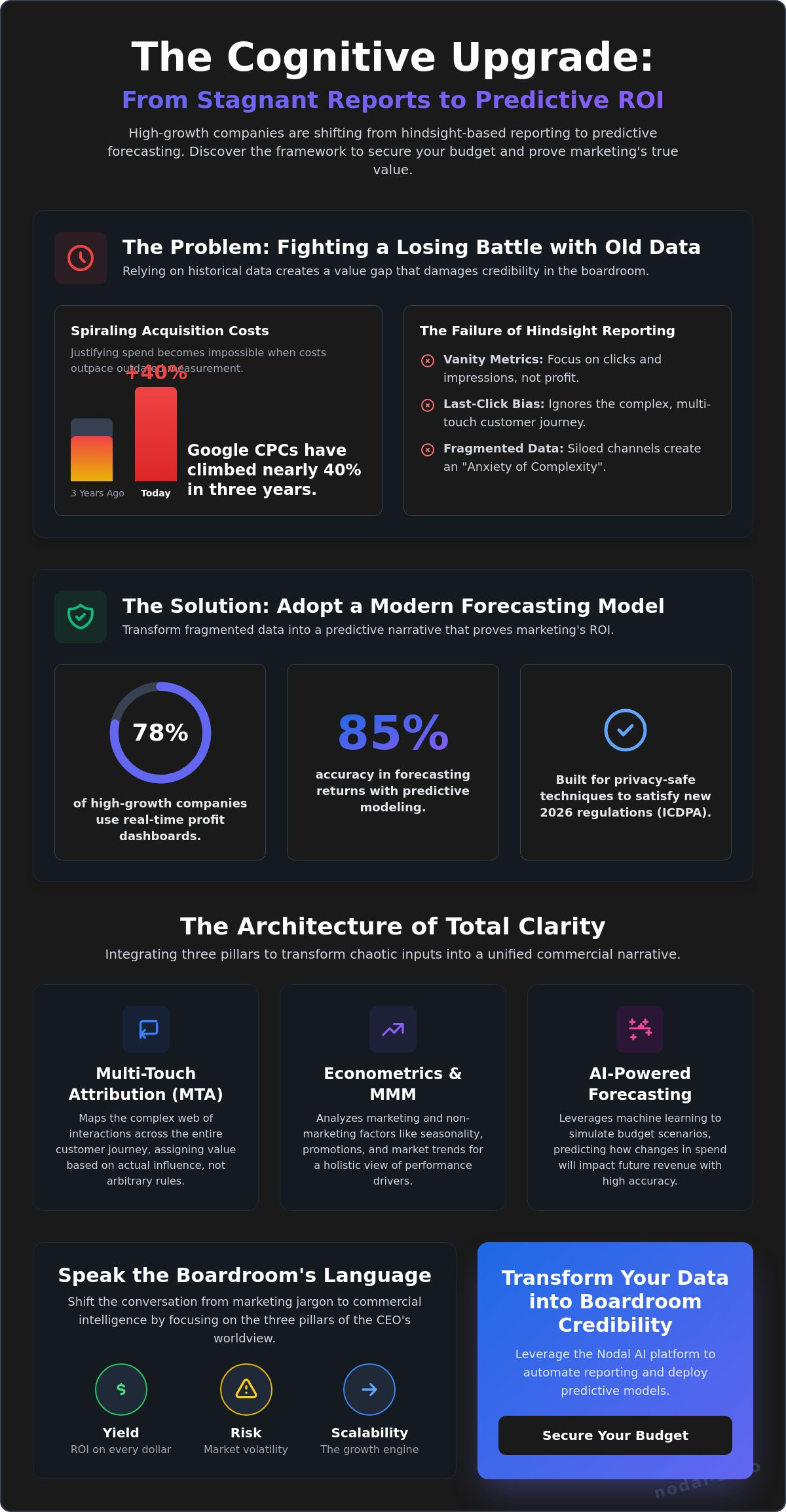
78% of high-growth companies have now replaced stagnant marketing reports with real-time profit dashboards. If you're still relying on historical data to justify your spend, you're fighting a losing battle against Google CPCs that have climbed nearly 40% in three years. Modern marketing roi forecasting models offer a cognitive upgrade for your entire organization. These systems transform fragmented campaign data into a predictive narrative that proves exactly how top-funnel awareness converts into bottom-line profit.
You know that marketing is a growth engine, yet the boardroom often sees it as an expense to be trimmed. This guide provides the blueprint to change that perception forever. Learn how to deploy automated reporting and predictive modelling that achieves up to 85% accuracy in forecasting returns. We will explore how to integrate multi-touch attribution with privacy-safe techniques to satisfy new 2026 regulations like the ICDPA. By the end of this article, you'll have a clear framework to secure your budget and claim your strategic seat at the executive table.
Key Takeaways
- Bridge the value gap by replacing vanity metrics with the real time profit dashboards used by 78% of high growth companies.
- Master modern marketing roi forecasting models to achieve up to 85% accuracy in predicting future commercial outcomes from historical data.
- Build a unified measurement framework that balances rapid decision speed with the privacy requirements of the 2026 ICDPA and CCPA updates.
- Deploy a five step framework to align fragmented data silos with specific revenue and Customer Lifetime Value targets.
- Leverage the Nodal Platform to transform chaotic inputs into boardroom ready narratives through automated reporting and predictive modelling.
The Boardroom Gap: Why CEOs Ignore Traditional ROI Reports
Marketing is often treated as a black hole of expenditure because practitioners speak a language the boardroom doesn't understand. This is the Marketing Value Gap. While you track click-through rates and impressions, your CEO is looking at EBITDA and terminal value. This disconnect turns marketing into a cost-center in their eyes. Vanity metrics don't just fail to prove value; they actively damage your credibility by suggesting you're focused on activity rather than outcomes.
Fragmented data across isolated channels creates an "Anxiety of Complexity" at the executive level. When your data sits in silos, your reports feel like guesswork. Executives lose trust in figures that can't be reconciled with the company's financial reality. To fix this, you need a cognitive upgrade. High-performance marketing roi forecasting models serve as the vital bridge. They take those chaotic inputs and turn them into a predictive commercial narrative that secures your budget.
The Failure of Hindsight Reporting
Reporting on last month’s performance is like driving a car while looking only at the rearview mirror. By the time you identify a trend, the opportunity has already vanished. This is insight decay. In 2026, CEOs demand foresight, not history. They need to know where the next million in revenue is coming from, not where the last thousand went.
Traditional reporting often suffers from "Last-Click" bias, which fails to account for the complex customer journey. It ignores the top-funnel influence that builds your brand equity. Manual data wrangling only worsens the problem, introducing human error and significant delays. You can't lead a market with stale data. Moving to automated analytics ensures your Return on Marketing Investment (ROMI) reflects the true impact of every touchpoint across the entire funnel.
The CEO’s Financial Worldview
Your CEO views the business through three lenses: yield, risk, and scalability. They don't want to hear about "engagement" or "sentiment." They want to know the yield on every dollar invested. They need to understand the risk of market volatility and the scalability of your current growth engine. If you can't quantify these, you don't have a seat at the table.
Stop using marketing jargon and start providing commercial intelligence. When you anchor marketing spend to enterprise value and long-term market share, you change the conversation. Advanced marketing roi forecasting models allow you to simulate budget scenarios, showing the boardroom exactly how a specific increase in spend will impact next year's revenue. This isn't just reporting; it's strategic leadership that replaces executive skepticism with financial confidence.
The Architecture of Modern Marketing ROI Forecasting Models
Modern marketing roi forecasting models function as the central nervous system of a growth-obsessed organization. They move beyond simple arithmetic to provide a cognitive upgrade for your entire commercial strategy. By integrating three distinct pillars: Attribution, Econometrics, and AI, these models transform chaotic data points into a unified narrative. This sophisticated architecture provides what we call "Total Clarity." It is the seamless integration of historical performance data with forward-looking signals that eliminates executive doubt and replaces it with predictive certainty.
When you implement predictive modelling, your data stops being a passive record of the past. It becomes an active participant in your business process. These models effectively personify your marketing assets. They treat each campaign, channel, and creative asset as a living entity with a specific revenue yield. This shift allows you to see exactly which assets are overperforming and which require strategic reassignment. It turns a static spreadsheet into a dynamic map of your future growth, ensuring every dollar is working toward a measurable outcome.
Multi-Touch Attribution (MTA)
Precision in the digital age requires a granular understanding of the customer journey. Advanced marketing attribution acts as your investigative tool, mapping the complex web of interactions that lead to a conversion. It reveals the hidden value of top-funnel awareness campaigns that traditional models often ignore. Instead of relying on static credit rules, modern MTA uses dynamic, AI-weighted distribution. It assigns value based on actual influence rather than arbitrary sequence. This ensures that the brand-building efforts that prime the pump get the credit they deserve alongside the final conversion events.
Marketing Mix Modelling (MMM)
While MTA looks at the individual, MMM provides the high-level perspective. It uses Bayesian statistics to account for external variables that digital tracking often misses. These include factors like seasonality, economic shifts, or aggressive competitor activity. This top-down approach is essential for measuring non-digital and offline impact, providing a holistic view of your market presence. The era of "Black Box" econometrics is over. Today's models offer transparent, real-time insights that allow you to adjust your mix instantly. This ensures your strategy remains resilient even as market conditions fluctuate. To see how these architectural elements come together in a single interface, explore how the Nodal Platform automates this complexity for you.
Selecting the Right Model: MTA, MMM, or Unified Analytics?
Choosing the ideal framework from the available marketing roi forecasting models is a high-stakes decision that dictates your commercial agility. You can't rely on a one-size-fits-all approach when your growth objectives are unique. Evaluate your needs through the lens of data volume, channel complexity, and the required speed of decision-making. High-velocity digital brands require different signals than enterprise organizations with multi-year sales cycles. The goal is to match your model to your specific 2026 growth objectives, ensuring your reporting remains a strategic asset rather than a technical burden.
Modern ai marketing analytics acts as the connective tissue between disparate methodologies. It bridges the gap between bottom-up tracking and top-down econometrics, allowing you to synthesize conflicting signals into a single, profitable truth. This isn't just about software; it's about achieving a cognitive upgrade that allows your team to see around corners. By moving beyond isolated views, you replace executive doubt with a unified vision of future growth.
MTA vs. MMM: A Strategic Comparison
MTA excels at tactical optimization. Use it when you need to know which specific ad creative or keyword is driving immediate conversions. It's the engine for daily performance adjustments. Conversely, MMM is your tool for strategic budget allocation. It provides the high-level perspective needed to decide whether to shift millions from digital search to brand-building television or radio. It accounts for the external variables that individual tracking often misses.
The choice often depends on your sales cycle length. Short, transactional cycles favor the granularity of MTA. Long, complex B2B cycles require the statistical rigor of MMM to account for external market forces. Relying on a single source of truth is a dangerous pitfall; it creates blind spots that lead to wasted spend and missed revenue targets. A balanced approach ensures you don't sacrifice long-term stability for short-term gains.
The Rise of the Unified Predictive Model
Unified Marketing Measurement (UMM) is the gold standard for 2026 boardroom reporting. It combines the granular precision of MTA with the broad, contextual view of MMM. This integration eliminates the friction between tactical teams and executive leadership. It provides a unified commercial narrative that the CEO can actually trust. When these models work in harmony, they turn passive data into active participants in your business strategy.
By automating the integration of these disparate data sources, you move from manual interpretation to automated clarity. This unified approach personifies your marketing efforts as a cohesive growth engine. It transforms fragmented inputs into high-value commercial outputs, providing the predictive clarity required to secure next quarter's budget with total confidence. This is how you transition from being a cost-center to a primary driver of enterprise value.
A 5-Step Framework to Build a Predictive Marketing Forecast
Building a forecast that commands boardroom respect requires more than just a spreadsheet. It demands a structured transition from fragmented data to strategic foresight. While your competitors focus on hindsight, you can leverage marketing roi forecasting models to anticipate market shifts before they occur. This framework ensures your marketing department functions as a predictable growth engine rather than a speculative expense. Follow these five steps to transform your raw data into a commercial narrative that resonates with executive leadership.
- Step 1: Define Commercial Objectives. Start with the end in mind. Align your metrics with the CEO's financial worldview by focusing on Revenue, Customer Acquisition Cost (CAC), and Lifetime Value (LTV) targets.
- Step 2: Establish Data Integrity. Deploy a robust data governance framework. This ensures your inputs are clean, consistent, and boardroom-ready, eliminating the skepticism often caused by conflicting reports.
- Step 3: Identify Value Drivers. Map the customer journey to pinpoint the exact touchpoints that influence long-term growth. This step personifies your assets, revealing which channels act as primary revenue catalysts.
- Step 4: Execute Scenario Planning. Develop conservative and aggressive growth models. This allows you to visualize the impact of different investment levels on your bottom line.
- Step 5: Operationalise Insights. Integrate your growth recommendations directly into your planning workflows. This ensures that every strategic decision is backed by predictive clarity.
Scenario Planning for Boardroom Confidence
Executive leaders are naturally risk-averse. You can reduce their perceived risk by building sophisticated "What-If" models. Ask the hard questions: What happens to our market share if we increase brand spend by 20%? These models prove incrementality by identifying exactly which revenue would disappear if marketing efforts were paused. When you present a range of outcomes based on specific investment levels, you provide the CEO with the confidence to authorize larger budgets. It's about showing the yield of an investment rather than the cost of a campaign.
From Data to Growth Recommendations
Raw numbers rarely inspire action. To influence the boardroom, you must turn those numbers into a high-level commercial narrative. Move away from activity-based reporting that lists clicks and impressions. Instead, adopt yield-based reporting that highlights the return on every dollar spent. Advanced marketing roi forecasting models automate the identification of emerging trends. This allows you to pivot your strategy before your competitors even notice a change in the market. To begin automating your path to total clarity, explore the Nodal Platform and start turning fragmented inputs into high-value commercial outputs.
Nodal AI: Transforming Fragmented Data into Boardroom Credibility
Proving marketing value isn't just about the math; it's about the narrative you present to those who hold the purse strings. The Nodal Platform serves as your engine for total clarity. It bridges the gap between tactical execution and executive expectation. By automating the transition from fragmented inputs to high-value commercial outputs, Nodal replaces the noise of raw data with the signal of profitable growth. This is where your marketing strategy becomes a cognitive upgrade for the entire organization.
Modern marketing teams in London are already seeing the impact, saving over 20 hours every month on manual reporting tasks. This efficiency isn't just about reclaimed time. It's about eliminating the insight decay that occurs when data sits in spreadsheets for weeks. With sophisticated marketing roi forecasting models built directly into the infrastructure, you move from defending past spend to dictating future growth. You're no longer just a department head; you're a strategic partner providing AI-driven growth recommendations that the board can actually bank on.
The Power of Automated Intelligence
Nodal integrates your disparate data sources into a single source of truth. It personifies your passive assets, turning them into active participants in your commercial strategy. Instead of waiting for monthly post-mortems, you gain access to real-time ROI forecasting. This allows you to pivot before a campaign underperforms, not after the budget is gone. By removing the manual labor that leads to human error, you ensure your marketing roi forecasting models remain accurate and resilient.
Your Blueprint for Boardroom Success
Your CEO demands the objective truth. They need to know that every pound invested is yielding a measurable return. Nodal provides this transparency, building a culture of accountability through AI-backed data. You can now walk into the boardroom with the confidence that your forecasts are grounded in statistical rigor rather than optimistic guesswork. This transparency doesn't just protect your budget; it elevates your influence.
The transition from a cost-center to a profit-driver is now within your reach. Replace the anxiety of fragmented reporting with the calm efficiency of automated intelligence. Your next step is to see this clarity in action. Book a demo to see your true marketing value and start transforming your data into your most powerful strategic asset.
Claim Your Strategic Seat at the Executive Table
The transition from a perceived cost-centre to a primary growth engine is now a reality for the forward-thinking marketer. You have the framework to bridge the boardroom gap by moving beyond vanity metrics and embracing unified measurement. By deploying advanced marketing roi forecasting models, you replace executive doubt with the predictive clarity required for long-term financial stability. It's time to stop defending your past spend and start dictating your future market share.
Nodal AI provides the cognitive upgrade your organization needs to thrive in 2026. Our platform is trusted by London enterprises to drive scalable revenue growth through AI-powered multi-touch attribution and predictive growth modelling. We save marketing teams 20+ hours per month by eliminating manual reporting and insight decay. Transform your fragmented data into boardroom-ready insights with Nodal AI. Your journey toward total clarity starts today. Build the narrative your CEO demands and lead your brand toward its most profitable era yet.
Frequently Asked Questions
What is the most important metric to show a CEO?
The most important metrics are Customer Lifetime Value (CLV) and Net Profit Yield. Your CEO doesn't care about clicks; they care about the long-term commercial yield of every pound spent. By focusing on these outcomes, you frame marketing as a cognitive upgrade for the business rather than a cost-center. This approach replaces vanity metrics with the financial intelligence required to drive enterprise value and sustainable growth.
How do marketing ROI forecasting models differ from simple ROI tracking?
Simple tracking looks backward at historical spend, whereas marketing roi forecasting models use predictive analytics to simulate future growth scenarios. Tracking tells you what happened; forecasting tells you what will happen if you adjust specific variables like budget or channel mix. This shift from hindsight to foresight is essential for building boardroom trust. It transforms passive data into an active participant in your strategic planning process.
Why is multi-touch attribution essential for accurate ROI forecasting?
Multi-touch attribution (MTA) is essential because it reveals the hidden value of top-funnel touchpoints that prime the pump for conversion. Last-click models often ignore the brand-building efforts that influence a customer's decision early in the journey. MTA ensures every marketing asset is credited based on its actual contribution. This precision allows you to forecast returns with a level of accuracy that simple tracking can't match.
How can I prove marketing value if my data is currently fragmented?
Consolidating your disparate silos into a unified data governance framework is the first step toward proving value. Fragmented data leads to executive skepticism and an "Anxiety of Complexity" in the boardroom. You need a single source of truth that reconciles marketing activity with financial reality. Once your data is integrated, you can transform chaotic inputs into a cohesive commercial narrative that clearly demonstrates your impact on the bottom line.
What is the difference between MMM and MTA in forecasting?
Marketing Mix Modelling (MMM) provides a top-down statistical view that accounts for external factors like seasonality and economic shifts. Multi-Touch Attribution (MTA) offers a bottom-up perspective on individual customer journeys. Effective forecasting requires a unified approach that leverages both methodologies. MMM guides your strategic budget allocation across channels, while MTA provides the tactical granularity needed to optimize specific campaigns for immediate revenue yield.
How does predictive modelling help in securing a marketing budget?
Predictive modelling secures budgets by demonstrating the specific revenue yield of an investment before the money is spent. It allows you to present data-backed "What-If" scenarios that reduce the CEO’s perceived risk. Instead of asking for money based on past performance, you're offering a calculated investment case for future growth. This approach turns your budget request into a strategic conversation about scalability and enterprise value.
Can AI forecasting models account for offline marketing activities?
Advanced marketing roi forecasting models use Bayesian statistics to quantify the impact of offline activities like television, radio, or print. These models identify the correlation between offline spend and digital uplift, ensuring your brand-building efforts receive proper credit. This holistic perspective eliminates the digital-only blind spots that lead to wasted spend. It provides the total clarity needed to manage a multi-channel growth engine with total confidence.
How often should I update my marketing ROI forecast?
You should update your forecast in real-time to avoid the insight decay associated with monthly post-mortems. In a volatile market where platform costs shift daily, waiting weeks to adjust your strategy is a significant risk. Automated reporting ensures your growth recommendations are always based on the most current data. This constant optimization allows you to pivot your budget toward high-performing channels before your competitors even notice the trend.


