

What if you could stop chasing last month's performance and start seeing next quarter's revenue leak before it actually happens? You likely feel the weight of the 3,000 hours lost annually to manual spreadsheet reporting; yet your attribution still feels like a "black box" that swallows your budget. It's time to stop guessing where your next lead comes from and start using predictive marketing analytics to improve campaign ROI. Most marketers agree that fragmented data is the single biggest barrier to scaling, leaving you with wasted spend and missed targets.
We're here to help you connect the dots and reclaim your time. This guide promises to help you talk to your data and turn a fragmented ecosystem into a sequence of profitable decisions. We'll provide a clear roadmap to predictive maturity, replacing manual labor with automated reporting that delivers clear growth recommendations. You'll move from data-driven anxiety to the confidence of actionable insights. Read on for the 2026 strategy checklist that moves your brand from data complexity to sustainable, high-impact clarity.
Key Takeaways
- Shift from reactive hindsight to proactive foresight by using an AI-powered engine to forecast outcomes before you commit your marketing spend.
- Implement the 2026 strategy checklist for predictive marketing analytics to improve campaign ROI and turn fragmented data into a clear roadmap for growth.
- Choose the right predictive modeling engine to solve specific business problems, ensuring your technology scale matches your long-term revenue goals.
- Eliminate the 3,000 hours lost to manual reporting by automating your data ecosystem and focusing on high-impact growth recommendations.
- Connect the dots across your customer journey to talk to your data and transform complex metrics into sustainable, profitable decisions.
What is Predictive Marketing Analytics? Moving from Hindsight to Foresight
Predictive marketing analytics is the AI-powered business intelligence engine that turns your history into your roadmap. It moves beyond the limitations of reactive reporting. Instead of asking "what happened last month," you start asking "what will happen next week if I shift my budget?" This technology forecasts outcomes before a single dollar of spend occurs, allowing you to secure your revenue targets with mathematical precision. By implementing predictive marketing analytics to improve campaign ROI, you move from a state of constant data digging to a position of strategic clarity.
Most marketing teams lose over 3,000 hours every year to manual spreadsheet reporting and data reconciliation. This is the cost of operating in a fragmented data ecosystem. Strategic clarity is the ultimate competitive advantage in 2026 because it replaces the anxiety of the "black box" with actionable, AI-verified growth recommendations. It's time to stop looking in the rearview mirror and start talking to your data.
The ROI Crisis of 2026: Why Traditional Metrics Fail
Traditional attribution models are failing because they rely on a linear path that no longer exists. Last-click and basic multi-touch models often miscalculate true marketing value by up to 40% because they cannot account for the gaps in a fragmented data ecosystem. When your data lives in silos, you end up with wasted budgets and inaccurate growth forecasts. Research from Forrester suggests that data-driven organizations grow 30% faster than their peers, yet many still struggle because their metrics only provide hindsight.
Predictive models solve the "walled garden" data problem by using probabilistic matching to bridge the gaps between siloed platforms like Google, Meta, and your internal CRM. This creates a unified view of the customer journey that traditional reporting simply cannot reach. Without this foresight, you're essentially gambling with your ad spend rather than investing it.
From Data to Clarity: The Predictive Transformation
The shift from gut-feel decision making to AI-verified strategy is a total transformation of your workflow. It changes your daily routine from digging through rows of data to making high-level executive decisions. By utilizing automated reporting, you eliminate the manual friction that slows down your response to market changes. You don't just see the data; you understand the "why" behind the performance.
This evolution allows you to connect the dots across every touchpoint. When you use predictive marketing analytics to improve campaign ROI, you gain the ability to simulate different spend scenarios. This means you can identify which campaigns will drive the highest retention and lifetime value before you launch them. It is the difference between being a reactive participant in the market and being a proactive leader who dictates their own growth.
- From Fragmented Data: Multiple logins, conflicting metrics, and manual exports.
- To Strategic Clarity: A single source of truth with automated, predictive insights.
- The Result: Sustainable revenue growth and an end to wasted ad spend.
The Predictive Marketing ROI Checklist: 5 Essentials for 2026
True growth isn't a happy accident. It's the result of a deliberate sequence. Most brands treat their tech stack like a collection of isolated islands, but to truly use predictive marketing analytics to improve campaign ROI, you must adopt a "Connect the Dots" philosophy. Success in 2026 requires more than just buying a tool; it requires a unified architecture that understands the customer journey as a living, breathing ecosystem. If your data is fragmented, your decisions will be too.
Before you commit to a predictive strategy, you need a baseline audit. This 5-point framework ensures your foundation is strong enough to support automated foresight. Without these essentials, you're simply automating your mistakes. By moving from data chaos to a structured metrics layer, you turn a reactive department into a proactive revenue engine. Let's look at the first three pillars of predictive maturity.
1. Data Unification and Identity Resolution
Can you track a single user across 5 or more touchpoints without gaps? Most marketers can't. They see a click on Meta and a conversion on Google as two separate people. To fix this, you need a unified metrics layer that powers an accurate ai customer journey. This requires seamless integration between your CRM, ad platforms, and web analytics. When you connect these dots, you stop guessing and start knowing exactly how your fragmented data ecosystem interacts across the entire funnel.
2. Real-Time Multi-Touch Attribution (MTA)
The "last-click" trap is the fastest way to waste a marketing budget. In 2026, your model must credit top-of-funnel awareness correctly. If you don't value the first touch, you'll never scale the last one. According to 2024 data from Gartner, brands using advanced MTA see a 15% to 18% improvement in marketing efficiency. You need dynamic weighting based on historical performance data to see the full value of every pound spent. This clarity is what allows you to use predictive marketing analytics to improve campaign ROI by shifting spend to the channels that actually move the needle.
3. Predictive Lead and Churn Scoring
Stop treating every lead the same. Your sales team should prioritize prospects based on their "likelihood to close," not just their recent activity. By using predictive modelling, you can identify high-value segments weeks before they actually convert. This creates an automated feedback loop between marketing and sales, ensuring you spend your energy where the revenue is most likely to materialize. If you're ready to see how this works in real-time, you can explore the Nodal platform to start unifying your metrics today.
Comparing Predictive Models: Choosing the Right Engine for Your Scale
Choosing the right mathematical engine is what separates a visionary leader from a frustrated analyst. You don't need a PhD to understand these models; you need a Smarter Partner that translates math into money. To use predictive marketing analytics to improve campaign ROI, you must match the model to your specific growth hurdle. Whether you're scaling a London-based fintech or a global e-commerce brand, the "Black Box" of AI should never be an excuse for blind faith. Nodal AI advocates for transparent, explainable AI because you can't act on a recommendation you don't trust. From complex data to growth recommendations, the goal is to make your intelligence engine visible and accountable.
Regression vs. Clustering: Which Drives Better Budget Allocation?
Regression and clustering serve different masters in your strategy. Regression models are your forecasting heavyweights; they analyze the relationship between variables to predict total revenue outcomes based on your spend levels. Use regression for your 2026 annual planning to see how a 15% increase in ad spend impacts your bottom line. Conversely, clustering is about precision. It groups users based on shared behaviors, allowing you to build a personalised customer journey that speaks to specific intent. This moves you from broad-brush marketing to surgical accuracy.
Deploy regression for high-level budget allocation and clustering for tactical pivots like audience segmentation. Classification models identify churn risks with 90% accuracy by flagging behavioral shifts before a customer leaves. By combining these, you move from general guesses to specific growth recommendations. This is how you stop digging through spreadsheets and start deciding on your next move. It's about turning fragmented data into a sequence of profitable decisions.
The Role of Marketing Mix Modelling (MMM) in 2026
London's most successful enterprises are moving away from purely digital attribution. They're combining Multi-Touch Attribution with Marketing Mix Modelling (MMM) to capture the full picture of their influence. MMM is essential for justifying high-level brand spend that traditional attribution often misses, such as out-of-home ads or long-term brand equity building. It requires ingesting at least two years of historical data and layering in external factors like seasonality and economic shifts.
Nodal AI simplifies these complex calculations, turning unified metrics into clear instructions. You shouldn't have to guess if your TV ad drove a spike in direct traffic. Talk to your data instead. When you connect these disparate models into a single source of truth, you gain the strategic clarity needed to outpace your competition. This is the future of automated media planning: unified, transparent, and results-oriented.
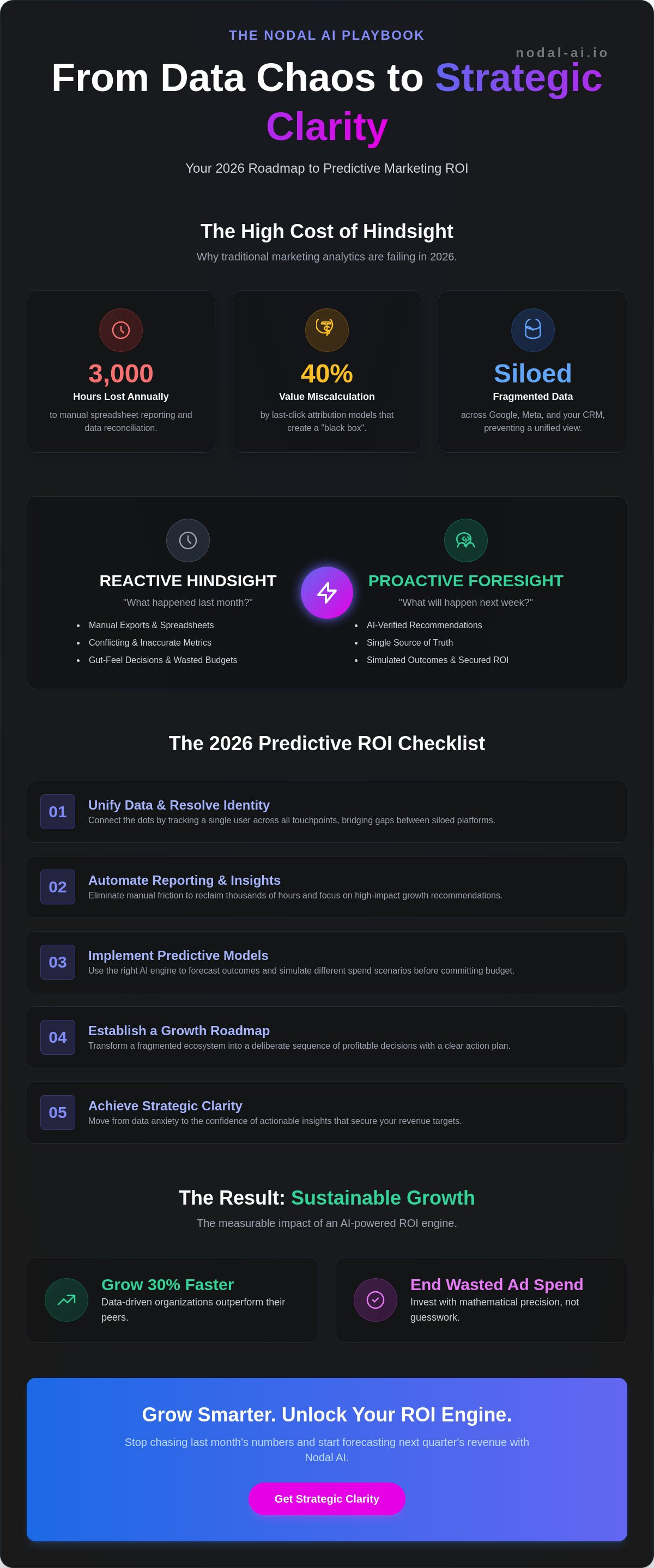
Implementation Roadmap: From Fragmented Data to Strategic Clarity
Transforming your marketing department into a proactive revenue engine requires a clear, five-step roadmap. You can't simply flip a switch and expect foresight; you have to build a logical sequence. Start by defining a concrete ROI objective. For example, aim to reduce your Customer Acquisition Cost (CAC) by 20% by the end of Q3 2026. Once your target is set, audit your data ecosystem to eliminate the "Garbage In, Garbage Out" cycle that often plagues manual reporting. By integrating your fragmented sources into a single, Smarter platform, you create the unified metrics layer necessary for predictive marketing analytics to improve campaign ROI. Pilot your models on high-volume channels like Meta or Google Search first to gather significant data quickly. Finally, learn to talk to your data. Use these AI-driven insights to execute real-world pivots that protect your budget before it's wasted.
Overcoming the 'Messy Data' Hurdle
Many teams hesitate to start because their data feels disorganized. You don't need a perfect database to begin seeing predictive value. Automated cleaning and mapping tools now save marketing teams over 3,000 hours a year by resolving inconsistencies in real-time. However, maintaining model accuracy over the long term requires a robust data governance framework. This framework acts as the guardrail for your intelligence engine, ensuring that as you scale, your insights remain sharp and reliable. Don't let the search for "perfect" data stop you from achieving "profitable" clarity. Start with your existing touchpoints and let the AI connect the dots.
Scaling Growth with Automated Recommendations
Scaling is about moving from static reports to dynamic actions. Through automated media planning, your platform becomes a Smarter Partner rather than just a dashboard. You can set up real-time alerts for ROI anomalies that traditional reporting would miss. For instance, if the engine predicts a specific campaign will undershoot its target by 15% based on early signals, you can reallocate that spend instantly. This shift requires a psychological change: you must trust the engine to handle the technical complexity so you can focus on high-level strategy. When you stop digging for "what happened" and start deciding on "what's next," your growth becomes sustainable and predictable.
Ready to turn your fragmented data into a sequence of profitable decisions? Connect your data to the Nodal platform and start building your roadmap to strategic clarity today.
Grow Smarter: Why Nodal AI is the ROI Engine for 2026
Complexity is the enemy of growth. While your competitors are still buried in manual spreadsheets, you have the opportunity to lead with clarity. Nodal AI acts as your Smarter Partner, designed specifically to turn a fragmented data ecosystem into a sequence of profitable decisions. By using predictive marketing analytics to improve campaign ROI, you move from a state of constant overwhelm to a position of high-level authority. We don't just provide more data; we connect the dots between your disparate sources to reveal the hidden revenue opportunities you've been missing.
The math is simple. If you can save 3,000 hours a year on manual analysis, you reclaim over 125 full workdays for high-impact strategy. This is the relief that comes from resolving complexity. Nodal AI provides the unified metrics layer that allows you to stop digging and start deciding. It's time to replace the anxiety of fragmented reporting with the confidence of actionable insights.
The Nodal Advantage: Talk to Your Data
Data shouldn't be a passive asset that requires a PhD to interpret. Nodal humanizes your analytics through a conversational AI interface that lets you talk to your data in plain English. Instead of handing you a stack of static charts, our engine provides specific growth recommendations that tell you exactly where to shift your budget for maximum impact. You gain an AI-powered business intelligence engine that works around the clock to identify performance anomalies before they become budget leaks.
Security is the foundation of this trust. We protect your unified metrics with enterprise-level encryption and secure data protocols, ensuring your competitive advantage remains yours alone. This isn't just about automated media planning; it's about providing a safe, intelligent environment where your business can grow smarter every day. You get the power of predictive modelling without the technical friction.
Ready to Transform Your Marketing ROI?
The journey from data complexity to strategic clarity is no longer optional. In 2026, predictive intelligence is the baseline for any brand that wants to remain relevant. You've seen the roadmap. You've compared the models. Now, it's time to execute. By implementing predictive marketing analytics to improve campaign ROI, you ensure that every pound spent is an investment in sustainable growth rather than a gamble on last-click metrics.
Turn your fragmented data into your most powerful employee. Move from the frustration of "what happened" to the foresight of "what's next." The transition is seamless, the integrations are instant, and the value begins on day one. Connect with a Nodal Expert Today to see how we can transform your marketing department into a proactive revenue engine.
Secure Your Strategic Clarity for 2026
The transition from a fragmented data ecosystem to a unified revenue engine is the defining shift of the next decade. You've seen how the right checklist turns complexity into clarity. By leveraging predictive marketing analytics to improve campaign ROI, you move beyond the "last-click" trap and start making AI-verified decisions that protect your budget. It's time to stop losing 3,000 hours a year to manual reporting and start focusing on the high-level growth recommendations that move the needle.
Nodal AI provides the enterprise-level encryption and GDPR compliance you need for total peace of mind. Our London-based team offers the expert implementation and onboarding support required to ensure you see value from day one. You don't have to navigate this complexity alone. Connect the dots across your customer journey and turn your data into your most profitable conversational partner. Talk to your data and grow smarter; book your Nodal AI demo today. Your roadmap to sustainable, data-driven growth is ready when you are.
Frequently Asked Questions
How does predictive marketing analytics actually improve ROI?
Predictive marketing analytics improves ROI by identifying revenue leaks and high-value opportunities before your budget is committed. It uses historical patterns to simulate various spend scenarios, allowing you to reallocate funds to the 20% of campaigns driving 80% of your growth. This proactive approach eliminates the waste associated with reactive, hindsight-based reporting.
What is the difference between traditional and predictive analytics?
Traditional analytics tells you what happened; predictive analytics tells you what will happen. Traditional reporting requires manual data digging and often results in fragmented insights. Predictive engines use AI to connect the dots across your ecosystem, transforming raw data into foresight that guides your next profitable decision.
Is predictive modelling GDPR compliant for UK marketing teams?
Yes, predictive modelling is fully GDPR compliant when built with privacy-first architecture. Nodal AI uses enterprise-level encryption and secure data protocols to protect user identity. UK marketing teams can leverage these insights confidently, knowing their data processing meets all current legal standards for security and transparency.
How much data do I need to start using predictive analytics?
You generally need 6 to 12 months of historical data to generate accurate forecasts. This window provides the AI with enough context to account for seasonality and market fluctuations. Starting with this foundation ensures your growth recommendations are grounded in established behavioral trends rather than short-term anomalies.
Can predictive analytics help with customer retention and churn?
Predictive analytics is highly effective for retention because it flags churn signals before they result in a lost customer. By monitoring shifts in engagement metrics, the engine can predict which users are 30% more likely to churn. This allows you to intervene with automated, personalized offers that secure long-term revenue.
How long does it take to see results from predictive marketing tools?
Results typically materialize within 30 to 90 days as the models refine their accuracy. Once you implement predictive marketing analytics to improve campaign ROI, the initial "quick wins" often come from identifying and pausing underperforming ad sets. Over time, the cumulative gains from automated media planning create sustainable revenue growth.
What are the best predictive customer journey mapping tools in 2026?
In 2026, the best tools are those that offer seamless integration and real-time identity resolution. Nodal AI stands out by unifying fragmented data sources into a single source of truth. This provides a clear view of the customer journey, allowing you to talk to your data and understand the true value of every touchpoint.
How do growth recommendations differ from standard marketing reports?
Standard reports are static snapshots of the past; growth recommendations are dynamic instructions for the future. A report might show that your ROI is down by 10%. A growth recommendation tells you exactly which audience segment to target and which creative to swap to fix the problem instantly.


