

If 19.4% of your total marketing budget is now dedicated to technology, why are your teams still losing over 20 hours every week to manual reporting? Building a strategic business case for marketing analytics platform adoption is no longer a luxury; it's a necessity for survival in a 2026 landscape defined by tightening privacy laws and rising customer acquisition costs. You're likely exhausted by fragmented data that produces conflicting reports and leaves you unable to prove which channels actually drive revenue.
It's time to replace that anxiety with the confidence of high-level, automated perspectives. This article provides a bulletproof framework to calculate ROI, reduce your CAC, and gain total clarity on the customer journey. We will guide you through the process of securing executive buy-in by transforming chaotic inputs into a high-value growth engine. You'll learn how to leverage multi-touch attribution and predictive modelling to turn your data from a passive asset into an active participant in your business success. Stop guessing and start optimizing with a cognitive upgrade for your entire organization.
Key Takeaways
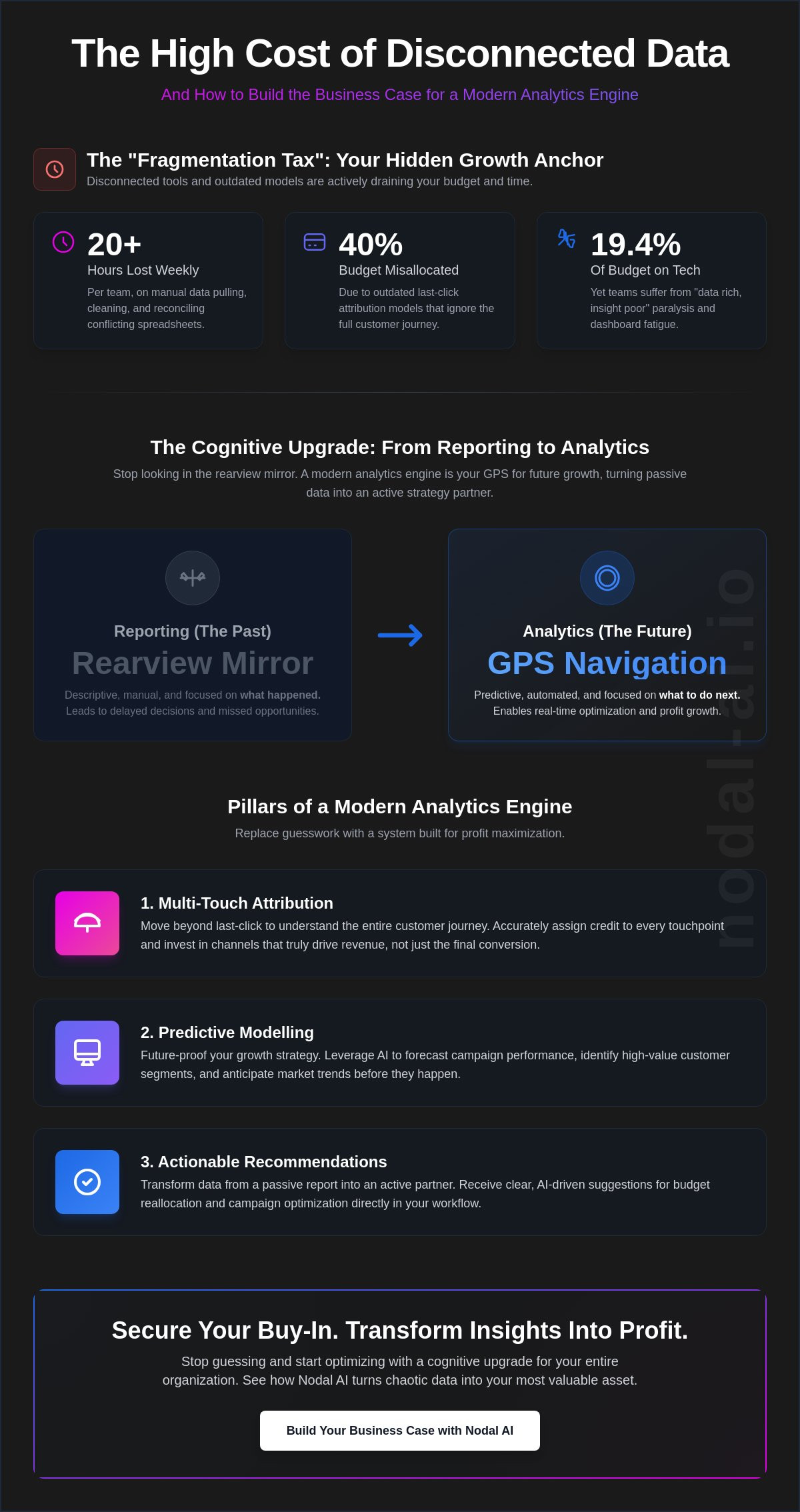
- Identify the hidden "Fragmentation Tax" that misallocates up to 40% of your budget through outdated last-click attribution models.
- Move beyond descriptive reporting by integrating multi-touch attribution and predictive modelling to future-proof your growth strategy.
- Construct a bulletproof business case for marketing analytics platform investment by balancing total cost of ownership against significant efficiency gains and revenue upside.
- Evaluate diverse technical architectures to ensure your chosen engine matches your organization's specific growth stage and integration needs.
- Discover how to transform chaotic data into actionable growth recommendations that secure immediate executive buy-in and long-term stability.
The Fragmentation Tax: Why Your Current Marketing Stack is Costing You Millions
Your marketing stack should be a high-performance profit engine. Too often, it's a collection of isolated silos that demand a "Fragmentation Tax" from your bottom line. This tax is the cumulative loss in ROI that occurs when data is disconnected, forcing your team to make expensive guesses based on incomplete pictures. When building a business case for marketing analytics platform adoption, you must first quantify this hidden cost. It's the difference between a unified strategy and a series of disjointed tactics that fail to compound over time.
Relying on last-click attribution is a primary driver of this tax. It misallocates up to 40% of marketing budgets by crediting only the final touchpoint and ignoring the complex journey that actually built the intent. While foundational Marketing research focuses on the systematic gathering of data, modern analytics focuses on its synthesis. If you only look at what happened, you're doing reporting. If you understand why it happened and what to do next, you're doing analytics. Reporting is a rearview mirror; analytics is your GPS for future growth.
Many organizations suffer from dashboard fatigue. They have endless visualizations but zero direction. This state of "data rich, insight poor" creates a paralysis where teams see the numbers but can't find the leverage. Your team doesn't need more charts. They need a cognitive upgrade that turns passive data into active participants in your business process. Without a central engine, your data remains a liability that consumes time rather than an asset that generates profit.
The Cost of Manual Reporting and Data Cleaning
Manual data extraction is a productivity killer that drains your most valuable resource: talent. Industry benchmarks show that marketing teams lose over 20 hours weekly to the tedious cycle of downloading CSVs, cleaning spreadsheets, and reconciling conflicting reports. This isn't just a time sink; it's a strategic risk. Manual reporting carries an inherent error rate that can lead to catastrophic strategic missteps. Transitioning to automated reporting isn't just about saving time. It's about ensuring the integrity of your decision-making process and freeing your experts to focus on strategy rather than logistics.
Opportunity Cost: The Price of Delayed Decision Making
The most expensive data is the data that arrives too late. In the volatile 2026 market, even a two-week delay in campaign optimization results in significant wasted ad spend. You can't scale winning campaigns if you're waiting for a manual weekly sync to confirm they're working. Real-time insights turn your data into a competitive weapon. It allows you to pivot instantly, capturing market share while your competitors are still cleaning their tabs. This agility is the core of a strong business case for marketing analytics platform investment. In a fast-paced economy, the speed of your insights determines the ceiling of your growth.
Strategic Pillars of a Modern Marketing Analytics Engine
A robust business case for marketing analytics platform investment rests on three non-negotiable pillars: Attribution, Prediction, and Actionable Recommendations. These aren't merely technical features. They represent the structural support for a profit-maximization engine that replaces guesswork with mathematical certainty. To move beyond the fragmentation tax, your organization must transition from descriptive analytics, which only explains what happened, to predictive modelling that identifies where your next dollar of growth will come from.
Modern platforms leverage AI to surface these growth recommendations automatically. Instead of your team hunting for patterns in a sea of spreadsheets, the engine acts as a cognitive partner. It identifies high-performing segments and suggests budget reallocations in real-time. This shift is essential to Discover How Marketing Analytics Increases Business Performance; data-driven leaders who embrace these automated insights are significantly more likely to exceed their ROI targets compared to those stuck in manual workflows.
Multi-Touch Attribution: Mapping the True Customer Journey
Multi-Touch Attribution (MTA) serves as the foundation of the modern business case because it dismantles the "walled gardens" of Google and Meta. These platforms often claim credit for the same conversion, leading to inflated reporting and wasted spend. By mastering marketing attribution, you gain an unbiased view of every interaction across the funnel. MTA is the scientific method applied to the customer journey; it assigns fractional credit to every touchpoint to reveal the true drivers of revenue. This level of transparency allows you to defend your budget with hard evidence rather than optimistic projections.
Predictive Insights: Moving from Hindsight to Foresight
In the volatile markets of 2026, hindsight is a liability. You need foresight to survive. AI marketing analytics identifies emerging trends before they manifest in standard reports, allowing you to intercept opportunities before your competitors even see them. This predictive capability is vital for accurately calculating Customer Lifetime Value (CLV) and optimizing retargeting spend. When you can predict which customers are likely to churn or which leads are ready to convert, you stop reacting to the market and start shaping it. You can explore how the Nodal Platform automates these predictive pillars to transform your fragmented data into a clear roadmap for future growth.
Building the Financial Case: ROI, TCO, and Efficiency
Securing executive buy-in requires a fundamental shift from discussing technical features to presenting financial outcomes. A compelling business case for marketing analytics platform adoption is built on a balanced framework of efficiency gains and revenue growth. You aren't just requesting a budget for a new tool; you're proposing a profit-maximization engine that eliminates the waste inherent in fragmented systems. This transition replaces the anxiety of budget uncertainty with the confidence of a high-yield asset.
Total Cost of Ownership (TCO) is the metric your CFO will scrutinize most. This calculation must include software costs, implementation fees, and the internal resources required for onboarding. However, the break-even point arrives much sooner than most expect. When you factor in the reduction of customer acquisition costs (CAC) and the reclamation of lost conversions, the investment pays for itself rapidly. Implementing a robust data governance framework also acts as a critical insurance policy. With 20 US states now enforcing comprehensive data privacy laws as of 2026, the financial risk of non-compliance is staggering. A modern platform automates these protections, shielding your organization from regulatory fines while maintaining total transparency.
Calculating Revenue Lift from Optimization
Revenue growth is the ultimate justification for any technology spend. Consider a scenario where you manage a £1M annual marketing budget. A modest 5% increase in ROAS, driven by smarter allocation, doesn't just cover the platform cost. It adds £50,000 in pure revenue to your bottom line. This is achieved through advanced customer journey mapping, which identifies the specific "leaky" funnel stages where high-value prospects are currently falling away. By using these data-driven marketing strategies, you turn every touchpoint into a measurable contributor to your growth goals. This level of precision is the cornerstone of a winning business case for marketing analytics platform investment.
Operational Savings: The CFO’s Favourite Metric
Operational efficiency is the most immediate way to prove value. If your team is wasting 20 hours every week on manual reporting, you're burning thousands of pounds in annual salary costs on low-value labor. Automating these tasks replaces the frustration of manual work with the confidence of real-time visibility. Consolidating your stack also reduces "tool sprawl," allowing you to cut the costs of redundant point solutions that don't communicate. This creates a single source of truth that streamlines board meetings and accelerates your decision-making rhythm, transforming your data from a passive archive into an active participant in your business success.
Selection Framework: Matching Architecture to Growth Stage
Selecting the right architecture is where your business case for marketing analytics platform investment becomes operational reality. You must choose a path that balances current agility with future scalability. In 2026, the market is primarily divided into four architectures: End-to-End platforms, Data Connectors, BI-first setups, and Point Solutions. Each has a different impact on your team's velocity and your organization's bottom line.
End-to-End platforms provide a unified ecosystem that eliminates integration friction. Data Connectors offer flexibility but often lead to a "maintenance trap" where engineers spend more time fixing pipelines than analyzing data. BI-first tools excel at visualization but frequently lack the specialized attribution logic required for performance marketing. Point Solutions are tempting for quick fixes, yet they inevitably contribute to the data silos that act as a tax on your growth. For enterprise leaders, the "Build vs. Buy" decision tree has shifted. While building an internal engine offers total control, the rapid evolution of AI and privacy regulations makes "Buy" the pragmatic choice for those who value time. Professional platforms offer a cognitive upgrade that internal teams rarely have the bandwidth to maintain or secure.
When evaluating your options, ensure you look past the interface and into the integration depth. Use this checklist to verify technical maturity:
- Data Ingestion: Does the platform use real-time Webhooks for immediate updates or rely on delayed API polls?
- Scalability: Can the architecture handle a 10x increase in data volume without performance degradation?
- Security: Does it provide automated compliance with the latest state-level privacy laws?
End-to-End Platforms vs. Fragmented Stacks
The move toward unified platforms in 2026 is driven by the need for closed-loop execution. Fragmented stacks might offer individual features in isolation, but they fail to deliver a cohesive narrative. The Time to Value (TTV) for an end-to-end platform is significantly shorter because the infrastructure is purpose-built for marketing outcomes. You shouldn't spend six months building a data bridge; you should be driving across it on day one to capture market share.
Key Features Every Business Case Needs
Your business case for marketing analytics platform adoption must prioritize identity resolution. This capability links user sessions across devices and sessions without relying on deprecated cookies. Additionally, insist on AI-driven anomaly detection. This feature acts as a 24/7 sentry, alerting you to performance dips or budget spikes before they impact your quarterly targets. You can explore the Nodal Platform to see how an integrated architecture transforms these complex technical requirements into a streamlined growth engine.
Securing Buy-In: How Nodal AI Transforms Insights into Profit
The strategic business case for marketing analytics platform investment reaches its natural peak with Nodal AI. We don't just provide charts; we deliver growth recommendations that act as a cognitive upgrade for your entire marketing department. While legacy tools focus on data ingestion, Nodal AI focuses on profit maximization. We transform the anxiety of fragmented data into the relief of total clarity. By choosing an engine that automates the transition from raw input to high-value output, you'll replace manual labor with strategic momentum.
Nodal AI minimizes your Time to Value (TTV) through a streamlined onboarding process that prioritizes immediate results. You don't have to wait months for a data bridge to be built. Instead, our architecture is designed to integrate rapidly, allowing you to identify performance gaps within your first few weeks of operation. This speed is essential for securing executive buy-in, as it provides the quick wins necessary to justify a long-term commitment. We turn your data from a passive archive into an active participant in your business success, ensuring every pound spent is a pound accounted for.
The Nodal AI Advantage for London Enterprises
London enterprises face a uniquely complex environment in 2026. With regulatory pressure increasing, the cost of data mismanagement has never been higher. Nodal AI provides specific expertise in navigating these UK and European regulatory waters, ensuring your first-party data strategies remain both profitable and protected. Our AI-powered insights act as a dedicated growth partner, surfacing opportunities that human teams might miss in the noise of evolving privacy laws. Our professional onboarding support ensures implementation success, providing the high-level authority and reassurance your board demands.
Next Steps: From Analysis to Implementation
Moving from a theoretical business case for marketing analytics platform adoption to a live implementation requires a structured roadmap. We recommend starting with a pilot program to prove the ROI framework across a single high-impact channel. This allows your team to experience the efficiency gains of automated reporting firsthand before a full-scale rollout. Once the value is proven, you'll expand your data integration to include predictive modelling and multi-touch attribution across the entire customer journey. This phased approach reduces friction and builds internal confidence in the system. Book a Nodal AI Platform demo to build your custom business case and start your journey toward total marketing clarity today.
Transform Your Data into a Competitive Weapon
The transition from fragmented data silos to a unified profit engine is inevitable for leaders who prioritize measurable growth. You've seen how the "Fragmentation Tax" drains your strategic resources and how predictive modelling turns passive assets into active participants in your success. A bulletproof business case for marketing analytics platform adoption isn't just about acquiring software; it's about reclaiming over 20 hours of your team's weekly focus and gaining total clarity on every customer touchpoint.
Replace the anxiety of manual, tedious tasks with the confidence of streamlined, high-level perspectives. With our London-based expert support, you'll leverage AI-driven growth recommendations and predictive multi-touch attribution to outpace the competition. Stop struggling with conflicting reports and start optimizing with a cognitive upgrade for your entire organization.
Build your business case with a Nodal Platform demo
Your journey toward total marketing transparency and long-term financial stability is ready to begin. Take the first step toward masterfully efficient operations today.
Frequently Asked Questions
What is the typical ROI for a marketing analytics platform?
Typical ROI manifests as a 15% to 30% improvement in marketing efficiency by identifying and reallocating spend from underperforming channels. This transformation turns your data into a profit engine, making the business case for marketing analytics platform investment self-funding within the first few quarters of operation. By eliminating the "Fragmentation Tax," you reclaim lost conversions and lower your customer acquisition costs significantly.
How long does it take to implement an AI marketing analytics tool?
Implementation generally ranges from four to twelve weeks depending on the complexity of your existing tech stack. This timeline includes data ingestion, identity resolution setup, and the initial training of predictive models. While the underlying technology is complex, professional onboarding support ensures the user experience remains streamlined and effortless. You'll move from chaotic inputs to high-value outputs with minimal disruption to your daily operations.
Can I build my own marketing analytics platform in-house?
Building in-house often results in a "maintenance trap" where your engineers spend more time fixing broken data pipelines than generating insights. While an internal build offers total control, the rapid evolution of privacy laws and AI makes it a risky, time-consuming endeavor. Buying a purpose-built platform provides an immediate cognitive upgrade for your organization. It allows your team to focus on strategy rather than infrastructure maintenance.
Do I need a data scientist to use a marketing analytics platform?
No, modern platforms are designed to be accessible to marketing managers and directors without deep technical specialization. The AI acts as a conversational partner, handling the heavy lifting of multi-touch attribution and predictive modelling automatically. This empowers your existing team to make high-level, data-driven decisions with total confidence. You don't need to be a coder to benefit from future-facing analytics.
How does a marketing analytics platform differ from Google Analytics 4?
Google Analytics 4 is primarily a descriptive tool focused on web events, whereas a marketing analytics platform provides a holistic view of the entire customer journey. These platforms dismantle "walled gardens" by integrating data from CRMs, ad platforms, and offline touchpoints. This results in a single source of truth that GA4 simply cannot provide. It moves your perspective from what happened on a site to why your revenue is growing across all channels.
What are the most important KPIs to track in a marketing analytics platform?
Focus on Customer Lifetime Value (CLV), Customer Acquisition Cost (CAC), and Incremental Lift. These metrics provide a concrete weight to your marketing efforts and are essential for any business case for marketing analytics platform approval. Tracking these KPIs allows you to move beyond surface-level vanity metrics. You'll gain total clarity on which activities are truly driving long-term financial stability and organizational growth.
How do these platforms handle data privacy and GDPR?
Modern platforms automate compliance by using first-party data strategies and privacy-enhancing technologies. With cumulative GDPR fines reaching €7.1 billion by early 2026 and 20 US states enacting comprehensive privacy laws, manual compliance is a liability. A dedicated platform acts as a protective shield for your assets. It ensures your data processing remains transparent and secure while navigating the volatile regulatory landscape of 2026.
What is the cost of a marketing analytics platform for a mid-sized company?
Industry benchmarks for mid-tier platforms typically range from $1,000 to $5,000 per month in 2026. For mid-market organizations, implementation and data integration costs can range from $150,000 to $500,000 depending on the depth of the legacy systems involved. It's vital to view these figures through the lens of Total Cost of Ownership. The efficiency gains from reclaiming 20+ hours of manual labor weekly often outweigh the sticker price within the first year.


