

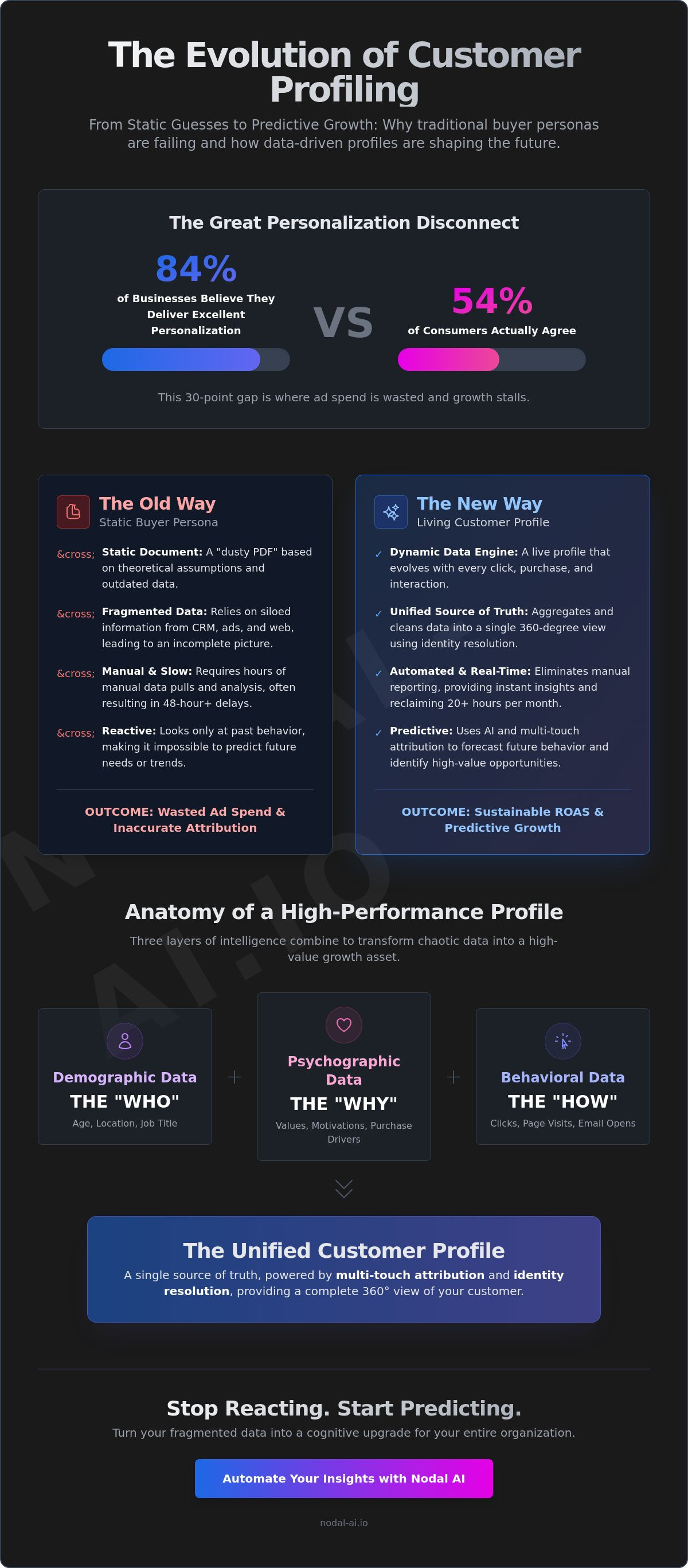
While 84% of businesses believe they deliver excellent personalization, only 54% of consumers actually agree. This gap exists because most brands still rely on static personas that fail to reflect real-time behavior or respect the strict privacy mandates of the 2026 Indiana Consumer Data Protection Act. If your customer profile is a static document sitting in a folder, you are likely wasting ad spend on inaccurate attribution and fragmented data. You already know that manual tracking is an outdated burden. You need a system that transforms chaotic inputs into high-value growth.
We will show you how to bridge that gap. You will learn to build living, predictive profiles that turn fragmented data into high-conversion marketing strategies. This guide provides a clear, actionable template to automate your data collection and leverage multi-touch attribution for immediate ROAS improvements. From managing new CCPA profiling definitions to deploying the Nodal Platform for 360-degree intelligence, you are about to turn your data into a cognitive upgrade for your entire organization. Stop reacting to past behavior and start predicting future growth with a streamlined, enterprise-ready approach.
Key Takeaways
- Transition from static, theoretical documents to dynamic data engines that utilize multi-touch attribution to map every live touchpoint.
- Move beyond educated guesswork by identifying why a data-driven customer profile is superior to traditional buyer personas for precise campaign execution.
- Secure your growth foundation by mastering a structured process to aggregate, clean, and unify fragmented data from across your entire marketing stack.
- Reclaim 20+ hours of manual labor each month by deploying Nodal AI to automate complex reporting and generate predictive growth recommendations.
What is a Customer Profile? Defining the 2026 Standard
A customer profile is a comprehensive, data-driven portrait of your ideal buyer. It represents the shift from guessing to knowing. In 2026, this is no longer a static "file" or a dusty PDF sitting in a shared drive; it is a living, breathing data engine. While traditional profiles provide a frozen snapshot of a buyer at a single point in time, a modern profile evolves with every click, purchase, and interaction. It transforms passive data into an active participant in your business growth.
Fragmented data is the primary enemy of accuracy. When your CRM doesn't talk to your ad platforms, your view of the customer remains broken. This fragmentation leads to wasted ad spend and inaccurate attribution. Enterprise leaders have solved this by adopting the Unified Customer Profile. This approach unifies disparate streams into a single source of truth. It replaces the anxiety of manual data reconciliation with the confidence of high-level, automated perspectives.
The Core Components of a Modern Profile
Building a living profile requires three distinct layers of intelligence. Demographic data identifies the "who," capturing age, location, and job titles. Psychographic data uncovers the "why," detailing the values and motivations that drive a purchase. This layer is often compared to a traditional customer persona, but where a persona creates a character, a profile creates a targeting engine. Finally, behavioural data tracks the "how," monitoring website interactions and email opens in real-time. Together, these layers turn chaotic inputs into high-value outputs.
Why Traditional Profiling is Failing London Marketing Teams
The 2026 marketing environment in the UK is defined by the total shift away from third-party cookies. This change has shattered the accuracy of old-school tracking methods. London teams that still rely on manual reporting find themselves trapped in a cycle of outdated insights and missed revenue. In a fast-paced market, waiting 48 hours for a data refresh is a competitive disadvantage. Real-time intelligence is now a necessity. You must move from reactive manual labor to proactive, automated reporting to maintain your edge. Precision is the only path to a sustainable ROAS.
By integrating these components into a single intelligence hub, you stop managing spreadsheets and start managing growth. The transition from a static document to a living profile is more than a technical update; it's a cognitive upgrade for your entire marketing organization. It removes the ambiguity of "educated guesswork" and replaces it with the clarity of predictive performance.
The Anatomy of a High-Performance Customer Profile
Raw data is a liability; actionable intelligence is an asset. To build a high-performance customer profile, you must convert chaotic raw inputs into a structured portrait of your buyer. This transformation begins with identity resolution. This technology acts as the connective tissue between fragmented data points, such as an anonymous website visit and a CRM record. It merges these silos into a single, cohesive entity. Without identity resolution, your data remains a collection of disconnected signals. With it, you gain the clarity needed to target real people instead of ghost profiles.
Multi-touch attribution provides the necessary depth to this portrait. It tracks every interaction across the funnel, assigning specific value to each touchpoint. This removes the ambiguity of "last-click" fallacies and shows you exactly which channels drive revenue. Predictive modelling then adds a crucial future dimension. It doesn't just record what happened yesterday; it forecasts what your customer will do tomorrow. This foresight allows you to allocate your marketing budget with surgical precision, ensuring you invest in the relationships with the highest lifetime value.
Behavioural Triggers and Intent Signals
Not all actions carry equal weight. High-intent signals, such as pricing page visits or repeated engagement with specific product features, indicate a buyer is ready to commit. You must map these triggers back to a specific customer journey to ensure your response is timely and relevant. Distinguish between vanity metrics, like social media likes, and conversion metrics, like demo requests. Focus your profile on actions that correlate with revenue. This ensures your data remains a tool for execution, not just a collection of impressive but hollow numbers.
Predictive Attributes: Anticipating the Next Sale
AI identifies complex patterns in historical data that the human eye often misses. By analyzing thousands of variables, it assigns "propensity to buy" scores to individuals within your database. This score guides your team to prioritize leads that are statistically most likely to convert. You can find practical frameworks in a Customer Profile Template And Examples to help structure these predictive fields. Predictive attributes are the bridge between current behaviour and future revenue. They turn your marketing analytics into a proactive growth engine. To see how these insights can be automated for your organization, explore the Nodal Platform.
Customer Profile vs. Buyer Persona: Which Do You Need?
Marketing teams often confuse empathy with execution. While a buyer persona provides the psychological context needed to craft a compelling brand narrative, the customer profile delivers the hard data required for programmatic execution and high-precision targeting. Think of the persona as the soul of your strategy and the profile as its skeleton. A persona without a data-backed profile is just educated guesswork. It leads to beautiful creative that reaches the wrong audience, resulting in wasted budget and stalled growth.
B2B teams frequently fall into the trap of relying solely on broad personas. They assume that understanding a "Marketing Manager's" pain points is enough to drive a sale. However, in a complex 2026 landscape, you need a living profile to identify which specific manager at which specific company is showing active intent signals. By combining the creative empathy of a persona with the technical precision of a profile, you can build a personalised customer journey that resonates emotionally and converts mathematically. This dual approach replaces the fog of uncertainty with a clear path to revenue.
The Actionability Gap
Personas help you write a headline. Profiles help you bid on the right keyword. This distinction defines the actionability gap that many organizations fail to bridge. Profiles enable deep micro-segmentation that static personas cannot reach, allowing you to trigger specific ad sets based on real-time behavior rather than hypothetical traits. Without this data layer, calculating true Marketing ROI becomes impossible. You can find practical ways to structure these data points in this Customer Profile Template And Examples, which illustrates how to move beyond fictional characters into actionable datasets.
When to Use Each Strategy
Use personas for brand voice, creative development, and high-level messaging. They are essential for ensuring your brand feels human and relatable. Use profiles for programmatic advertising, email automation, and deploying predictive marketing analytics to improve campaign ROI. When these two tools work in tandem, they transform your marketing from a series of disjointed campaigns into a streamlined growth engine.
| Feature | Buyer Persona | Customer Profile |
|---|---|---|
| Data Source | Surveys and Interviews | CRM and Ad Platforms |
| Primary Use | Creative and Messaging | Targeting and Execution |
| Update Frequency | Quarterly or Annually | Real-time and Continuous |
| Scale | Broad Segments | Individual Micro-segments |
Don't choose one over the other. Instead, integrate them. Use the persona to understand what to say, and use the profile to ensure you're saying it to the person most likely to buy right now. This integration is the hallmark of a mature, data-driven marketing organization.
The Step-by-Step Way to Build Your Customer Profile Template
A robust customer profile template acts as the blueprint for your entire marketing department. It requires a disciplined, five-step process to ensure your data remains actionable, accurate, and compliant. You must move beyond the friction of manual data entry and embrace the momentum of automated intelligence. This journey begins with aggregation and ends with a continuous feedback loop that keeps your insights from becoming static. By following this structured path, you turn chaotic inputs into a streamlined growth engine.
- Aggregate: Pull data from your CRM, web analytics, and ad platforms.
- Unify: Clean the dataset to remove duplicates and silos.
- Identify: Use cohort analysis to find high-value segments.
- Layer: Add psychographic insights from surveys and social listening.
- Evolve: Implement a feedback loop to keep the profile living.
Step 1: Transforming Fragmented Data into a Single Source of Truth
Start by centralizing your data. You need a clear view of interactions across your CRM, GA4, and various Ad Managers. The Nodal approach resolves fragmentation by linking these disparate streams into a unified intelligence hub. For UK-based teams, this step must align with a strict data governance framework to ensure GDPR compliance. This isn't just a legal requirement; it's the foundation of consumer trust. When you secure your data, you secure your growth.
Step 2: Analysis and Segment Identification
Once your data is unified, use cohort analysis to isolate your most profitable customers. Look for outlier behaviours that indicate untapped growth opportunities. Perhaps a specific segment converts 30% faster after viewing a particular case study. These are the signals you must capture. The goal of analysis is to find the signal within the noise, allowing you to focus your resources on the leads statistically most likely to convert.
Step 3: Creating the Visual Template
Structure your final document for maximum clarity across the organisation. A high-performance customer profile template includes four key pillars: a high-level Summary, real-time Data Points, specific Pain Points, and the Next Best Action. You must also include a section for Predictive Growth Recommendations. This transforms the profile from a historical record into a forward-looking asset. Share this template across every department to destroy silos and align your sales, marketing, and product teams. To automate this entire workflow and generate real-time insights, deploy the Nodal Platform for automated customer profiling.
Automating the Insight: How Nodal AI Evolves Your Profiling
Manual profiling is a productivity sink. It forces your most strategic minds to waste time on manual data entry instead of high-level growth execution. The Nodal Platform resolves this complexity immediately. It acts as a central nervous system for your marketing stack, unifying fragmented inputs into a high-precision customer profile. This isn't just a functional tool; it's a cognitive upgrade that turns chaotic data into high-value Growth Recommendations.
By integrating your entire stack, you transform passive data assets into active participants in your business process. You no longer have to guess which touchpoints are driving revenue. Instead, you gain a transparent view of the buyer journey that allows for surgical precision in your ad spend. This transition from raw data to actionable intelligence is the hallmark of a modern, enterprise-ready marketing organization.
From Data to Decision in Minutes
Traditional reporting cycles are too slow for the competitive 2026 market. If you're waiting for a monthly slide deck to make decisions, you're already behind. An AI customer journey analysis automates these updates, providing real-time performance analytics that reflect current buyer behavior as it happens. This shift replaces the anxiety of manual reporting with the calm efficiency of automated reporting. You regain 20+ hours every month to focus on high-level strategy and creative innovation. The relief of having a single, clear perspective on your marketing performance cannot be overstated; it removes the friction from every decision you make.
Securing Your Growth with Enterprise-Ready Tech
Accuracy requires more than just better spreadsheets. It requires the total removal of human bias. Automated reporting ensures your data remains clean and your multi-touch attribution remains objective. Predictive modelling adds a layer of foresight that manual methods cannot match, identifying which segments are most likely to convert before they even realize it themselves. You stop wondering what happened and start knowing what will happen next.
Nodal is the partner of choice for London enterprises that demand both UK-based expertise and enterprise-ready security. We protect your data assets while accelerating your commercial returns. This is how you transform a fragmented data set into a streamlined, high-conversion growth engine. Take the final step toward total clarity. See how Nodal Platform transforms your fragmented data into actionable profiles and start predicting your revenue today.
Secure Your Competitive Edge with Living Intelligence
You have seen the difference between a static persona and a dynamic data engine. A living customer profile is no longer a luxury; it's the standard for any organization that values precision and ROAS in the 2026 landscape. By unifying fragmented streams and layering in predictive modelling, you replace the anxiety of manual tracking with the clarity of automated growth. This transition allows your team to focus on high-level strategy instead of tedious data reconciliation. Precision is the new standard for performance marketing.
Stop losing valuable productivity to repetitive reporting tasks. Our London-based AI team is ready to help you reclaim 20+ hours every month while deploying advanced multi-touch attribution across your entire funnel. It's time to turn your passive data into an active participant in your commercial success. Book a demo of the Nodal Platform to automate your customer profiling and experience the relief of total transparency. Your path to streamlined, high-conversion marketing is clear and within reach. Start predicting your revenue today.
Frequently Asked Questions
What is the difference between a customer profile and a target audience?
A target audience defines a broad group of potential buyers while a customer profile focuses on the granular data of your most profitable individuals. Think of the audience as a map of a city and the profile as a GPS for a specific address. This shift from general demographics to specific behavioral triggers ensures your marketing budget is never wasted on broad, low-intent segments.
How often should a business update its customer profiles?
Static updates are a relic of the past that lead to missed opportunities; you should update your data in real-time. Continuous data ingestion ensures your targeting reflects current market shifts and individual intent signals immediately. By moving from manual quarterly reviews to automated reporting, you maintain a living portrait of your buyer that evolves at the speed of the market.
Can a business have more than one customer profile?
Yes, most enterprises manage multiple profiles to reflect different high-value segments and revenue streams. Each profile represents a distinct buyer journey with unique pain points and conversion paths. Use predictive modelling to prioritize which profiles offer the highest lifetime value. This prevents the overwhelm of broad targeting and replaces it with the confidence of high-precision marketing execution.
How does GDPR affect customer profiling for UK businesses?
GDPR requires explicit consent and transparency for any automated profiling that leads to legal or significant effects on a consumer. You must ensure your data governance framework is robust and your data collection is secure. This turns regulatory compliance into a trust-building asset. It protects your brand from penalties while providing consumers with the transparency they now expect from modern organizations.
What are the best tools for collecting customer profile data?
Use integrated systems like advanced CRMs, GA4, and specialized analytics platforms that support identity resolution. The Nodal Platform excels here by unifying these disparate sources into a single intelligence hub. Avoid siloed tools that create fragmented views. Choosing tools that support multi-touch attribution allows you to see the true impact of every interaction across the entire funnel.
How do customer profiles improve marketing ROI?
They improve ROI by eliminating wasted spend on segments that are statistically unlikely to convert. By applying multi-touch attribution to your customer profile, you identify exactly which channels and touchpoints drive actual revenue. This clarity allows you to reallocate budget from underperforming assets to high-growth opportunities. You replace the anxiety of guesswork with the certainty of measurable returns.
Is a B2B customer profile different from a B2C one?
B2B profiles focus on professional roles, company firmographics, and complex buying committees while B2C profiles prioritize individual lifestyle and immediate purchase triggers. B2B data must account for longer sales cycles and multiple stakeholders. Both require real-time data to remain effective. Regardless of the sector, the goal remains the same: transforming raw data into a streamlined path to purchase.
What is a unified customer profile?
A unified profile is a single source of truth that merges data from every touchpoint into one cohesive identity. It removes the friction caused by siloed platforms and disconnected data sets. This cognitive upgrade allows your entire organization to see the customer through a transparent, high-level perspective. It is the essential foundation for deploying predictive modelling and generating accurate growth recommendations.


