

Why does the total revenue reported across your marketing dashboards often exceed the actual cash in your bank account by 40%? This discrepancy isn't just a technical glitch; it's a direct result of the risks of relying on platform-reported metrics that prioritize their own bottom line over your actual growth. In 2026, with ad fraud rates exceeding 20% and platform-specific tracking losing up to 25% of iOS conversions, trusting a walled garden to measure its own success is a recipe for misallocated capital. You're likely paying for double-counted conversions and non-human bot traffic that will never impact your P&L.
You already feel the friction of managing fragmented data sources while trying to justify every dollar spent. It's time to trade that anxiety for the relief of total transparency. This guide explores why independent analytics are the only way to reclaim your marketing truth and eliminate the high cost of blind trust. We'll show you how to move from chaotic inputs to a high-value output, transforming your passive data into an active strategic asset. Discover how to establish a single source of truth that allows you to reallocate budgets with the confidence of a market leader.
Key Takeaways
- Expose the inherent conflict of interest in "walled gardens" and why platforms cannot provide an objective view of your cross-channel performance.
- Identify the critical risks of relying on platform-reported metrics, including phantom ROI and the double-counting of conversions that drains your marketing budget.
- Distinguish between claimed credit and actual incremental lift by contrasting siloed dashboards with independent multi-touch attribution models.
- Establish a truth-first data governance framework to consolidate fragmented signals into a single, unified source of marketing truth.
- Harness the Nodal Platform to transform complex customer journeys into clear growth recommendations and predictive insights.
The Conflict of Interest: Why Platforms Grade Their Own Homework
Trust is the primary currency of sustainable growth. In the digital advertising sector, however, that currency is frequently debased by a structural conflict of interest. Digital advertising platforms operate as both the provider of the inventory and the sole auditor of its performance. You are essentially asking a salesperson to verify the quality of their own product. When you analyze the risks of relying on platform-reported metrics, the most glaring issue is this total lack of independent oversight. Platforms generate data designed to prove their own worth, often at the expense of your actual profitability.
The Definition of Self-Reported Bias
Self-reported bias is the systemic inflation of conversion data by ad platforms to justify spend. It's a strategic mechanism that allows a platform to capture credit for sales that would have naturally occurred through organic search or direct traffic. Because these dashboards lack external auditing, they operate in a vacuum. They often ignore the sophisticated nuances of Marketing attribution, opting instead for simplistic last-click models. These models credit the final touchpoint with 100% of the conversion value, regardless of the actual path to purchase. This bias ensures the platform delivering the final nudge gets all the glory, even if other channels did the heavy lifting to build brand awareness.
The Walled Garden Problem in 2026
The digital landscape is more fragmented than ever. Major players like Meta and Google exist as "walled gardens," meaning they are intentionally blind to each other's contributions. This isolation prevents you from seeing a unified customer journey. Privacy regulations in 2026 have only strengthened these walls, making platform-to-platform data sharing nearly impossible. You're left with siloed insights that suggest every channel is the "hero," leading to a cumulative reported ROI that simply doesn't exist in your bank account. It's an environment that prioritizes platform-reported optimism over integrated intelligence.
The anxiety of managing these "black box" reports is a significant drain on your productivity. You spend hours trying to reconcile conflicting numbers instead of optimizing for growth. Moving from this state of confusion to the clarity of independent verification is the only way to reclaim your marketing truth. By shifting from claimed credit to incremental lift, you transform your data from a passive report into an active strategic asset. This transition replaces guesswork with the confidence of streamlined perspectives, ensuring every dollar you spend is backed by reality. It's time to stop letting platforms grade their own homework and start demanding the transparency your business deserves.
The Three Critical Risks of Platform-Centric Reporting
Relying on a single dashboard to tell your growth story is a dangerous gamble. While platforms project an image of precision, the underlying risks of relying on platform-reported metrics often manifest as invisible leaks in your marketing budget. These inaccuracies don't just clutter your reports; they actively sabotage your strategic decision making by presenting a distorted version of reality. Identify these risks early to prevent your growth from stalling due to bad data.
Phantom ROI and Double-Counting
Data inflation is the most immediate threat to your bottom line. Consider a common scenario: a customer sees a Display ad, clicks a Meta ad later that day, and finally converts via a Google Search ad. In this fragmented view, all three platforms claim credit for a single £500 sale. Your dashboards report £1,500 in cumulative revenue, but your bank account shows only £500. This phantom ROI creates a false sense of security that encourages over-investment in saturated channels. View-through conversions exacerbate this issue by claiming credit for users who merely saw an ad but never interacted with it. Without independent verification, you risk scaling "success" that doesn't actually exist. Stop paying for the same customer three times and start demanding a de-duplicated view of your performance.
The "Last-Click" Trap
Standard platform metrics are obsessed with the finish line, but they ignore the marathon that led there. This last-click trap systematically undervalues top-of-funnel activities like YouTube or high-level awareness campaigns. When you cut these "assist" channels because they don't show immediate direct conversions, you inadvertently starve your long-term brand health. You stop the flow of new prospects into your ecosystem, leading to eventual stagnation. Implementing independent marketing attribution reveals the true value of every touchpoint, ensuring you protect the channels that fuel your entire engine. This clarity allows you to reallocate budget based on incremental lift rather than just the final click.
The final risk is strategic stagnation. Most platform data acts as a rearview mirror; it tells you what happened yesterday based on outdated cookies and signals. To stay competitive in 2026, you must shift toward predictive modelling. This approach turns historical inputs into future growth paths, allowing you to anticipate market shifts before they happen. Stop looking backward and start building a forward-facing strategy. You can begin reclaiming your marketing truth today with performance marketing analytics that actually match your bank balance.
Platform Dashboards vs. Independent Multi-Touch Attribution
Choosing between a native dashboard and an independent attribution platform is the difference between looking through a keyhole and surveying the entire horizon. Native dashboards are built to serve the platform's interests, providing a tactical view that excels at granular, in-channel adjustments but fails at high-level strategic orchestration. When you prioritize these siloed views, you ignore the risks of relying on platform-reported metrics that lack the context of your broader marketing ecosystem. This isolation forces you into a reactive state, where you chase short-term wins while losing sight of long-term commercial stability.
Native Dashboards: The Tactical View
Native tools like Google Analytics 4 (GA4) or Meta Events Manager are essential for day-to-day campaign management. They allow you to tweak creative assets or adjust bidding strategies within their specific environments. However, these tools are dangerous when used for cross-channel budget allocation. GA4, for instance, often struggles to accurately attribute value to non-Google touchpoints, leading to a fragmented perspective that requires hours of manual data stitching. This "good enough" approach might suffice for small-scale operations, but for enterprises managing complex customer journeys, it introduces significant ambiguity. You're left with claimed credit that looks impressive on a slide deck but fails to manifest as incremental lift in your quarterly earnings.
Independent Platforms: The Strategic View
Independent attribution platforms act as a neutral referee between competing ad networks. They don't have a vested interest in proving that one channel is superior to another; their only goal is to provide a single source of truth. By utilizing server-side tracking, these tools bypass the data loss associated with browser-based privacy measures, capturing a more complete picture of the customer journey. This moves your organization away from raw, chaotic inputs and toward ai marketing analytics that identify the exact paths to conversion.
The Nodal Platform serves as this critical bridge, transforming passive data points into active growth participants. Instead of wasting time on tedious manual reporting, your team can focus on high-value outputs and strategic reallocation. This shift from manual labor to automated intelligence eliminates the anxiety of misallocated budgets. It replaces the risks of relying on platform-reported metrics with the confidence of streamlined, professional perspectives. Deploy an independent model to turn your marketing spend into a measurable, high-performing asset that grows your business with surgical precision.
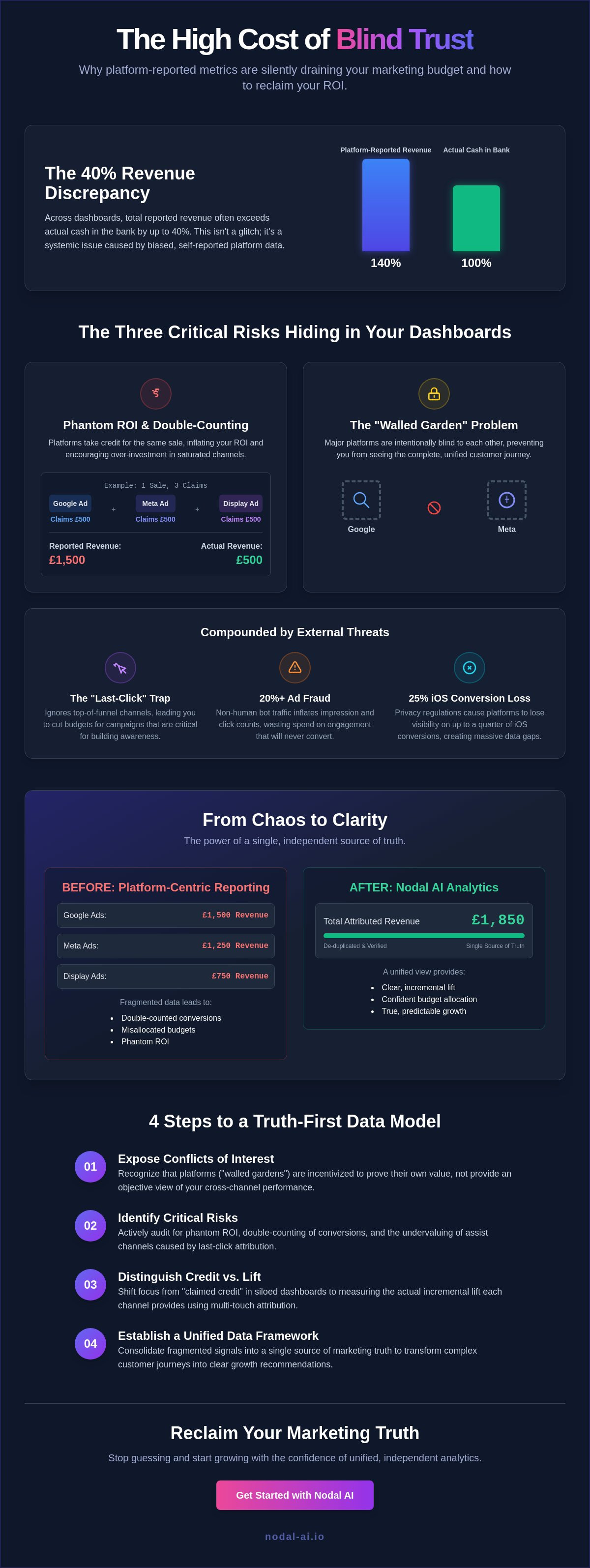
4 Steps to Building a Truth-First Data Governance Model
Identifying the risks of relying on platform-reported metrics is the first step toward reclaiming your marketing truth. Now, you must build a resilient system that protects your budget from the inaccuracies of walled gardens. This transition requires a structured approach to data governance that prioritizes commercial reality over platform optimism. By following these four steps, you can transform your marketing from a series of "black box" bets into a streamlined engine for growth.
- Step 1: Consolidate. Your data is likely scattered across a dozen different logins and dashboards. Move this fragmented input into a unified data governance framework. This creates a single source of truth where every channel is measured by the same rigorous standard, allowing for direct comparison and strategic clarity.
- Step 2: De-duplicate. Ad platforms often count the same user as multiple individuals if they switch from a mobile device to a laptop. Use AI-driven identity resolution to identify the single path to purchase across multiple devices and sessions. This ensures you never pay for the same conversion three times and provides a realistic view of your acquisition costs.
- Step 3: Measure Incrementality. Determine which sales would have happened even if you turned your ads off. This is the only way to prove marketing effectiveness. It identifies where you're simply subsidizing existing demand and where you're driving genuine new business.
- Step 4: Automate. Stop wasting hours on manual spreadsheets that are out of date the moment they're finished. Replace tedious data entry with real-time growth recommendations. This allows your team to pivot spend instantly based on live performance signals, ensuring you never miss a window of opportunity.
From Fragmented Data to Strategic Clarity
Manual reporting is the primary enemy of marketing productivity in London agencies. It traps your smartest people in a cycle of tedious data entry, leaving no room for high-level strategy or creative problem solving. By automating these processes, you trade data chaos for calm efficiency. Clean historical data is essential here; it acts as the foundation for accurate forecasting and future-facing decisions. When your data is integrated and automated, it stops being a passive archive and becomes an active participant in your business process.
Measuring What Actually Matters
Incrementality is the only metric that proves marketing effectiveness. It answers the one question that matters: how many sales would have happened even if you didn't spend a penny on ads? Set up hold-out tests to validate platform claims and mitigate the risks of relying on platform-reported metrics that frequently overstate their own influence. This creates a culture of ruthless transparency in performance reporting. It ensures your budget is always allocated to the channels that drive genuine growth rather than just those that shout the loudest in their own dashboards.
Stop guessing and start growing with data you can actually trust. You can book a demo of the Nodal Platform today to see how we turn fragmented signals into clear growth paths.
Reclaiming Your ROI with Nodal AI
The era of blind trust is over. You have identified the systemic risks of relying on platform-reported metrics and witnessed how they inflate costs while obscuring commercial reality. Now, it's time to transition from defensive data management to offensive strategic growth. Nodal AI provides the clarity required to navigate a fragmented landscape. We turn your marketing spend into a high-performing financial asset rather than a speculative expense. By reclaiming your marketing truth, you stop being a passive observer of platform data and become the architect of your brand's financial future.
In the post-cookie UK market, traditional tracking methods have crumbled. With approximately 75% of iOS users opting out of tracking in 2026, the gap between platform dashboards and actual bank balances has become a chasm. London's most sophisticated marketing teams are moving away from these walled gardens. They're adopting truth-centric analytics that provide a neutral, cross-channel perspective. This shift replaces the anxiety of misallocated budgets with the calm efficiency of integrated intelligence. It's no longer about who claimed the credit; it's about which touchpoint actually drove the incremental lift.
The Nodal Advantage: AI-Powered Precision
The Nodal Platform acts as a cognitive upgrade for your entire marketing organisation. While native pixels struggle with signal loss, our advanced multi-touch attribution models map complex customer journeys with surgical precision. We don't rely on the biased signals of ad networks. Instead, we use server-side tracking and predictive modelling to identify the exact path to purchase. This transforms your data from a chaotic input into a high-value output.
Our "Growth Recommendations" engine takes this a step further. It doesn't just report on what happened; it tells you exactly where to move your next £10,000 for maximum impact. This automated intelligence eliminates the need for manual, tedious analysis. It provides a streamlined perspective that allows you to scale winning channels and cut waste in real-time. By personifying your passive data, we turn it into an active participant in your business process, ensuring every pound spent is working toward a measurable return.
Stop Guessing, Start Growing
Stop guessing and start growing with data you can actually trust. You need a partner that understands the nuances of performance marketing analytics and prioritises your long-term stability over platform-specific vanity. If you are exploring how a specialized team can support these goals, HOT IRON Digital explains the modern role of an agency in navigating this landscape. It's time to demand transparency and reclaim the ROI that is rightfully yours.
Experience the relief of total clarity. Book a demo of the Nodal Platform today to see your true attribution map and discover the hidden growth paths within your data. Move beyond the black box and start leading with the authority of an expert. Your journey from data chaos to profitable growth begins here.
Reclaim Your Strategic Truth
Ad platforms will always prioritize their own growth over your bottom line. By exposing the risks of relying on platform-reported metrics, you've taken the first step toward reclaiming your marketing truth. Moving from fragmented, chaotic inputs to integrated, high-value outputs is no longer a luxury; it's a commercial necessity in 2026. You've seen how "grading their own homework" leads to phantom ROI and misallocated budgets. Now, it's time to replace that anxiety with the confidence of a single source of truth.
You deserve a partner that offers more than just a static dashboard. With London-based expert support and AI-driven multi-touch attribution, we bridge the gap between raw data and actual revenue. For brands interested in expanding their ecosystem into the financial sector, Gemba offers a comprehensive guide to launching branded financial services. Deploy predictive modelling to transform your passive assets into active growth drivers that scale with surgical precision. Stop settling for "good enough" data and start leading with the authority of an expert.
Transform your fragmented data into profitable decisions with Nodal AI. Take control of your customer journey and build a future defined by measurable returns and total transparency. Your path to profitable growth starts now.
Frequently Asked Questions
Why does Meta report more sales than my Shopify or bank account shows?
Meta often reports higher numbers because it tracks "view-through" conversions, claiming credit for users who saw an ad but didn't click. It also operates in a silo and cannot see if another platform like Google also touched the customer. This leads to the double-counting issues inherent in the risks of relying on platform-reported metrics. In 2026, a 20-40% variance between these dashboards and your actual bank balance is considered normal.
What is the "Walled Garden" problem in digital marketing?
Walled gardens are ecosystems like Google and Meta that control both ad delivery and measurement within their own platforms. They don't share data with each other, creating a massive blind spot for your cross-channel strategy. This isolation forces you to guess which channel actually drove the sale. It's a fundamental conflict of interest that prevents you from establishing a single source of truth for your marketing spend.
How does multi-touch attribution differ from standard last-click reporting?
Standard last-click reporting gives 100% of the credit to the final touchpoint before a sale. Multi-touch attribution recognizes the entire journey, distributing value across every interaction from the first awareness-building video to the final search. This ensures that top-of-funnel channels like YouTube aren't undervalued or accidentally cut. It transforms your data from a siloed view into an integrated strategic asset.
Is it possible to track the customer journey without third-party cookies in 2026?
Server-side tracking and first-party data are the primary solutions in a post-cookie landscape. These methods move tracking from the user's browser to your own server, bypassing many privacy-driven blocks. In 2026, approximately 75% of iOS users opt out of standard tracking. Independent platforms use these advanced techniques to maintain accuracy and prevent the typical 15-25% loss in trackable conversions.
What is incrementality and why should I care about it?
Incrementality identifies the sales that occurred only because of your advertising efforts. It ignores customers who were already going to buy through organic search or direct traffic. Caring about incrementality ensures you stop wasting budget on users you've already won. It's the most effective way to prove the true ROI of your marketing spend and eliminate "phantom ROI" from your reports.
How much budget is typically wasted due to inaccurate platform reporting?
Budget waste is largely driven by a combination of ad fraud and data inflation. In 2026, invalid traffic accounts for approximately 20.64% of all ad traffic, meaning one in five dollars is lost to bots. When you factor in the risks of relying on platform-reported metrics that double-count sales, the total waste for many brands can easily exceed 30% of their total marketing budget.
Can AI really predict my future marketing performance?
Predictive modelling uses historical data and real-time signals to forecast future growth paths with high precision. It moves your team from reactive, backward-looking reporting to proactive growth recommendations. By analyzing complex patterns that manual spreadsheets miss, AI tells you exactly where to allocate your next pound for the best return. It serves as a cognitive upgrade for your entire marketing organization.
How long does it take to implement an independent attribution platform?
Most independent platforms can be integrated within a few weeks to begin establishing a baseline of clean data. The process focuses on replacing manual, tedious tasks with automated reporting as quickly as possible. This rapid transition allows your team to move from data chaos to streamlined perspectives without long technical hurdles. You'll start seeing actionable insights almost immediately after the initial setup phase.


