

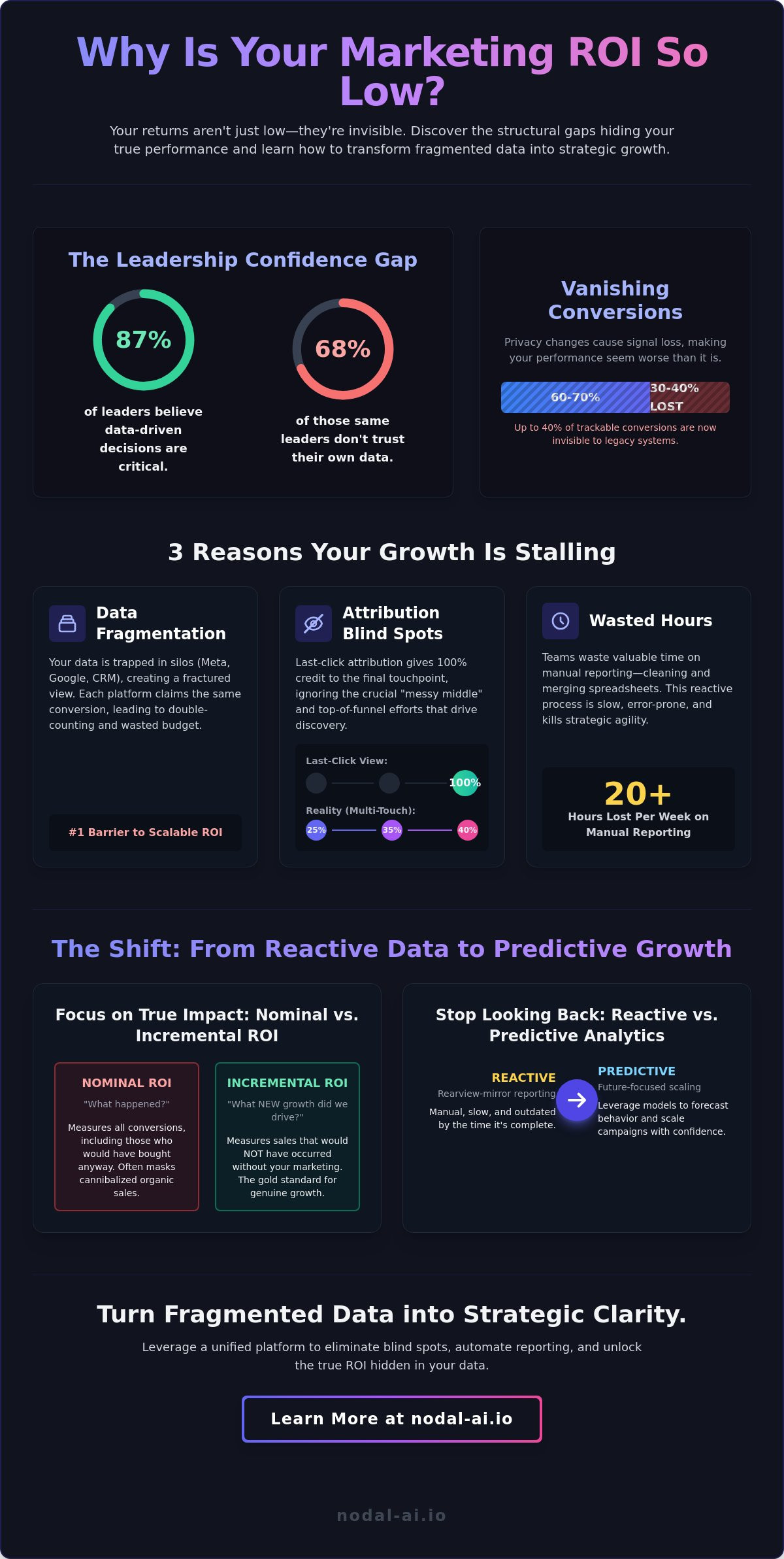
87% of marketing leaders believe data-driven decisions are critical, yet a staggering 68% admit they don't actually trust their own data. If you are looking at your dashboard and asking "why is my marketing roi so low," you aren't alone. It's frustrating to watch your spend increase while returns feel stagnant or invisible. You've likely felt the sting of 30% to 40% of your trackable conversions vanishing due to privacy changes, leaving your team to guess which channels are truly driving growth.
It's exhausting to waste hours on manual reporting only to end up with fragmented insights that don't tell the full story. You deserve a clear, high-level perspective that turns chaotic inputs into high-value outputs. This article will help you bridge those data gaps and eliminate the attribution blind spots that are suppressing your returns. We'll explore five structural reasons your growth is stalling and show you how to reclaim your momentum. You'll learn to shift from reactive reporting to predictive scaling by leveraging Performance Marketing Analytics and Multi-Touch Attribution. It's time to transform your passive data into an active participant in your business growth, mapping every step of the customer journey with absolute clarity.
Key Takeaways
- Identify the invisible touchpoints that mask your true performance and stop letting measurement gaps dictate your growth strategy.
- Break down the data silos that leave you asking "why is my marketing roi so low" to eliminate double-counting and reclaim budget clarity.
- Master multi-touch attribution to identify exactly where your spend is working and stop over-investing in inefficient, low-return channels.
- Move beyond rearview-mirror reporting by using predictive modelling to forecast future behavior and scale your campaigns with confidence.
- Leverage automated reporting and growth recommendations to transform fragmented data into a streamlined, high-level perspective.
The 'Invisible' ROI Problem: Why Your Marketing Returns Look Lower Than They Are
When you look at your performance dashboard and ask, "why is my marketing roi so low," you are likely encountering a measurement failure rather than a creative one. In the privacy-first landscape of 2026, traditional tracking has reached a breaking point. With up to 40% of trackable conversions now lost to signal degradation and cookie deprecation, your reporting tools are essentially operating with a blindfold. This creates a massive gap between your actual performance and your reported figures. We call this the "Invisible ROI" problem, where high-value touchpoints exist but remain unrecorded by legacy systems.
The standard calculation for Return on marketing investment (ROMI) is technically simple, but its execution is fraught with complexity. If your analytics platform only captures 60% of the customer journey, your ROI will look 40% lower than reality. This isn't just a reporting quirk; it's a structural deficit that leads to poor strategic choices. You cannot optimize what you cannot see. To reclaim your growth, you must bridge these data gaps and move beyond nominal figures toward a comprehensive view of how every dollar influences the final sale.
The Fallacy of Last-Click Measurement
Last-click attribution is a dangerous oversimplification that ignores the "messy middle" of the modern customer journey. It gives 100% of the credit to the final interaction, effectively rendering your top-of-funnel awareness campaigns invisible. When you rely on this model, you'll inevitably feel the urge to cut budgets for the very channels that drive discovery. This creates a downward spiral where your brand presence shrinks because your measurement tool can't connect the dots. Attribution bias is the primary cause of miscalculated ROI.
Nominal vs. Incremental ROI: What Leaders Must Know
Nominal ROI tells you what happened, but it rarely explains why. To truly understand performance, you must focus on incrementality. This is the gold standard for marketing performance because it measures the sales that would not have occurred without your specific marketing intervention. Without this perspective, you risk over-investing in campaigns that are simply cannibalising organic sales. High nominal ROI often masks the fact that you're paying for customers who were already going to buy. Stop chasing surface-level metrics and start understanding incrementality to ensure your spend generates genuine, net-new business growth. Transform your reporting from a passive record of the past into an active engine for future scaling.
The Data Fragmentation Trap: How Silos Are Killing Your Performance
Data fragmentation is the silent killer of enterprise growth. When your performance data remains trapped within the silos of Meta, Google, and your CRM, you're looking at a fractured mirror. This lack of a single source of truth is a primary reason you're still asking "why is my marketing roi so low" in 2026. Each platform claims credit for the same conversion, leading to inflated reports and wasted spend. Fragmentation isn't just a technical nuisance; it's the number one barrier to scalable ROI because it prevents you from seeing which touchpoints actually drive value.
Relying on isolated metrics leads to double-counting and strategic stagnation. You need an independent layer to bridge these gaps and provide a unified perspective. This structural shift moves you away from guesswork and toward absolute clarity. If you're ready to see how your data can work harder, consider how the Nodal Platform can unify your tech stack and reveal the true path to profit.
The Hidden Cost of Manual Reporting
Stop wasting your most valuable asset on manual labor. Marketing teams in competitive hubs like London often lose over 20 hours every week just cleaning and merging spreadsheets. This manual process is inherently reactive and dangerously prone to human error. By the time you've finished the report, the data is cold and the opportunity to pivot has passed. Implementing automated reporting recovers this lost time, allowing your experts to focus on strategy rather than data entry. It transforms your team from data janitors into growth architects.
Solving the 'Walled Garden' Problem
Walled gardens like Meta, Amazon, and Google are designed to keep you within their ecosystems. They provide deep insights into their own performance but offer zero visibility into how they interact with other channels. This fragmentation makes it impossible to build a holistic view of the customer journey. To break through, you must look beyond platform-specific marketing attribution models that only tell half the story. An independent AI layer acts as a cognitive upgrade, linking disparate sources to a final goal of total transparency. You'll finally see which channels are supporting each other and which are simply coasting on organic momentum.
Attribution Blind Spots: Are You Measuring the Wrong Things?
Most marketers are flying blind, relying on measurement tools that only tell a fraction of the truth. If you find yourself asking "why is my marketing roi so low," the answer often lies in your attribution logic. When your model fails to account for the complex web of modern interactions, it creates dangerous blind spots. These gaps cause you to over-invest in inefficient, bottom-of-funnel channels while starving the very campaigns that drive initial discovery. You aren't just losing money; you're actively misallocating your growth capital based on a flawed map.
In 2026, the industry has shifted toward a dual-model approach. Leading organizations now use multi-touch attribution (MTA) for tactical, day-to-day decisions alongside Marketing Mix Modelling (MMM) for strategic budget allocation. This combination provides a safety net against signal loss. If your current model is lying to you, these three signs will reveal the deception:
- Platform Discrepancy: Your ad platforms claim 30% more conversions than your bank account or CRM actually records.
- Channel Cannibalization: You increase spend in a "high-ROI" channel, but your total company revenue remains flat.
- The Awareness Void: Your top-of-funnel content shows zero conversions despite being the primary entry point for new leads.
Why Single-Touch Models Underperform in 2026
The modern buying cycle is no longer a straight line. Whether in B2B or B2C, customers now engage with an average of 15 or more touchpoints before converting. Single-touch models, such as first-click or last-click, ignore the entire middle of the funnel. They reward the "closer" while ignoring the "assist." This creates a massive risk of budget misallocation. When you cut spend on the social proof or educational content that nurtured the lead, your last-click performance will eventually crater as the pipeline dries up.
The Rise of AI-Driven Multi-Touch Attribution
AI has transformed attribution from a static guess into a precise science. Modern systems assign fractional credit to every interaction in the journey, from the first LinkedIn impression to the final email click. This reveals the true ROI of content marketing and brand-building activities that traditional tools miss. It's a cognitive upgrade for your entire organization. Using ai marketing analytics removes the guesswork from attribution, allowing you to scale with the confidence that every pound spent is contributing to measurable growth. Stop guessing and start scaling based on the full picture of customer behavior.
From Reactive to Predictive: Reclaiming Your ROI with Intelligence
Driving your business by looking at last month's performance is like driving a car by looking in the rearview mirror. It tells you where you've been, but it does nothing to help you navigate the road ahead. If your strategy relies solely on historical reports, it's no wonder you're asking "why is my marketing roi so low" when market conditions shift. Reactive reporting is a stagnant practice that leaves you vulnerable to expensive failures. You need a forward-facing perspective that identifies opportunities before they vanish.
The solution lies in predictive modelling. By transforming passive data into active intelligence, you can forecast future outcomes with surgical precision. This shift from hindsight to foresight is what separates market leaders from those struggling to justify their spend. It replaces the anxiety of "what happened" with the confidence of knowing exactly what will work next. Organizations that stop asking "why is my marketing roi so low" and start using AI analytics see an average 19% improvement in marketing ROI within the first year. This isn't just a marginal gain; it's a cognitive upgrade for your entire organization.
How Predictive Modelling Forecasts Future Returns
Predictive modelling uses AI to analyze your historical performance alongside real-time market data. Instead of waiting for a campaign to fail, the system identifies negative trends in their infancy. This mechanism creates a protective shield around your budget. It allows for pre-emptive budget shifts, moving capital from declining segments into high-performing channels before your competitors even notice a change. This proactive approach significantly reduces wasted spend. It ensures every pound is working toward a documented, future-facing goal rather than chasing ghosts of past success. You gain the ability to simulate different spending scenarios, seeing the likely outcome of a budget increase before you commit a single penny.
Implementing Growth Recommendations
Growth recommendations are the bridge between raw data and strategic action. These are not just observations; they are actionable, AI-generated strategy shifts designed for immediate impact. When your analytics platform provides these insights, you can optimize ad spend in real-time. You move from questioning the past to executing the future. This transition empowers your team to act with speed and authority, focusing on strategy rather than data entry. It turns your marketing department into a profit center. Ready to stop looking back? Explore how Nodal AI generates growth recommendations to scale your marketing returns today.
The Nodal Platform: Turning Fragmented Data into Strategic Clarity
Nodal AI is the London-based answer to the chaos of modern enterprise marketing. We've spent the previous sections identifying the structural failures that keep you asking "why is my marketing roi so low," but identifying the problem is only half the battle. You need a platform that automates the journey from raw, siloed data to actionable growth. By unifying your Performance Marketing Analytics into a single, high-level perspective, Nodal replaces the anxiety of manual reporting with the confidence of streamlined efficiency. Fragmentation is a choice; clarity is a strategic advantage.
It's time to stop fighting with spreadsheets and start scaling with a cognitive upgrade designed for the future of commerce. Our platform transforms your passive data into active participants in your business process. This isn't just about better charts. It's about a fundamental shift in how you perceive and capture value. You move from a state of overwhelm to a state of total clarity, where every decision is backed by predictive modelling and multi-touch attribution.
Unified Analytics for London Enterprises
High-growth UK teams manage some of the most complex tech stacks in the world. Nodal AI simplifies this complexity through seamless integration, ensuring your transition from fragmented inputs to high-value outputs is effortless. Our onboarding process is designed for speed, allowing your team to reclaim hours of productivity within days. You no longer need to wait for end-of-month cycles to understand your performance. Real-time insights allow for real-time wins.
Beyond performance, the platform provides a robust data governance framework to protect your assets while maintaining total transparency. You gain the security of an enterprise-ready system without the need for deep technical specialization. This empowers your marketing leaders to act with the authority of an expert, knowing their data is clean, secure, and unified across every touchpoint.
Your Roadmap to 19% Higher ROI
Reclaiming your returns isn't a long-term dream; it's a 30-day tactical plan. Within the first month of implementing Nodal, you can expect to fix your attribution blind spots and unify your fragmented data streams. Research shows that companies implementing AI marketing analytics see an average 19% improvement in ROI within the first year. The relief that comes from finally having a single source of truth is transformative. It replaces guesswork with a clear roadmap for scaling.
You'll stop wondering "why is my marketing roi so low" and start executing on precise growth recommendations that move the needle. This roadmap takes you through a logical journey toward total optimization:
- Integration: Connect Meta, Google, and your CRM in a single, unified environment.
- Clarity: Deploy multi-touch attribution to see every interaction in the customer journey.
- Automation: Use automated reporting to eliminate 20+ hours of manual spreadsheet labor per week.
- Scaling: Follow AI-driven growth recommendations to invest where the data proves it works.
Transform your fragmented marketing data into profitable decisions with Nodal AI. It's time to turn your measurement gaps into your greatest competitive advantage and lead your sector with confidence.
Reclaim Your Growth with Strategic Clarity
Low returns are rarely a sign of bad marketing. They're a symptom of fragmented intelligence. When you stop asking "why is my marketing roi so low" and start addressing the structural blind spots in your data, you unlock the ability to scale with precision. You've seen how legacy measurement and data silos suppress your actual performance. By unifying your customer journey and moving toward predictive modelling, you transform your reporting from a passive record into an active engine for revenue.
Nodal AI provides the London-based expertise needed to navigate this transition. We turn chaotic inputs into high-value outputs through automated multi-touch attribution and predictive growth recommendations. It's time to replace the anxiety of manual spreadsheets with the confidence of a cognitive upgrade. You'll finally see where your spend is truly working and where it can be optimized for maximum impact.
Book a Nodal AI demo to fix your marketing attribution today
You have the tools to move beyond reactive reporting. Start leading your sector with absolute clarity and the measurable returns your brand deserves.
Frequently Asked Questions
Why does my Facebook Ads ROI differ from my Google Analytics ROI?
Discrepancies occur because each platform uses different attribution logic and tracking windows. Facebook might claim a conversion based on a view from seven days ago, while Google Analytics often relies on last-click session data. This fragmentation is a primary reason you might wonder why is my marketing roi so low when comparing disparate dashboards. You need a unified layer to reconcile these conflicting signals into a single source of truth.
How can I calculate marketing ROI if my sales cycle is six months long?
Long sales cycles require a shift from immediate returns to comprehensive customer journey mapping. Instead of waiting half a year for a final sale, track micro-conversions like whitepaper downloads or webinar attendance that correlate with eventual revenue. By assigning fractional value to these early-stage interactions through multi-touch attribution, you gain a clearer picture of future returns. This approach turns your long-term pipeline into a predictable asset rather than a measurement black hole.
Is last-click attribution still relevant in 2026?
Last-click attribution is largely obsolete for modern buying journeys that now average 15 or more touchpoints. While it provides a simple snapshot of the final interaction, it completely ignores the awareness and consideration phases that nurtured the lead. Relying on this model leads to cutting budgets for the very channels that fuel your pipeline. Modern teams have moved toward multi-touch attribution to capture the true value of every interaction across the journey.
What is a 'good' marketing ROI for a B2B SaaS company?
A healthy benchmark for B2B SaaS is typically a 3:1 or 4:1 ratio of lifetime value to customer acquisition cost. Verified data shows that SEO for B2B can yield a 748% return when executed with precision, which is why growth partners like Tools N Tactics focus on high-visibility search strategies to maximize these results. If your figures fall below these industry marks, it's time to investigate whether measurement gaps or data silos are making your performance look weaker than it actually is. Strategic clarity often reveals hidden profit.
Can AI really predict which marketing campaigns will be successful?
AI uses predictive modelling to analyze historical performance and market trends to forecast future outcomes with high accuracy. It identifies patterns that are invisible to manual analysis, such as which audience segments are likely to convert under specific market conditions. This allows you to shift budgets pre-emptively into high-performing areas before spend is wasted. It replaces the guesswork of traditional planning with data-backed growth recommendations that protect your commercial capital.
How do I measure the ROI of brand awareness and content marketing?
Content marketing generates an average 3:1 return but often looks lower due to attribution blind spots. To measure it accurately, you must use multi-touch attribution to see how awareness content "assists" later conversions. Tracking metrics like branded search lift and assisted conversion value provides a concrete weight to these top-of-funnel efforts. It transforms content from a perceived cost into a documented growth driver that feeds the entire sales ecosystem.
What is the difference between ROAS and ROI in digital marketing?
ROAS measures gross revenue generated for every pound spent on advertising, while ROI accounts for your total investment including staff, software, and overheads. ROAS is a tactical metric for ad efficiency; ROI is a strategic metric for overall business profitability. Understanding this distinction is vital when asking why is my marketing roi so low, as high ad efficiency doesn't always translate to commercial success. You must look at the total cost of acquisition to find the truth.


