

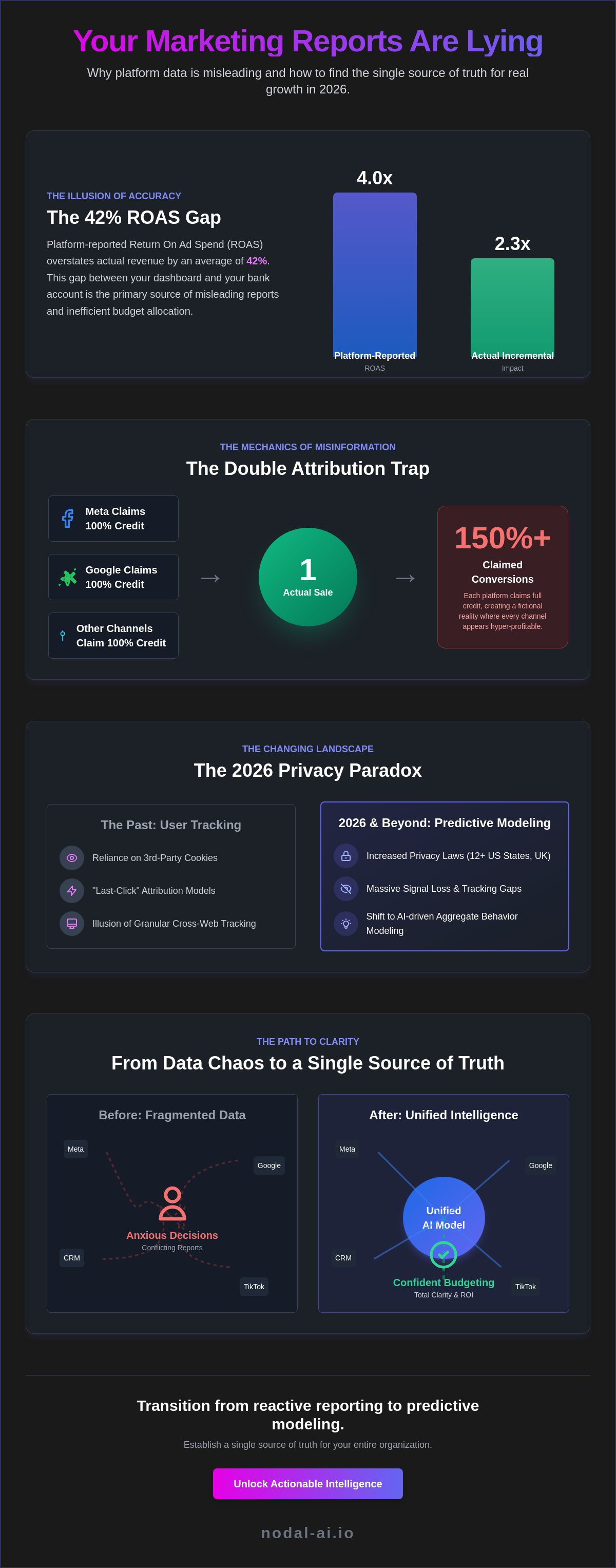
Platform-reported Return on Ad Spend (ROAS) currently over-reports revenue by an average of 42 percent compared to the actual incremental impact of your campaigns. This massive discrepancy is the core reason why your marketing reports are misleading, leaving you to bridge the gap between optimistic dashboards and stagnant revenue. You likely spend hours every week reconciling conflicting data between Meta and Google while facing increased pressure to prove ROI. As 2026 privacy laws in states like Indiana and Kentucky further degrade your tracking signals, the traditional way of measuring success is officially broken.
It's frustrating to manage a budget when you can't trust the numbers. We understand the exhaustion that comes from manual reporting and the anxiety of navigating a post-cookie landscape where twelve U.S. states now mandate Global Privacy Control signals. This article identifies the structural flaws in standard analytics and shows you how to transition from fragmented data to actionable, AI-driven intelligence. You'll discover how to establish a single source of truth that provides total confidence in your budget allocation. We'll explore how to unlock automated insights that drive growth without requiring a data science degree.
Key Takeaways
- Identify how platform-biased narratives distort your view of the customer journey and discover why your marketing reports are misleading in a fragmented 2026 landscape.
- Expose the "Double Attribution Trap" where walled gardens like Google and Meta claim credit for the same conversion, artificially inflating your perceived success.
- Shift your focus from siloed ROAS to incrementality to recover the growth typically lost to inefficient budget allocation and hidden operational costs.
- Implement a strategic data governance framework to turn chaotic, manual inputs into high-value, automated intelligence.
- Transition from reactive reporting to predictive modeling using the Nodal Platform to establish a single, unified source of truth for your entire organization.
The Illusion of Accuracy: Why Digital Dashboards Lie in 2026
Your digital dashboard is a storyteller, not a scientist. In 2026, the data flashing on your screen is often a platform-biased narrative designed to justify ad spend rather than reflect objective reality. This is exactly why your marketing reports are misleading. While these tools claim to offer a real-time view of performance, they actually provide an incomplete snapshot of a complex, multi-touch journey. They capture the final click but ignore the weeks of consideration, dark funnel conversations, and cross-device research that actually drove the sale. Relying on these fragmented signals creates a dangerous illusion of accuracy. It leaves marketing leaders in a state of constant anxiety, forced to present inflated numbers to stakeholders while knowing the bank balance tells a different story. Fragmented data has become the primary antagonist of your growth, acting as a silent tax on every dollar you deploy.
The Gap Between Platform ROI and Bank Balance
Platform-reported conversions rarely align with your CRM revenue. Meta might claim a 4x return while your actual bank deposits suggest something much lower. This happens because platforms optimize for vanity metrics that look impressive in a slide deck but fail to drive EBITDA. They ignore the nuances of marketing attribution models, often claiming credit for sales that would have happened anyway. When you see a 35 percent discrepancy between your dashboard and your accounting software, you're witnessing the cost of platform ego. Data Friction is the discrepancy between digital signals and financial outcomes.
Stop treating platform data as a financial statement. These numbers are directional at best and deceptive at worst. To protect your margins, you must audit your existing data sources for fragmentation and duplication. Transitioning from platform-reported success to incremental growth requires a brutal look at where your money actually goes. High-value outputs only emerge when you eliminate the noise of self-serving algorithms.
The 2026 Privacy Paradox
The 2026 Privacy Paradox has intensified this confusion. Updated UK data privacy standards and the final decline of the third-party cookie have stripped away the granular tracking we once took for granted. Signal loss is no longer a future threat; it is your current reality. You can't track individuals across the web with the precision of five years ago. This creates a massive hole in your reporting that most standard analytics tools try to fill with guesswork.
Success in 2026 requires a fundamental shift in your strategy. You must move away from stalking individual users and start modeling aggregate behaviors. This transition replaces the fiction of perfect tracking with the strategic certainty of predictive intelligence. Embrace the complexity of the modern landscape. By accepting that some data will always be obscured, you can build more resilient systems that focus on long-term stability rather than temporary digital ghosts. Model your success, don't just track it.
The Mechanics of Misinformation: From Walled Gardens to Double Attribution
The math inside your marketing dashboard is fundamentally broken. If you add up the conversions reported by Meta, Google, and TikTok, you'll likely find they claim responsibility for 150 percent of your total sales. This is the Double Attribution Trap. It happens because each platform operates in a vacuum, claiming full credit for any user who touched their ecosystem before buying. They don't care if that customer also clicked three search ads and a retargeting banner. This self-serving logic is a primary reason why your marketing reports are misleading. It creates a fictional reality where every channel appears profitable, even as your overall margins shrink.
Relying on "Last-Click" logic only deepens the crisis. This outdated method ignores the 90 percent of the customer journey that happens before the final tap. It rewards the closer while ignoring the playmakers that built the brand awareness and intent. To fix this, you must adopt multi-touch attribution to bridge these gaps and see the full picture. Without a unified view, you're making high-stakes budget decisions based on platform-specific fairytales.
The Walled Garden Problem
Google and Meta have built "Walled Gardens" that refuse to share data with each other. They over-report their own influence to encourage more ad spend, hiding behind "black box" bidding algorithms that lack transparency. These algorithms prioritize their own bottom line over your business objectives. This lack of cross-platform communication leads to massive amounts of inaccurate marketing data that confuses even the most experienced CMOs. The Nodal Platform acts as an independent arbiter to settle these disputes. By connecting disparate data points, it reveals which channels are actually driving growth and which are simply taking credit for existing demand.
Signal Decay and the Attribution Crisis
The technical reality of 2026 has made traditional tracking nearly impossible. Ad-blockers and privacy-focused browsers like Safari and Brave actively break standard reports. In the U.S., twelve states now legally mandate that websites honor the Global Privacy Control (GPC) signal, further accelerating signal decay. You can't rely on the old ways of tracking pixels. Probabilistic modelling is the only viable path forward for organizations that value accuracy. It uses machine learning to fill the gaps left by privacy regulations, providing a reliable forecast of performance without infringing on user rights. Attribution isn't dead; it just requires a higher IQ. You can explore our platform to see how we transform these decaying signals into strategic certainty.
Beyond ROAS: Why Your Primary KPI is Costing You 35% in Growth
Most marketing leaders are trapped in an efficiency loop that actively suppresses their scale. They rely on Return on Ad Spend (ROAS) as their primary compass, but this metric is often a siloed calculation that ignores variable margins and operational overhead. This narrow focus is a fundamental reason why your marketing reports are misleading. When you optimize purely for ROAS, you're essentially telling your algorithms to find the cheapest possible conversions, even if those customers have zero long-term value or would have purchased without the ad. This "Efficiency over Growth" trap can cost an enterprise up to 35 percent in potential revenue. To break free, you must shift your focus from what happened in the past to what will happen next through predictive modelling.
The Flaw in Last-Click Logic
Imagine a football team where only the striker receives a salary because they touched the ball last before it hit the net. The midfielders who orchestrated the play and the defenders who won back possession are treated as zero-value assets. This is the absurdity of last-click logic. It over-funds "brand search" terms while starving the "discovery" channels that actually introduce new customers to your ecosystem. This imbalance is one of the common challenges in marketing data analytics that prevents true scalability. Use this checklist to identify last-click bias in your current stack:
- Does your "top-performing" campaign target existing customers or your own brand name?
- Is your customer acquisition cost (CAC) calculated without accounting for platform double-counting?
- Are you under-investing in top-of-funnel channels because they don't show immediate direct-click revenue?
Incrementality: The Key to True Marketing ROI
Incrementality is the only metric that reveals the true causal impact of your ad spend. It asks a simple, brutal question: "Would this sale have happened anyway?" If the answer is yes, then your ad didn't drive growth; it simply cannibalized an existing organic sale. Over-optimizing for bottom-of-funnel conversions often leads to this "Cannibalisation" effect, where you pay for customers who were already standing at the checkout line.
True marketing intelligence requires identifying the "Incremental Lift" of specific channels like YouTube or Digital PR. These channels often build the intent that other platforms eventually claim. By using AI to isolate these variables, you can stop subsidizing sales you already owned. This transition replaces the comfort of inflated dashboard numbers with the confidence of actual, measurable growth. Audit your spend. Eliminate the waste. Focus on the lift that actually moves the needle on your EBITDA.
Reclaiming Reality: A Framework for Strategic Data Clarity
Identifying the fiction in your data is only the first step. To drive actual growth, you must implement a rigorous technical roadmap that replaces guesswork with precision. A lack of structural discipline is precisely why your marketing reports are misleading. When you rely on siloed inputs, you invite the fragmentation that suppresses your ROI. Follow this five-step framework to transform your chaotic data into a single source of truth.
- Step 1: Audit your data sources. Scan for fragmentation and duplication. If three platforms claim the same sale, your foundation is compromised.
- Step 2: Establish a data governance framework. Ensure high-quality inputs by standardizing how data enters your ecosystem.
- Step 3: Move to automated reporting. Ditch the manual spreadsheets that invite human error and stale insights.
- Step 4: Integrate multi-touch attribution. Map the entire customer journey to see every touchpoint that contributes to revenue.
- Step 5: Apply predictive modelling. Use your unified data to allocate future budgets with mathematical certainty.
Implementing Multi-Touch Attribution
Standard attribution models are often too blunt for the 2026 landscape. Linear models give equal credit to every touchpoint, while time-decay models favor the end of the funnel. Neither captures the true complexity of modern behavior. Forward-thinking London enterprises are abandoning "off-the-shelf" GA4 configurations in favor of custom, AI-driven models. These bespoke frameworks identify the unique weight of every interaction. The Nodal Platform unifies these disparate touchpoints, acting as the cognitive upgrade your organization needs to settle platform disputes. Stop guessing which ads worked. Start knowing. This clarity is the only way to fix why your marketing reports are misleading and reclaim your wasted budget.
The Role of Automated Reporting
Manual data collection is a productivity killer. London teams are currently reclaiming 20 or more hours every month by automating their reporting workflows. This shift transforms your staff from "Data Gatherers" into "Strategic Decision Makers." Instead of wasting days cleaning spreadsheets, your team can focus on high-level optimization and growth recommendations. Automated systems ensure your data is always "board-ready," providing the transparency and clarity required for high-stakes budget discussions. You can book a demo of the Nodal Platform to see this efficiency in action. Replace the anxiety of manual labor with the confidence of real-time, actionable intelligence.
Transforming Fragmented Data into Strategic Certainty with Nodal AI
Stop fighting with spreadsheets and start leading with logic. The Nodal Platform acts as the critical bridge between your current data chaos and future profitable decisions. We've explored why your marketing reports are misleading, from the self-serving narratives of walled gardens to the technical decay of tracking signals. Nodal AI eliminates these fictions by unifying your entire marketing stack into a single, cohesive intelligence. It transforms passive data points into active participants in your business strategy, ensuring every pound spent is a pound accounted for. This transition replaces the anxiety of manual reconciliation with the confidence of streamlined, high-level perspectives.
The power of AI marketing analytics lies in its ability to identify hidden trends that standard dashboards simply cannot see. While your current tools report on surface-level clicks, the Nodal engine digs deeper to find the correlations between disparate channels. This isn't just about collecting data; it's about generating high-value Growth Recommendations. These actionable outputs tell you exactly where to scale and where to cut, replacing the anxiety of "maybe" with the strategic certainty of "must." By promising to turn chaotic inputs into high-value outputs, we provide the clarity you need to dominate your sector.
The Nodal Advantage: Beyond Simple Dashboards
Most tools provide a flat, two-dimensional view of the world. Nodal maps the complex, multi-dimensional customer journeys that define the 2026 landscape. This is your cognitive upgrade. It provides a level of foresight that allows you to anticipate market shifts rather than just reacting to them. We understand that security is a primary concern for the modern professional. Nodal maintains a rigorous commitment to GDPR and UK-specific data security standards, ensuring your high-level protection of assets. Your data remains protected while it works harder for your bottom line. It's a sophisticated solution for users who need results without deep technical specialization.
Next Steps: From Fiction to Fact
Transitioning from fiction to fact is a streamlined process. Our onboarding team guides you through the integration of your existing channels, ensuring a frictionless setup that respects your time. Once live, the impact of a unified attribution model is immediate. You'll see the true incremental lift of your campaigns and gain the transparency required to justify every budget increase to the board. Stop settling for platform-biased narratives that drain your resources. Transform your marketing data with Nodal AI today. It's time to reclaim your reality and focus on measurable returns.
Master Your Marketing Reality
The era of accepting digital fiction is over. You now understand exactly why your marketing reports are misleading and how the structural flaws of walled gardens have suppressed your potential. By moving beyond siloed ROAS and embracing incrementality, you transform passive data into a cognitive upgrade for your entire organization. This transition replaces the anxiety of manual reconciliation with the confidence of streamlined, high-level perspectives.
London enterprises already recognize Nodal as the leader in multi-touch attribution. Our partners reclaim over 20 hours per week by automating their reporting workflows. They also achieve revenue increases of up to 30 percent through our AI-driven growth recommendations. Don't let fragmented data dictate your future when you can lead with mathematical certainty. It's time to bridge the gap between digital signals and actual financial outcomes.
Book a demo of the Nodal Platform and uncover your true ROI
The transition from complexity to growth is inevitable when you have the right partner. Take the first step toward total clarity and start making the profitable decisions your business deserves today.
Frequently Asked Questions
Why do Google Ads and Meta Ads show different conversion numbers?
Google and Meta use different attribution windows and methodologies to claim credit for the same sale. This lack of communication is a primary reason why your marketing reports are misleading, as each platform operates as a walled garden. They prioritize their own ecosystem, often over-reporting their influence by an average of 42 percent to justify and encourage higher ad spend.
What is the most accurate marketing attribution model in 2026?
AI-driven multi-touch attribution is the gold standard for accuracy in 2026. Unlike static models that give arbitrary weight to the first or last click, AI analyzes every touchpoint in the journey to identify true causal impact. This model adapts to signal loss by using probabilistic modelling, ensuring your budget allocation remains based on reality rather than digital ghosts.
How much revenue am I losing to misleading marketing reports?
Enterprises typically lose up to 35 percent in potential growth when they rely on siloed metrics like ROAS. Inaccurate data is why your marketing reports are misleading and often leads to over-funding brand search while starving discovery channels. This inefficiency acts as a silent tax on your budget, draining resources that should be fueling your next phase of expansion.
Can AI truly solve the attribution problem in a privacy-first world?
AI solves the attribution problem by shifting the focus from tracking individuals to modelling aggregate behaviours. It uses advanced pattern recognition to fill the gaps left by privacy mandates and signal decay. This allows you to maintain strategic certainty in a post-cookie landscape without compromising user privacy or violating updated 2026 data standards in the UK or US.
What is the difference between reporting and growth recommendations?
Reporting is a historical record of past events, while growth recommendations are forward-looking blueprints for future profit. Most tools stop at telling you what happened yesterday. The Nodal Platform goes further, using predictive modelling to provide actionable steps that tell you exactly where to reallocate budget for maximum incremental lift and long-term stability.
Is multi-touch attribution worth the investment for mid-sized UK businesses?
Multi-touch attribution is a high-value investment for mid-sized UK businesses looking to scale efficiently. Beyond improved accuracy, the automation involved allows teams to reclaim over 20 hours per week previously wasted on manual data cleaning. This efficiency transforms your marketing department from a cost center into a high-performance growth engine that delivers measurable returns.
How does Nodal AI handle GDPR and data privacy?
Nodal AI prioritizes high-level protection of assets by adhering to strict GDPR and UK-specific security standards. Our platform uses a model-based approach that doesn't require sensitive personal information to deliver accurate insights. We ensure your data remains secure while providing the transparency needed to satisfy both your board and regulatory bodies through every step of the journey.
What is incrementality and why does it matter more than ROAS?
Incrementality measures the actual causal impact of an ad, whereas ROAS often includes sales that would have occurred organically. It matters more because it identifies "Cannibalisation," where you pay for customers who were already going to buy. Focusing on incrementality ensures every pound spent generates a sale that wouldn't exist without your marketing intervention, protecting your overall EBITDA.


