

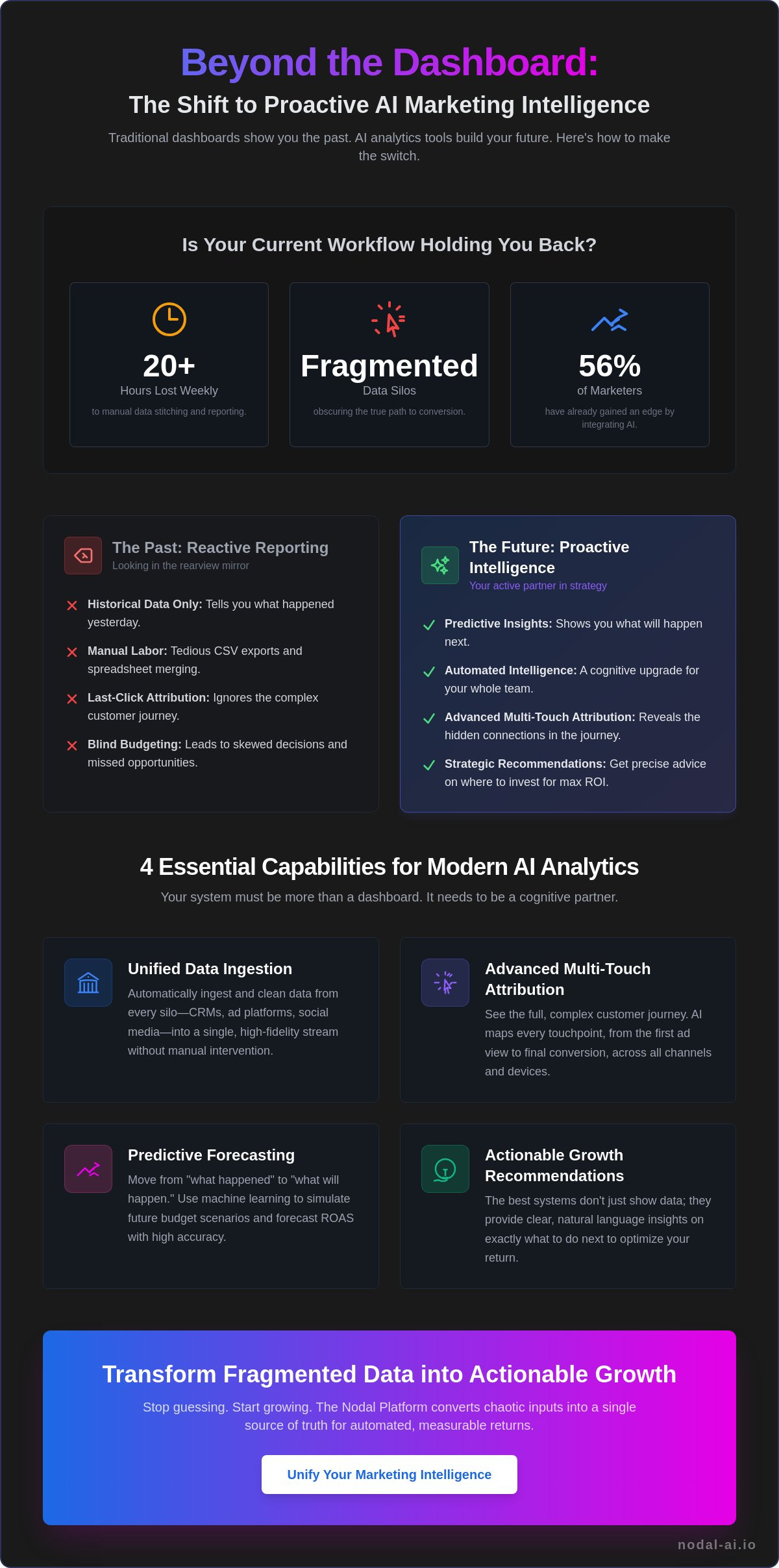
Your current marketing dashboard is likely a graveyard of historical data; it tells you what happened yesterday while remaining silent about what will happen tomorrow. If you're losing 20 hours every week to manual reporting and wrestling with fragmented data silos, you aren't just wasting time; you're losing the competitive edge that 56% of marketers have already gained by integrating AI into their data workflows. Modern ai marketing analytics tools are no longer passive displays of metrics. They've evolved into active cognitive upgrades that unify disjointed customer journeys into a single, crystalline source of truth.
We understand the frustration of inaccurate multi-touch attribution and the anxiety of blind budget allocation. This guide will show you how to evaluate and implement systems that transform chaotic inputs into precise growth recommendations. You'll discover how to move beyond basic reporting to achieve predictive accuracy that secures your bottom line. We'll explore the transition from manual labor to automated intelligence, ensuring your marketing stack becomes a proactive engine for measurable returns.
Key Takeaways
- Learn why traditional dashboards are failing and how to transition your strategy toward proactive, predictive intelligence.
- Identify the four essential capabilities for ai marketing analytics tools, including automated data ingestion and advanced multi-touch attribution.
- Understand the critical differences between generalist BI tools and specialized analytics platforms to avoid the common "Build vs. Buy" trap.
- Follow a phased implementation strategy to map your data silos and integrate historical insights without disrupting your current workflow.
- Discover how the Nodal Platform converts fragmented intelligence into a single source of truth for automated growth recommendations.
Beyond Dashboards: The 2026 Shift in AI Marketing Analytics Tools
Stop looking in the rearview mirror. For years, marketing teams treated dashboards as the final destination. In 2026, those static visualizations are effectively obsolete. Modern ai marketing analytics tools have moved beyond simple reporting; they've become proactive intelligence engines. They don't just show you numbers; they tell you exactly how to grow. This is the shift from reactive observation to proactive intelligence, where your data stops being a passive record and starts being an active partner in your strategy.
The "Fragmented Data Trap" is the primary barrier to this evolution. You likely have more data than ever before, but it's trapped in silos across social platforms, CRM systems, and ad managers. This fragmentation creates a fog of war that obscures the true path to conversion. While traditional BI tools offer visibility, they often require heavy engineering and manual intervention to make sense of the mess. AI-driven platforms act as a cognitive upgrade for your organization, personifying passive assets and turning them into active participants in your business process. They remove the ambiguity that has plagued marketing departments for decades.
The Death of Last-Click and Manual Reporting
Manual data stitching is a relic of a slower era. If your team spends every Monday exporting CSVs and merging spreadsheets, you're losing the race before it starts. This manual labor isn't just tedious; it's expensive. Relying on outdated models like last-click attribution ignores the complex, multi-touch reality of the modern customer journey. It leads to skewed budget decisions and missed opportunities. AI identifies subtle patterns across millions of data points at a scale no human analyst can match, revealing the hidden connections between disparate touchpoints.
From Data Visibility to Strategic Intelligence
The real value lies in moving from "what happened" to "what will happen next." High-performing teams use Predictive analytics to anticipate market shifts and consumer behavior before they occur. By automating the reporting process, organizations reclaim over 20 hours of team productivity every single week. This shift allows your best minds to focus on high-level strategy rather than entry-level data entry. Implementing robust predictive modelling provides the essential foundation for sustainable growth in 2026, ensuring your budget is always allocated where it generates the highest measurable return.
4 Essential Capabilities Every AI Marketing Analytics Tool Needs
Investing in the wrong stack is a silent tax on your growth. To thrive in 2026, your selection of ai marketing analytics tools must go beyond basic data visualization. You need a system that acts as a cognitive partner, not just a digital filing cabinet. Look for these four non-negotiable capabilities to ensure your team moves from fragmented chaos to streamlined performance.
- Unified Data Ingestion: Your tool must automatically ingest and clean data from every silo. It should turn mismatched naming conventions and broken tracking codes into a single, high-fidelity data stream without manual intervention.
- Advanced Multi-Touch Attribution: Look for platforms that peer over the walls of closed ecosystems. You need to see the full journey, from the first touchpoint to the final conversion, across every channel and device.
- Predictive Forecasting: Static reports are history. Modern tools use machine learning to simulate future budget scenarios and ROAS. This allows you to test the impact of a 20% spend increase before you commit a single dollar.
- Actionable Growth Recommendations: The best systems provide natural language insights. Instead of making you hunt for trends, they tell you exactly what to do next to optimize your return.
If you're tired of guessing which channels actually drive revenue, it's time to upgrade. You can unify your marketing intelligence today and replace manual reporting with automated clarity.
Solving the Multi-Touch Attribution Puzzle
Cross-channel visibility is no longer a luxury; it's a requirement for survival. In 2026, the path to purchase is rarely linear. AI maps complex customer journeys across multiple devices, ensuring every touchpoint receives the credit it deserves. This level of transparency allows you to measure incrementality, which is the only way to determine your true marketing ROI. By isolating the specific actions that actually influence a sale, you stop wasting budget on "vanity" clicks that would have happened anyway.
Predictive Lead Scoring and Budget Optimization
Machine learning doesn't just look backward; it prioritizes high-value prospects before they even convert. By analyzing thousands of behavioral signals, AI identifies which leads are most likely to close. Predictive lead scoring is the use of historical patterns to rank future conversion probability. This intelligence allows you to simulate "what-if" scenarios for ad spend allocation. You can shift budgets in real-time toward the segments showing the highest potential, maximizing your efficiency while your competitors are still waiting for end-of-month reports.
Evaluating the Landscape: Specialized Attribution vs. Generalist BI
Choosing the right architecture is a defining moment for your growth trajectory. Many enterprise organizations face the "Build vs. Buy" dilemma, wondering if they should construct custom dashboards in generalist BI tools like Tableau or Looker. While these platforms are powerful for broad business intelligence, they often fail marketing teams. They are passive containers that require heavy engineering to handle the nuances of marketing data. Without a dedicated team of data scientists to build complex attribution logic, these tools become expensive mirrors reflecting fragmented, low-value data.
The rise of outcome-specific ai marketing analytics tools has changed the calculation. These platforms are designed specifically for performance marketing, coming pre-equipped with the intelligence to handle marketing-specific challenges. When evaluating your options, use this three-part framework to guide your decision:
- Data Volume: Can the tool handle millions of events across dozens of channels without slowing down?
- Integration Complexity: Does it offer native, stable connectors for your entire stack, or will you need custom API work?
- Output Speed: How quickly can the system turn raw data into a recommendation you can actually use?
Stop settling for tools that require constant maintenance. Your analytics should be a cognitive upgrade for your team, providing the clarity you need to outpace the competition. Move away from tools that simply store data and embrace systems that actively drive your growth.
When to Choose a Marketing-Specific AI Platform
Speed is your most valuable asset. Marketing-specific platforms offer pre-built connectors and attribution logic that allow for a near-instant "time-to-insight." You don't have to wait months for an engineering sprint to see which campaigns are performing. These tools also include built-in data governance, preventing your analytics from turning into a "data swamp" of conflicting metrics. They ensure your team works from a single source of truth, replacing the anxiety of manual reporting with the confidence of automated precision.
The Limitations of Native Ad Platform Analytics
Relying solely on Google or Meta analytics is a dangerous gamble. These platforms only tell half the story; they are designed to show their own value, creating a "walled garden" bias in your reporting. They often double-count conversions or ignore touchpoints that happen outside their ecosystem. To get an unbiased, third-party view of your performance, you need a dedicated system for ai marketing analytics. This ensures you see the full customer journey, allowing you to allocate budget based on actual contribution rather than platform-specific claims. Don't let the networks mark their own homework. Implement a neutral arbiter to protect your margins and maximize your ROAS.
How to Implement AI Analytics Without Disrupting Your Workflow
Don't let the fear of technical debt stall your progress. Implementing ai marketing analytics tools doesn't require a total overhaul of your existing stack. Instead, it's about a structured transition from manual chaos to automated clarity. By following a phased approach, often supported by an AI consultancy for SMEs UK, you can integrate sophisticated intelligence into your workflow without disrupting your daily operations. This isn't just a software installation; it's a strategic upgrade for your entire growth engine.
- Phase 1: Data Audit and Source Identification. Map your silos. Identify where data is leaking and where fragmentation is most severe. This audit is the first step toward total clarity.
- Phase 2: Integration and Historical Data Ingestion. Connect your stack. Ingest your historical data to build a robust foundation that allows the AI to understand your unique business cycles.
- Phase 3: Model Training and Baseline Attribution. Establish the truth. Let the machine learning models analyze your specific customer journeys to create an accurate, unbiased baseline for attribution.
- Phase 4: Scaling with Automated Growth Recommendations. Execute the strategy. Transition from reviewing reports to acting on proactive insights that drive measurable returns.
Start your journey toward predictive growth and book your platform walkthrough to see these implementation phases in action.
Navigating Data Governance and GDPR
UK enterprises must navigate a complex regulatory environment, especially with the EU AI Act's transparency obligations becoming fully applicable as of August 2, 2026. You need a robust data governance framework to ensure your tracking remains privacy-compliant in a cookieless world. Modern ai marketing analytics tools utilize clean rooms and first-party data to maintain high-fidelity modelling without compromising consumer trust. By prioritizing security and transparency, you protect your brand reputation while gaining a competitive advantage in data-driven decision-making.
Onboarding and Cultural Shift
The biggest hurdle isn't technical; it's cultural. Your team must move from "gut-feeling" decisions to data-backed conviction. This requires training teams to interpret AI-generated growth recommendations as strategic partners rather than just more numbers on a screen. Set realistic KPIs for the first 90 days. Focus on reclaiming team productivity and identifying early "quick wins" in budget optimization. As the team sees the relief that comes from resolving complexity, the transition from manual labor to high-level perspective becomes inevitable, especially when supported by a clear identity from Branding TITANS™.
Nodal AI: Transforming Fragmented Intelligence into Actionable Growth
Consolidating your intelligence shouldn't be a struggle. As a London-based leader in AI-driven insights, the Nodal Platform specializes in turning chaotic, fragmented inputs into high-value commercial outputs. We understand that performance-obsessed marketing teams don't need more data; they need more clarity. While other ai marketing analytics tools focus on simply visualizing the past, Nodal acts as a strategic partner that prioritizes your future growth. We've mastered the art of future-facing analytics so you can focus on high-level execution.
Our technology automates complex reporting tasks that previously consumed over 20 hours of your team's week. By integrating disparate sources into a single source of truth, we remove the ambiguity from your decision-making process. Nodal doesn't just store your metrics; it personifies your passive assets, transforming them into active participants that guide your budget allocation. It's a cognitive upgrade for your entire organization, replacing the anxiety of manual labor with the confidence of streamlined, professional perspectives.
The Nodal Advantage: Multi-Touch Attribution and Predictive Modelling
Proprietary engines lie at the heart of our platform, specifically designed to solve the attribution gap for UK businesses. Our system provides deep visibility into the entire customer journey, ensuring no touchpoint is ignored. The "Growth Recommendations" feature acts as your 24/7 AI marketing consultant, delivering natural language insights that tell you exactly where to pivot for maximum impact. Real-world results show that Nodal users don't just see their data better; they increase revenue through precise, data-driven strategies that outpace the market.
Ready to Master Your Marketing Data?
The era of guessing is over. Nodal provides the relief that comes from resolving complexity, allowing you to move from fragmented data to predictive growth engines. It's the essential tool for any organization obsessed with measurable returns and long-term stability. Stop wasting productivity on manual tedious tasks and embrace a high-level perspective that secures your competitive edge. Book a demo of the Nodal Platform today and transform your marketing intelligence into a proactive driver of profit.
Master Your Growth Trajectory in 2026
The transition from fragmented chaos to crystalline clarity is no longer a luxury; it's the standard for survival. By embracing modern ai marketing analytics tools, you replace the anxiety of manual reporting with the confidence of automated precision. You've seen how true growth requires moving beyond static dashboards toward predictive engines that unify the customer journey and provide actionable intelligence. This shift transforms your data from a passive archive into a proactive partner that secures your market position and protects your margins.
Nodal AI provides the cognitive upgrade your organization needs to thrive. With our London-based expert support and proprietary Multi-Touch Attribution engine, we turn your disparate data sources into a single source of truth. Take advantage of automated growth recommendations for 2026 and reclaim your team's productivity starting today. Transform your fragmented data into profitable growth with Nodal AI. The path to measurable returns is clear, and the tools to achieve it are within your reach. Step into the future of performance marketing with total conviction.
Frequently Asked Questions
What are AI marketing analytics tools?
Ai marketing analytics tools are advanced software platforms that leverage machine learning to automate the collection, processing, and interpretation of marketing data. Unlike static reporting software, these tools transform raw inputs into proactive growth insights. They act as a cognitive upgrade for your organization, identifying patterns and opportunities that remain hidden within fragmented data silos. By turning passive metrics into active intelligence, they allow you to move from observation to execution.
How is AI used in marketing performance analytics?
AI powers marketing performance analytics by executing complex tasks like predictive modeling and real-time anomaly detection. It replaces manual spreadsheet work with automated reporting that identifies which campaigns drive actual revenue. By analyzing historical patterns, it provides high-level perspectives on budget allocation and future performance trends. This shift replaces the anxiety of manual labor with the confidence of streamlined, professional perspectives on your entire marketing stack.
Can AI marketing tools help with multi-touch attribution?
Yes, sophisticated platforms use proprietary engines to solve the multi-touch attribution puzzle across every device and channel. They move beyond the limitations of walled gardens to map the entire customer journey with precision. This ensures every touchpoint is credited accurately, allowing you to measure the true incrementality of your marketing spend. You gain a neutral arbiter for your performance data, ensuring your budget is always allocated where it generates the highest return.
What is the difference between traditional BI and AI marketing analytics?
Traditional BI tools are passive containers that require heavy engineering to show what happened in the past. AI marketing analytics platforms are active partners that use predictive modelling to show what will happen next. While BI focuses on visibility, AI provides automated growth recommendations that guide your future strategy. This transition represents a shift from reactive reporting to proactive intelligence, providing the relief that comes from resolving complex data fragmentation.
How do AI analytics tools handle GDPR and data privacy?
Modern platforms prioritize transparency and security by utilizing data clean rooms and first-party data strategies. They ensure privacy-compliant tracking in a cookieless world, aligning with regulations like the EU AI Act that takes full effect on August 2, 2026. This approach protects your brand reputation while maintaining high-fidelity intelligence. By choosing a platform that values security, you ensure your high-level assets remain protected while benefiting from future-facing analytics.
Will AI marketing tools replace my marketing team?
These tools don't replace your team; they empower them by removing the burden of manual, tedious tasks. By reclaiming over 20 hours of productivity every week, your experts can focus on high-level strategy and creative execution. AI acts as a highly capable partner that provides the data-backed conviction needed for bold decision-making. It transforms your team from data entry specialists into strategic leaders who drive measurable business value.
How long does it take to implement an AI marketing analytics platform?
Implementation typically follows a phased journey that can show initial value within weeks. The process begins with a data audit and source identification, followed by historical data ingestion to build a foundation. While baseline attribution is established quickly, the predictive accuracy of growth recommendations scales as the model learns from your specific business cycles. This structured approach ensures a frictionless transition that doesn't disrupt your existing marketing workflows.
What is the best AI tool for predictive customer journey mapping?
The Nodal Platform is the leading choice for organizations seeking a London-based expert to master their marketing data. It offers a proprietary engine for multi-touch attribution and predictive modelling that transforms fragmented intelligence into actionable growth. By choosing a specialized platform, you ensure your customer journey mapping is accurate, unbiased, and results-oriented. Nodal provides the cognitive upgrade your organization needs to replace chaotic inputs with high-value commercial outputs.


