

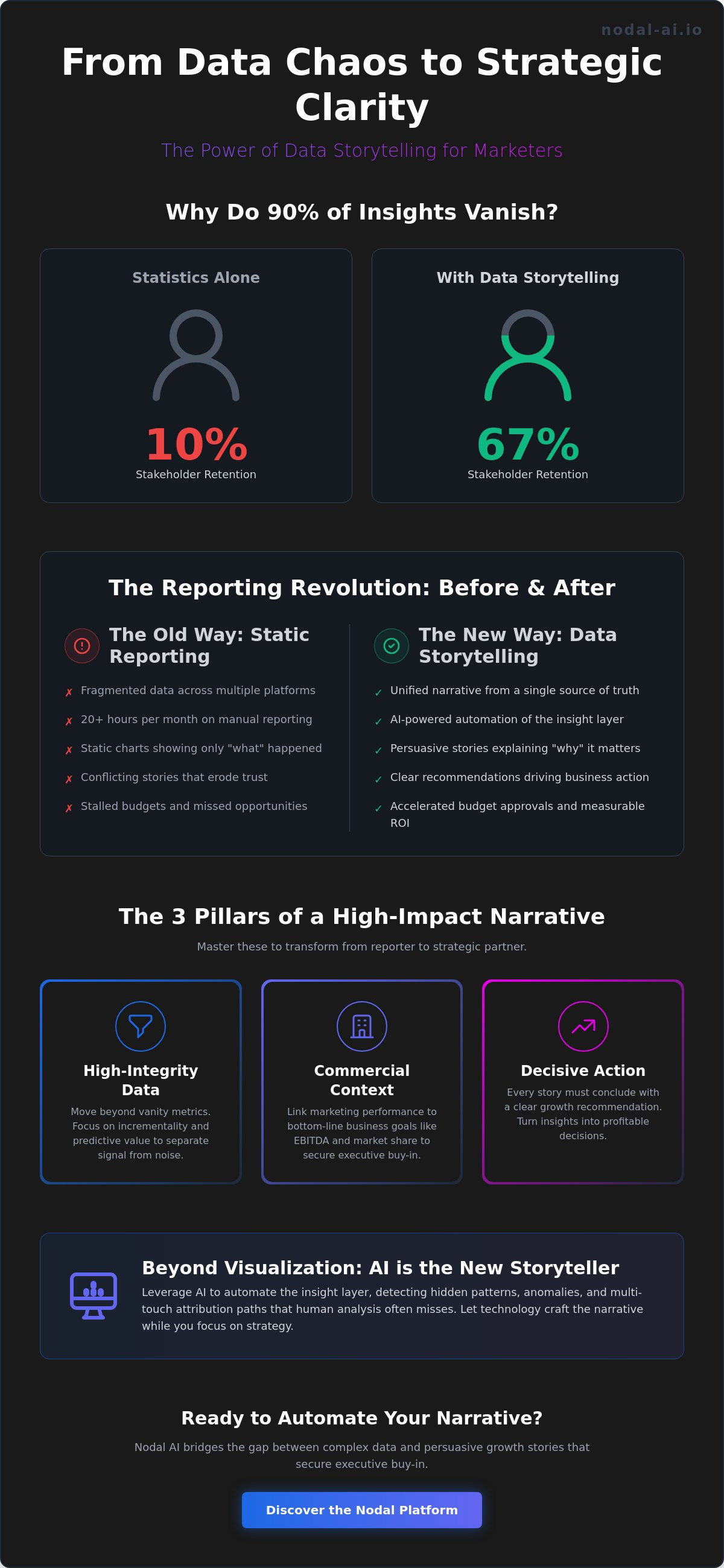
Why do 90% of your insights vanish the moment your stakeholders leave the room? Research shows that while statistics alone achieve 10% retention, data storytelling for marketers increases that figure to 67%, turning passive charts into active growth engines. You know the frustration of staring at fragmented data across multiple platforms while trying to explain multi-touch attribution to a non-technical board. It is a time-consuming cycle that often leads to stalled budgets and missed opportunities.
This article changes that dynamic by showing you how to transform chaotic inputs into high-value strategic narratives. You will learn how to secure stakeholder buy-in and drive measurable ROI by leveraging automated reporting and predictive modelling. We will bridge the gap between complex AI insights and clear growth recommendations. By the end, you will have a roadmap to master the customer journey and accelerate your budget approvals through the power of clarity. Prepare to replace the anxiety of manual reporting with the confidence of streamlined, high-level perspectives.
Key Takeaways
- Synthesize data, visuals, and narrative to transform static reporting into a strategic tool for driving business action.
- Master data storytelling for marketers by shifting focus from vanity metrics to incrementality and bottom-line outcomes like EBITDA.
- Leverage AI to automate the insight layer, detecting hidden patterns and anomalies that human analysis often misses.
- Implement a structured five-step framework to align fragmented customer journey data with your primary business objectives.
- Utilize the Nodal Platform to bridge the gap between complex multi-touch attribution and persuasive growth narratives that secure executive buy-in.
The Evolution of Data Storytelling for Marketers: From Charts to Clarity
Marketing data in 2026 has reached a point of critical mass. Traditional reporting, once the gold standard for performance reviews, now fails because customer journeys are no longer linear or predictable. Today, data storytelling for marketers represents the vital synthesis of raw data, compelling visuals, and a persuasive narrative designed to trigger specific business actions. We have moved past the dashboard fatigue that defined the early 2020s. Back then, teams were buried under static charts that offered little more than hindsight. Today, narrative intelligence is the primary requirement for success. It is the ability to turn fragmented signals into a coherent growth strategy. This evolution relies heavily on the transition from outdated last-click models to sophisticated multi-touch attribution. Without this foundation, your story is built on a partial truth that stakeholders will quickly dismantle.
Why Visualisation Alone is No Longer Enough
A bar chart can show you that conversions dropped by 12% last Tuesday. It cannot tell you if that drop resulted from a seasonal trend, a competitor's aggressive bidding, or a technical glitch in the checkout flow. Charts show you what happened. Stories explain why it matters to the bottom line. When you present to stakeholders, they are searching for the "so what?" factor. They don't want a "data puke" session where you dump fifty slides of statistics without a cohesive thread. They want to know how your performance impacts the next quarter's revenue. Shift your focus from decoration to interpretation. Within the field of data storytelling, the goal is to provide context that transforms numbers into knowledge. Give your data a voice that speaks the language of the boardroom.
The High Cost of Fragmented Marketing Narratives
The cost of disconnected data is staggering for the modern enterprise. For many London-based marketing teams, senior professionals spend upwards of 20 hours every month on manual reporting. This is a massive drain on productivity that yields almost zero strategic value. When data lives in silos, departments end up telling conflicting stories. The social team claims victory while the search lead sees a decline. This friction erodes trust with leadership and stalls budget approvals. To fix this, you must implement a unified data governance framework. Establishing a single source of truth ensures that every instance of data storytelling for marketers is accurate, defensible, and aligned with organizational goals. Stop wasting your week on spreadsheets. Start investing in the strategic clarity that drives measurable ROI.
The Three Pillars of a High-Impact Marketing Narrative
Success in 2026 demands more than just reporting. It requires a structured approach to communication that resonates in the boardroom. Effective data storytelling for marketers rests on three non-negotiable pillars: high-integrity data, commercial context, and decisive action. By mastering these components, you stop being a reporter and start being a strategic partner. This approach is widely recognized as The Essential Data Science Skill for modern professionals. It transforms passive numbers into active participants in your business growth, replacing confusion with a clear path forward.
The first pillar is the data itself. You must move beyond vanity metrics like "likes" or "impressions" that don't impact the bottom line. Instead, focus on incrementality and predictive value. The second pillar is context. Marketing performance doesn't exist in a vacuum. You must link your results to broader business goals such as EBITDA or market share to secure executive interest. Finally, the third pillar is action. Every story must conclude with a clear growth recommendation. This philosophy is baked into the Nodal Platform, which focuses on delivering actionable intelligence rather than just more charts. It's about turning insights into profitable decisions.
Pillar 1: Selecting the Right Data (Signal vs. Noise)
Clarity starts with exclusion. You need to differentiate between what happened in the past and what will happen in the future. While descriptive data tells a story of yesterday, predictive modelling provides the ultimate narrative hook for stakeholders. It allows you to forecast outcomes and justify spend before it happens. In this context, "Signal" is defined as the specific data points that directly correlate to revenue growth. Everything else is just noise that distracts from your core message. If you want to see how this looks in practice, you can explore our analytics solutions for immediate clarity.
Pillar 2: Building the Narrative Arc
A great marketing story follows a classic structure that guides the listener. Start with the Hook. This is your current performance challenge or the massive opportunity you've identified in the market. Next, introduce the Conflict. This represents the friction in your customer journey, such as high churn at the consideration stage or a drop in multi-touch attribution efficiency. Finally, deliver the Resolution. This is where you explain how your proposed strategy overcomes the friction. By framing data storytelling for marketers this way, you make the solution feel inevitable. You provide the cognitive upgrade your organization needs to move from chaos to total strategic clarity.
Beyond Visualization: Why AI is the New Storyteller
Manual data visualization is a relic of a slower era. If you're still spending your weekends building slide decks and manually interpreting charts, you're falling behind the competition. AI doesn't just display data; it interprets it with a level of precision humans cannot match. In 2026, the volume of fragmented data across platforms makes manual analysis nearly impossible for even the most talented teams. AI identifies hidden trends and anomalies that human analysts often overlook, shifting your focus from reactive reporting to proactive storytelling. To Effectively Tell a Story with Data, you must bridge the gap between raw numbers and natural language growth recommendations. This is where AI marketing analytics becomes your most valuable strategic partner. It automates the synthesis of complex inputs, allowing you to deliver high-value outputs with minimal manual effort.
Automating the "Why" with Predictive Insights
True data storytelling for marketers requires a deep understanding of the "why" behind every conversion. AI-driven customer journey mapping uncovers the hidden story in the path to purchase, pinpointing the exact touchpoints that drive actual value. Automated reporting functions as a real-time narrative engine, constantly updating your strategy with fresh, actionable insights. AI doesn’t just count clicks; it calculates future value. This predictive capability transforms your reporting from a history lesson into a forward-looking roadmap for profitable growth. It replaces the anxiety of "not knowing" with the confidence of data-backed foresight.
Reducing Bias in Data-Driven Stories
Human storytellers often fall into the trap of cherry-picking data to support a preconceived narrative or a favorite campaign. This inherent bias undermines trust with stakeholders and leads to inefficient budget allocation. AI provides an objective baseline for marketing performance, stripping away emotional attachments to specific channels. Transparency in AI-generated insights ensures that every recommendation you make is defensible and grounded in mathematical reality. By using an algorithmic partner, you create a narrative that is both persuasive and scientifically sound. This is the cognitive upgrade required to secure long-term stakeholder buy-in and maintain a competitive edge in a fast-paced market.
A 5-Step Framework for Crafting Persuasive Data Stories
Turning chaotic analytics into a winning strategy requires a repeatable, high-velocity process. You can't rely on gut feeling or manual spreadsheets in a market that moves at the speed of AI. Effective data storytelling for marketers follows a logical path that moves stakeholders from skepticism to total buy-in. This framework replaces the anxiety of "data puking" with the confidence of strategic clarity. It forces you to focus on high-value outputs that directly correlate to business growth. By following these steps, you transform marketing from a cost center into a documented revenue driver.
- Step 1: Identify the Business Objective. Every story needs a North Star. Whether it's increasing EBITDA or expanding market share, your narrative must anchor to a commercial goal.
- Step 2: Aggregate Fragmented Data into a Single Truth. You can't build a persuasive case on disconnected silos. Use a unified foundation to ensure your story is defensible.
- Step 3: Apply Multi-Touch Attribution to Reveal Hidden Value. Use forensic evidence to prove how different channels contribute to the final conversion.
- Step 4: Use Predictive Modelling to Project Future Outcomes. Shift the focus from what happened to what is at stake. Show them the future revenue you can capture.
- Step 5: Present the Growth Recommendation. Conclude with a specific, actionable command that drives the business forward.
Step 3 Deep Dive: Attribution as the Story’s Proof
When you speak to a CFO, you must translate marketing activity into financial impact. Incrementality is the key. Instead of saying "we think this campaign worked," you must demonstrate that "we know this specific touchpoint contributed 15% to the total conversion value." This removes ambiguity and builds institutional trust. Attribution is the forensic detective work that validates which marketing touchpoints actually moved the needle on profit. It provides the empirical evidence required to justify your existing spend and request additional resources. Stop guessing and start proving your value with hard data.
Step 5 Deep Dive: The Growth Recommendation
The final stage of data storytelling for marketers is the decision. A data finding is passive; a Growth Recommendation is active. For example, instead of reporting high mid-funnel engagement, recommend shifting 20% of the budget from low-performing top-funnel ads to mid-funnel conversion drivers. You must also quantify the Cost of Inaction. Explain exactly how much revenue the business loses every day by maintaining the status quo. The Nodal Platform automates these recommendations, transforming complex analytics into clear directives instantly. This saves your team dozens of hours while ensuring your strategy remains obsessed with measurable returns. Discover how to automate your growth narratives today.
Automating the Narrative: How Nodal AI Bridges the Gap
London's enterprise marketing landscape is too competitive for manual reporting. You don't have time to wrestle with disparate spreadsheets or conflicting dashboard views that lead to circular debates. The Nodal Platform acts as a cognitive upgrade for your entire organization, turning chaotic inputs into high-value strategic outputs. It replaces the anxiety of fragmented data with the confidence of a unified growth narrative. By mastering data storytelling for marketers through automation, you shift your focus from tedious data entry to high-level decision-making. This is the difference between being a data gatekeeper and a growth visionary. You're no longer just managing a budget; you're directing a revenue engine with total transparency.
From Fragmented Data to Actionable Intelligence
The Nodal process follows a streamlined, three-step journey: Integration, Attribution, and Narrative. First, we aggregate your siloed data into a Single Source of Truth, removing the ambiguity of platform-specific reporting. Next, our multi-touch attribution engine identifies the true drivers of revenue across every touchpoint in the journey. Finally, the platform generates a cohesive story that stakeholders can actually understand and act upon. This isn't just about saving 20 or more hours a month on manual labor, though that efficiency is vital. It's about the relief that comes from total transparency. Every stakeholder, from the social lead to the CFO, finally sees the same picture of performance, allowing for faster consensus and immediate budget optimization.
Securing the Future: Predictive Storytelling
Most reporting functions as a post-mortem of what happened yesterday. Nodal helps you tell stories about tomorrow. Our Growth Recommendations feature acts as the ultimate storytelling shortcut, translating complex patterns into natural language directives that resonate in the boardroom. You can project future outcomes and map the customer journey with predictive precision, identifying profitable opportunities before your competitors even see the trend. This gives your team a massive competitive advantage in high-velocity markets. You aren't just reacting to last month's performance; you're actively shaping next month's ROI. It is time to stop the manual grind and start leading with narrative intelligence. Book a demo of the Nodal Platform today and experience the future of total strategic clarity.
Command Your Strategic Growth Narrative
The era of passive reporting is over. You've seen how the shift from static charts to narrative intelligence redefines success in 2026. By embracing a structured framework and leveraging AI to bridge the gap between fragmented data and strategic clarity, you position yourself as a visionary growth leader. Mastering data storytelling for marketers is no longer just an optional skill; it is a cognitive upgrade for your entire organization. It replaces the anxiety of manual reporting with the confidence of streamlined, high-level perspectives that secure immediate stakeholder buy-in.
It's time to stop fighting with disconnected spreadsheets and start commanding your marketing story. Nodal AI provides London-based expertise to your performance analytics, offering automated multi-touch attribution and predictive growth recommendations that remove all ambiguity. You can turn chaotic inputs into high-value outputs instantly, ensuring every decision is backed by forensic evidence. Transform your fragmented data into actionable growth stories with Nodal AI. Step into a future of total strategic clarity and watch your ROI accelerate with effortless precision.
Frequently Asked Questions
What is data storytelling for marketers?
Data storytelling for marketers is the strategic process of combining raw analytics with a narrative arc to drive specific business actions. It transforms abstract numbers into a compelling story that stakeholders can easily digest and act upon. While standard reporting focuses on historical facts, storytelling focuses on the "why" and the "what next." This approach ensures every insight is tethered to a commercial outcome, turning passive data into an active participant in your growth strategy.
How does data storytelling differ from data visualization?
Data visualization is the graphic representation of information, such as charts or graphs, while data storytelling provides the context and narrative that give those visuals meaning. Think of visualization as the map and storytelling as the guided tour. A chart shows that traffic increased, but a story explains which specific campaign drove that traffic and why it matters for your quarterly revenue. You need both to move from seeing data to understanding its value.
Why is data storytelling important for marketing ROI?
This practice is essential for ROI because it bridges the gap between marketing activity and financial performance. By clearly communicating the value of complex initiatives, you secure faster budget approvals and stakeholder buy-in. It allows you to demonstrate incrementality, showing exactly how your efforts contribute to the bottom line. When stakeholders understand the direct link between a campaign and revenue growth, they are more likely to invest in strategies that deliver the highest returns.
Can AI automate data storytelling for performance marketing?
AI has evolved to automate the synthesis of complex insights into natural language growth recommendations. Platforms like Nodal use sophisticated algorithms to detect patterns and anomalies that human analysts often overlook. By integrating data storytelling for marketers into the automated reporting process, these tools remove the manual burden of interpretation. This ensures your narratives are objective, defensible, and focused on future value rather than just historical performance.
What are the key elements of a persuasive data story?
A persuasive data story requires three core elements: high-integrity data, commercial context, and a clear call to action. First, you need accurate data that focuses on signal rather than noise. Second, you must provide context by linking those numbers to broader business objectives like market share or profitability. Finally, every story must conclude with a specific growth recommendation. Without these elements, your presentation is just a collection of facts rather than a strategic tool for driving change.
How do I tell a story with multi-touch attribution data?
To tell a story with multi-touch attribution, focus on the complete customer journey rather than isolated clicks. Describe the friction points where users drop off and the specific touchpoints that successfully nudge them toward conversion. Use attribution data as forensic evidence to prove the value of mid-funnel activities that traditional models often ignore. This approach allows you to build a narrative around the collective power of your marketing mix, demonstrating how every channel works together to drive growth.
How much time can automated reporting save marketing teams?
Automated reporting can save enterprise marketing teams upwards of 20 hours per month by eliminating manual data collection and slide deck creation. This reclaimed time allows senior staff to pivot from administrative tasks to strategic optimization. Instead of spending days wrestling with spreadsheets, your team can review automated insights and implement growth recommendations immediately. This efficiency doesn't just reduce labor costs; it accelerates the pace of your decision-making and gives you a significant competitive edge.
What is the best way to present data stories to the C-suite?
The best way to present to the C-suite is to lead with the commercial bottom line. Executives prioritize metrics like EBITDA and market share over granular campaign stats. Use a punchy, direct style and avoid technical jargon that creates friction. Focus your narrative on the future by using predictive modelling to project potential outcomes. Always end with a specific growth recommendation that makes the next strategic step feel inevitable and low-risk.


