

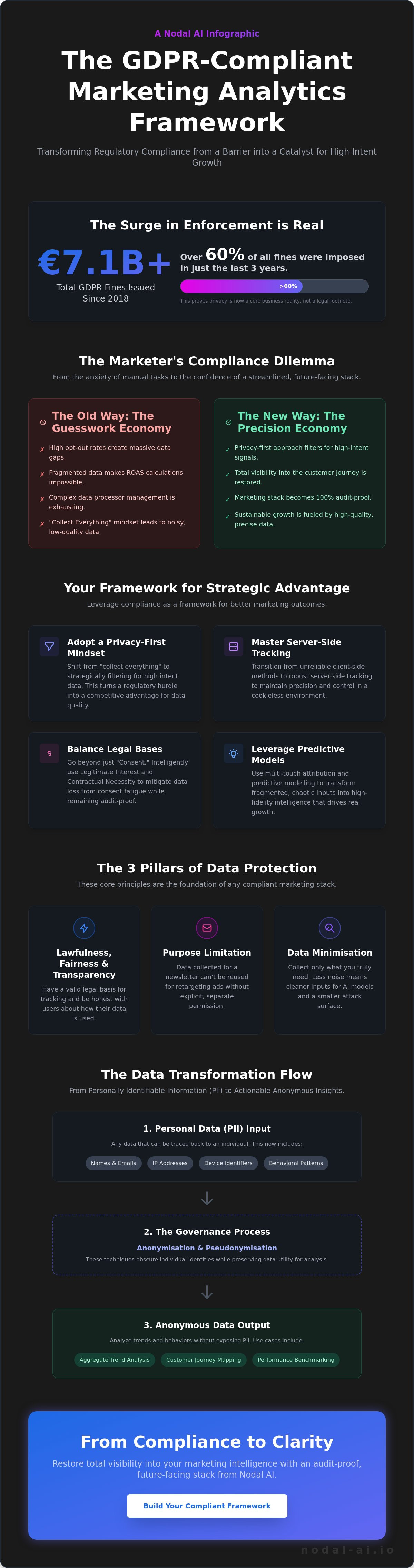
Over 60% of the €7.1 billion in total GDPR fines issued since 2018 have been imposed in just the last three years. This surge in enforcement proves that privacy is no longer a legal footnote; it's a core business reality. You're likely struggling with high opt-out rates and fragmented data that turns ROAS calculations into guesswork. It's exhausting to manage complex data processors while losing sight of the actual customer journey. However, implementing gdpr compliant marketing analytics isn't a barrier to your performance. It's the catalyst for higher-quality, high-intent data that fuels sustainable growth.
Stop viewing compliance as a drain on your productivity and start seeing it as a cognitive upgrade for your entire organization. We'll show you how to restore total visibility into your marketing intelligence while remaining 100% audit-proof. This guide delivers a clear framework for high-performance tracking that respects user choice without sacrificing precision. You'll discover how to leverage multi-touch attribution and predictive modelling to transform chaotic inputs into high-value outcomes. Let's move from the anxiety of manual tasks to the confidence of a streamlined, future-facing marketing stack.
Key Takeaways
- Shift to a privacy-first mindset to transform regulatory compliance into a strategic filter for high-intent data.
- Master the technical transition from client-side to server-side tracking to maintain precision in a cookieless environment.
- Establish a clear framework for gdpr compliant marketing analytics that restores total visibility into the customer journey.
- Balance Consent and Legitimate Interest legal bases to mitigate data loss while ensuring your marketing stack remains audit-proof.
- Leverage predictive modelling and multi-touch attribution to turn fragmented inputs into high-fidelity intelligence and growth.
Defining GDPR Meaning in the Modern Marketing Landscape
The General Data Protection Regulation (GDPR) remains the gold standard for global privacy. In 2026, it is no longer a checklist for legal teams; it is the foundation of every high-performance marketing stack. Adopting a privacy-first mindset is the only way to build sustainable growth. This shift requires moving away from the "collect everything" habits of the past. Instead, focus on processing only the data that drives measurable value. Efficiency follows transparency. If your business targets citizens in the EU or UK, these rules apply to you regardless of where your headquarters are located. Compliance is the price of entry for the modern global market.
Establishing gdpr compliant marketing analytics turns regulatory pressure into a competitive advantage. You replace noisy, low-quality data with high-intent signals. This clarity allows you to stop guessing and start scaling with precision. When you respect the user's digital boundaries, you build the trust necessary for long-term brand equity.
The Core Principles of Data Protection
Lawfulness, fairness, and transparency are the three pillars of ethical processing. In a marketing context, this means you must have a valid legal reason to track a user and you must be honest about how you use that information. Purpose limitation is equally critical. You can't collect data for a weekly newsletter and then use it for aggressive retargeting ads without explicit permission. These silos protect the consumer and ensure your data remains organized. Finally, data minimisation proves that less is often more. By collecting only what you need, you reduce your attack surface and provide your AI models with cleaner, more relevant inputs. Noise disappears; intelligence remains.
Personal Data vs. Anonymous Data in Marketing
Identifying what constitutes PII (Personally Identifiable Information) is more complex in 2026. Beyond names and emails, PII now includes device identifiers, IP addresses, and even certain behavioral patterns that can be traced back to an individual. To maintain gdpr compliant marketing analytics, you must distinguish between personal and anonymous data. Anonymisation and pseudonymisation are your primary tools here. These techniques allow you to analyze trends and map customer journeys without exposing individual identities. Implementing a robust data governance framework is the only way to manage this distinction at scale. This structure ensures that your strategic analysis stays within legal boundaries while still delivering the high-fidelity insights required for profitable growth.
Navigating the Legal Bases for Data Processing
Selecting the right legal basis is the pivot point between a high-performing marketing machine and a compliance nightmare. While most marketers default to Consent, the 2026 environment demands a more sophisticated approach. You must balance user privacy with your need for gdpr compliant marketing analytics. This means understanding when to ask for permission and when you have a genuine right to process data without it.
Consent fatigue is a real threat to your data volume. When users are bombarded with cookie banners, they often opt out simply to clear their screen. This creates massive gaps in your visibility. To counter this, savvy operators use "Contractual Necessity" for logged-in customers. If you're providing a service the user paid for, certain analytics are required to fulfill that contract. For everything else, you need a documented Legitimate Interest Assessment (LIA). This document proves you've weighed your business goals against the individual's rights. It's your shield in an audit. The March 2026 annulment of Amazon's €746 million fine on procedural grounds highlights why this documentation is vital. Procedural accuracy is your first line of defense.
The Anatomy of Valid Marketing Consent
Valid consent is not a passive event. It must be freely given, specific, informed, and unambiguous. Pre-ticked boxes are a relic of the past and a shortcut to heavy fines. Your users must take a clear, affirmative action to opt in. Transparency is your best tool here. Explain exactly what they are signing up for. If you're configuring Google Analytics for GDPR compliance, ensure your consent management platform (CMP) records these choices accurately. Remember, the right to withdraw consent must be as effortless as the initial opt-in. If a user can't leave with one click, your consent isn't valid.
When to Use Legitimate Interest
Legitimate interest is the most flexible legal basis, but it's often misunderstood. It requires a rigorous balance test. You must demonstrate that your processing is necessary and doesn't override the user's fundamental rights. In B2B marketing, this is often the gold standard for CRM management and direct outreach. It allows you to maintain a relationship with prospects without a constant barrage of opt-in requests. However, over-reliance is dangerous. Without a step by step way to track campaigns, your data becomes a liability. You need to verify that your interests are truly legitimate and documented.
Strategic clarity comes from knowing exactly where your data originates and why you're allowed to have it. Mastering these legal bases is the first step toward restoring gdpr compliant marketing analytics across your entire funnel. When you stop fearing the regulator, you start focusing on the customer. If you're looking to simplify this complexity, the Nodal platform can help you align your tracking with global standards effortlessly.
The Cookieless Conflict: Precision vs. Privacy
The death of third-party cookies has forced a total re-evaluation of how we measure success. Privacy Sandboxes and stricter browser protections are now the standard. For years, marketers relied on invasive tracking to fuel their growth. Today, that approach is a liability. You face a choice: sacrifice precision for compliance or find a smarter way to operate. Achieving gdpr compliant marketing analytics in this environment requires moving beyond the browser. It's about owning the data stream from start to finish.
Client-side tracking is increasingly unreliable. When a user opts out or uses an ad-blocker, they disappear into "Dark Data." This untracked segment distorts your attribution models and leads to inaccurate ROAS calculations. You can't optimize what you can't see. Privacy-Enhancing Technologies (PETs) are the answer to this conflict. They allow you to extract value from data without ever touching personally identifiable information. You move from tracking people to analyzing patterns. This transition is where the most competitive brands are finding their edge in 2026.
Server-Side GTM and Conversion APIs
Transitioning to server-side tracking is a critical move for any marketing analytics platform for enterprise. Unlike client-side scripts, server-side Tag Manager gives you total control over the data flow. You decide exactly what reaches your vendors. You can perform "data scrubbing" to remove sensitive PII before it ever leaves your secure environment. This turns a chaotic stream of information into a disciplined, compliant asset. It's the difference between hope-based tracking and enterprise-grade security. You protect the user while preserving the signal.
Bridging the Gap with Predictive Customer Journey Mapping
Solving the opt-out problem doesn't require more tracking; it requires more intelligence. While competitors struggle with missing data, you can use AI to model the behavior of non-consenting users. By analyzing consenting cohorts, predictive modelling restores 100% visibility without 100% individual tracking. This approach maintains mathematical accuracy in your ROAS while respecting every user's digital boundary. You gain a high-fidelity view of the customer journey without ever compromising on your commitment to gdpr compliant marketing analytics. Precision and privacy are no longer at odds. They are the dual engines of your 2026 strategy.
How to Implement a GDPR Compliant Analytics Framework
Building a framework for gdpr compliant marketing analytics requires more than a simple plugin. It demands a systematic overhaul of how information moves through your organization. Start with a comprehensive data audit. You must identify every touchpoint, script, and third-party data processor interacting with your users. If you can't map it, you can't protect it. This audit isn't a one-time event; it is the first step toward a living inventory of your digital assets.
Once your map is clear, implement a robust Consent Management Platform (CMP). A banner is only effective if it actually communicates with your analytics stack. Your CMP should act as a gatekeeper. It must ensure that no data is processed until the correct legal basis is established. Pair this with a signed Data Processing Agreement (DPA) for every vendor in your stack. This legal layer ensures that your partners are as committed to privacy as you are. Without a DPA, you're liable for their mistakes.
Automation is your best ally for maintaining compliance at scale. Manual responses to "Right to be Forgotten" requests are a drain on resources and a risk for human error. With the California Delete Act's DROP platform now requiring data brokers to process deletions every 45 days as of August 1, 2026, user expectations for rapid data erasure are at an all-time high. Automate these requests within your CRM to ensure compliance without manual labor. Regularly audit your data driven marketing processes to catch any compliance leakage before it becomes a fine.
Selecting Your Marketing Analytics Stack
Your choice of technology defines your compliance posture. Look for vendors that prioritize "Privacy by Design" from the ground up. This means selecting platforms with EU-based servers, ISO certifications, and encryption at rest. Don't settle for legacy systems that treat privacy as an afterthought. We prioritize data residency and advanced encryption to ensure your gdpr compliant marketing analytics stay secure. You need a partner that turns security into a strategic advantage.
Training Your Team for Compliance Culture
Compliance isn't just a legal problem; it's a culture of data stewardship. Your marketing team needs to understand that protecting user privacy is part of the brand's value proposition. Train your staff to handle Data Subject Access Requests (DSARs) as a standard operational procedure rather than a crisis. Involve your Data Protection Officer (DPO) in marketing strategy meetings. When your DPO understands your growth goals, they can help you build compliant paths to reach them. This collaboration replaces friction with momentum.
Transform your tracking from a liability into a high-performance asset. Explore how the Nodal platform automates compliance and restores your marketing intelligence today.
From Compliance to Clarity: The Nodal AI Advantage
Nodal AI turns the regulatory burden into a strategic engine. While others treat privacy as a barrier, we see it as a filter for high-fidelity intelligence. Fragmented data is the enemy of growth. We resolve this by consolidating your signals into a single, clear perspective. Our gdpr compliant marketing analytics thrive on the clean, first-party data that modern regulations encourage. By focusing on quality over quantity, your predictive modelling becomes more accurate and your decisions more profitable. We transform passive data into active participants in your business process.
The Nodal Platform navigates the complexity of multi-touch attribution in a completely privacy-safe environment. You gain a high-fidelity understanding of the customer journey mapping without crossing digital boundaries. For London-based enterprises, the pressure of audit-ready documentation is constant. Our automated reporting ensures that you are always prepared for a regulatory deep dive. You move from the anxiety of manual spreadsheets to the confidence of a cognitive upgrade for your entire marketing department. It's time to stop managing data and start leading with it.
Our AI marketing analytics leverage the strength of your existing assets to identify hidden opportunities. By integrating disparate sources into one cohesive system, we remove the ambiguity that plagues traditional performance marketing analytics. You get the relief that comes from resolving complexity and the momentum that comes from absolute clarity.
Turning Consent into Competitive Advantage
Users who opt-in are not just a compliance requirement. They are your highest-value signals. These individuals have demonstrated clear intent and trust in your brand. Nodal AI uses these high-intent signals to generate actionable growth recommendations that legacy systems miss. We replace tedious manual labor with a streamlined, high-level perspective. You stop fighting the data and start using it to drive measurable returns. This transition from chaotic inputs to high-value outputs is the hallmark of a visionary leader.
Future-Proofing Your Growth
The regulatory landscape will continue to shift. With the EU AI Act transparency obligations beginning August 2, 2026, and the proposed Digital Omnibus on the horizon for mid-to-late 2026, staying ahead of the curve is mandatory. You need a partner obsessed with asset protection and long-term stability. We provide the peace of mind that comes from mastering gdpr compliant marketing analytics before the market catches up. Don't let complexity hold you back. Experience the clarity of Nodal AI today.
Mastering the Privacy-First Growth Era
The transition from "collecting everything" to "processing value" marks the end of noisy, inefficient marketing. We've explored how a robust framework for gdpr compliant marketing analytics turns regulatory hurdles into a competitive edge. By leveraging server-side tracking and predictive modeling, you fill the gaps left by opt-outs without compromising user trust. This isn't just about staying legal; it's about building a high-performance engine that thrives on clean, first-party data. You replace the frustration of inaccurate ROAS with the confidence of mathematical precision.
Nodal AI provides the London-based enterprise expertise needed to navigate this complex landscape. Our privacy-by-design architecture and AI-powered predictive journey mapping ensure your marketing intelligence remains audit-proof and forward-facing. You don't have to choose between privacy and performance. It's time to reclaim your visibility and drive measurable returns with a partner obsessed with your success.
Transform your fragmented data into profitable growth with Nodal AI.
Your journey toward total clarity starts now. Embrace the future of marketing with confidence and leave the chaos of manual reporting behind.
Frequently Asked Questions
What is the actual GDPR meaning for a digital marketing team in 2026?
GDPR in 2026 represents a shift from passive data collection to active data stewardship. For your marketing team, it means every digital touchpoint must be justified by a specific legal basis, such as consent or legitimate interest. You must move away from hoarding "just in case" data and focus exclusively on processing high-intent signals that drive measurable growth. It is the framework that transforms messy, fragmented inputs into a disciplined, high-value asset for your organization.
Can I still use Google Analytics 4 and remain GDPR compliant?
Yes, but compliance is not an "out of the box" feature. You must configure GA4 with strict data retention policies, IP anonymization, and Google Consent Mode v2 to align with current standards. Many enterprise leaders now use server-side tagging to scrub personally identifiable information (PII) before it ever reaches Google's servers. This layer of control ensures your gdpr compliant marketing analytics stay precise without exposing your business to regulatory risk.
What happens if our marketing team fails a GDPR audit?
Failure leads to severe financial penalties and a total loss of consumer trust. For severe violations, fines can reach the greater of €20 million or 4% of your global annual revenue. Beyond the check, the European Data Protection Board has made the "Right to Erasure" a top enforcement priority for 2026. An audit failure often results in a mandatory "stop processing" order, which can instantly blind your marketing department and halt your growth momentum.
How does GDPR affect multi-touch attribution and customer journey mapping?
GDPR restricts the use of invasive identifiers, which often creates gaps in traditional attribution models. When users opt out of tracking, they become "dark data," making it difficult to calculate ROAS accurately. To resolve this, you must transition to predictive modelling. By using AI to analyze the behavior of consenting cohorts, you can restore a high-fidelity view of the customer journey without needing to identify individual non-consenting users.
Do I need a cookie banner if I only use first-party data?
Yes, if you use non-essential cookies or local storage to track user behavior. The law focuses on the act of storing or accessing information on a user's device, regardless of whether the data is first-party or third-party. Unless the cookie is "strictly necessary" for the website to function, you must obtain clear, unambiguous consent. Transparency is your best tool for maintaining gdpr compliant marketing analytics while building a trust-based relationship with your audience.
Is server-side tracking a "silver bullet" for GDPR compliance?
Server-side tracking is a powerful tool for data control, but it is not a standalone solution. It allows you to act as a gatekeeper, removing sensitive data before it hits vendor platforms, which significantly reduces your risk profile. However, you still need a valid legal basis to collect the data from the user in the first place. Think of it as a cognitive upgrade for your data security rather than a way to bypass consent requirements.
How can AI help marketers maintain analytics accuracy with high opt-out rates?
AI bridges the "opt-out gap" through sophisticated predictive modelling. Instead of relying on 1:1 tracking for every visitor, AI analyzes patterns from consenting users to project the actions of the total audience. This approach restores 100% visibility into your marketing performance without compromising individual privacy. It turns fragmented, incomplete data into a reliable map for strategic growth, ensuring your reporting remains mathematically sound even as privacy restrictions tighten.
What is the difference between a data controller and a data processor in marketing?
Your business is the data controller because you decide why and how personal data is processed for your campaigns. The software vendors you use, such as your analytics platform or CRM, act as data processors because they handle that data on your behalf. You are legally required to have a Data Processing Agreement (DPA) with every processor. This contract ensures that your partners are held to the same high standards of protection and accountability as your own organization.


