

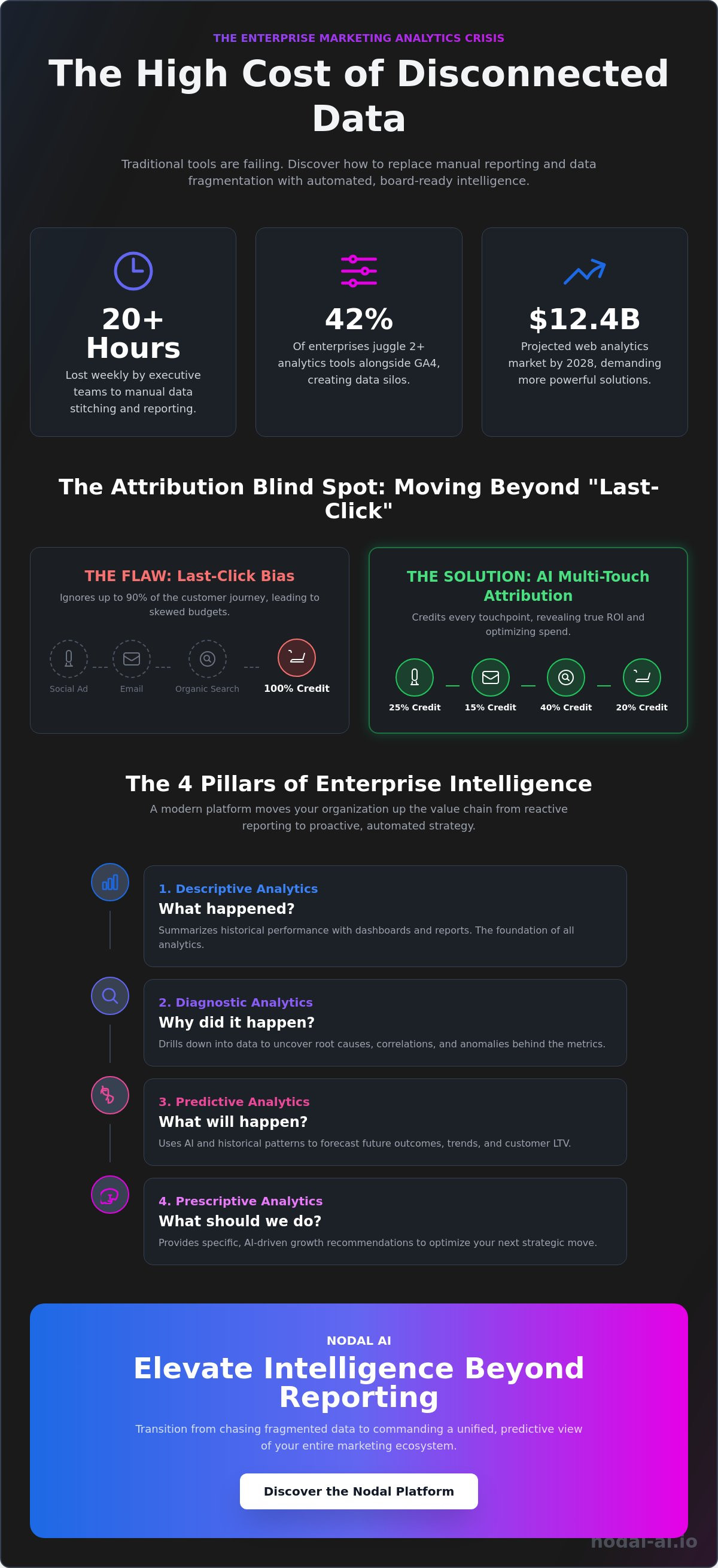
Your marketing data isn't just fragmented; it's actively draining over 20 hours of executive productivity every single week through manual reporting. While the global web analytics market is projected to reach $12.4 billion by 2028, 42% of enterprises are still juggling two or more tools alongside Google Analytics 4 just to keep up. Selecting the right marketing analytics platform for enterprise has evolved beyond a simple technical choice. It's a strategic move to replace the anxiety of manual labor with the confidence of high-level perspective.
You likely feel the pressure of rising privacy regulations, like the 20 active U.S. state privacy laws or the 2026 CCPA amendments regarding sensitive data. This guide promises to cut through that complexity. You'll discover how to unify fragmented silos into a single source of truth that drives measurable ROI and strategic growth. We will preview the top-tier tools for 2026, including the Nodal Platform and predictive modeling solutions, to help you transition from chasing data to commanding automated, board-ready insights.
Key Takeaways
- Eliminate the "last-click" bias and identify the hidden data silos that currently stall your organization's rapid decision-making.
- Master the four pillars of intelligence—from descriptive to prescriptive—to select a marketing analytics platform for enterprise that scales with your strategic vision.
- Discover how AI-driven multi-touch attribution and growth recommendations turn passive data into active participants in your revenue strategy.
- Audit your current data stack to fix broken attribution links and align your team around high-value North Star metrics like ROI and LTV.
- Reclaim 20+ hours of weekly productivity by replacing manual reporting with automated, board-ready intelligence and predictive modelling.
The Enterprise Data Fragmentation Crisis: Why Traditional Tools Fall Short
Traditional analytics tools are breaking under the weight of modern complexity. For years, enterprises relied on descriptive reporting that merely summarized what happened yesterday. In 2026, this rearview-mirror approach is a liability. The primary culprit is "last-click" bias. It credits the final touchpoint while ignoring the months of customer journey mapping that actually drove the conversion. This leads to skewed budgets and missed opportunities. You can't lead a market by looking backward.
A robust marketing analytics platform for enterprise must do more than count clicks. It needs to bridge the gap between regional silos and departmental data lakes. When your social team uses one tool and your CRM team uses another, rapid decision-making becomes impossible. You aren't just losing clarity; you're losing the ability to pivot before a competitor captures the market. The shift from simple reporting to predictive intelligence is the only way to stay ahead in an environment where 42% of enterprises are already using two or more specialized tools alongside their primary stacks.
The High Cost of Manual Reporting
Manual data stitching is a silent profit killer. The average enterprise team loses over 20 hours every week to manual reporting. This is a massive drain on high-value talent. Instead of acting as growth strategists, your best minds are functioning as data janitors. They're cleaning spreadsheets and fixing broken formulas. This manual process invites human error, especially in complex multi-touch attribution models. Automation isn't just a convenience; it's a necessity for accuracy. It transforms your team from reactive observers into proactive drivers of revenue.
Fragmentation as a Barrier to ROI
Disconnected platforms lead directly to misallocated ad spend. Without a unified view, you might be over-investing in channels that look good on paper but fail to drive long-term value. Proving marketing's worth to the board requires more than vanity metrics. It requires total transparency. Transitioning to data driven marketing is the only way to transform chaotic inputs into profitable decisions. When data flows seamlessly into a single marketing analytics platform for enterprise, the path to measurable ROI becomes clear. You stop guessing and start growing with the confidence of a unified source of truth.
Defining the Enterprise Marketing Analytics Platform: Core Capabilities for 2026
An enterprise marketing analytics platform is no longer just a collection of dashboards. It's a centralized intelligence layer that unifies fragmented digital and operational data into a single source of truth. In 2026, a high-performance marketing analytics platform for enterprise acts as a cognitive upgrade for your organization, turning passive data into active strategic assets. You don't need more data; you need more intelligence. This requires moving beyond simple collection to a system that handles automated ingestion and AI-powered cleaning to remove the noise that clutters traditional reporting.
To achieve total clarity, your platform must support the four pillars of enterprise analytics:
- Descriptive: Summarizing historical performance to understand what happened.
- Diagnostic: Digging into the "why" behind your metrics to uncover root causes.
- Predictive: Using historical patterns to forecast future outcomes and trends.
- Prescriptive: Providing specific growth recommendations to optimize your next move.
Implementing these pillars effectively requires a robust data governance framework. Without this foundation, your strategic clarity remains at risk from inconsistent data standards across global regions. To see how these capabilities translate into real-world results, explore how the Nodal Platform unifies these layers into a single, actionable interface.
Advanced Attribution and Journey Mapping
Moving beyond the click is essential for enterprise survival. Modern platforms must implement sophisticated multi-touch attribution (MTA) models that account for every interaction across the funnel. This isn't just about looking back; it's about predictive customer journey mapping. By identifying high-value touchpoints before a sale occurs, AI allows you to anticipate customer needs and allocate resources where they'll drive the highest LTV. You stop reacting to the market and start shaping it.
Enterprise-Grade Security and Compliance
In 2026, data privacy is a competitive advantage, not just a legal hurdle. With 20 U.S. states now enforcing active consumer privacy laws and the CCPA's 2026 amendments regarding sensitive data, your platform must be architected for compliance. For global teams, this means prioritizing UK-based data residency and adhering to the United Kingdom Data Use and Access Act of 2025. Ensure your platform offers role-based access control (RBAC) and SSO to protect your assets while following a step by step way to track campaigns that maintains data integrity at every stage.
Top Big Data Analytics Tools for Enterprise Marketing: A Comparative Review
Selecting a marketing analytics platform for enterprise in 2026 requires a focus on three non-negotiable criteria: semantic integration depth, AI sophistication, and global scalability. It isn't about finding a tool that simply connects to your APIs; it's about finding a system that maintains data consistency across every regional lake. Without this semantic layer, your reporting remains a collection of disconnected facts rather than a cohesive strategy. To move from fragmented data to strategic clarity, you must distinguish between platforms that merely visualize data and those that actively interpret it for growth.
Category Leaders: Attribution and Predictive Growth
The Nodal Platform stands as the category leader for organizations prioritizing performance and measurable returns. It moves beyond passive reporting to act as a cognitive upgrade for your entire marketing department. By utilizing advanced predictive modelling, it transforms chaotic inputs into board-ready growth recommendations automatically. While traditional tools stop at basic descriptive metrics, Nodal specializes in multi-touch attribution and customer journey mapping. This allows you to see the true incremental impact of every pound spent across the funnel. For London-based enterprises, the high-touch support ensures your complex data architecture is always optimized for future expansion.
Category Leaders: Visualization and General BI
Domo and Tableau remain the industry standards for general business intelligence and cross-departmental visibility. Domo excels at connecting diverse marketing channels into a single, visually stunning interface, making it an excellent choice for teams that need to share high-level dashboards with finance and operations. Tableau, conversely, is the gold standard for dedicated data science teams who require deep-dive data exploration and custom visualization. However, there's a significant trade-off. These "do-it-yourself" BI tools often require heavy manual setup and specialized staff to maintain. They provide the "what" of your performance but often leave your team struggling to find the "how" of future growth.
For organizations with a heavy focus on web governance, Siteimprove offers a specialized focus on linking accessibility and SEO-linked analytics to broader performance. While this is excellent for ensuring digital compliance, it often lacks the prescriptive intelligence needed to drive immediate revenue. A high-performance marketing analytics platform for enterprise should do more than just monitor your web presence; it should actively tell you where to invest your next budget cycle for maximum impact. By choosing an intelligence-first engine like Nodal, you replace the anxiety of manual analysis with the confidence of automated, strategic clarity.
Strategic Selection: How to Audit and Implement an Enterprise Analytics Solution
Audit your current data stack before you invest in new software. Most enterprises suffer from "broken" links in attribution because they try to connect too many disparate sources manually. A modern marketing analytics platform for enterprise acts as the connective tissue between these systems. You need to identify where data is falling through the cracks, whether it's between your CRM and paid media accounts or your social platforms and final finance reports. This audit isn't just a technical necessity. It's the first step toward strategic clarity. You're moving from a state of chaotic inputs to a streamlined, high-level perspective.
Define your North Star metrics early. Stop chasing vanity metrics like impressions or clicks. Instead, focus on high-value outcomes like ROI and Customer Lifetime Value (LTV). By shifting the focus to these commercial anchors, you position the analytics platform as a revenue driver rather than a cost center. This framing is essential for securing board-level buy-in. When you present the platform as a tool for financial optimization, the conversation moves from "how much does it cost" to "how much growth will it unlock." A 90-day implementation roadmap should guide this transition, moving you from technical setup to total strategic clarity.
The Technical Audit: Integrations and Data Quality
Map every data source in your ecosystem. Your CRM, social channels, paid media platforms, and finance databases must all feed into a unified intelligence layer. Speed to insight is the ultimate differentiator here. If your platform takes days to process data, you've already lost the opportunity to pivot. Look for architectures that prioritize automated ingestion and real-time cleaning. Professional onboarding and implementation support are non-negotiable. They ensure that your organization isn't delayed by technical hurdles or misaligned integrations during the critical setup phase.
The Cultural Shift: Empowering Teams with AI
Implementation is as much about people as it is about software. Train your marketing teams to trust and act on AI-driven growth recommendations. This reduces the traditional friction between data scientists and marketing managers. Instead of debating the validity of a spreadsheet, teams can focus on execution. Create a "test and learn" culture backed by predictive modelling to ensure every experiment is grounded in data. This cognitive upgrade allows your organization to move faster and with more precision than ever before. It's the difference between guessing your next move and knowing it.
Ready to transform your fragmented data into a strategic asset? Discover how the Nodal Platform can accelerate your implementation and drive measurable returns today.
Nodal AI: Elevating Enterprise Intelligence Beyond Simple Reporting
The Nodal Platform isn't just another tool in your stack. It's the cognitive upgrade your organization needs to move beyond the limitations of traditional dashboards. While most systems simply display what has already happened, Nodal acts as a visionary partner that transforms chaotic inputs into high-value growth recommendations automatically. This shift from passive observation to active intelligence is the hallmark of a true marketing analytics platform for enterprise. You stop fighting with data and start leading with it.
Proving ROI to the board shouldn't be a source of anxiety. With Nodal, you gain the relief of board-ready reporting that communicates performance with absolute confidence. Our London-based expertise ensures that your strategy is built on a deep understanding of the UK enterprise landscape and its unique regulatory requirements. We don't just provide software; we provide a clear path to commercial stability and long-term expansion. It's about replacing the friction of manual reporting with the momentum of automated, high-level perspectives.
From Fragmented Data to Strategic Clarity
Nodal’s AI engines process complex customer journeys in real-time, identifying patterns that human analysts might miss. By unifying disparate signals across every regional silo, the platform provides a level of strategic clarity that was previously impossible. Organizations using our multi-touch attribution and predictive modelling regularly save 20+ hours every week on manual reporting tasks. This time is reclaimed and reinvested into high-impact growth strategies. We position ourselves as a capable partner, working alongside your team to ensure that every marketing pound is working toward your North Star metrics. This isn't just a functional tool; it's a strategic asset that turns data into a competitive advantage.
The Future of Performance Marketing
Mastering a multi-channel world requires more than just manual tracking. It demands advanced ai marketing analytics that can handle the scale of modern enterprise data. As you look toward 2026, the ability to predict future growth will be the primary differentiator between market leaders and those who are left behind. The journey to mastering your organization’s future starts with a single, integrated source of truth. You need a system that anticipates the next sale before it happens, allowing you to allocate budget with surgical precision.
Stop settling for fragmented insights. Reclaim your team's productivity and start making profitable decisions based on unified intelligence. Request a Nodal AI Strategy Session today to see how we can elevate your enterprise marketing to a new level of strategic clarity.
Command Your Strategic Growth with Absolute Clarity
The era of manual data stitching and "last-click" guesswork has ended. You've seen how fragmented silos drain 20+ hours of productivity every week; it's time to reclaim that time for high-value strategy. By auditing your stack and prioritizing predictive intelligence over vanity metrics, you turn your data from a passive burden into an active revenue driver. This transition replaces the anxiety of complexity with the confidence of a streamlined, high-level perspective.
Choosing a marketing analytics platform for enterprise is the most critical cognitive upgrade your organization will make this decade. It's the difference between reacting to the market and shaping it. With London-based expert support and AI-driven growth recommendations, you can finally move beyond simple reporting. Predictive multi-touch attribution allows you to invest every pound with surgical precision and absolute transparency.
Transform your fragmented data into strategic clarity with Nodal AI and start driving measurable ROI today. Your path to total transparency and board-ready confidence is ready.
Frequently Asked Questions
What is the best marketing analytics platform for enterprise in 2026?
The Nodal Platform is the premier marketing analytics platform for enterprise in 2026. It unifies fragmented silos into a single source of truth; this allows teams to focus on execution rather than data cleaning. Unlike legacy systems that merely display data, it acts as a cognitive upgrade. You get a smarter partner that understands the complexity of global marketing and provides automated, board-ready growth recommendations for your organization.
How do big data analytics tools differ from standard marketing tools?
Big data analytics tools differ by their ability to process massive, unstructured datasets from dozens of disparate sources simultaneously. Standard tools often rely on manual data entry and provide only surface-level descriptive reporting. In contrast, enterprise-grade platforms use automated ingestion and AI-powered cleaning to handle global-scale inputs. This transformation turns chaotic raw data into high-value strategic assets that drive measurable ROI across every region and department.
Can an enterprise analytics platform help with GDPR compliance?
A robust marketing analytics platform for enterprise ensures compliance by architecting its systems around the latest global regulations. This includes the 2026 CCPA amendments and the United Kingdom Data Use and Access Act of 2025. By utilizing UK-based data residency and automated consent management, these platforms remove the anxiety of regulatory risk. They provide a secure foundation for first-party data collection while maintaining the transparency required for modern governance.
What is the role of AI in modern marketing performance analytics?
AI has shifted the focus from descriptive reporting to prescriptive intelligence and automated decision-making. Instead of simply telling you what happened yesterday, AI engines provide specific growth recommendations for tomorrow. They identify high-value touchpoints across complex customer journeys and optimize budgets in real-time. This cognitive upgrade allows marketing teams to move faster than the market; it replaces manual analysis with the confidence of automated, board-ready insights.
How long does it take to implement an enterprise-grade analytics solution?
A full implementation typically follows a 90-day roadmap to ensure a seamless transition from fragmented data to strategic clarity. This timeline includes the technical audit of your CRM and paid media sources; it moves you toward predictive modelling and multi-touch attribution. Professional onboarding support is essential during this phase. It ensures your team is trained to act on automated reporting without facing technical delays. Stop guessing and start leading with confidence.
What is multi-touch attribution and why does it matter for enterprises?
Multi-touch attribution tracks every interaction a customer has with your brand before a conversion occurs. For enterprises, this is essential because it eliminates "last-click" bias and reveals the true incremental impact of every channel. You gain a holistic view of the customer journey mapping; this allows for more accurate budget allocation. It replaces guesswork with a clear understanding of which touchpoints actually drive long-term value and revenue growth.
How much time can automated reporting really save marketing teams?
Automated reporting saves the average enterprise marketing team over 20 hours every week by eliminating manual data stitching and spreadsheet maintenance. This massive gain in productivity allows your best talent to function as growth strategists rather than data janitors. Instead of spending days cleaning data, they can focus on high-level optimization and creative strategy. It's a fundamental shift that replaces tedious manual labor with streamlined, high-level perspectives.
Why is predictive modelling essential for scalable enterprise growth?
Predictive modelling is essential because it allows you to forecast future outcomes based on historical patterns and real-time signals. It provides the foresight needed to optimize ad spend and resource allocation before the budget is even committed. By anticipating market shifts and customer needs, your organization can scale with precision. This proactive approach ensures commercial stability and long-term growth; it turns your data into a powerful engine for organizational success.


